Colorado School of Mines: Programs, Rankings & Student Life
There's a school in Golden, Colorado that most people outside engineering have never heard of. It sends graduates into jobs paying a median $148,700 after ten years, ranks #1 in the state across multiple major indices, and competes with flagship engineering programs at institutions ten times its size. Colorado School of Mines has worked quietly in this niche for 150 years. It's not flying under the radar anymore.
How Mines Ranks — and Why the Consistency Matters
Rankings are usually a game of moving goalposts. One formula's #1 is another formula's #12. But Mines shows unusual consistency across methodologies, and that consistency tells you something real.
In the 2025 U.S. News & World Report cycle, Mines landed at #76 among all national universities and #36 among public schools. For a school with fewer than 6,000 undergraduates, that's remarkable placement. It also earned #31 in Best Undergraduate Teaching — a category that reflects class sizes and faculty engagement rather than research prestige, which is a more honest signal for most students than raw reputation scores.
The program-specific numbers are sharper still.
| Ranking Source | Position | Category |
|---|---|---|
| U.S. News 2025 | #76 | National Universities |
| U.S. News 2025 | #36 | Top Public Schools |
| U.S. News 2025 | #31 | Best Undergraduate Teaching |
| U.S. News 2025 | #43 | Best Undergrad Engineering Programs |
| U.S. News 2025 | #2 | Petroleum Engineering |
| Niche 2026 | #1 | Best College in Colorado |
| Wall Street Journal | #16 | Best Salaries |
| Payscale | #21 | Salary Potential (National) |
The Wall Street Journal's #16 nationally for best salaries deserves attention it rarely gets. That ranking measures what graduates actually earn in the labor market — career trajectory, not just starting offers. Mines sits ahead of Penn State, University of Wisconsin, and dozens of other engineering powerhouses in that specific category.
The Niche 2026 data places Mines #1 best college in Colorado, up from #2 in 2024. When multiple ranking systems with completely different methodologies agree this consistently, you stop second-guessing the signal.
The Programs: 13 Degrees, Zero Filler
Mines offers 13 undergraduate degree programs, all in STEM. No business school. No journalism track. No pre-law advising office. That narrowness is deliberate, and it's the whole point.
The biggest programs by enrollment are Mechanical Engineering, Computer Science, and Chemical Engineering. But the programs with the most distinct positioning are worth understanding separately:
- Petroleum Engineering — one of a handful of accredited programs in the country, consistently ranked #1 or #2 nationally. Median starting salary sits around $94,022.
- Mining and Mineral Engineering — #1 in the country, full stop. Connects directly to sectors facing genuine talent shortages: critical minerals, rare earth elements, mine safety compliance.
- Computer Science — the fastest-growing program on campus, scoring 86 out of 100 on DegreeOutlook's ranking methodology, with average early-career earnings of $86,268. CS at Mines leans systems and software engineering rather than pure theory, shaped by the engineering culture around it.
- Geological and Geophysical Engineering — one of the few places in the U.S. where this exists at the undergraduate level.
At the graduate level, Mines runs master's and doctoral programs across most of these same disciplines, plus nuclear engineering, hydrology, and materials science. PhD programs attract substantial NSF and Department of Energy funding, particularly in subsurface energy and water systems research.
One thing that rarely surfaces in the standard rankings coverage: Mines has been deliberately integrating data science and AI into its traditional disciplines. Mining companies using satellite imagery for site analysis. Energy firms applying machine learning to seismic interpretation. Students in many programs now graduate writing production code alongside their domain expertise, which is a genuinely different preparation than most schools offer.
Admissions: What the Numbers Mean in Practice
The acceptance rate hovers around 61% — competitive without being brutal. In the most recent cycle, approximately 11,436 students applied and 6,940 were admitted. That's more accessible than elite engineering schools but still selective enough that casual applications don't get through.
What Mines actually filters for: strong math and science preparation above everything else. If a student hasn't taken calculus before arriving, the first semester will be punishing. The curriculum assumes readiness in a way that most large universities don't.
The demographics are worth knowing before you visit:
- 68% male, 32% female enrollment — improving over time, but still significant
- More than 800 international students representing 80 countries
- Total enrollment around 7,172, with 5,839 undergraduates
Cost breaks down like this:
- In-state tuition: $21,186/year
- Out-of-state tuition: $44,130/year
- Average net price after aid: ~$29,425
- Average aid package: $20,443 (42.3% of students receive aid)
The in-state ROI math is genuinely hard to argue with. Four years at $21,186 and a 10-year career median of $148,700 produces a payback period that most peer schools can't match.
Career Outcomes: Where Mines Actually Earns Its Reputation
This is where the story gets specific in ways that matter.
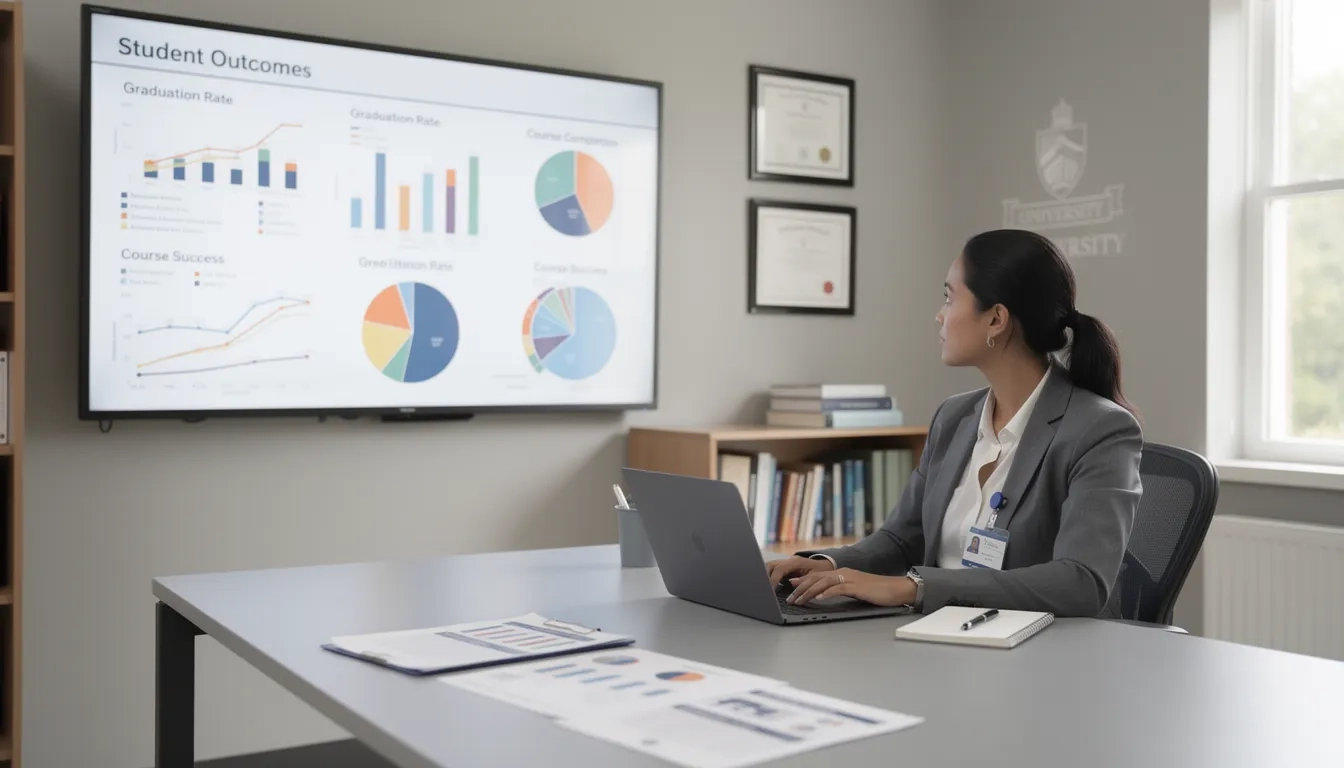
95% of 2022-2023 graduates achieved positive outcomes — employment, graduate school, military service, or equivalent. That figure was 93% in 2021-2022, so the trend is moving the right direction. Master's graduates hit 97%. PhDs hit 98%.
Five majors — chemistry, economics, geophysical engineering, mining engineering, and petroleum engineering — achieved 100% positive outcomes in the most recent reporting cycle.
Nearly 1,500 organizations recruited or hired Mines students in that same year. On-campus interviews jumped 59%. Employer attendance at Career Days rose 22%. The U.S. Geological Survey, Chevron, SLB (formerly Schlumberger), Lockheed Martin, and Google all show up as consistent recruiters — which tells you the employer mix has expanded well beyond traditional energy.
By program, early-career salary medians break down roughly like this:
- Petroleum Engineering: ~$94,022
- Computer Science: ~$86,268
- Mining and Mineral Engineering: ~$83,309
- Electrical Engineering: ~$80,815
- Mechanical Engineering: ~$74,145
- Civil Engineering: ~$65,074
The gap between petroleum and civil isn't a quality judgment — it reflects pure labor market supply and demand in those sectors. Petroleum engineers are rare. Civil engineers are not.
Payscale's data places Mines #21 nationally for salary potential, ahead of flagship state engineering schools with four times the enrollment. For context, that puts Mines roughly in the same salary-outcome neighborhood as Georgia Tech and ahead of most Big Ten engineering programs.
Life in Golden: What Students Actually Experience
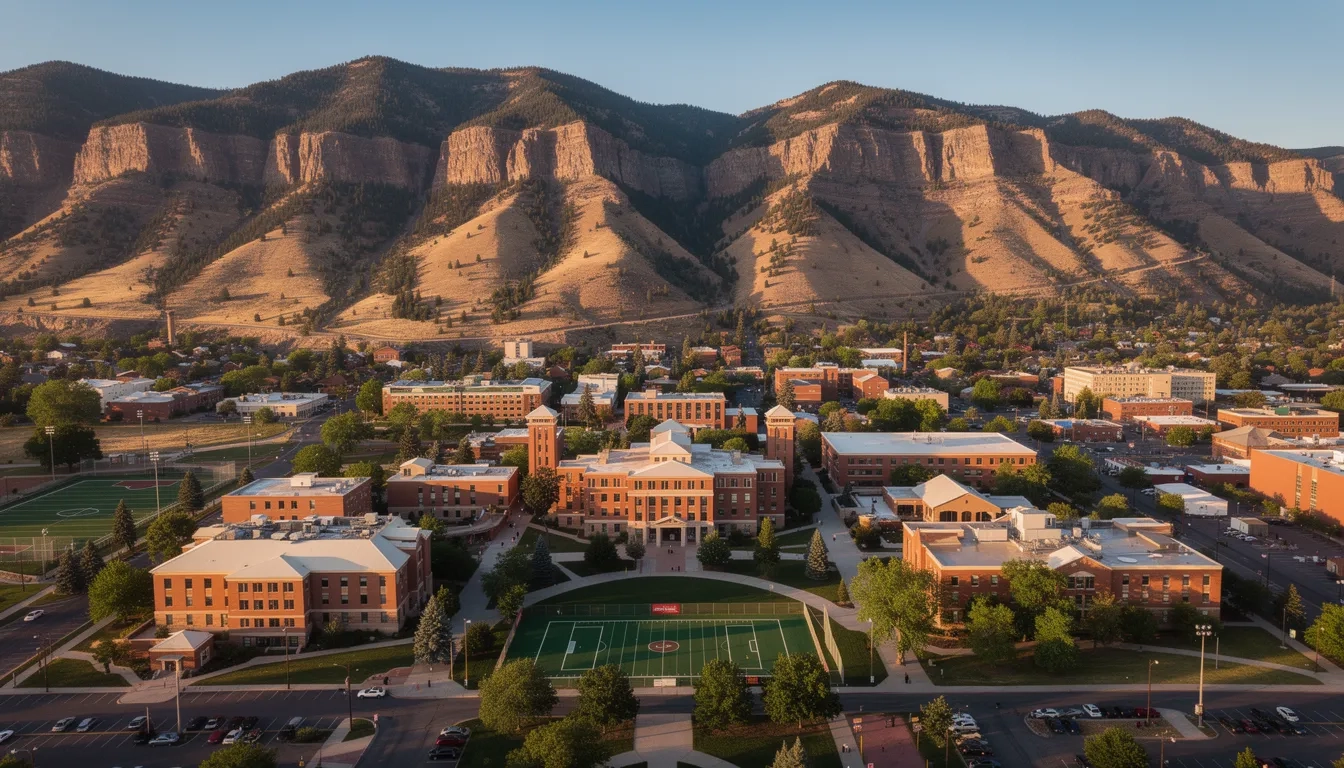
Golden, Colorado is not a typical college town. Population around 20,000, sitting at the base of the Front Range where Clear Creek cuts through downtown, roughly 20 miles from Denver. For students who chose Mines partly because of Colorado, the location is a real feature — not marketing copy.
Outdoor access is genuine. Rocky Mountain hiking is 30 minutes in any direction. Loveland Basin skiing runs about an hour. Kayaking on Clear Creek happens essentially on campus. Students who care about outdoor recreation get a lifestyle here that larger urban campuses simply can't offer.
The campus is compact, walkable in minutes from dorm to classroom. All first-year full-time students are required to live on campus (a policy that drives early community formation). Students who arrive from different states frequently point to this first year as the period when real friendships formed.
Over 200 student organizations cover the expected range: professional societies like IEEE and SPE, cultural clubs, outdoor recreation groups, Greek life (fraternities and sororities both), and the Undergraduate Student Government. The E-Days festival — Engineers' Days, a tradition running since 1899 — involves a mine rescue competition, a concrete canoe race, and engineering-themed events that function as genuine community rituals rather than just resume items.
The social scene is honest about its limits. Mines is academically intense. Students describe the first two years as front-loaded and relentless. The male-skewed ratio shapes social dynamics in ways that matter more for some students than others. Golden's distance from Denver requires either a car or advance planning for anything resembling a city night out.
But the tradeoff is real community. Small school, people know each other's names. Study groups form early and hold together. The shared academic pressure — shared suffering, really, but the productive kind — creates a cohesion that students from larger universities often describe missing.
The Honest Tradeoffs
Mines is excellent for the students it's built for. But clarity about what it isn't saves people from a bad fit.
It isn't a broad education. All 13 programs are in engineering and applied science. Students who want to explore disciplines, change directions, or take a philosophy elective alongside their thermodynamics course will find the structure limiting.
The first two years are a filter. The shared engineering curriculum — calculus, physics, chemistry, and foundational engineering across every major — is non-negotiable. Roughly 15-20% of students don't complete their original major. Arrive prepared or arrive willing to work harder than you've ever worked before.
The gender ratio has real effects. For women at Mines, the campus isn't hostile — the Society of Women Engineers chapter is one of the larger collegiate chapters in the region, and women-in-STEM networks are active. But 68/32 shapes daily social dynamics in visible ways. Women considering Mines consistently recommend talking to current female students before deciding.
The flip side: the specialization that narrows the experience also deepens the pipeline. Employers who need specific expertise know exactly where to recruit. The Mines alumni network, while smaller than flagship schools, runs deep and loyal in energy, mining, defense, and applied tech — exactly the sectors where that loyalty pays off fastest.
My read: for students genuinely drawn to energy systems, critical minerals, environmental engineering, or technical computing with a systems bent, Mines delivers a better four-year outcome than most large state flagships. Not because of brand prestige, but because the curriculum density and employer pipeline are precisely matched to those career paths in a way that general engineering schools rarely achieve.
Bottom Line
- Know your field before applying. Mines works best for students already oriented toward engineering and applied sciences — the 13-program structure leaves no room to explore broadly.
- The salary ROI on in-state tuition is exceptional. At $21,186/year against a 10-year median of $148,700, few public engineering schools can match this math.
- 95% graduate outcome rates backed by 1,500 recruiting employers signal real labor market demand, not just placement-office statistics.
- Golden's location is a genuine lifestyle advantage for outdoors-minded students, but the small-town distance from Denver requires intentionality about social life.
- Women and international students should research campus community proactively — the demographics are improving, but understanding the culture before arriving matters.
Frequently Asked Questions
Is Colorado School of Mines hard to get into?
The acceptance rate is around 61%, making it more accessible than elite engineering schools but still competitive in context. Strong math and science preparation matters more than a perfectly rounded application. Students without a pre-calculus foundation typically hit serious friction in the first semester, regardless of their overall GPA.
What programs is Mines best known for?
Petroleum Engineering and Mining and Mineral Engineering are Mines' most distinctive programs — both rank #1 or #2 nationally and connect to industries with real graduate demand. Computer Science has grown significantly and now offers strong salary outcomes, with a 15.1x ROI on in-state tuition according to DegreeOutlook's analysis.
Is Colorado School of Mines only for engineering students?
Effectively, yes. All 13 undergraduate programs fall within engineering and applied sciences. There's no business school, pre-law track, or liberal arts curriculum. Students who want the flexibility to change majors into non-technical fields would be better served at a comprehensive university.
How does Mines compare to CU Boulder for engineering?
Both are solid Colorado options, but they serve different students. CU Boulder has 35,000+ students, a broader major selection, and a more traditional college-town environment (Boulder). Mines is smaller, more focused, consistently ranks higher for engineering specifically, and produces better average salary outcomes. The tradeoff is a more intense academic culture and a far smaller social scene.
Does the 68/32 gender ratio at Mines affect daily life?
It shapes social dynamics in noticeable ways, particularly for women. The campus isn't unwelcoming — the Society of Women Engineers chapter is active and well-connected, and women-in-STEM organizations have strong alumni networks. But the imbalance is real, and women considering Mines almost universally recommend connecting with current female students before making a final decision.
What industries hire the most Mines graduates?
Energy (oil, gas, renewables), mining and minerals, defense and aerospace, environmental consulting, and tech. Consistent campus recruiters include Chevron, SLB, Lockheed Martin, the U.S. Geological Survey, and Google. The 1,500 organizations that recruited Mines students in 2022-2023 span well beyond traditional resource industries, reflecting the school's expansion into data-driven engineering fields.
Sources
- Colorado School of Mines top university in state across numerous rankings
- Mines graduates continue to see overwhelmingly positive outcomes
- Colorado School of Mines Degrees: 13 Programs Ranked by Salary & ROI
- Colorado School of Mines – U.S. News Best Colleges
- Payscale: Colorado School of Mines grads have fourth highest salary potential among public universities
- Student Life – Colorado School of Mines