How First-Generation College Students Are Changing Higher Ed
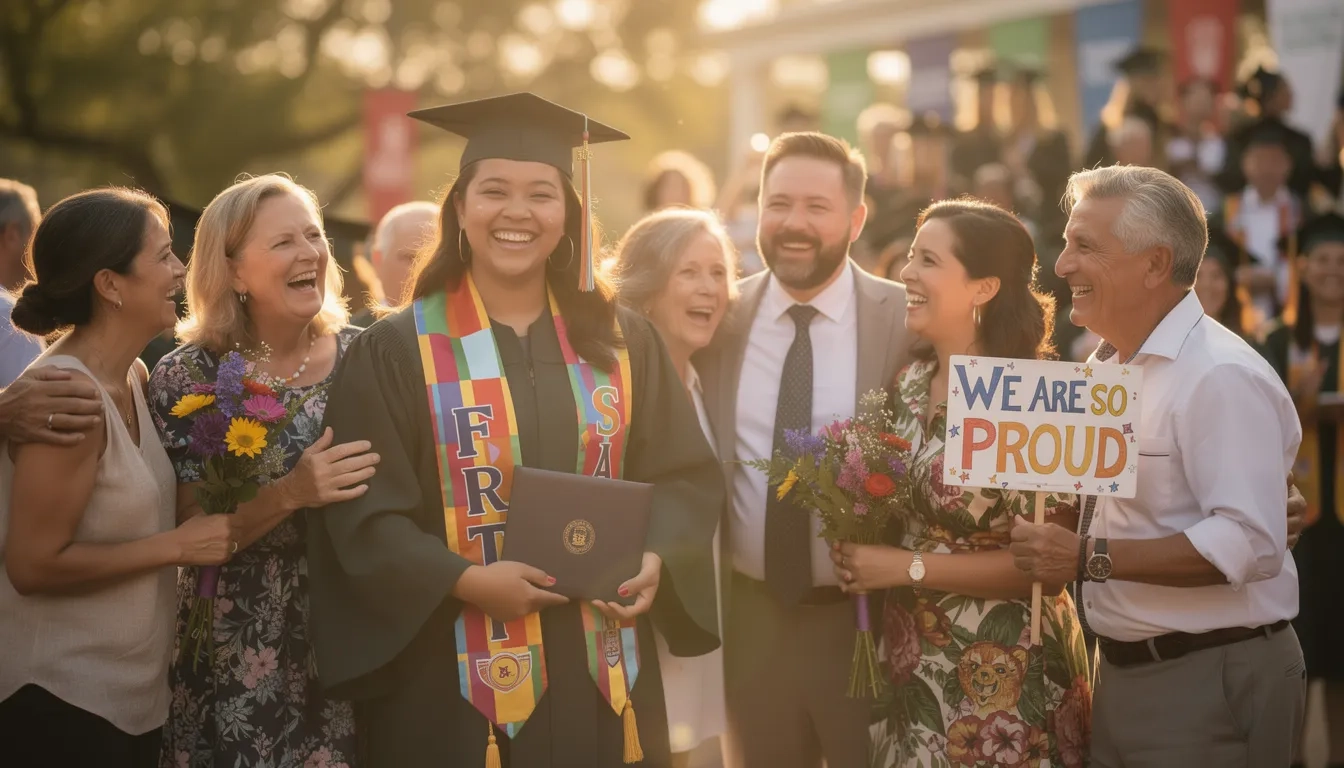
If you walked onto a random four-year campus this fall and lined up 100 undergrads, more than half of them would be the first in their immediate family to go to college. That's not a niche demographic anymore — it's the new center of gravity in American higher ed. According to the Center for First-generation Student Success, an initiative of NASPA and The Suder Foundation, first-generation students now make up 54% of all undergraduates in the United States, roughly 8.2 million people.
That number alone should tell you something: colleges built their traditions, their jargon, their unspoken rules, and even their orientation schedules around the assumption of a "typical" student whose parents already knew how FAFSA worked, what a syllabus week was, or why office hours mattered. That student is no longer the majority. And schools are scrambling — some more successfully than others — to catch up.
This article looks at what's actually changing, what isn't, and where the real gaps still sit. No fluff, no fabricated stats — every number here traces back to NCES, the Center for First-generation Student Success, or a named university program.
Who counts as "first-generation," anyway?
This sounds like it should be simple. It isn't. Different institutions, and even different federal programs, define it differently:
- The U.S. Department of Education's TRIO programs define a first-generation student as someone whose parents did not complete a bachelor's degree — even if one parent has an associate degree.
- NCES has historically used a narrower version: neither parent enrolled in any postsecondary education at all.
- Many colleges' own first-gen centers use the "no bachelor's degree" definition, which is why the Center for First-generation Student Success's 54% figure is bigger than older estimates that hovered closer to 20-30%.
That definitional mess matters in practice. A student whose mom has an associate degree in nursing might get flagged as first-gen at one school's scholarship application and not at another's. If you're a student or parent trying to figure out whether a "first-gen scholarship" or support program applies to you, always check the specific definition the program is using — don't assume.
The data: first-gen vs. continuing-generation students
Here's a side-by-side look at how first-generation students compare to their continuing-generation peers, using the most recent published figures from NCES and the Center for First-generation Student Success's fact sheets built on federal longitudinal data.
| Metric | First-Generation Students | Continuing-Generation Students |
|---|---|---|
| Share of all U.S. undergraduates | 54% (~8.2 million) | 46% |
| Six-year bachelor's degree completion rate | 24% | 59% |
| Received a Pell Grant | ~70% | ~44% |
| Made at least one late federal loan payment within 6 years | 69% | 50% |
| More likely to enroll in | Public 2-year / part-time | Public/private 4-year, full-time |
| Median household income (post-graduation) | ~$99,600 | ~$135,800 |
A few things jump out. The completion gap (24% vs. 59%) is the single most-cited statistic in this space, and it comes from a federal longitudinal cohort that started college in 2011-12 and was tracked for six years. It's stark, but it's also aggregate — it doesn't mean an individual first-gen student is destined to struggle. It means the system, on average, is not currently built to get them across the finish line at the same rate, which is a very different problem to solve.
Common misconception: first-gen automatically means low-income
Here's where a lot of well-meaning coverage — and even some campus programming — gets it wrong. First-generation status and low-income status are correlated, but they are not the same thing, and treating them as interchangeable causes real problems.
It's true that there's overlap: roughly 70% of first-gen students receive Pell Grants (versus 44% of continuing-gen students), and about a quarter of all college students are both first-gen and low-income. But a first-gen student can come from a comfortably middle-class or even wealthy family — their parents just never finished a four-year degree, whether because of immigration, military service, a skilled trade, running a business, or simply not having access to college when they were young. Conflating the two identities means colleges sometimes design "first-gen support" that's really just financial-aid triage, while missing the very real navigational and cultural gaps — not knowing what a "credit hour" is, not having a family member who can explain how to talk to a professor, not knowing that unpaid internships even exist as an option — that a financially comfortable first-gen student faces just as much as a low-income one.
The flip side of this misconception is assuming first-generation is a synonym for first-generation immigrant. It isn't. Roughly 30-47% of first-gen students (depending on the dataset) do come from immigrant families, but plenty are multi-generation American families where a bachelor's degree simply skipped a generation or never appeared at all. Good first-gen programming treats "first-gen" as its own distinct identity — separate from income, separate from immigration status, separate from race — even though it frequently intersects with all three.
What's actually changing on campus
This is the part that's genuinely new. It's not just awareness — it's structural change, and you can see it in a few concrete places.
Dedicated centers and staff are now standard at large publics. A decade ago, "first-gen support" mostly meant a line in a diversity statement. Now it's a physical office with a director, a budget, and a name. The University of North Texas runs a First-Generation Success Center serving a student body that is 41.5% first-gen, offering workshops on financial literacy, academic coaching, and career prep. USC has its First Generation Plus Success Center, which also serves undocumented and former foster youth students under one roof. UC Berkeley's Educational Opportunity Program runs an annual First-Generation College Celebration and maintains basic-needs referrals alongside academic counseling. These aren't outliers anymore — they're the expected baseline at most large public research universities.
National Celebration Day gave the movement a rallying point. Every November 8, hundreds of colleges mark National First-Generation College Celebration Day, timed to the anniversary of the Higher Education Act of 1965 — the law that created federal financial aid as we know it. The Council for Opportunity in Education and the Center for First-generation Student Success co-launched it in 2017; by 2023 it had bipartisan congressional recognition. It's a small thing on its face, but it's done real work normalizing "first-gen" as an identity students put in their Instagram bios rather than something to hide.
Institutions are professionalizing how they track and support this population. FirstGen Forward's most recent national landscape survey — collecting responses from 571 practitioners at 411 institutions across 47 states — found that the field has grown well past awareness campaigns into actual organizational structure: dedicated staff lines, budget allocations, and formal programming. The catch, and it's a real one: 57% of institutions still lean on federal funds like TRIO or Title III to pay for this work, rising to 75% at community colleges. That means first-gen support at a lot of schools is only as stable as the next federal budget cycle.
Basic-needs infrastructure has expanded because first-gen students use it more. Food pantries are a good example. Membership in the College and University Food Bank Alliance has more than doubled since 2015 to nearly 500 campuses, and research on food pantry usage has found first-generation students are both more aware of these resources and more likely to use them. That's not a coincidence — students who don't have a parent who went through this before them are also more likely to be the ones supporting family financially rather than the other way around.
"First-generation students were more aware of the pantry, perhaps hearing about it through formal or informal networks of support, seeking out resources, or being exposed to food pantries before college."
That's a small, specific finding, but it captures something bigger: first-gen students aren't passive recipients of new support systems — their actual behavior and needs are shaping what colleges build.
Where the change hasn't caught up yet
It would be dishonest to frame this as a success story with a bow on it. The completion gap — 24% vs. 59% at six years — hasn't meaningfully closed in the years these longitudinal cohorts have been tracked. Loan repayment outcomes are worse too: 69% of first-gen borrowers made at least one late payment within six years, compared to 50% of continuing-gen borrowers, even when accounting for similar debt loads. Faculty development on how to actually teach and advise first-gen students unevenly lags behind the creation of student-facing centers — it's easier to open an office than to retrain a tenured professor's advising habits. And the funding instability mentioned above (that 57-75% reliance on federal grant dollars) means a lot of these gains are more fragile than the glossy admissions-website language suggests.
Bottom line
First-generation students aren't a side population anymore — they're the majority of American undergraduates, and that shift has forced real, visible change: dedicated centers, a national celebration day, basic-needs infrastructure, and more sophisticated institutional data collection than existed a decade ago. But the outcomes gap that motivated all of this in the first place — the 24%-vs-59% completion rate — is still wide, and a lot of the infrastructure supporting first-gen students runs on federal funding that isn't guaranteed year to year. If you're a first-gen student or the parent of one, don't assume every school markets its support the same way, and don't assume "first-gen program" automatically means "financial aid office." Ask what the school's specific definition is, what the center actually offers beyond a welcome event, and whether the funding for it is stable or grant-dependent.
FAQ
Is a first-generation college student the same as a low-income student? No. They frequently overlap — about 70% of first-gen students receive Pell Grants — but a first-gen student can come from any income bracket. The defining trait is simply that neither parent (in the narrower NCES definition) or neither parent holding a bachelor's degree (in the broader, more common definition) went to college.
What percentage of college students are first-generation? 54% of U.S. undergraduates, or about 8.2 million students, according to the Center for First-generation Student Success's most recent published figures.
Do first-generation students graduate at lower rates than other students? Yes, on average. Federal longitudinal data tracked over six years found 24% of first-gen students completed a bachelor's degree, compared to 59% of continuing-generation students. That's an aggregate statistic, not a prediction for any individual student — plenty of first-gen students graduate on time or early, especially with the right support.
What is National First-Generation College Celebration Day? It's an annual observance on November 8, marking the anniversary of the 1965 Higher Education Act. Co-launched in 2017 by the Council for Opportunity in Education and the Center for First-generation Student Success, it's now recognized at hundreds of campuses and received bipartisan congressional recognition in 2023.
How can I find out if my school has first-gen support? Search "[your school name] first-generation center" or check with the office of student affairs — most large public universities now have a dedicated center or program, often bundled with TRIO Student Support Services. Ask specifically what the office's definition of "first-gen" is, since it varies by campus.
Does being first-generation mean my parents are immigrants? Not necessarily. There's real overlap — depending on the dataset, somewhere between 30% and 47% of first-gen students come from immigrant families — but many first-gen students are from multi-generation American families where no parent happened to complete a four-year degree.
Sources
- Fact Sheets - Center for First-generation Student Success / FirstGen Forward
- First-generation College Students' Achievement and Federal Student Loan Repayment (RTI International / FirstGen Forward)
- First-Generation Students: College Access, Persistence, and Postbachelor's Outcomes (NCES 2018-421)
- First-Generation College Student Facts and Statistics - BestColleges
- First-Generation Success Center - University of North Texas
- Educational Opportunity Program - First-Generation College Celebration - UC Berkeley
- First Generation Plus Success Center - USC
- First-Generation College Celebration Day - Council for Opportunity in Education
- National Landscape Reports - FirstGen Forward

