Middlebury College: Admissions Rankings and Student Life
Middlebury College: Admissions, Rankings, and Student Life
If you mention Middlebury College to most people, the first thing out of their mouth is usually something about language immersion — the famous Language Pledge, the summer schools where you supposedly can't speak a word of English. That reputation is earned. But it's also incomplete, and if it's the only thing shaping how you think about applying, you're missing most of the picture: a small, intensely selective liberal arts college tucked into the Champlain Valley of Vermont that competes with the Amhersts and Williamses of the world across nearly every field, not just foreign languages.
This guide pulls together the real, current numbers — acceptance rate, test scores, rankings — straight from Middlebury's own admissions office and independent sources, along with an honest look at what daily life actually feels like on that campus.
Middlebury College at a Glance
| Category | Data |
|---|---|
| Location | Middlebury, Vermont (Champlain Valley, between the Green Mountains and Adirondacks) |
| Founded | 1800 — the first college in Vermont |
| Undergraduate enrollment | ~2,600–2,760 students |
| Acceptance rate (Class of 2029) | 13.9% (1,655 admitted of 11,831 applicants) |
| Middle 50% SAT (recent enrolled class) | ~1445–1550 combined |
| Middle 50% ACT | 33–35 |
| Testing policy | Test-optional; roughly 44–49% of applicants submit scores |
| Student-faculty ratio | 9:1; average class size 16 |
| Majors offered | 45+, across 850+ courses |
| US News National Liberal Arts Colleges rank | Tied for 13th (2026 edition) |
| Tuition and fees (2024–25) | $67,600 |
| Total cost of attendance (on-campus) | ~$88,850 |
| Financial aid | Meets 100% of demonstrated need; ~46% of students receive aid, average package ~$60,000 |
| First-year retention rate | 94% |
| 6-year graduation rate | 91% |
| Athletic conference | NESCAC; 46 NCAA team championships |
The Real Admissions Numbers
Let's start with what everyone actually wants to know: how hard is it to get in?
For the Class of 2029 (students who started in fall 2025), Middlebury received 11,831 applications and admitted 1,655 students, for an overall acceptance rate of 13.9%. That admitted pool included 519 students accepted through Early Decision (ED1 and ED2 combined) and 1,136 admitted in the Regular Decision round. Notably, application volume for that cycle actually dipped from the prior year's peak, which nudged the acceptance rate up slightly compared to some recent cycles that dipped closer to 11%. Either way, you're looking at a school that turns away roughly six or seven of every eight applicants — this is a reach school for the overwhelming majority of students who apply, even very strong ones.
A few other data points worth knowing from that admitted class: 18% were first-generation college students, they came from 1,112 different high schools in 73 countries, and 44% chose not to submit standardized test scores under Middlebury's test-optional policy. Among students who did submit scores in recent cycles, the middle 50% SAT range runs roughly 1445–1550, and the ACT middle 50% sits at 33–35 — competitive, but Middlebury has been explicit that omitting scores does not disadvantage an application.
Here's how the admissions office itself described what it's looking for in that applicant pool:
The admissions committee reviewed applicants "who have demonstrated their rigorous academic preparation, personal fortitude, and deep curiosity for ideas."
That phrasing is worth sitting with. Middlebury isn't just stacking up GPAs and test scores — the essays, recommendations, and demonstrated intellectual curiosity carry real weight in a process this selective, because the academic bar is already cleared by nearly everyone who applies.
On cost: tuition and fees for 2024–2025 ran $67,600, with total cost of attendance (including room, board, and fees) landing around $88,850 for students living on campus. That number scares a lot of families off before they even look at aid. Don't let it — Middlebury meets 100% of demonstrated financial need for every admitted student, roughly 46% of the student body receives need-based aid, and the average aid package is around $60,000. Run the net price calculator before you rule the school out on sticker price alone.
Where Middlebury Actually Ranks
Middlebury's rankings have bounced around more than you'd expect for a school this established, which is a useful reminder that year-to-year ranking movement usually says more about methodology tweaks than about the school itself.
In the 2026 U.S. News & World Report edition, Middlebury is tied for 13th among National Liberal Arts Colleges (out of 211 ranked schools). That's a notable rebound — the previous cycle had actually dropped Middlebury to 19th, its lowest position since it first appeared in the U.S. News rankings back in 1988, largely due to changes in how U.S. News weights outcomes and social mobility metrics. Beyond U.S. News, Washington Monthly ranked Middlebury 8th among liberal arts colleges in its 2025 rankings (which weight research, service, and social mobility more heavily), while Forbes places it in the low-50s among all national colleges.
The takeaway: Middlebury sits comfortably in the "top 15-ish" tier of American liberal arts colleges by any reasonable measure, alongside schools like Wellesley, Bowdoin, Carleton, and Washington and Lee — but exactly where it lands depends heavily on which publication's formula you trust, and that formula changes more than most families realize.
The Language Schools: Where the Reputation Comes From
Now, the thing Middlebury actually is famous for, because it deserves the attention. Middlebury's Language Schools were founded in 1915, making them over a century old, and they remain one of the most distinctive language-immersion programs in American higher education. Roughly 1,400 students attend each summer — undergraduates, graduate students, and adult learners ranging from 18 to 80-plus years old — studying across 12 languages, including Arabic, Chinese, French, German, Hebrew, Italian, Japanese, Korean, Portuguese, Russian, Spanish, and even Abenaki, an Indigenous language of the region.
The signature feature is the Language Pledge®, a commitment students sign to communicate exclusively in their target language for the full 7-to-8-week summer immersion — no English at meals, in the dorms, on the phone with home, anywhere on campus. Middlebury describes it as turning "everyday life into a challenge," and it's genuinely unlike anything most other colleges offer. Graduate degrees in the Language Schools can be completed over four summers in Vermont, or one summer plus an academic year studying abroad or online.
This is also where a lot of the school's identity outside admissions circles comes from — decades of alumni, diplomats, and academics who came through Bread Loaf or the summer language programs and carried the Middlebury name into fields far from Vermont.
Common Misconception: "It's Just a Languages School"
Here's the myth that trips up a surprising number of applicants: assuming Middlebury is primarily a languages-and-international-affairs school, and that if you're planning to major in biology, economics, or computer science, it's somehow the "wrong" Middlebury.
That's backwards. The Language Schools are a graduate/summer division that operates largely separately from the undergraduate college — most Middlebury undergrads never set foot in a Language School classroom. The undergraduate college itself is a full liberal arts institution offering 45+ majors and 850+ courses, and it's nationally recognized well beyond languages. Middlebury's environmental studies program, established in 1965, was one of the first of its kind in the country and remains one of its most respected departments. Economics, international politics and economics (IPE), geography, film and media culture, and a growing set of STEM and pre-professional offerings all draw serious applicants who have zero interest in language immersion.
Undergraduates can absolutely take advantage of Middlebury's language strength — through the undergraduate language departments (distinct from the summer schools), the C.V. Starr–Middlebury Schools Abroad network spanning 17 countries, and a genuine campus culture that prizes global fluency. But picking Middlebury because you want to major in geology or molecular biology and never touch a foreign language requirement beyond what's needed to graduate is a completely normal, well-supported path there. Don't self-select out of a school that might be a great academic fit because of a reputation built on its summer division.
Life in Middlebury, Vermont
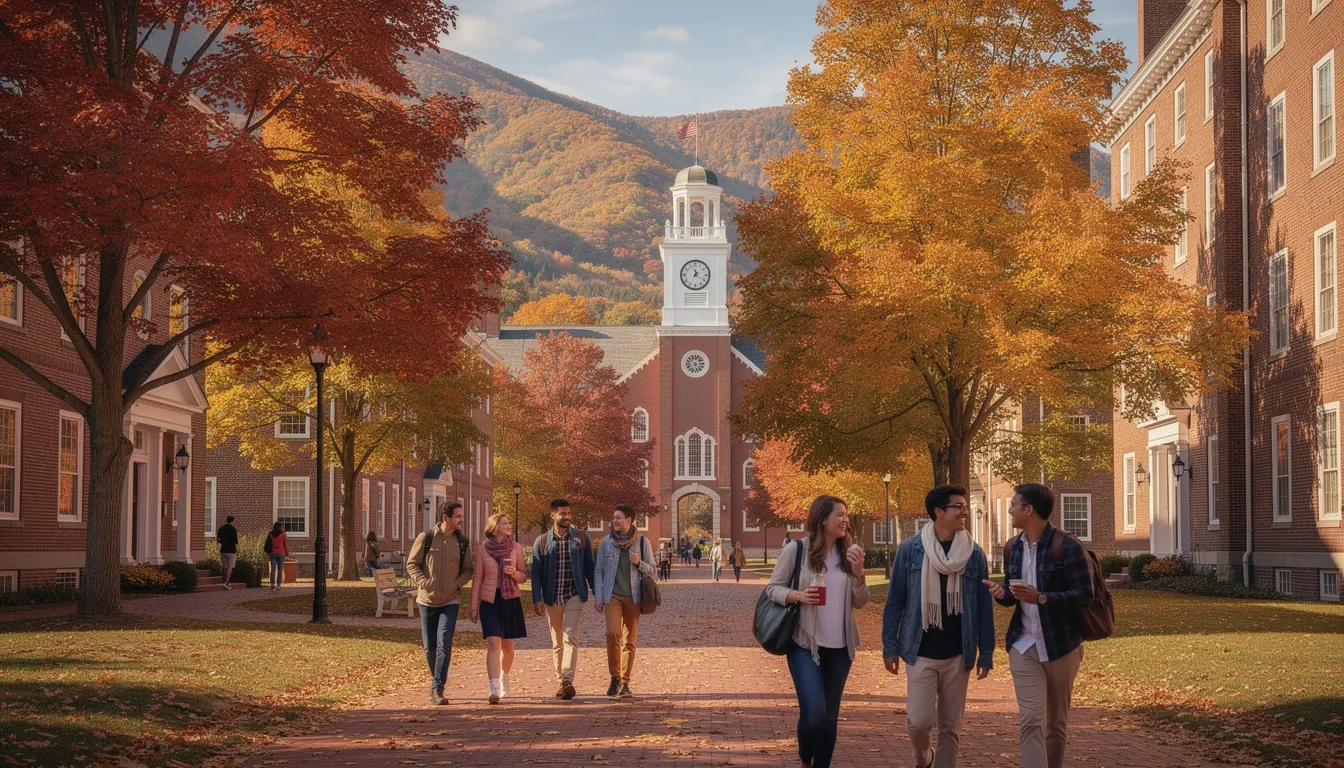
Middlebury the town has a population in the low thousands, sits in Vermont's Champlain Valley between the Green Mountains and the Adirondacks, and the closest real city — Burlington — is about 45 minutes north. This is rural New England: covered bridges, working farms, a genuinely gorgeous fall, and winters that are long, cold, and central to the culture rather than something students endure.
That geography shapes everything about student life. Outdoor recreation isn't a niche club activity at Middlebury — it's close to a campus religion. The college owns and operates the Middlebury College Snow Bowl, a ski area a short drive from campus, along with the Rikert Nordic Center for cross-country skiing, and students get discounted or free access. Winter Carnival, held every February, is one of the school's oldest traditions, built entirely around embracing (not surviving) the Vermont winter.
Housing runs on a residential commons system, splitting the campus into smaller communities (each with its own dining hall access, staff, and traditions) that anchor a student's social life, particularly in the first two years. Middlebury competes in NESCAC — the same conference as Williams, Amherst, Wesleyan, and Bowdoin — and has racked up 46 NCAA championship teams, with especially dominant histories in women's lacrosse and field hockey. Athletics matter socially even for students who never play a varsity sport, since a huge share of the student body participates in club or intramural leagues.
Beyond sports and skiing, the Bread Loaf campus (home to the historic Bread Loaf Writers' Conference) and a lively student arts, theater, and a cappella scene round things out. It's a small, somewhat isolated campus by design — students who thrive there tend to genuinely like that closeness and quiet, rather than tolerating it for the academics.
Bottom Line
Middlebury is a highly selective liberal arts college — sub-15% acceptance rate, top-15-ish national ranking depending on the year and publication — that happens to have built an unmatched reputation in language immersion through a summer division most undergraduates never use directly. If you're drawn to a small, rigorous, close-knit academic community with real strength in environmental studies, international affairs, economics, and the sciences, set in a genuinely stunning (and genuinely remote) corner of Vermont, it deserves a serious look regardless of whether languages are your thing. Just go in with realistic odds, apply Early Decision if it's truly your first choice (the admit rate advantage is real), and don't skip the financial aid application over sticker shock — the aid is generous for families who qualify.
Frequently Asked Questions
What is Middlebury College's acceptance rate? For the Class of 2029, Middlebury admitted 13.9% of applicants — 1,655 students out of 11,831 who applied. Rates have hovered in the 11–16% range in recent cycles, making it one of the more selective liberal arts colleges in the country.
Is Middlebury test-optional? Yes. Middlebury has operated a test-optional admissions policy for several years, and in the most recent admitted class, roughly 44% of students chose not to submit SAT or ACT scores. Among those who did submit scores, the middle 50% SAT range was approximately 1445–1550 and ACT 33–35.
What is Middlebury ranked? In the 2026 U.S. News & World Report rankings, Middlebury is tied for 13th among National Liberal Arts Colleges, a rebound from 19th the prior cycle. Washington Monthly ranked it 8th among liberal arts colleges in 2025. Rankings vary meaningfully by publication and methodology, so treat any single number as a rough signal, not gospel.
Is Middlebury only good for language majors? No — that's a common misconception. Middlebury's famous Language Schools are a largely separate summer/graduate division. The undergraduate college is a full liberal arts institution with particular strength in environmental studies (one of the oldest programs in the country), economics, international politics and economics, geography, and growing STEM programs.
How much does Middlebury cost, and is it affordable? Total cost of attendance runs around $88,850 for the 2024–2025 year, but Middlebury meets 100% of demonstrated financial need for admitted students. About 46% of students receive need-based aid, with an average package near $60,000, so the actual price for many families is far below the sticker figure.
Does Middlebury have a strong study abroad program? Yes. Middlebury undergraduates have access to the C.V. Starr–Middlebury Schools Abroad network, operating in 17 countries, which is closely tied to the college's overall reputation for global and language-focused education — separate from, but philosophically connected to, the summer Language Schools.
Sources
- Middlebury Admits Class of 2029 and 2029.5 | Middlebury News and Announcements
- Middlebury Language Schools
- Middlebury College Facts
- Middlebury College - Profile, Rankings and Data | US News Best Colleges
- Middlebury College - Wikipedia
- Middlebury College - College Navigator, National Center for Education Statistics
- Middlebury College Admissions & Financial Aid
- Middlebury falls to 19th in U.S. News & World Report ranking - The Middlebury Campus