Morehouse College: Programs, Rankings, and Student Life
When Morehouse College posted a 33% acceptance rate for the Class of 2029, some people were surprised. They shouldn't have been. The school has been building something steadily for years, and the 2026 U.S. News rankings made official what Atlanta insiders already knew: Morehouse isn't just the most famous HBCU anymore. It's competing with the best small colleges in the country on its own terms.
Why Morehouse's 2026 Rankings Tell a More Interesting Story
The headline number: Morehouse climbed to No. 3 among HBCUs in the 2026 U.S. News & World Report Best Colleges rankings, jumping from No. 5 the year before. Good progress, clearly.
But the more useful data sits outside the HBCU category entirely. No. 96 among all national liberal arts colleges puts Morehouse alongside schools with far larger endowments and longer traditions of name recognition. That's not a consolation prize.
The specialty rankings add real texture:
- No. 1 for Best Value among all HBCUs nationwide
- Tied No. 1 with Spelman College for Most Innovative HBCUs
- No. 2 for HBCU business programs nationally
- No. 24 in Social Mobility across all U.S. colleges
LinkedIn, running its own methodology entirely independent of U.S. News, put Morehouse at No. 2 on its inaugural 2025 Top HBCUs list. That ranking evaluated alumni career placement rates, recruiter demand, internship access, and network strength — not prestige signals. For a prospective student weighing where to invest four years and significant money, that's arguably a more useful number than a magazine ranking.
What's driving the rise? Part of it is the $500 million "Making Men of Consequence" campaign, which is funding new residence halls, a campus center, and expanded academic infrastructure. Part of it is outcomes: 95% of the 2025 graduating class left with a confirmed job or continuing education plan in hand.
The No. 24 Social Mobility ranking is worth pausing on. It measures how many Pell Grant-eligible students a school graduates at strong career rates. It's the metric researchers increasingly use to evaluate whether a college is actually delivering on its promise to students who can't afford a failed experiment.
Academic Programs: 34 Majors and Some Standouts
Morehouse offers 34 majors and 34 minors organized across four broad divisions. The curriculum runs from the expected to the genuinely interesting.
Business Administration remains the most popular major, with roughly 150 degrees awarded annually in that field alone. Biology, Political Science, Psychology, and Economics round out the most common paths. These are solid foundations, but the more telling programs are the newer additions.
Software Engineering and Journalism in Sports, Culture, and Social Justice both reflect a deliberate push to connect a liberal arts education to careers where Morehouse graduates can gain early traction. Neither existed here a decade ago.
For students with engineering ambitions, the Dual-Degree Engineering Program (DDEP) is a smart structure. Students spend three years at Morehouse building their academic foundation, then transfer to a partner engineering school for two years to earn a specialized technical credential. Aerospace, biomedical, civil, electrical, environmental, and mechanical engineering are all available pathways. Applied Physics is reserved exclusively for DDEP students, which signals how seriously the program takes its technical preparation.
| Program Area | Notable Majors & Minors |
|---|---|
| STEM | Biology, Chemistry, Software Engineering, Mathematics, Kinesiology |
| Business | Business Administration, Economics, Applied Management Studies |
| Humanities | English, History, Philosophy, Africana Studies, Urban Studies |
| Arts & Media | Cinema & TV, Dance, Theatre, Journalism in Sports/Culture |
| Social Sciences | Political Science, Psychology, Sociology, International Studies |
| Engineering Track | Applied Physics, General Science (DDEP) |
| Minors of Note | Data Science & Analytics, Neuroscience, Public Health Science, Entrepreneurship |
Two programs deserve special mention. The Howard Thurman Honors Program offers a rigorous interdisciplinary track for high-achieving students through smaller seminars, dedicated research opportunities, and faculty mentorship. The Oprah Winfrey Scholars Program provides financial support and academic enrichment to students who demonstrate exceptional potential, and it carries real alumni visibility.
The average incoming GPA for the Class of 2025 was 3.6, up from 3.55 two years prior. Not a dramatic jump, but a consistent upward trend — which typically signals structural demand rather than a one-year blip.
Getting In: The Numbers Have Changed
Not long ago, Morehouse admitted close to half its applicants. That era is over.
The Class of 2029 received 6,217 applications, a record for the college, and only 33% were accepted, down from 44% the prior year. That puts Morehouse below Fordham, Lehigh, and several schools that consider themselves selective. The writing was on the wall a few years ago when applications started climbing, but the pace of change surprised even the admissions office.
Students should target a GPA of 3.5 or higher. Morehouse uses full-file review, which means leadership experience and essays that engage specifically with the college's mission carry real weight. This isn't a generic "show leadership" prompt. Morehouse knows exactly what kind of student it's looking for — Black men who want to be shaped into leaders, not just credentialed — and the application materials are where you demonstrate you understand that distinction.
Applying Early Decision signals genuine commitment, which matters in full-file review. If Morehouse is your actual first choice, applying early is a straightforward decision.
What Morehouse Actually Costs
Tuition for 2025–2026 runs $32,893. Add room, board, and fees and the on-campus cost of attendance reaches $52,545. Four years totals roughly $212,513 at current rates.
That sounds steep. But 77% of enrolled students receive some form of grant or scholarship aid, with an average annual award of $19,731 (roughly 60% of tuition). For qualifying students, the actual net price drops substantially.
The real calculation isn't sticker price against sticker price. It's net price against a 95% post-grad placement rate. Those two numbers together change the math significantly.
Federal financial aid, institutional scholarships, Georgia state grant programs, and UNCF (United Negro College Fund) scholarships all apply. The "Making Men of Consequence" campaign has an explicit fundraising component targeting scholarship endowments, so aid availability has been trending upward. File the FAFSA by the priority deadline — timing moves the needle more than most applicants realize.
Students who receive award letters they consider inadequate should contact the financial aid office directly. Awards can be discussed, especially when competing offers from comparable schools are on the table.
Student Life: Brotherhood Is the Product
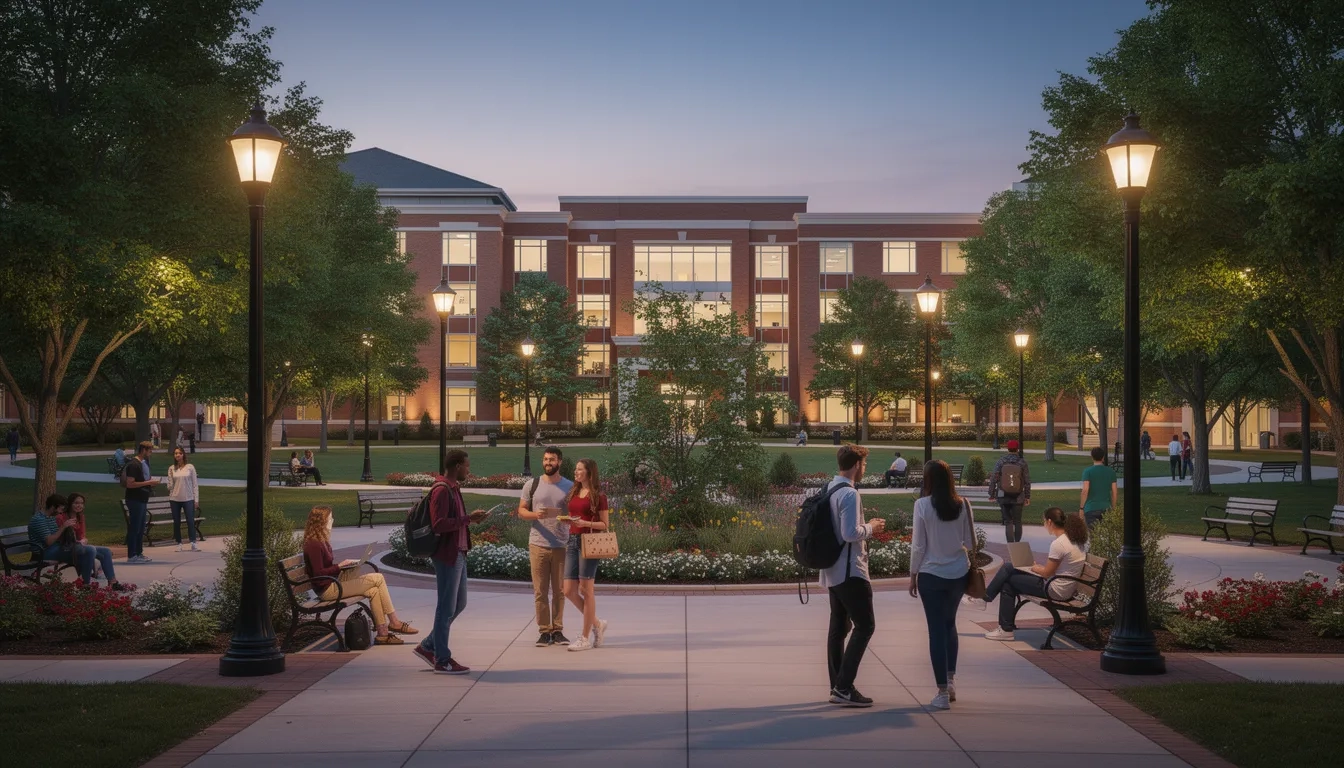
Morehouse doesn't hesitate to call brotherhood its core offering. That sounds like marketing until you talk to alumni, who describe friendships from college as unlike anything they've found since.
New Student Orientation runs for eight full days. New students don't just learn how to register for classes — they're inducted into the college's history, traditions, and expectations. The term "Morehouse Mystique" is used without irony; it's something the institution actively cultivates, and NSO is where it begins.
First-year residence halls run stroll-offs, chant-offs, and inter-hall competitions throughout the year (complete with the occasional well-organized prank). These aren't random social programming. They're structured to build bonds that survive decades after graduation.
Over 50 recognized student organizations span academic, pre-professional, artistic, cultural, fraternal, honorary, and special interest categories. Some of the most active are the pre-law and pre-med societies and the Student Government Association, which has an unusually strong history of producing graduates who go on to elected office.
Atlanta does something for a Morehouse education that a rural campus simply can't replicate. Internships at Delta Air Lines, CNN, and Coca-Cola are accessible in ways they aren't from a campus three hours from a major city. The relationships students build with Atlanta-based employers during their undergraduate years often convert directly into post-graduation offers.
Signature traditions include Homecoming, which draws alumni from across the country for several days of events, and Founder's Week, which connects current students to the college's 1867 founding through programming that is part celebration, part history lesson. These events create continuity between student generations that compounds into a functional alumni network.
Campus support infrastructure includes counseling services, health resources, fitness facilities, and MAAP (Morehouse Academic Achievement Program), which provides individualized tutoring and academic advising. The college's model treats education as developing the whole individual, and the support systems are built around that premise rather than just graduation checklists.
Athletics: The Maroon Tigers in 2025–26
Morehouse competes as NCAA Division II in the Southern Intercollegiate Athletic Conference (SIAC), fielding varsity teams in baseball, basketball, cross country, football, golf, tennis, and track and field.
The 2025–26 season was unusually strong. The Maroon Tigers claimed four SIAC championships: men's cross country, men's basketball, men's indoor track and field, and men's outdoor track and field. Winning four conference titles in a single year is rare at any level of NCAA competition.
Division II athletics sits at an interesting level for students who competed in high school. The competition is serious without consuming the undergraduate experience the way Division I programs can. Students who want to stay competitive athletically while fully engaging academically often find the Division II structure more workable than they expected.
Football and basketball games carry real campus energy. The Homecoming football game is one of the signature social events of the fall semester, drawing crowds that include alumni who graduated decades ago and have no intention of missing it.
Alumni, Outcomes, and Why the Network Actually Works
The alumni list is impressive in a way that can't be written off as selective sampling. Martin Luther King Jr. is the most cited name, but Morehouse also produced Spike Lee (film), Samuel L. Jackson (acting), Maynard Jackson (Atlanta's first Black mayor), and U.S. Senator Raphael Warnock. Six Rhodes Scholars have graduated from Morehouse, with Aniaba Jean-Baptist N'guessan named the sixth in 2025. Eleven Fulbright Scholars. Five Marshall Scholars.
What makes the network functional rather than decorative is how actively it operates. LinkedIn's 2025 ranking methodology specifically measured recruiter demand and alumni network connectivity — not prestige metrics. Morehouse ranked No. 2 partly because its alumni actually hire other Morehouse graduates. That feedback loop compounds with every graduation cycle.
The 2025 Fulbright HBCU Institutional Leader designation matters specifically for graduate school aspirants. It means Morehouse has dedicated advising infrastructure for Fulbright applications, which changes the realistic odds considerably for qualified applicants compared to applying from a school without that designation.
For pre-professional students, the combination of Atlanta's corporate presence, an active alumni network, and a 95% placement rate creates a recruiting position that goes beyond reputation alone. Companies that recruit at Morehouse tend to return consistently. The pipeline is structural, not occasional.
Bottom Line
- Morehouse is genuinely selective now. The 33% acceptance rate for the Class of 2029 is not a blip. Build your application around the mission specifically, not generic selectivity prep.
- Run the net price calculation before deciding it's unaffordable. With 77% of students receiving aid and average awards of $19,731, real costs are often well below the $52,545 sticker price.
- The outcomes data is real. A 95% post-grad placement rate combined with LinkedIn's No. 2 HBCU alumni network ranking means the investment has measurable returns.
- The experience is specific. If you want a research university or a large state school environment, Morehouse is the wrong fit. If you want eight days of orientation, a lifetime of brotherhood, and Atlanta at your doorstep, it's hard to find a better-built institution for exactly that.
Frequently Asked Questions
Is Morehouse College only for Black men?
Yes. Morehouse is one of the few remaining all-male HBCUs in the United States and admits Black men (or those who identify as Black men) as undergraduates. This is intentional and central to the institution's educational model, not an administrative holdover from another era.
What GPA and test scores do I need to get into Morehouse?
The incoming class average GPA is 3.6, and the acceptance rate for the Class of 2029 was 33%. Morehouse uses full-file review, so leadership experience and application essays carry meaningful weight. A GPA below 3.5 makes admission difficult without exceptional circumstances in other areas.
Is Morehouse College the same as Morehouse School of Medicine?
No. Morehouse College is the undergraduate liberal arts institution founded in 1867. Morehouse School of Medicine is a separate graduate medical school based in Atlanta. They share institutional history and geographic proximity but operate independently, with distinct admissions, tuition, and degree programs.
How strong is Morehouse's financial aid program?
77% of enrolled students receive grant or scholarship aid, with an average package of $19,731 per year. Students should file the FAFSA by the priority deadline and research UNCF scholarships and Georgia state aid programs, which can meaningfully reduce net cost beyond the institutional award alone.
What is the "Morehouse Mystique"?
It's the term the college uses to describe its culture of brotherhood, excellence, and shared identity. Students are introduced to it formally during the eight-day New Student Orientation and develop it through living on campus, participating in traditions like Homecoming and Founder's Week, and the daily experience of an institution with a clear mission and over 150 years of history behind it.
How does Morehouse compare to Howard or Spelman for prospective students?
Morehouse (No. 3 HBCU, 2026), Howard (No. 1), and Spelman (No. 2) serve distinct student profiles. Howard is larger with significant graduate and professional school presence in Washington, D.C. Spelman is a women's college sharing Atlanta's University Center with Morehouse and carries particular strength in fine arts and health sciences. Morehouse's specific advantage is the depth of its brotherhood model for Black men and the density of alumni in corporate, creative, and political fields. None of the three is a generic backup for the others.
Sources
- Morehouse College Rises to Top Three Among HBCUs — Morehouse News
- Morehouse College 2026 — Programs, Rankings, Key Facts | Research.com
- Morehouse College Student Life & Activities 2025 | Research.com
- More than a College Campus: Thriving in the Morehouse HBCU Experience
- Morehouse College — US News Best Colleges Profile
- Morehouse College Majors & Minors
- Morehouse College Cost of Attendance 2024-2025