Quinnipiac University: Programs, Rankings, and Whether It's Worth It
Quinnipiac jumped 40 spots on the Wall Street Journal's college rankings in a single year — landing at #51 nationally in 2026, second in Connecticut only to Yale. That's not incremental improvement. That's the kind of leap that makes admissions offices print new brochures. And it happened because the Wall Street Journal measures what many families actually care about: career outcomes, graduation rates, and what a degree does to your earning power after you leave campus.
Whether you're a prospective student sorting through options or a parent trying to reconcile conflicting ranking systems, Quinnipiac deserves a harder look than the US News number alone might prompt.
Nine Schools, One Mid-Sized Campus
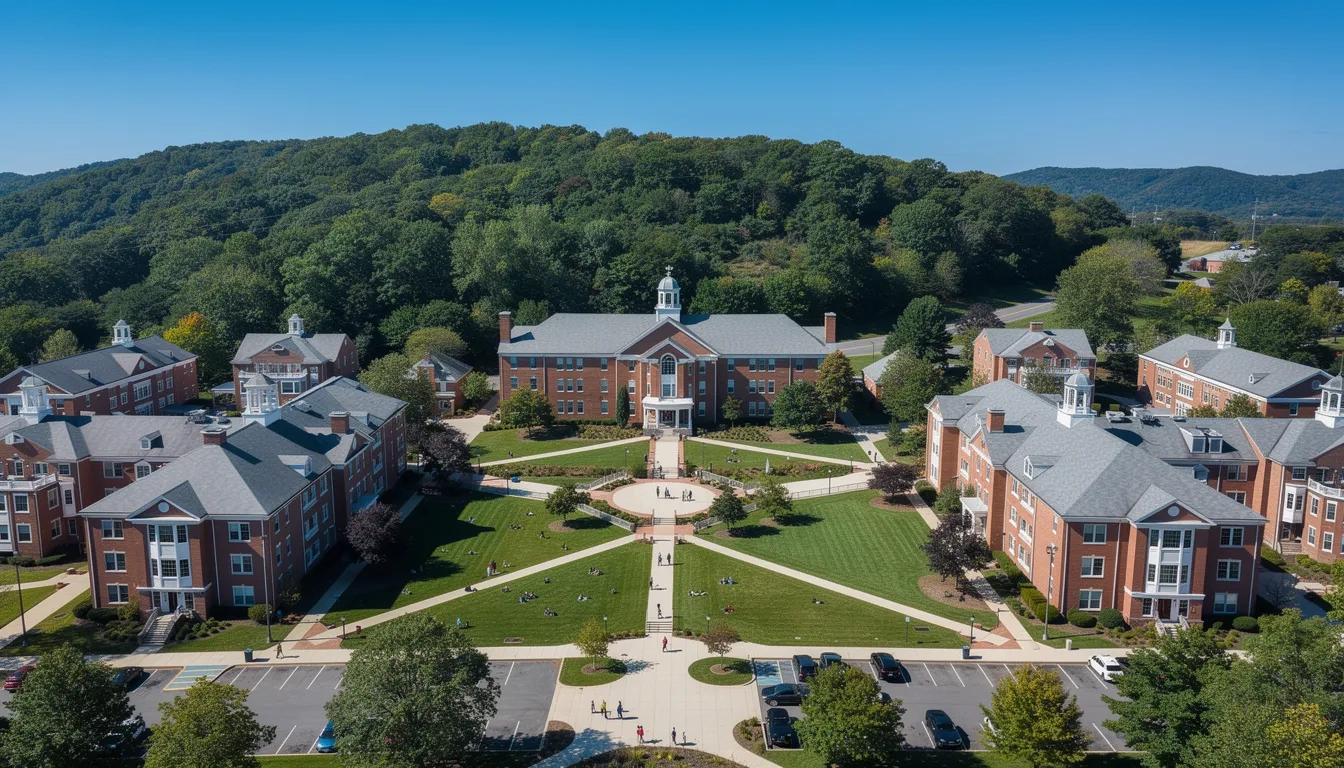
Quinnipiac isn't a liberal arts college. And it's not a sprawling research university. It occupies an interesting position: a mid-sized private institution in Hamden, Connecticut, serving about 6,500 undergraduates and roughly 2,900 graduate, law, and medical students.
That scale matters more than people realize. You get access to professional schools — law, medicine, nursing — that most institutions this size simply don't have. Only about 2.1% of U.S. universities can claim both a law school and a medical school. Quinnipiac is one of them, and that fact alone shapes what's possible for undergraduates eyeing accelerated or dual-degree pathways.
The nine academic divisions are:
- College of Arts & Sciences — humanities, social sciences, natural sciences, and interdisciplinary programs
- School of Business — accounting, finance, management, marketing, economics, and international business
- School of Communications — journalism, public relations, film, and media production
- School of Computing & Engineering — computer science, software engineering, data science, and cybersecurity
- School of Education — teacher preparation and educational leadership programs
- School of Health Sciences — physical therapy, occupational therapy, and physician assistant studies
- School of Law — J.D., LLM in health law, dual J.D./MBA
- School of Nursing — bachelor's through doctoral programs
- Frank H. Netter MD School of Medicine — a patient-centered MD program with a strong primary care emphasis
A student choosing between nursing, cybersecurity, and journalism can explore all three on one campus before committing. That program breadth isn't common at institutions with fewer than 10,000 students.
What the Rankings Actually Show
Here's where the story splits. Quinnipiac's rankings tell very different things depending on which list you consult.
| Ranking System | Position | Category |
|---|---|---|
| Wall Street Journal / College Pulse | #51 | National Universities (2026) |
| US News & World Report | #179 | National Universities (2026) |
| US News | #98 | Best Value Schools (2026) |
| US News | #88 | Medicine — Primary Care (Graduate) |
| US News | #93 | Best Graduate Medical Schools |
| US News | #108 | Best Business Schools |
| Military Times | #1 in Connecticut | Best for Veterans (2025) |
| Princeton Review | Top 391 Colleges | (2026) |
The gap between #51 and #179 is jarring. So what explains it?
US News weights research output and peer reputation heavily — areas where flagship state universities and elite research institutions dominate structurally. The WSJ methodology is built around outcomes: graduation rates, salary impact (how much earning power a school adds compared to peers), career preparation scores, and learning environment quality. Quinnipiac earned its highest marks in all of those outcome categories.
My take: for students who care about career preparation and return on investment, the WSJ ranking is a more useful signal. If you're pursuing an academic research career and graduate school at a top-10 institution is the goal, the US News number provides more relevant context. Not all ranking systems are created equal, and knowing which one reflects your priorities is half the battle.
The Programs That Punch Above Their Weight
The Frank H. Netter MD School of Medicine is probably Quinnipiac's most distinctive asset. The school is named after Frank H. Netter — a physician whose anatomical illustrations became the reference standard for medical education worldwide (you've seen his work if you've ever opened a Gray's Anatomy textbook). The curriculum builds around patient-centered care, and the US News primary care ranking of #88 nationally puts it in solid company among medical schools with far longer histories.
Nursing earns consistent recognition across US News program lists and health sciences rankings. The program runs from bachelor's through doctoral level, which means a student can pursue an undergraduate nursing degree and continue to a DNP or Ph.D. without changing institutions. That continuity matters for students who already know where they want to end up professionally.
Cybersecurity holds a designation that most applicants overlook: Quinnipiac is a National Center of Academic Excellence in Cybersecurity, a credential granted jointly by the NSA and the Department of Homeland Security. Fewer than 400 institutions in the country hold it. For students heading toward federal contracting, defense, or enterprise security roles, that designation signals something employers in those sectors specifically look for.
The School of Law offers specializations in health law (a natural fit given the medical school on the same campus), civil advocacy, intellectual property, and family law. The dual J.D./MBA program is worth flagging for students who want to practice in corporate or healthcare environments where business fluency is expected from day one — rather than something you pick up over ten years of practice.
What The SITE Building Says About Where Quinnipiac Is Headed
In 2023, Quinnipiac opened The SITE — a 137,000-square-foot academic complex designed around computing, engineering, and collaborative research. That number, 137,000 square feet, means something: it's the kind of capital investment that takes years of planning and signals a genuine institutional commitment to expanding in these areas.
The building houses wet labs, fabrication spaces, and open design studios. Graduate and undergraduate students share research areas, which is less common in practice than university brochures tend to suggest. The layout actively encourages work across disciplines — data science students running into health sciences students, engineers collaborating on biomedical problems.
That bet on cross-disciplinary work reflects a broader strategy. The graduates who land well in technical fields increasingly need to communicate across domain boundaries, and building physical environments that force that kind of overlap is one way institutions try to bake it into the culture.
Quinnipiac also runs 17 centers and institutes dedicated to specialized research and experiential learning — including the Polling Institute, which produces political surveys widely cited by national media. That institute gives communications and political science students real exposure to data-driven research methods while they're still undergraduates.
Cost, Aid, and the Honest Value Calculation
Quinnipiac's sticker price is real. Undergraduate tuition and fees run $55,480 per year (2025 figures), and total cost of attendance — room, board, and fees included — reaches approximately $76,270.
"The Wall Street Journal's recognition affirms Quinnipiac's mission to prepare students for successful careers and purposeful, fulfilling lives." — President Marie Hardin
That price sits in the range of most private universities, but the US News #98 Best Value ranking suggests the aid picture softens the blow for a meaningful share of enrolled students. The acceptance rate of 72.15% makes Quinnipiac accessible to a wide applicant pool — which also means competition for merit scholarships is real and worth preparing for.
Three things to know before you run the numbers:
- Apply early action if merit aid matters. Quinnipiac uses merit scholarships as an enrollment tool, and students who apply early often receive stronger initial packages.
- Always compare net price, not sticker price. The gap between published tuition and what families actually pay varies widely based on household income and academic profile.
- Factor in program-specific outcomes. A physician assistant or nursing graduate's earnings trajectory looks nothing like a communications major's first five years — and that difference should shape how you think about any debt you take on.
The Acceptance Rate Misconception
There's a mistake prospective students make with Quinnipiac regularly: treating a 72% acceptance rate as evidence of lower academic standards. It's not.
Acceptance rate measures selectivity, not educational quality. Quinnipiac made a deliberate choice to be a career-focused, mid-sized institution rather than a hyper-selective national brand. That choice lets it enroll students who might otherwise fall through the cracks of more selective applicant pools, while still producing graduates who perform well in competitive job markets.
The WSJ methodology rewards this. Schools that serve a broad range of students and still deliver strong career outcomes score higher under an outcomes-based model than under a prestige-and-selectivity model. For students who didn't get into Boston University or Northeastern but are genuinely weighing Quinnipiac as an option: the data suggests it's worth treating as more than a fallback plan.
Who Actually Thrives Here
Quinnipiac probably isn't the right fit if your primary goal is graduate school at a top-10 research institution. The research infrastructure exists but isn't the dominant feature of undergraduate life, and the faculty profile reflects a teaching-focused institution more than a research-first one.
But for students who want a clear professional track — in healthcare, law, business, communications, or technology — the combination of professional schools, career-oriented rankings, and strong alumni networks in the Connecticut and greater New York corridor makes a real case. The Military Times #4 national ranking for veterans (and #1 in Connecticut) also signals an institutional culture that takes student support seriously across the board, not just in classroom metrics.
The proof is in the pudding: WSJ's top-51 placement reflects outcomes, not reputation. And outcomes are what students actually live with after graduation day.
Bottom Line
- If career outcomes drive your college decision, Quinnipiac's WSJ #51 placement is more meaningful than its US News #179 — those two methodologies measure genuinely different things.
- The medical, law, nursing, and health sciences programs are legitimately strong with clear professional pipelines and nationally recognized rankings in their categories.
- Run net price, not sticker price. The $76,270 total cost of attendance is the ceiling, not the floor, for most admitted students.
- Cybersecurity and computing programs have institutional momentum behind them — the 137,000-square-foot SITE building is not a cosmetic investment.
- The right question isn't "Is Quinnipiac a good school?" It's "Does Quinnipiac's specific program mix match the career I'm building toward?" For a meaningful number of students, the answer is yes.
Frequently Asked Questions
Is Quinnipiac University hard to get into?
With an overall acceptance rate of about 72%, Quinnipiac admits the majority of applicants. But specific programs — particularly nursing, physician assistant studies, and accelerated pre-med pathways — carry additional requirements and are meaningfully more selective than the university-wide number suggests. Apply to the general university and the targeted program separately if both matter to you.
How does Quinnipiac compare to other Connecticut universities in the rankings?
The Wall Street Journal ranked Quinnipiac #51 nationally in 2026, placing it second in Connecticut only to Yale — ahead of schools with much longer reputations for prestige. Military Times ranks it #1 in Connecticut and #4 nationally for veteran-friendliness. The US News National Universities ranking of #179 reflects that system's heavier weighting of research output, where flagship state universities structurally have an edge.
What is Quinnipiac University best known for academically?
Health sciences is the clearest strength: nursing, physician assistant studies, and the Frank H. Netter MD School of Medicine all hold solid national positions. The Polling Institute gives it unusual visibility in political research. And the National Center of Academic Excellence in Cybersecurity designation sets the computing and engineering programs apart from most similarly sized institutions.
Does Quinnipiac offer online or flexible programs?
Yes, particularly at the graduate level. Quinnipiac offers online and hybrid formats for MBA tracks, nursing graduate programs, and several professional certificates. The university also provides micro-credentials and badges aimed at working professionals who want targeted skill development without committing to a full degree program.
Is Quinnipiac a good financial value given the tuition?
US News ranks it #98 for Best Value among national universities, which accounts for financial aid against educational outcomes. Whether it's personally a good value depends on your specific program, the financial aid package you're offered, and your post-graduation earning trajectory. Health professions graduates and business graduates historically see stronger returns in the first decade out than some other programs — so the calculus isn't uniform across majors.
What dual-degree and accelerated programs does Quinnipiac offer?
Quinnipiac offers several accelerated pathways: a dual J.D./MBA, 3+3 programs into law, and 3+4 pathways for students targeting medical school. There are also combined bachelor's/master's tracks across multiple disciplines, designed to reduce time-to-degree without sacrificing accreditation standards. These are worth exploring early — most require you to declare interest before the end of sophomore year.
Sources
- Rankings and Distinctions | Quinnipiac University
- Wall Street Journal ranks Quinnipiac among top 100 best universities | Quinnipiac Today
- Quinnipiac University Overall Rankings | US News Best Colleges
- How Does Quinnipiac Rank Among America's Best Graduate Schools? | US News
- Academics | Quinnipiac University
- 2026 Quinnipiac University Rankings | Niche