University of Arkansas: Admissions, Rankings, and Student Life
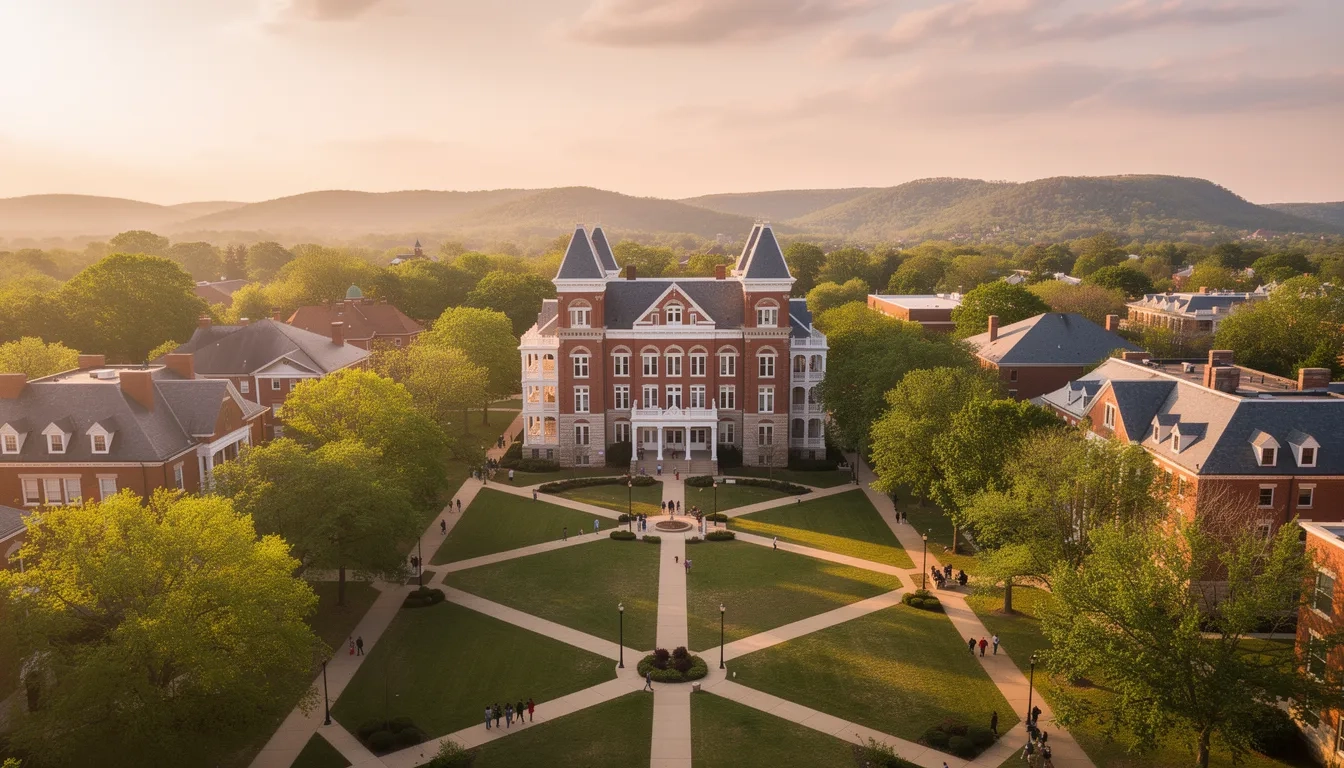
The University of Arkansas awarded 7,875 degrees in 2025 — a single-year record representing an 11.91% jump from the year before. Full degrees, across undergraduate and graduate levels, not certificate padding. That same year the school entered the top 100 public universities in America for the first time according to U.S. News & World Report. If you have been treating Arkansas as a backup option on your college list, the data is starting to make that harder to justify.
Where the Rankings Actually Land
U.S. News ranks Arkansas #183 nationally among all universities and #100 among public schools. The public ranking matters far more for most applicants, since U of A competes in the same recruiting pool as schools like University of Kentucky, Virginia Tech, and Iowa State.
Global rankings tell a more modest story. The QS World University Rankings place it in the 1001–1200 band, and Times Higher Education has it in the 501–600 range for 2025, up from 601–800 in 2024. For a student choosing between state flagships, those international figures are largely irrelevant. They weight research output in fields where American regional schools simply cannot compete.
What matters more is where specific programs land:
| Program | National Ranking |
|---|---|
| Supply Chain Management / Logistics | #11 |
| Undergraduate Business (Walton College) | #41 |
| Bachelor of Science in Nursing | #74 |
| Undergraduate Engineering (doctorate-granting) | #96 |
A #11 in supply chain is not a ceremonial stat. Walmart, the world's largest company by revenue, is headquartered 30 minutes away in Bentonville. J.B. Hunt Transport Services operates out of Lowell, Arkansas. Tyson Foods is in Springdale. Students in the Sam M. Walton College of Business recruiting pipeline get access to internships that students at nominally higher-ranked business schools often cannot match.
Admissions: Who Gets In and How
The acceptance rate sits between 71% and 79% depending on the measurement year and source, which makes Arkansas accessible without being open-enrollment. Most applicants with a solid B+ to A- average are competitive.
The SAT middle 50% for admitted students runs 1050–1220. ACT middle 50% falls roughly 22–28. Arkansas is test-optional (meaning submitting scores only helps if they sit above the middle-50% range, not below it), so students with strong transcripts but weaker standardized scores are not automatically disadvantaged.
Key things to know about applying:
- Rolling admissions with no fixed deadline, but applying in October or November maximizes scholarship consideration
- Common App accepted; application fee is $50
- Early action acceptance rates run around 88%, noticeably higher than the overall admit rate
- 98% of Arkansas resident freshmen received scholarship awards in each of the past two academic years
- Scholarship funding has grown by $7 million since 2019
"Rolling admissions schools reward early applicants more than students realize. An October application and a March application go to the same school — but the October one often gets better money."
The first-year retention rate now exceeds 86% and the fall-to-spring rate sits above 94%. Those numbers tell you that students who get in tend to stay, which matters when you are comparing institutional fit, not just acceptance odds.
What You Will Actually Pay
In-state tuition runs $269.75 per credit hour at the standard rate for 2025–2026 (programs in business, engineering, and nursing charge roughly 20–30% more per credit). For a full-time in-state student, annual tuition lands around $9,672 before fees.
Out-of-state tuition is $26,690. That is the sticker price, and it stops a lot of out-of-state conversations too early. Here is where the New Arkansan Non-Resident Tuition Award (NRTA) reshapes the math: it is automatically granted to eligible out-of-state students and covers most of the difference between in-state and out-of-state tuition. Many out-of-state students end up paying $10,000–$14,000 annually, not the headline number.
| Student Type | Sticker Tuition | Realistic Net Cost |
|---|---|---|
| Arkansas resident | ~$9,672 | ~$8,000 after grants |
| Out-of-state (NRTA eligible) | $26,690 | ~$10,000–$14,000 |
| International undergraduate | ~$33,960 | Limited institutional aid |
52% of Arkansas undergraduates receive grants or scholarships, averaging $9,029 per student. Room and board adds another $12,000–$15,000 to total cost of attendance. Factor that in before comparing U of A's tuition to a cheaper regional alternative.
I'll make the case plainly: for out-of-state students who qualify for NRTA, Arkansas is one of the better value propositions among SEC flagship schools. That combination of automatic aid plus a #41 business school is hard to beat at this price point.
Academic Programs Worth Knowing
Walton College of Business earns its reputation. The #11 supply chain ranking is backed by a geographic advantage no curriculum redesign can replicate: the density of Fortune 500 logistics companies within 30 miles of Fayetteville creates a recruiting environment that is genuinely unusual. Students serious about operations management, retail analytics, or transportation logistics should put this program on their radar.
Engineering has been on a steady climb. The university's $230.6 million in research expenditures during fiscal year 2024 (a record) means research assistantships and lab opportunities exist at a scale that mid-tier engineering schools cannot offer.
Nursing is quieter but strong. The BSN at #74 nationally is solid for a school without a standalone health sciences campus, and healthcare employment in Arkansas is growing above the national average.
Beyond those three programs:
- The Honors College provides a more selective track within the flagship, with smaller seminars, thesis requirements, and priority registration
- Agricultural programs benefit directly from the Arkansas Agricultural Experiment Station
- The university has set a goal of reaching $500 million in annual research output, which should expand graduate funding opportunities considerably
Student Life and the Fayetteville Factor
This is where U of A gets undersold, in my view. Fayetteville is genuinely one of the better college towns in the South, and U.S. News ranked it among the top 10 best places to live in the country.
The Ozark Mountains begin near campus. University Recreation runs guided trips, equipment rentals, and outdoor courses — mountain biking, paddling, and hiking are not theoretical amenities. Students actually use them because the terrain is right there, not a two-hour drive away.
More than 7,000 students live on campus. On-campus housing draws consistently positive feedback for quality relative to peer schools. Dining is functional but not a major selling point — most students eat off-campus regularly, which works because the city is genuinely walkable and bike-accessible.
Fayetteville has also grown as a technology and startup hub, driven in part by the Walmart vendor ecosystem. That means internship options extend well beyond agriculture and retail, which is a newer development worth noting for students evaluating career proximity.
90% of students in campus surveys report feeling extremely safe on campus — above average for a university enrolling more than 34,000 students.
Greek Life, Organizations, and the Social Scene
Greek life is a real part of the culture at U of A. With 6,800 members across 33 organizations, it accounts for roughly 20–25% of undergraduates. Large enough to shape campus social norms, not so large that it excludes everyone else.
One thing to go in knowing: Greek organizations at U of A skew heavily toward students from Arkansas, Oklahoma, and Texas. The social networks that make rushing easier are often pre-formed before freshmen arrive. Not a disqualifier for students from outside the region, but worth factoring into expectations.
Beyond Greek life, 400+ registered student organizations span cultural groups, professional associations, and niche interest clubs. The Associated Student Government allocates annual funding to these organizations, so even smaller clubs can put on programming.
The Distinguished Lecture Series has brought in speakers including Jane Goodall and His Holiness the Dalai Lama. Free concerts through university programming are a regular feature. Students who expect a football-only social calendar tend to be surprised by the depth of the events calendar.
Athletics and the SEC Reality
Arkansas fields 19 varsity teams in the Southeastern Conference, translating to 200+ sporting events on campus per academic year. Football is the cultural centerpiece, and Donald W. Reynolds Razorback Stadium fills to capacity every fall Saturday.
But track and field is the academic secret of Arkansas athletics. The Razorbacks have accumulated more NCAA indoor and outdoor track championships than almost any program in college sports. Cross country is equally decorated. Students who follow elite collegiate competition beyond football will find an unusually strong program here.
SEC membership has practical implications beyond wins and losses. It drives research partnerships, expands alumni networks across the South, and signals a tier of institutional investment that affects everything from lab funding to corporate recruiting events on campus.
Bottom Line
- Apply in October or November — rolling admissions pools and scholarship allocations reward early applicants; waiting until spring costs money
- Check NRTA eligibility before ruling Arkansas out on cost — many out-of-state students end up paying close to in-state rates after the automatic scholarship
- Walton College is the strongest academic selling point — the #11 supply chain ranking combined with Walmart and J.B. Hunt recruiting on campus is a career-launch advantage that a higher overall ranking rarely compensates for
- Fayetteville adds real value to the four years — outdoor access, growing tech presence, and genuine walkability make the student experience better than the school's #183 overall ranking suggests
- The 70%+ six-year graduation rate and 86% first-year retention signal that students who start here finish. That is the ROI metric that matters most when comparing institutions.
Frequently Asked Questions
Is University of Arkansas hard to get into?
Not by flagship standards. The acceptance rate runs 71–79%, making it moderately selective. Students with a solid B+ average and SAT scores around 1100 are competitive. Early action applicants historically see acceptance rates closer to 88%, so applying by November gives borderline candidates a meaningful statistical advantage.
Can out-of-state students get good financial aid at University of Arkansas?
Yes, more than most assume. The New Arkansan Non-Resident Tuition Award (NRTA) is automatically granted to eligible out-of-state applicants and closes most of the gap between the $26,690 sticker tuition and in-state rates. Combined with need-based grants, many out-of-state students pay $10,000–$14,000 in annual tuition — not the headline figure.
What is University of Arkansas best known for academically?
The Walton College of Business, particularly its supply chain and logistics program ranked #11 nationally, is the flagship academic strength. The geographic concentration of Fortune 500 companies — Walmart, J.B. Hunt, Tyson Foods — near campus creates recruiting pipelines that students at higher-overall-ranked schools often can't replicate. Nursing (#74) and engineering (#96) are also stronger than the university's overall ranking implies.
Is Fayetteville actually a good college town?
One of the better ones in the South. U.S. News ranked it among the top 10 best places to live in the country, driven by outdoor access, housing affordability, and a growing technology sector tied to the Walmart vendor ecosystem. The Ozark Mountains offer mountain biking, hiking, and paddling within minutes of campus — and University Recreation makes that gear-accessible without needing your own equipment.
Is Greek life dominant at University of Arkansas?
It is significant but not all-consuming. With roughly 6,800 members across 33 organizations, Greek life represents about 20–25% of undergraduates. Campus culture is influenced by it, but 400+ other student organizations, an active events calendar, and strong outdoor programming give non-Greek students plenty of social infrastructure. Students from outside Arkansas should know that many Greek social networks form before freshman year.
What GPA do you need to get into University of Arkansas?
There is no published cutoff. The admitted student middle 50% generally falls in the 3.3–3.9 unweighted range, and Arkansas evaluates applications holistically. A strong upward grade trend, meaningful extracurricular involvement, or a compelling personal statement can offset a GPA sitting below the median — particularly for in-state applicants, nearly all of whom receive scholarship offers.
Sources
- U of A Moves Up in National Rankings | University of Arkansas News
- University of Arkansas Profile & Rankings | US News Best Colleges
- 2026 University of Arkansas Rankings | Niche
- Campus Life | University of Arkansas Admissions
- Cost of Attendance | University of Arkansas Financial Aid
- University of Arkansas Tuition and Costs | Research.com