UIUC Admissions, Rankings, and Student Life: What to Know in 2026
Something clicked at the University of Illinois Urbana-Champaign that the raw numbers make hard to ignore. In 2021, the school admitted roughly 59% of applicants. By the 2024-2025 cycle, that figure had dropped to 42%. In Computer Science specifically, it's 7.2%. Applications surged 12.62% in a single year, jumping from 73,742 to 83,045. Forbes named UIUC a "New Ivy" two years in a row. The school didn't launch a rebranding campaign. The word just got out.
How the Rankings Actually Stack Up
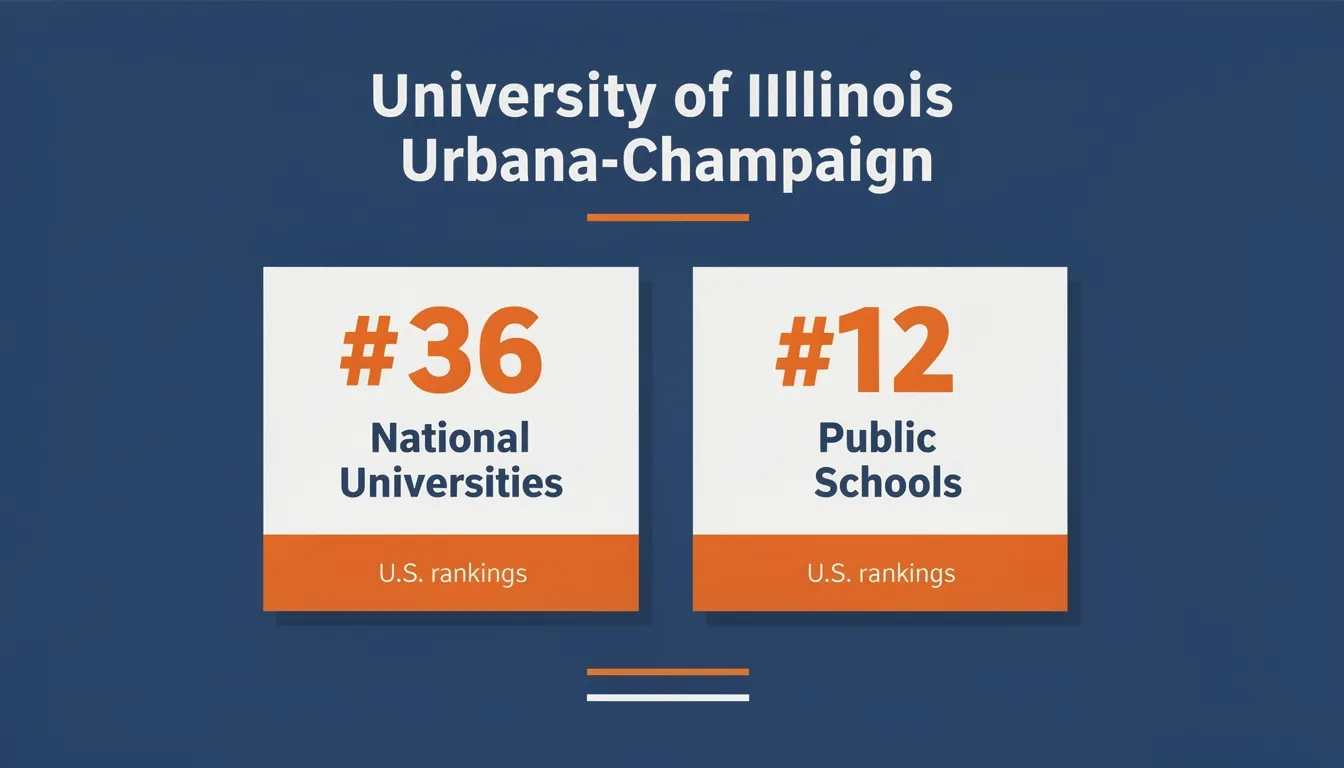
US News ranks UIUC #36 among National Universities and #12 among public schools in its 2026 edition. Solid numbers. But they undersell the story in technical fields.
The Grainger College of Engineering tells a more specific tale. Undergraduate engineering sits at #5 nationally. The graduate program ranks #6. Within Grainger, Computer Science lands at #7 for undergrad programs, Civil Engineering holds #4, and Agricultural and Biological Engineering is #2 in the country. These aren't niche sub-rankings — they put UIUC alongside MIT, Georgia Tech, and Carnegie Mellon in the fields that matter most to employers.
Globally, UIUC holds the #70 spot on the QS World University Rankings (2026) and #42 on the Times Higher Education World University Rankings (2025). Both place it comfortably inside the world's top 75 research institutions.
Forbes recognized UIUC on its New Ivies list in both 2024 and 2025. The methodology drew on employer surveys where approximately three-fourths of respondents held direct hiring authority. In engineering, CS, and business, employers seek UIUC graduates over candidates from schools with more recognizable brand names.
"Employers are souring on Ivy League grads, while these 'New Ivies' ascend." — Forbes, 2024
My honest read: UIUC is not a consolation prize for students who didn't get into Cornell or Northwestern. For engineering and CS, it's a first-choice school that happens to cost significantly less.
How Competitive Is UIUC, Really?
The headline 42% acceptance rate can lull applicants into a false sense of comfort. Look at who actually enrolls.
The middle 50% GPA of admitted students runs from 3.70 to 4.0, with most admitted students carrying a weighted GPA of 3.9 or higher. The middle 50% SAT range is 1390-1520; ACT is 30-34. More than 56% of enrolled students ranked in the top 10% of their high school class.
Applications grew from 73,742 to 83,045 in a single cycle without a matching expansion in class size. With 37,140 undergrads enrolled in fall 2024, the university is large, but admission slots haven't kept pace with demand. The trend runs in one direction.
UIUC has maintained test-optional admissions through the 2025-2026 cycle. But submitting strong scores still helps — of enrolled students who did submit, the ranges above reflect where competitive applicants landed. Skipping scores with a borderline academic profile isn't a workaround; it's a gap in your application.
Acceptance Rates by College: The Real Picture
The 42% headline covers programs with genuinely different bars. Applying to UIUC without knowing your target college's specific rate is a bit like applying for a job without reading the job description.
| College / Program | Approximate Acceptance Rate |
|---|---|
| Overall University | 42% |
| Grainger Engineering | ~21% |
| Computer Science (undergrad) | 7.2% |
| Gies College of Business | ~21% |
| Liberal Arts & Sciences | ~50%+ |
| Illinois residents (average) | 54% |
| Out-of-state applicants (average) | 36% |
Computer Science at 7.2% sits in the same selectivity range as Dartmouth's overall admit rate. Students targeting CS should build their application like they're applying to a top-15 school. Because by program-level selectivity, they are.
In-state applicants carry a real advantage. The 18-point gap between resident (54%) and non-resident (36%) rates reflects the university's public mission. Illinois taxpayers built this institution, and state students see the benefit. That gap tightens in the most selective programs but doesn't vanish.
One thing applicants frequently get wrong: UIUC requires you to apply to a specific college within the university, not to "UIUC" at large. Internal transfers from a less competitive major into Grainger or CS after enrolling are possible but selective. Applying to Liberal Arts & Sciences with a plan to transfer into Computer Science sophomore year is a known strategy — and one the admissions office is well aware of.
What the Admissions Committee Actually Weighs
UIUC does not factor in legacy status, demonstrated interest, or class rank. That's genuinely unusual among competitive universities, and good news for first-generation applicants who aren't working with a $5,000-per-year private counselor.
What UIUC marks as Very Important:
- Rigor of coursework (AP, IB, honors classes signal readiness for a research university)
- GPA
What it marks as Important:
- Essays
- Extracurricular activities
- Talent, character, and first-generation status
Depth beats breadth in extracurriculars. A student who co-founded one engineering club and ran it for three years reads stronger than one with eight surface-level memberships and no leadership role in any.
Apply Early Action by November 1. It's non-binding (you can still compare other offers in the spring), but it gets your file reviewed before program cohorts fill. Students targeting Grainger, the CS program, or Gies should treat this deadline as fixed, not optional.
Write essays for your specific program, not for "UIUC" in the abstract. Admissions readers in the Grainger College can tell immediately when they're reading a repurposed version of someone's Michigan essay. Name the faculty whose research interests you. Reference a specific course sequence. The applications that work are specific.
Life on a Campus That Spans Two Cities
The campus straddles Urbana and Champaign — two different municipalities — which sounds odd until you're walking through and realize you've crossed an invisible city line without noticing. With more than 37,000 undergrads, it's large enough to feel like a small city, but students consistently say the size stops overwhelming you once you find your corner of it.
More than 1,000 registered student organizations cover academic clubs, cultural communities, media outlets (including the Daily Illini student newspaper, which has been running since 1871), service organizations, and groups that don't fit tidy labels. Greek life draws about 23% of undergrads across 90+ chapters. It's one of the larger Greek systems at any public university. But unlike schools where the fraternity-sorority network is practically the entire social infrastructure, plenty of students here build full social lives outside it.
Big Ten athletics is a genuine part of campus culture. Memorial Stadium holds over 60,000 fans for football games. Basketball plays at State Farm Center (capacity 15,500). The school fields 21 varsity sports at the NCAA Division I level.
Beyond varsity sports, two large campus recreation centers offer indoor pools, climbing walls, basketball courts, indoor tracks, and saunas. Intramural leagues are popular enough to find competition at almost any skill level. Students arrive from 47 states and 125 countries, with more than 20,000 students of color enrolled as of fall 2024.
Most students live in residence halls their first year, then move into off-campus apartments. Living-learning communities (LLCs) organized around themes like Engineering, Business, and Global Crossroads give first-year students a built-in cohort before the larger campus absorbs them.
The Financial Reality
In-state tuition for Grainger Engineering students runs $20,714 per year (2024-2025 rates). Out-of-state engineering students pay $39,344. Add room, board, and fees, and total cost of attendance lands around $36,000 for Illinois residents and $57,000 for non-residents studying engineering.
| School | Approx. Annual Tuition | Est. Total COA |
|---|---|---|
| UIUC — IL resident (Engineering) | $20,714 | ~$36,000 |
| UIUC — out-of-state (Engineering) | $39,344 | ~$57,000 |
| Carnegie Mellon (School of CS) | ~$62,812 | ~$83,000 |
| Northwestern University | ~$63,468 | ~$84,000 |
For Illinois residents, the value argument is hard to challenge. A Grainger CS degree, backed by employer relationships that Forbes-surveyed hiring managers specifically named, at roughly a third the cost of Carnegie Mellon. That difference over four years is real money.
Out-of-state students face a tighter calculation. At $57,000 total COA, UIUC starts competing price-wise with private schools that sometimes offer substantial merit aid. Run the net price calculator at every school before comparing sticker prices.
The Illinois Student Assistance Commission (ISAC) offers additional grant funding for state residents beyond federal aid. Submitting the FAFSA before UIUC's February priority deadline matters — institutional aid distributes on a rolling basis, and students who file in April often find the pool partially depleted.
Bottom Line
UIUC has earned its current reputation through program rankings, employer relationships, and research output. The 83,045 applications in the 2025 cycle and the 7.2% CS admit rate reflect a school that students, families, and hiring managers have all quietly reassessed.
If you're applying:
- Apply Early Action by November 1, especially for Grainger, CS, or Gies — treat it as a hard deadline
- Apply to the right college within UIUC, not to the university in the abstract
- Write program-specific essays: name the department, the research, the faculty, the why-here
- Illinois residents should file FAFSA before February to maximize available grant money
- Don't anchor on the 42% headline — CS at 7.2% is top-tier selectivity by any standard, and engineering at 21% isn't far behind
The value proposition at UIUC, especially for in-state students pursuing engineering or CS, remains one of the more defensible spending decisions in American higher education.
Frequently Asked Questions
Is UIUC actually a good school for computer science?
Yes — and not just by public university standards. The CS undergraduate program at Grainger ranks #7 nationally per US News, with a 7.2% acceptance rate that puts it in the same selectivity range as Dartmouth's overall admit rate. Major tech companies (Google, Amazon, Microsoft, and dozens of mid-size firms) recruit directly from UIUC's CS pipeline with dedicated recruiting programs.
What GPA do I need to get into UIUC?
The middle 50% GPA of admitted students runs from 3.70 to 4.0, with most admitted students holding a weighted GPA of 3.9 or higher. That number skews higher for Engineering and CS. Course rigor matters alongside raw GPA — a 3.8 loaded with AP classes reads better than a 4.0 in standard-level coursework.
Does UIUC favor Illinois residents over out-of-state applicants?
Yes, meaningfully. The in-state acceptance rate is approximately 54%, compared to 36% for out-of-state applicants. About 70% of undergraduates are Illinois residents, which reflects the university's public mission rather than bias. The gap tightens in the most selective programs, but it doesn't disappear entirely.
Is applying Early Action at UIUC worth it?
Yes. The November 1 EA deadline is non-binding, so you're not giving up your ability to compare spring offers. But it puts your file in front of reviewers before program cohorts fill. Students targeting Grainger Engineering, the CS program, or Gies Business should treat EA as near-mandatory rather than an optional courtesy.
What is UIUC student life actually like day-to-day?
Think of it as 1,000+ parallel communities happening simultaneously on one campus. With over 37,000 undergrads, 1,000+ student organizations, and Greek life drawing 23% of students, there's enough going on that most people find their niche within the first semester. Big Ten football draws 60,000+ fans. Most students move off-campus after first year, centering their social lives around Campustown and their department's circles.
Is UIUC worth attending from out of state?
It depends on the program. For Grainger Engineering or CS, the case is strong even at $57,000 total COA — the program rankings and employer relationships are nationally competitive. For programs where UIUC's ranking advantage is smaller, the out-of-state premium warrants comparison against private schools with merit aid offers. Use the net price calculator before deciding.
Sources
- How to Get Into UIUC – CollegeVine
- Facts & Rankings – The Grainger College of Engineering
- Employers Are Souring On Ivy League Grads, While These 'New Ivies' Ascend – Illinois College of Education
- UIUC Acceptance Rate and Admissions – GH Students
- UIUC Ranking 2025: Stats + Admission Tips – AdmissionSight
- University of Illinois Urbana-Champaign – US News Best Colleges