University of Tampa: Programs, Rankings, and What Life Is Really Like
Plant Hall stops people mid-stride. Thirteen silver minarets shoot up from a Victorian structure facing the Hillsborough River, Moorish arches framing doorways that Henry Plant commissioned in 1891 for what was then the Tampa Bay Hotel. Plant reportedly spent over $2.5 million on the project — in the 1890s — and the building still looks like it belongs in a different country. Today it anchors the University of Tampa's campus and houses the administration, plus a small museum in the old hotel's east wing.
That architectural backdrop is more than just a fun fact. It telegraphs what UT actually is: urban, a little eccentric, with deep city ties and a personality that leans into its surroundings. The question worth asking is whether the academics and campus experience live up to the setting. The answer is complicated in useful ways.
Rankings: What the Numbers Mean in Context
U.S. News & World Report places UT at #13 among Regional Universities in the South in its 2026 Best Colleges rankings, with a separate #9 distinction for Most Innovative Schools in the same regional category. These aren't national university rankings — UT sits in a different classification than the University of Florida or Florida State — but inside its competitive set, both positions are genuinely strong.
What makes the U.S. News picture more credible is the breadth. UT simultaneously landed on four supplementary lists: Best Value Schools, Most Innovative Schools, Top Performers on Social Mobility, and Best Colleges for Veterans. Earning all four in the same year is not common for a university this size.
The graduate-level headline belongs to Bloomberg Businessweek, which ranked the Sykes College of Business MBA #51 in the United States for 2025-2026 — a jump of 21 spots from the prior year's ranking of #72. Additionally, Sykes earned #27 nationally for "Learning" and #34 for "Entrepreneurship" in Bloomberg's subcategory rankings.
Globally, EduRank places UT around 1,718th worldwide and 424th in the United States. For undergraduates this number matters less than program-specific rankings, but it reflects a real research presence: the university has produced 5,582 scientific publications with over 104,000 total citations, concentrated in medicine, biology, and social sciences.
Programs That Actually Distinguish UT
The university offers more than 200 degree programs. Most are competently delivered. A handful genuinely punch above the school's overall tier.
U.S. News identified four undergraduate programs through its 2026 peer assessment survey — a process where deans and senior faculty at comparable institutions evaluate programs they know well:
- Sykes College of Business (finance, marketing, entrepreneurship, international business)
- Nursing (BSN through DNP, all CCNE-accredited)
- Computer Science
- Psychology
Marine Science deserves mention separately. UT's campus sits on the Hillsborough River, minutes from Tampa Bay, and marine science students run field research in real coastal environments rather than simulated lab settings. It's one of those programs where geography creates genuine academic advantage.
Here's a cleaner comparison across UT's most recognized offerings:
| Program | Degree Levels | Notable Strength |
|---|---|---|
| Business (Sykes) | BS, MBA, MS | Entrepreneurship, Finance, International Business |
| Nursing | BSN, MSN, DNP | Full CCNE accreditation, clinical partnerships |
| Marine Science | BS (multiple tracks) | Tampa Bay access, hands-on field research |
| Computer Science | BS, MS | Peer-ranked top undergrad (U.S. News 2026) |
| Psychology | BS, MS | Peer-ranked top undergrad (U.S. News 2026) |
| Criminology | BS | Local sports/law enforcement employer connections |
Sports management and criminology programs benefit from Tampa's professional sports infrastructure. The city houses three major league franchises, and proximity to those organizations creates internship pipelines that students in smaller markets simply don't have.
The Sykes Business School Case
If one program defines UT's national reputation, it's Sykes. The Bloomberg Businessweek climb from #72 to #51 in a single year isn't just a ranking bump — it's evidence of momentum in employer satisfaction scores and alumni outcomes, which are heavily weighted in that methodology.
The subcategory numbers are actually more useful than the overall rank. A #27 national placement for "Learning" and #34 for "Entrepreneurship" suggests that Sykes competes on instructional quality and real-world business preparation, not just brand prestige or alumni salary data.
Tampa's economic trajectory matters here. The city added major financial operations over the past decade — Goldman Sachs, TIAA, and Raymond James all run significant Tampa operations — and business graduates who want to stay in Florida have access to a job market that's actively hiring. UT's employer relationships inside that market are tangible, not theoretical.
But here's the honest tradeoff: Sykes is regionally strong, not nationally portable in the way that a top-20 MBA program is. Students targeting Wall Street or San Francisco need stronger coastal alumni networks than Sykes currently provides. Students building careers in Florida and the Southeast? Sykes makes real sense.
Campus Life: The City Is the Campus
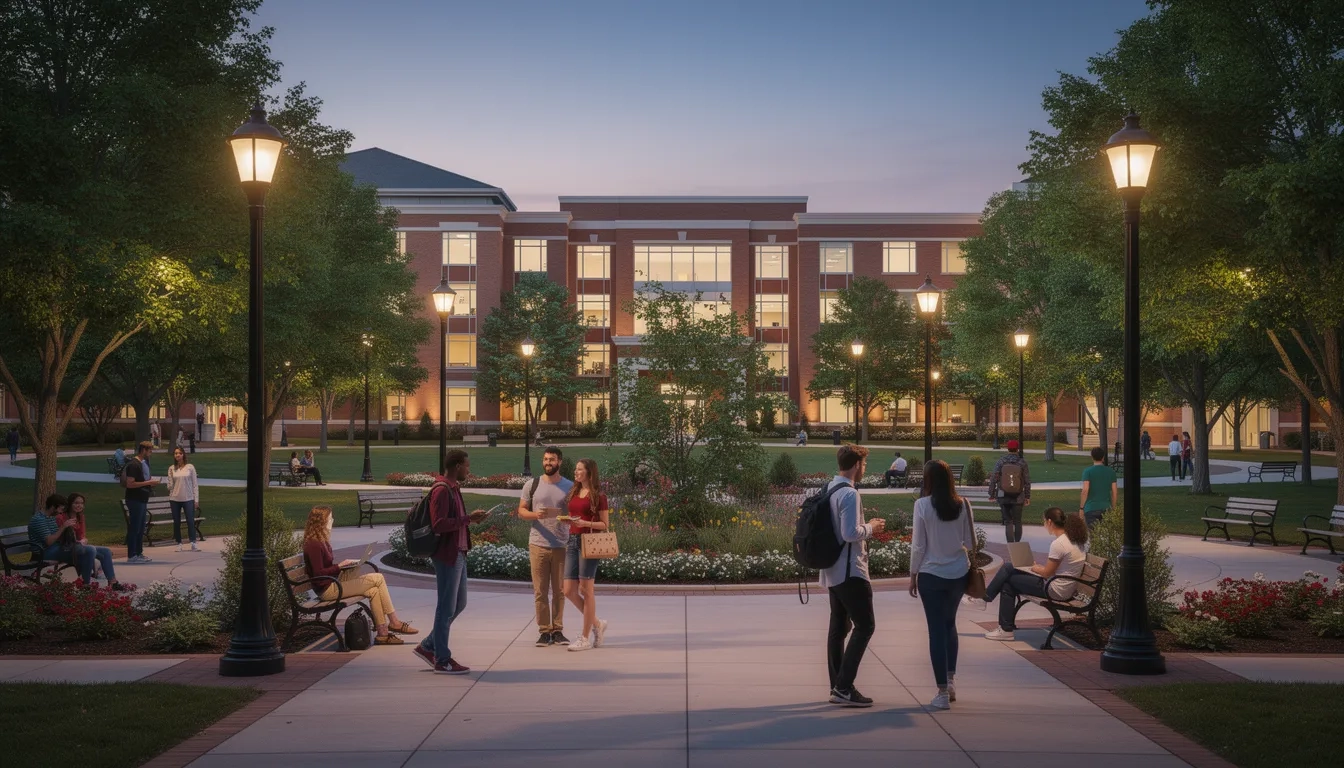
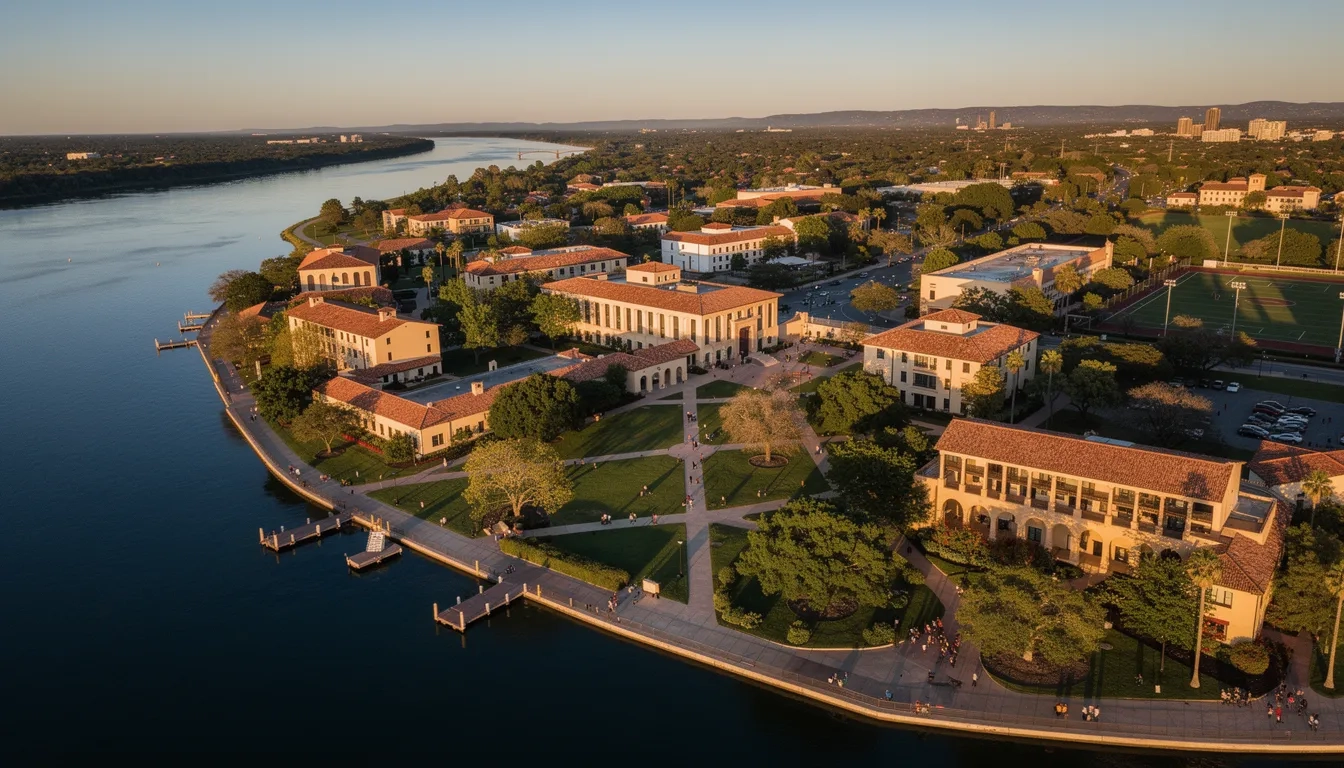
UT's 105-acre campus runs along the Hillsborough River, immediately adjacent to downtown Tampa. The Tampa Riverwalk — a 2.6-mile waterfront promenade — practically borders campus. Clearwater Beach is roughly 45 minutes away. The food, nightlife, and cultural access are genuine.
Students consistently name the location as the best part of attending UT. Over 315 student organizations operate on campus, including 27 Greek chapters. The Vaughn Center serves as the student hub, with dining, a theater, recreational facilities, a Barnes & Noble, and a ninth-floor conference space with views across Tampa Bay (which students regularly claim is one of the best study spots in the city).
Spartan athletics compete in NCAA Division II's Sunshine State Conference across 19 sports. There is no football team — something worth knowing if your high school years revolved around Friday night games and homecoming traditions. UT's school spirit runs through soccer, baseball, and basketball instead.
The social scene gets genuinely mixed reviews. Small class sizes and professor accessibility earn consistent praise. But campus culture can feel stratified — a substantial portion of the student body comes from affluent East Coast families, particularly from New York and New Jersey, and some students report feeling socially excluded. This isn't a universal experience, but it comes up frequently enough in student feedback to mention honestly rather than gloss over.
Off-campus housing is expensive. Tampa's rental market has tightened considerably over the past four years, and upperclassmen who don't secure on-campus priority sometimes face $1,600-plus monthly rents in nearby neighborhoods.
The Real Cost of Attending
Sticker price: $33,348 in annual tuition plus $2,312 in mandatory fees, plus room and board estimated at $13,274. Total listed cost of attendance runs around $60,000 per year. That's full private-school pricing.
The picture changes with aid. According to EduRank's compiled data, approximately 97% of students receive some form of financial assistance, with the average award at $15,945 per year. The average net cost after aid drops to $35,679 annually — a meaningful gap from the sticker price, though still a substantial commitment.
Here's how the math breaks down depending on your situation:
- Strong merit aid recipients (UT awards scholarships based on GPA/test scores): Net cost can fall to $25,000-$30,000/year, competitive with many out-of-state public school costs
- Moderate need-based aid: Net cost around $35,000-$40,000/year — defensible if the program directly supports career goals
- Full-pay families: $60,000/year is real money, and an honest ROI calculation against the specific program is worth doing before committing
The graduation rate sits at 64%, which falls slightly below the national average for four-year universities. This doesn't disqualify UT, but it's a real data point when evaluating long-term investment. Students who engage early with academic support and career resources graduate at higher rates than those who drift.
Admissions: Selective Without Being Stressful
UT's acceptance rate is currently around 40%. That places it in a moderately selective tier — meaningful enough that an unfocused application can hurt you, but not so competitive that qualified students should lose sleep over it.
The university has maintained test-optional policies, which benefits students with strong GPAs but lower standardized test scores. The typical admitted student carries a GPA somewhere in the 3.3-3.7 range. There's no published middle-50% test score range that UT heavily publicizes, which signals that GPA and demonstrated interest carry more weight.
For students comparing UT against regional peers like Rollins College, Stetson University, or Florida Southern College, the decision usually comes down to three things: the downtown Tampa urban access versus a more traditional suburban campus feel, whether a specific UT program (especially Sykes) aligns with career goals, and which school offers the better financial aid package.
My position: UT is the right call for business-oriented students who want real city access and professional networking during their undergraduate years, and for students pursuing nursing or health sciences who value clinical proximity over research prestige. It's not the right call for students who prioritize tight-knit campus community, strong school spirit culture, or graduate school research pipelines.
Bottom Line
- Best fit for: business, nursing, marine science, and health sciences students targeting Florida and Southeast careers; students who want urban access and professional networking baked into their college years
- Rankings in plain English: #13 Regional University South and #51 MBA nationally (Bloomberg 2025-2026) are solid numbers in context — meaningful, not elite
- Net cost reality: the $60,000 sticker drops to roughly $35,679/year for average aid recipients; always evaluate the actual financial aid offer before comparing schools
- Campus culture caveat: the city over-delivers, but on-campus community can feel socially stratified — go in knowing this rather than discovering it in October of freshman year
- Graduation rate: 64% is real data; engage with academic resources and career services early, because students who do graduate at higher rates than those who don't
Frequently Asked Questions
Is the University of Tampa a respected school?
Within its category — Regional Universities in the South — yes. U.S. News ranks it #13 in that group and recognizes four of its undergraduate programs as top performers. It's not a flagship research institution, so reputation varies by field and by where you plan to work. In Florida and the Southeast, particularly for business graduates, UT carries real weight with employers.
What GPA and test scores do you need to get into UT?
The typical admitted student has a GPA around 3.3-3.7. UT is currently test-optional, so SAT/ACT scores aren't required, but submitting strong scores can support merit scholarship consideration. With an acceptance rate around 40%, it's selective enough to warrant a thoughtful application but not so restrictive that strong students should treat it as a stretch.
Is the Sykes College of Business worth attending over other Florida schools?
For students planning careers in Tampa and the broader Southeast, the argument is solid. The Bloomberg Businessweek #51 MBA ranking and strong peer assessments at the undergraduate level are backed by genuine employer relationships in Tampa's financial services sector. The tradeoff is alumni network reach — Sykes doesn't travel as well as a top-15 program if your target is coastal finance or consulting.
Does UT offer good financial aid, or is it primarily a full-pay school?
Roughly 97% of students receive some aid, and the average net cost is $35,679 per year after awards — well below the $60,000 sticker price. UT offers merit scholarships based on academic performance, so students with stronger GPAs can negotiate better packages. The key move is comparing actual financial aid letters, not comparing sticker prices.
What do students actually complain about most at UT?
Off-campus housing costs come up constantly — Tampa's rental market has become competitive, and many upperclassmen pay significantly more than expected. Social cliquishness is the other recurring theme, particularly for students who don't connect with the dominant East Coast social culture. The absence of a football program also catches some students off guard when they arrive expecting a traditional big-college atmosphere.
How strong are UT's graduate programs outside of the MBA?
Limited but credible in specific areas. The nursing school's MSN and DNP programs carry full CCNE accreditation and are the strongest non-business graduate offerings. Most of UT's graduate programs are professionally oriented rather than research-driven. Students who want to go on to doctoral programs in the sciences or humanities typically use UT as a launching pad, not a destination.
Sources
- UTampa Highlighted for Top Undergrad Business, Nursing, Computer Science and Psychology Programs (2025)
- UTampa Sykes College of Business Climbs 21 Spots in Bloomberg Businessweek Rankings
- UTampa Highlighted by U.S. News for Top Undergraduate Business, Nursing and Psychology Programs (2024)
- University of Tampa Rankings and Statistics — EduRank 2025
- University of Tampa Campus Life — Official UT Site
- University of Tampa Student Reviews — Niche
- UTampa Sykes College of Business Receives High Marks in Bloomberg Businessweek Best Business School List