How University Patent Revenue Supports Research
When Northwestern University licensed a patent for a drug compound in the early 2000s, the resulting royalty deal eventually generated over $700 million — enough to endow entire research institutes. That kind of number gets headlines. But here's what doesn't: the average U.S. research university loses millions on patents every year. The gap between the myth and the math is where the real story of university patent revenue lives.
The Law That Changed Everything
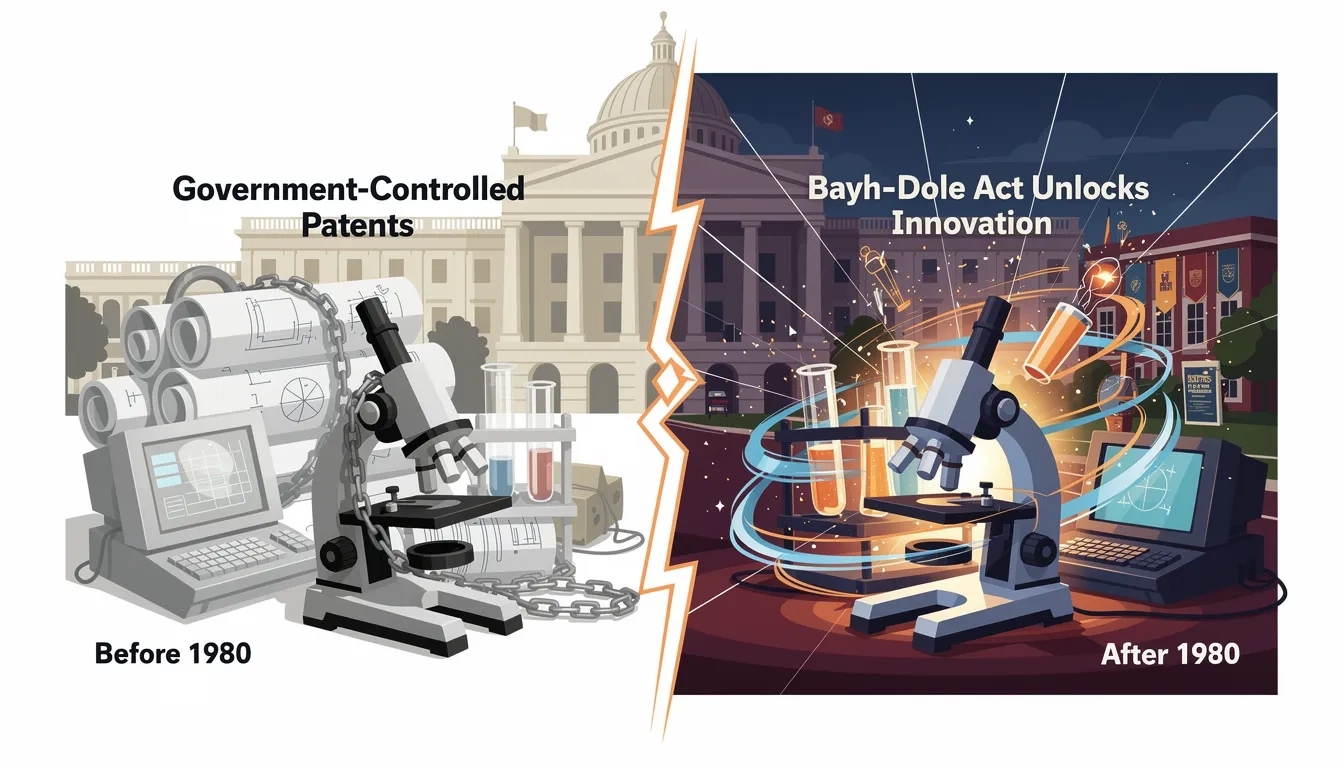
Before 1980, federally funded research discoveries were owned by the federal government. Universities did the work. Taxpayers footed the bill. And then the patents sat in a drawer in Washington, unlicensed. Fewer than 5% of those government-held patents were ever commercialized.
The Bayh-Dole Act of 1980 changed all of that. It let universities, nonprofits, and small businesses retain title to inventions developed under federal funding — and then license them to the private sector. Suddenly, universities had an incentive to patent their researchers' discoveries and cut licensing deals with companies that could actually turn bench science into products people use.
The downstream numbers are hard to argue with. Since 1980, academic technology transfer has produced over 117,000 patents, helped launch 19,000 startup companies, and contributed an estimated $1.9 trillion in gross industrial output. The Association of American Universities puts the cumulative economic impact north of $1.3 trillion. The Bayh-Dole Act is, by almost any measure, one of the more consequential pieces of legislation in the history of American innovation policy.
How the Money Actually Flows
Every major research university has a technology transfer office (TTO), sometimes called an office of technology licensing or commercialization. When a faculty member or grad student invents something, they file an "invention disclosure" with this office. The TTO decides whether to patent it, who might want to license it, and under what terms.
Licenses typically come in two flavors:
- Exclusive licenses give one company the sole right to commercialize the invention. These command higher royalty rates and upfront fees because the licensee is taking on commercial risk without competition.
- Non-exclusive licenses let multiple companies use the technology simultaneously, usually at lower rates. Better for widely applicable tools, less attractive for expensive drug development.
Once royalties start flowing in, universities split the money according to internal policies that vary significantly by institution. A common structure looks like this:
| Recipient | Typical Share |
|---|---|
| Inventor(s) | 25–40% |
| Department/Lab | 15–25% |
| School/College | 10–20% |
| Central University | 20–40% |
The exact percentages differ at every institution. Stanford has had one of the more inventor-friendly policies for decades, which is often cited as a reason the Bay Area startup culture developed so densely around Palo Alto.
What Universities Actually Do With Their Cut
Here's where it gets interesting — and where most coverage drops the ball. The university's share of royalty income is legally required, under Bayh-Dole, to go back into science research and education. This isn't discretionary. It's the deal.
In practice, that reinvestment takes several forms:
- Seed funding for early-stage research that isn't yet ready for federal grants. Ideas too speculative for NIH often get their first dollars from royalty pools.
- Laboratory equipment and renovation. A new mass spectrometer or a refurbished cleanroom costs money that research grants don't always cover.
- Graduate student fellowships. Fellowship support funded by licensing income shows up at institutions like MIT, Stanford, and Columbia, often quietly.
- Proof-of-concept programs. UC Riverside invested $1.4 million from its IP income into proof-of-concept funding, which directly attracted 42 new patents and boosted corporate research funding by 10% — or about $16 million in additional dollars.
- Junior faculty startup packages. New professors often receive discretionary lab funds that come, in part, from royalty pools.
Missouri University of Science and Technology has been explicit about this cycle: the institution channels its patent earnings directly into a Technology Acceleration Program that provides seed money for commercially viable research. The seed money generates more patentable discoveries. Those discoveries generate more royalties. Rinse, repeat.
"Universities most frequently use royalty income for research and educational expenses of graduate students, start-up research costs for new or junior faculty, seed money for innovative new projects, and laboratory equipment." — Council on Governmental Relations summary on university royalty use
The Revenue Concentration Problem
Now for the reality check nobody wants to give you. American universities generated approximately $3.6 billion in patent income in 2023 — a number that sounds enormous until you understand how it's distributed.
In the AUTM licensing data, one institution accounted for nearly 30% of the $3.8 billion total in a recent survey year. That's not a healthy, distributed system. That's one blockbuster drug royalty propping up an industry average.
MIT's own analysis found that only 0.66% of its active licenses — 4 out of 605 — generated more than $1 million in revenue. The rest generated very little or nothing at all. And MIT is one of the best tech transfer programs in the country.
This matters because the institutions most likely to benefit from patent revenue are already the wealthiest research universities. Johns Hopkins, with $1.5 billion in annual research funding, generated less than $16 million in licensing fees in 2012. That's barely 1% of their research spend. Meanwhile, Columbia's patent on CRISPR and Stanford's old patent portfolio represent windfalls that most institutions will never come close to replicating.
The result is that patent revenue, despite its potential, functions more like a lottery than a business model for most universities.
The Hidden Costs That Get Ignored
The cheerful headline number — "$3.6 billion in 2023" — disappears when you do full-cost accounting.
Running a tech transfer office isn't cheap. Patent prosecution alone can cost $15,000–$50,000 per application, and that's before litigation. When researchers spend time on patent applications, they're not writing grant proposals. That opportunity cost is real. One study found faculty time costs in patent work ran at more than 33 times the licensing income realized.
The result: just under half of U.S. tech transfer offices break even when you count all the costs. The average American research university loses millions of dollars on patents annually. One case study institution documented a $9 million net loss in a single year from its IP investments.
Purdue has worked hard to improve these economics — patent applications were up 42% over five years, and licensing deals rose 13% — but even strong growth doesn't automatically translate to net-positive returns.
When the System Works
So when does this actually work? The honest answer is: when a university produces a blockbuster.
Drug patents are the engine of university patent revenue. Pharmaceutical royalties operate on a fundamentally different scale than software or engineering patents, because a single successful drug can generate hundreds of millions annually for decades. The University of Florida's Gatorade royalties — still flowing, still funding research — are the textbook example: around $281 million collected since the formula's invention in 1965.
Startup formation is where the system shows its best face. When universities grant licenses to spin-off companies, they often take equity stakes rather than (or alongside) royalties. If that company succeeds, the university gets a much larger payoff than royalties alone would have provided. The NSF's I-Corps program has trained researchers in commercial thinking, and it's working: 644 startup companies have emerged from that training as of recent tallies. AUTM data shows 67% of university licenses go to startups and small businesses, not large corporations.
Stanford's Office of Technology Licensing has structured itself around this approach, reporting 560 invention disclosures and 150 licensing agreements in a recent year — and deliberately seeding companies that keep alumni engaged and donor relationships warm. The financial and reputational returns compound in ways that pure royalty models can't capture.
The Feedback Loop That Matters Most
Here's the argument I'd make: the direct financial contribution of patents to university research budgets is real but often overstated. What's understated is the indirect effect on research momentum.
Patent revenue buys seed funding for high-risk experiments that federal agencies won't touch yet. That seed funding generates pilot data. Pilot data gets NIH grants. NIH grants produce papers. Papers attract graduate students. Graduate students make discoveries. Some of those discoveries get patented. The cycle continues.
The 8% increase in research expenditures that AUTM tracked — to over $90 billion nationally — reflects a system where royalty income is a relatively small piece of a much larger, self-reinforcing engine. Patent revenue at most universities represents less than 2% of total research budgets. But that 2%, targeted at early-stage and seed-level work, may punch well above its weight.
And then there's the external credibility effect. A university with a track record of producing commercially relevant research attracts industry-sponsored research agreements, gifts from entrepreneur alumni, and corporate partnerships. Johns Hopkins recognized this and created Johns Hopkins Technology Ventures specifically to capture those upstream relationship benefits — and it worked well enough to land them fourth in national startup creation rankings.
Bottom Line
- Patent revenue funds research in real, concrete ways — equipment, fellowships, seed grants — but only after the inventor's cut and the overhead costs are covered. Assume a smaller number than the headline figure actually reaches new science.
- The Bayh-Dole Act created the system, and for top-tier research universities with pharmaceutical breakthroughs, it has been a genuine windfall. For everyone else, the ROI is uncertain at best.
- Most universities lose money on patents when you count all costs. Full-cost accounting matters. "Gross royalties" is a very different number than "net benefit to research."
- The real value is often in startup formation and indirect momentum — the credibility loop that attracts industry dollars, donor money, and top graduate students far exceeds what royalty checks alone deliver.
- If you're evaluating a university's research strength, look at sponsored research expenditures and startup formation rates alongside royalty income. Any one of those numbers alone tells you very little.
Frequently Asked Questions
Do universities actually make money from patents?
Most don't, at least not net of costs. Full-cost accounting — which includes tech transfer office operations, patent prosecution fees, litigation, and faculty time diverted from grant writing — shows that fewer than half of U.S. tech transfer offices break even. The profitable ones tend to have had one or two blockbuster pharmaceutical licenses that skew the average significantly.
How does the Bayh-Dole Act require universities to use royalty income?
Under Bayh-Dole, universities that receive royalties from inventions developed under federal funding are required to reinvest those revenues in scientific research and education. The law doesn't prescribe the exact allocation, but universities cannot pocket licensing income as general operating revenue — it must cycle back into research-related activities.
Which universities generate the most patent revenue?
A small number of institutions dominate the totals. In any given AUTM survey year, the top five institutions often account for 50% or more of total licensing revenue. Columbia, Stanford, MIT, and the University of California system historically top the charts, largely due to pharmaceutical and semiconductor patents. One unnamed institution accounted for nearly 30% of the entire national total in a recent survey year.
Is university patent revenue a reliable research funding stream?
No — and treating it as one is a mistake some institutions have made. Royalty income is lumpy, unpredictable, and highly concentrated in a few deals. Research offices that budget around expected licensing revenue can find themselves exposed when a key patent expires or a licensing deal falls through. It works best as opportunistic supplemental funding, not a planning baseline.
What's the difference between royalties and equity from university startups?
Royalties are ongoing payments — typically a percentage of sales — that a licensee pays in exchange for rights to use the technology. Equity means the university takes an ownership stake in a startup company. Equity can produce far larger returns if the company succeeds (and zero if it fails). Many modern tech transfer offices prefer equity deals, especially in biotech, because the upside better reflects the discovery's true commercial potential.
How do universities split patent revenue with inventors?
Most universities use a tiered formula, with inventors typically receiving 25–40% of net licensing income after patent costs are deducted. The remainder is divided among the inventor's department, their school or college, and the central university administration. Stanford, historically, has been one of the more inventor-generous institutions — a deliberate policy choice that has influenced the culture of faculty entrepreneurship around the university.
Sources
- Taxing University Royalties Would Deliver Few Benefits, but Great Harms — ITIF (2025)
- Universities Lose Millions Chasing Patent Profits — Idaho Business Review (2025)
- Think Universities Are Making Lots of Money from Inventions? Think Again — Hechinger Report
- Technology Transfer — Association of American Universities
- AUTM Technology Transfer Licensing Survey
- Summary Points on University Use of Royalty Income — Council on Governmental Relations