Penn (UPenn): Admissions, Rankings, and What Student Life Really Looks Like
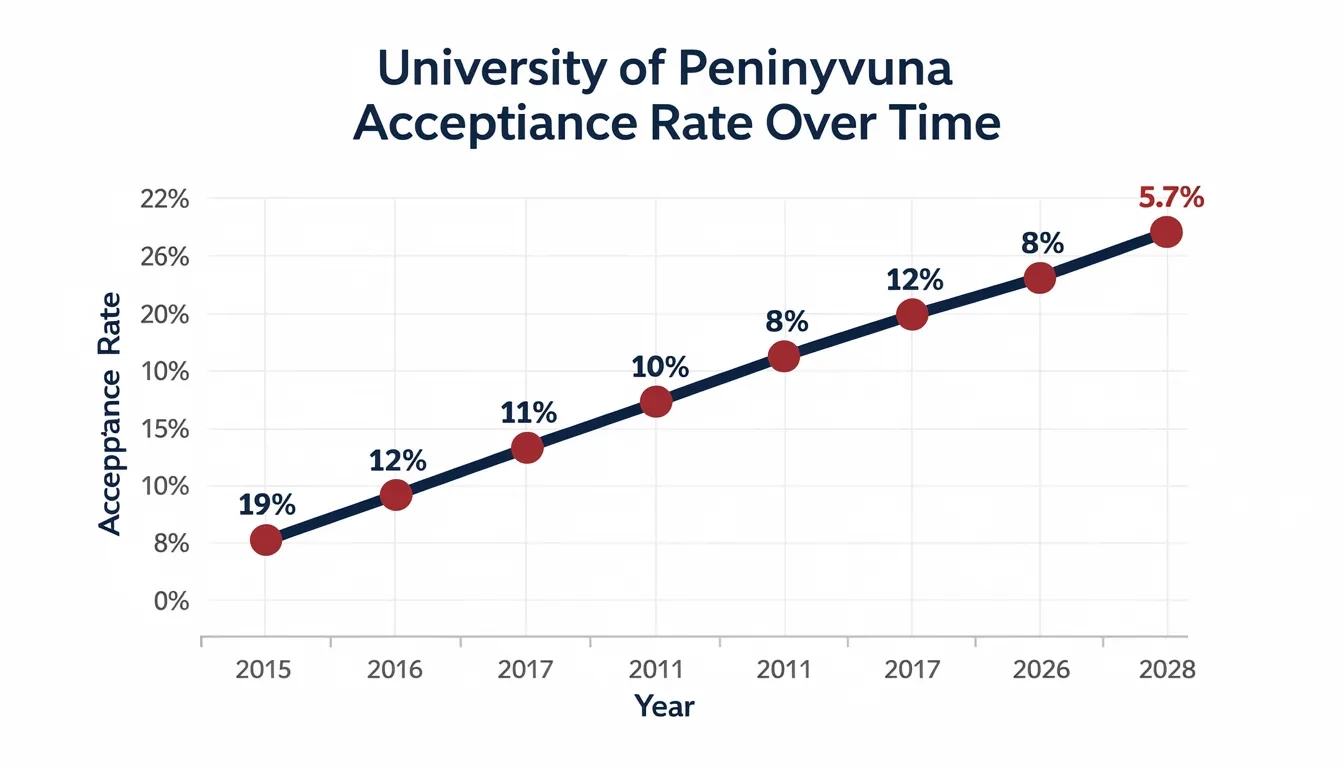
Penn received 72,544 applications for the Class of 2029. 3,530 got in. That 4.8% acceptance rate gets cited constantly — but it's almost the wrong number to pay attention to if you're actually building an application strategy. The more actionable figure is 51%: the share of Penn's incoming class filled through Early Decision admits, at an acceptance rate of roughly 13%. Understanding that gap, and what drives it, will tell you more about how Penn works than any headline statistic.
The Numbers Behind Penn's Acceptance Rate
Penn's selectivity has tightened dramatically over the past decade. For the Class of 2025, the overall rate was 9.0%. By the Class of 2028, it had fallen to 5.38%. The Class of 2029 came in at 4.8%, the most selective cycle in the university's history.
That trend reflects two forces: a surging applicant pool and a stable admitted class size near 3,500 students.
| Class | Applicants | Admitted | Rate |
|---|---|---|---|
| 2025 | 42,205 | 3,789 | 9.0% |
| 2026 | 56,332 | 3,304 | 5.9% |
| 2027 | 54,588 | 3,549 | 6.5% |
| 2028 | 65,235 | 3,508 | 5.38% |
| 2029 | 72,544 | 3,530 | 4.8% |
Penn also reinstated its standardized testing requirement for 2026 applicants, ending the test-optional window that opened during COVID. Middle 50% SAT scores for recent admitted classes run 1500–1570; ACT composites sit at 34–35. These numbers represent a floor, not an automatic admit — but falling meaningfully below them creates real friction in the review process.
The Class of 2029 was 21% first-generation college students, with 24% coming from historically underrepresented racial and ethnic backgrounds, according to Penn's own admissions release.
Penn's Rankings and What They Actually Signal
US News ranked Penn #7 in National Universities for 2026, up three spots from its 2025 position at #10. In a ranking system where top-10 positions tend to calcify, that kind of movement is notable.
QS World University Rankings 2026 placed Penn at #15 globally, behind MIT, Stanford, and a cluster of UK research universities, but ahead of most Ivy peers by that metric.
For a significant segment of applicants, Penn's overall university ranking matters far less than the fact that Wharton exists. Wharton's undergraduate program sits at #1 nationally for business — and for a 17-year-old committed to finance or consulting, that credential carries a different weight than any general university ranking.
Graduate programs reinforce Penn's depth across professional fields: Penn Law (#6 by US News 2025), Perelman School of Medicine (#6), and Wharton's MBA (#3) all rank among the top in their respective areas. For undergraduates, this means access to faculty doing serious research and clinical work, not just professors recycling lecture notes.
What Actually Gets You In
Here's a misconception worth clearing up early: a 1540 SAT and a 4.0 GPA won't get you into Penn. They'll get you past the initial academic screen. Practically every applicant in the pool clears that bar.
Penn's own published admissions criteria rate essays, character/personal qualities, extracurricular activities, and letters of recommendation as "very important" in their decisions. Those aren't filler categories.
What differentiates admitted students tends to fall into a few patterns:
- School-specific reasoning — not "Penn's reputation" but why Wharton vs. the College vs. SEAS vs. Nursing fits your actual goals
- Sustained leadership or genuinely unusual achievement (a business generating real revenue, original published research, a regional competition win)
- A coherent narrative — where your essays, activities, and recommendations tell the same story about who you are
- Demonstrated fit for Penn's interdisciplinary, practically-oriented academic character
One mistake that surfaces constantly: applying to the College of Arts & Sciences because it feels "safer" than Wharton, with a plan to pivot into business later. Internal transfers between Penn's four undergraduate schools are rare and genuinely competitive. Apply to the school that matches what you actually intend to study. The "safer school, transfer later" logic almost never works out the way applicants expect.
The Early Decision Question
Applying ED to Penn is the single biggest strategic move available to applicants. The numbers make the case plainly: a 13% ED acceptance rate versus roughly 3–4% in Regular Decision means applying early roughly triples your odds, holding everything else constant.
ED is binding. Get in, and you're committed — all other applications come down immediately.
The financial tradeoff is where things get complicated. Penn meets 100% of demonstrated financial need for admitted students. That sounds reassuring, but binding ED means accepting Penn's offer before seeing what other schools would offer. For families on the margins of affordability, losing the ability to compare packages from Yale, Vanderbilt, or other strong aid schools can translate to real dollars left behind.
For families who've run the need-analysis numbers ahead of time and feel confident Penn will be workable, ED is the obvious call. For families who genuinely can't know that until they see an actual aid letter, the calculus is harder. There's no shame in applying Regular Decision — you just need to understand the statistical tradeoff you're accepting.
One more nuance: students who apply ED and are deferred (not rejected) get reviewed again in the RD pool. Being deferred isn't a disqualification. But the RD pool is considerably more crowded.
What Penn Offers That Other Ivies Don't
Penn was founded by Benjamin Franklin in 1751 with an explicitly practical mission — preparing students for commerce and civic life, not just classical scholarship. That philosophy didn't fade. It shaped the institution's structure in ways that still genuinely differentiate it from Harvard, Princeton, and Yale.
Penn's dual-degree and coordinated programs are the clearest expression of this:
- The Huntsman Program in International Studies and Business admits approximately 43 students per year and combines a full Wharton degree with international studies and a semester abroad in your target language region.
- The Jerome Fisher Program in Management and Technology (M&T) bridges Wharton and Penn Engineering, producing graduates who can move between finance and technical product roles with equal fluency.
- The Vagelos Program in Life Sciences and Management connects pre-medical and life sciences coursework with Wharton for students pointed toward biotech or healthcare entrepreneurship.
None of these have direct equivalents at Harvard, Princeton, or Columbia. If you're the kind of student who can't choose between medicine and business, or engineering and finance, Penn's architecture was built for you.
Penn Medicine is also one of the most generously funded academic medical centers in the country, which means undergraduates can access clinical research at an earlier stage than at most peer schools. Pennovation Works and the Wharton Small Business Development Center give entrepreneurially minded students genuine resources, not just networking events.
Student Life on and Around Locust Walk
Penn's 299-acre campus in West Philadelphia has Locust Walk running through its center — a tree-lined pedestrian corridor that functions as the social backbone of undergraduate life. On any warm afternoon, you'll find club tabling, pop-up performances, and the kind of sprawling sidewalk conversations that make a 10,000-student university feel smaller.
Over 1,700 registered student organizations cover the range from academic to political to artistic. Greek life is prominent (31 Interfraternity Council fraternities, 8 Panhellenic sororities, plus multicultural Greek organizations), with somewhere around 25–30% of students participating in some form.
Penn's performing arts community is unusually developed. Penn Masala, founded in 1996, is one of the oldest and most recognized South Asian a cappella groups in the country. The Daily Pennsylvanian (founded 1885) has sent graduates to major national outlets for over a century. The Pennsylvania Punch Bowl humor magazine has been running since 1889 — longer than most campus traditions anywhere.
Traditions Worth Knowing Before You Arrive
- Toast Throwing: During football games, students throw literal pieces of toast onto the field during "Drink a Highball." The origin is disputed (Prohibition? Rocky Horror? Both?), but the tradition is very real.
- Hey Day: Every April, juniors in straw boater hats and canes march down Locust Walk to College Hall to be officially declared seniors. Started in 1931.
- Spring Fling: A multi-day festival regularly described as the largest college party on the East Coast, with major musical acts and campus-wide events.
- Penn Relays: Held at Franklin Field since 1895, this is the oldest and largest track and field relay competition in the United States, drawing more than 15,000 athletes from around the world each April.
The Penn Face Problem
Ask Penn students what they'd change about their school, and many will say something about "Penn Face" — the campus norm of projecting confidence and success while privately drowning. It's not unique to Penn (every selective school has a version of this), but Penn's concentration of Wharton finance students, pre-med undergrads, and pre-law hopefuls in a single social world makes the performance feel particularly intense.
Penn has invested in mental health resources — expanded CAPS capacity and embedded counselors within individual schools — and the conversation has opened up considerably since around 2019. But students should go in with eyes open. The competitive social atmosphere is a documented feature of the culture, not an anomaly that catches everyone equally.
Philadelphia as an Asset (With an Honest Caveat)
Penn's location in West Philadelphia puts students inside a real city — not a college town playing dress-up. Philadelphia has the Barnes Foundation (2,500 works, including 181 Renoirs and 69 Cézannes), Reading Terminal Market, and SEPTA transit connecting campus to Center City in under 20 minutes.
The honest tradeoff: Philadelphia has real poverty and crime in some surrounding neighborhoods. Penn operates PennMoves (a free campus transit system) and maintains a dedicated Penn Police zone, but that doesn't change what lies outside the perimeter. Students from suburban environments sometimes find the adjustment jarring in ways that campus visits don't fully convey.
The students who do best tend to treat Philadelphia as part of their education: interning at Comcast, Penn Medicine, or Children's Hospital of Philadelphia; spending weekends at the Philadelphia Museum of Art or the Italian Market. The city is a genuine professional and cultural asset. But getting that value requires intention — it won't happen automatically just because you're enrolled.
| Feature | Penn | Harvard | Princeton |
|---|---|---|---|
| US News 2026 Rank | #7 | #3 | #1 |
| Undergrad Business School | Yes (Wharton) | No | No |
| Overall Accept Rate (2025) | 4.8% | ~3.2% | ~3.7% |
| City Location | Philadelphia | Cambridge/Boston | Suburban NJ |
| ED Program | Yes (binding) | REA (non-binding) | REA (non-binding) |
Bottom Line
- Apply Early Decision if Penn is your genuine first choice and you can assess your financial position in advance. A 13% ED rate vs. ~3–4% RD rate is the most significant practical lever in the entire process. Use it if you can.
- Apply to the school that matches your actual goals. Internal transfers between Penn's undergraduate schools are difficult and competitive. Applying to CAS as a "safer" path to Wharton is a common mistake with real consequences.
- Penn's dual-degree programs — Huntsman, M&T, Vagelos — don't have direct equivalents at most peer schools. If you want to work across business and another discipline at the undergraduate level, Penn's structure is genuinely built for that.
- Take the Penn Face conversation seriously before you arrive. The competitive social atmosphere is real and persistent. Students with strong self-awareness and support systems outside the academic pressure environment tend to have the fullest experience.
Frequently Asked Questions
What GPA do you need to get into UPenn?
Penn doesn't publish a minimum GPA, but admitted students typically have unweighted GPAs above 3.9 and rigorous course loads. The difficulty of your high school curriculum — AP, IB, or dual enrollment coursework — carries as much weight as the raw number. A 3.95 at a demanding school often reads better than a 4.0 at one with limited advanced course options.
Is Early Decision to Penn really worth it?
For most applicants who can commit financially, yes. The ED acceptance rate (~13%) is roughly three to four times the Regular Decision rate (~3–4%). The real cost is binding yourself before you can compare financial aid packages from multiple schools. Run the financial numbers with your family before deciding — if Penn's likely aid package is predictable, ED is the clear play.
Does Penn require SAT or ACT scores in 2026?
Yes. Penn reinstated its testing requirement for 2026 applicants, ending the test-optional period. Submitting scores is now required. Middle 50% SAT: 1500–1570. Middle 50% ACT: 34–35.
Is "Penn Face" a myth or does it actually affect students?
It's documented and real. The concentration of intensely driven students across Wharton, pre-med, and pre-law tracks in one social environment creates visible pressure to appear fine when you're not. Penn has made genuine investments in CAPS and embedded counselors since 2019, and the conversation has become more open. But it hasn't gone away — and knowing it exists before you arrive genuinely helps.
Can I transfer from one Penn school to another after I enroll?
Officially yes, but practically it's quite hard. Internal school transfers at Penn require a formal application and are competitive. The assumption that you can apply to the College of Arts & Sciences and pivot to Wharton once you're on campus almost always turns out to be wrong. Apply to the school that matches your actual intended path.
What is Penn Relays and why does it matter?
Penn Relays is the oldest and largest track and field relay competition in the United States, held at Franklin Field since 1895. More than 15,000 athletes from high schools, colleges, and international programs compete each April. It's both a major Penn tradition and a genuine Philadelphia civic event — the kind of thing that makes campus feel connected to something bigger than the university itself.
Sources
- UPenn Acceptance Rate and Admission Trends | PathIvy
- Penn Acceptance Rate Statistics | PrepMaven
- University of Pennsylvania Student Life | Wikipedia
- UPenn Class of 2029 Early Decision Stats | Ivy Link
- 2026 Best National Universities Rankings | US News
- University of Pennsylvania Rankings 2026 | Shiksha