WashU St. Louis: Admissions, Rankings, and Student Life
Washington University in St. Louis has quietly become one of the most competitive universities in the country. Its acceptance rate hovered around 20% in the early 2010s. For the Class of 2029, it landed at 11.92%. If you're a prospective student — or a parent — who hasn't recalibrated your mental model of WashU recently, the gap between expectation and reality is wide enough to derail an otherwise solid college strategy.
Rankings: Where WashU Actually Sits
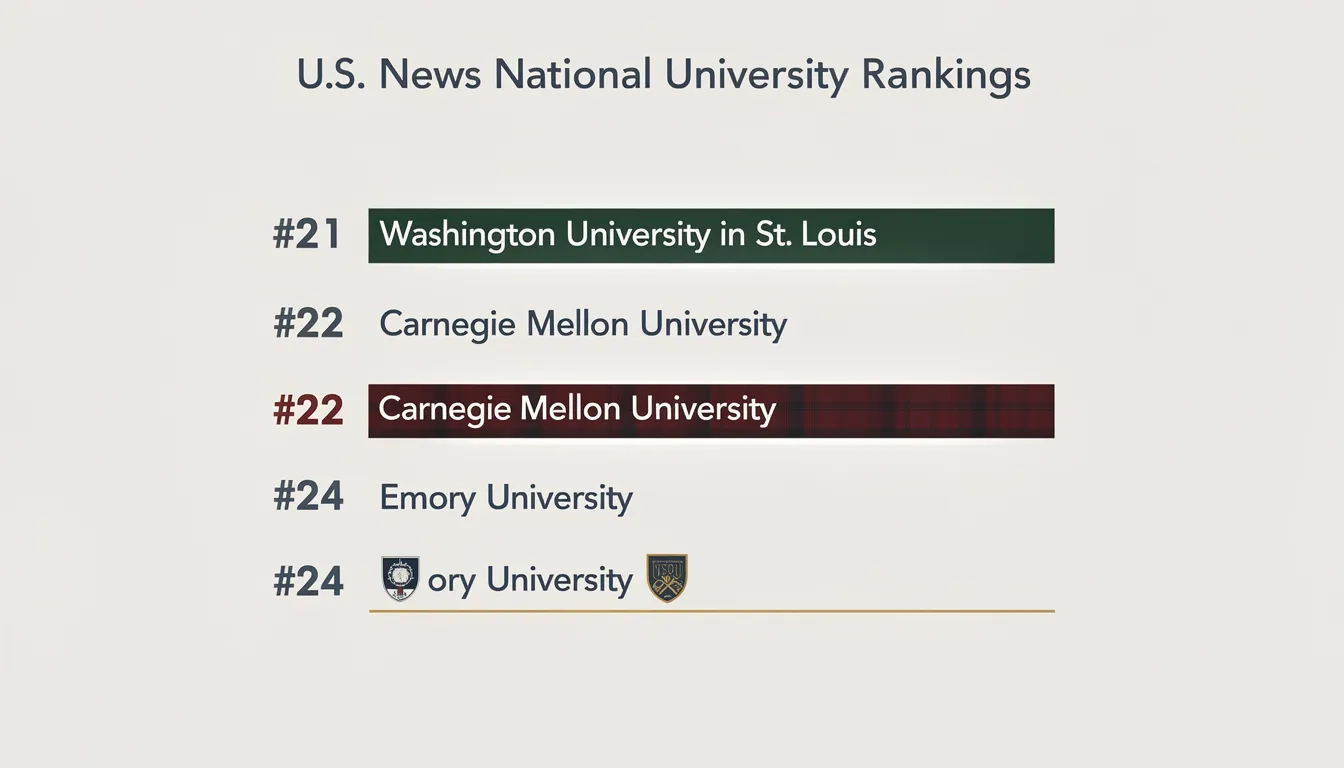
U.S. News ranked WashU #21 among national universities in 2025, placing it just behind Carnegie Mellon and just ahead of Emory. The QS World University Rankings puts it at #171 globally, and the Times Higher Education World Rankings at #69 — a notably higher global position that reflects WashU's research output relative to its size.
Headline rankings, though, can obscure what's actually happening with the applicant pool. WashU's admitted student profile — SAT middle 50% of 1500-1570, ACT of 33-35 — overlaps closely with schools ranked 10 to 15 spots higher. Part of this gap comes down to yield rates, which feed into the U.S. News methodology in ways casual observers don't always account for.
Program-specific reputations tell a more useful story for students evaluating fit. The Olin Business School ranks among the top 15-24 undergraduate business programs nationally (depending on the methodology). The McKelvey School of Engineering has gained ground over the past decade. The Brown School of Social Work carries strong independent standing. For students targeting those programs, the #21 overall figure actually undersells the school.
| Ranking System | WashU Position | Context |
|---|---|---|
| U.S. News National Universities (2025) | #21 | Between CMU (#22) and Emory (#22) |
| QS World University Rankings | #171 | Top 1% globally |
| Times Higher Education | #69 | Strong research output |
| Olin Business School (undergraduate) | Top 15–24 | Consistent performer |
The Admissions Numbers, Decoded
For the Class of 2029, WashU received 33,283 applications and admitted 3,968 students. That 11.92% overall rate is reported everywhere, but it's the wrong number to anchor your expectations to.
Recruited athletes, legacy admits, and development-related admits all count inside that 11.92%. Strip those out, and analyst estimates put unhooked applicants — students without institutional hooks — at roughly 8-10%. That's the realistic baseline for a typical high-achieving applicant.
Here's the full picture of who gets in:
- SAT: 1500–1570 (middle 50%)
- ACT: 33–35 (middle 50%)
- Class rank: 86% from the top 10% of their high school class
- Test optional: WashU remains test-optional through 2027; 44% of recently enrolled students submitted no scores
- Pell Grant eligible: 25% of the class, reflecting meaningful socioeconomic range
- First-generation college students: 18% of enrolled students
- International: 12% of the enrolled class, though international applicants face roughly a 6.8% acceptance rate
The real acceptance rate for unhooked applicants sits closer to 8-10 percent — not the 12 percent figure that gets quoted in admissions guides. Build your strategy around the actual number.
Since the Supreme Court's 2023 ruling on race-conscious admissions, WashU and all peer institutions shifted to race-neutral review. The enrolled class's demographic composition shifted modestly as a result, which is worth factoring in if campus diversity is a priority for your search.
Early Decision: The Strategy Most Families Miss
The Early Decision acceptance rate runs around 25%. The unhooked regular decision rate sits at roughly 8-10%. That gap isn't marginal. It's the biggest leverage point in the entire WashU application.
WashU offers both ED I (notification in December) and ED II (notification in February). That two-round structure is more useful than it first appears. If you're solidly decided on WashU by October, ED I is the move. Still comparing it seriously against two or three other schools in late November? ED II gives you until January to commit while still outperforming regular decision odds.
The writing is on the wall: if WashU genuinely tops your list, the ED advantage is too large to leave on the table.
One caveat that doesn't get discussed enough: ED is binding, so students who need to compare financial aid packages from multiple schools face a real dilemma. WashU's financial aid office does provide non-binding Early Financial Aid Estimates — most families who'd benefit from this don't know to ask for it. Request one before you commit.
A common misconception worth correcting: applying ED doesn't lower the academic bar. The admitted profile from ED and RD applicants is similar. What changes is the signal of genuine, demonstrated interest, which carries real weight when readers are deciding between two otherwise comparable files.
What WashU's Review Actually Values
WashU's admissions philosophy centers on intellectual curiosity with evidence behind it. Reading beyond the curriculum, independent research, building or publishing something — these signal the kind of engagement WashU's small class size (roughly 1,850 enrolled per year) can actually support.
Demonstrated, specific knowledge of WashU programs separates competitive essays from the forgettable ones. Generic "your vibrant campus community" writing gets spotted immediately. If you're applying to Olin, reference faculty research you've read. If neuroengineering is your focus, name the specific interdisciplinary courses that draw you there. Admissions readers spend roughly 10-15 minutes per file — they're matching for coherence and specificity, not enthusiasm.
A practical framework for building a strong application:
- Identify one or two WashU programs that align with a genuine academic interest — not just a prestigious one
- Do real research beyond the admissions site: faculty pages, published papers, department blogs
- Build essays around a coherent narrative connecting who you are, what you want to do, and what WashU specifically offers that other schools don't
- Show depth in one or two activities rather than a scattered 11-item list
Depth over breadth is not just advice here. It's what the admitted profile consistently reflects.
Financial Aid: The No-Loan Promise Is Real
WashU meets 100% of demonstrated financial need through grants and scholarships rather than loans. The average net price for students receiving need-based aid works out to $21,916 per year — roughly what many students pay at flagship state universities after merit aid, despite WashU's sticker price sitting above $85,000 annually.
The Danforth Scholars, Ervin Scholars, and Rodriguez Scholars programs are the flagship merit awards, with the most competitive reaching full tuition. These come with research funding, mentorship, and a cohort-based experience distinct from general enrollment. Each undergraduate school also awards its own scholarships, up to full tuition, so merit aid isn't limited to the three named programs.
More than 60% of enrolled WashU students receive some form of financial assistance. That figure includes international students — who often receive nothing from financial aid offices at peer institutions. WashU's willingness to extend aid to international applicants is genuinely uncommon at this level of selectivity.
WashU is a QuestBridge partner school. High-achieving, low-income students applying through QuestBridge can match for full-ride consideration, and given WashU's consistent need-based commitment, it's one of the stronger matches in the QuestBridge network.
Student Life: What Day-to-Day Actually Looks Like
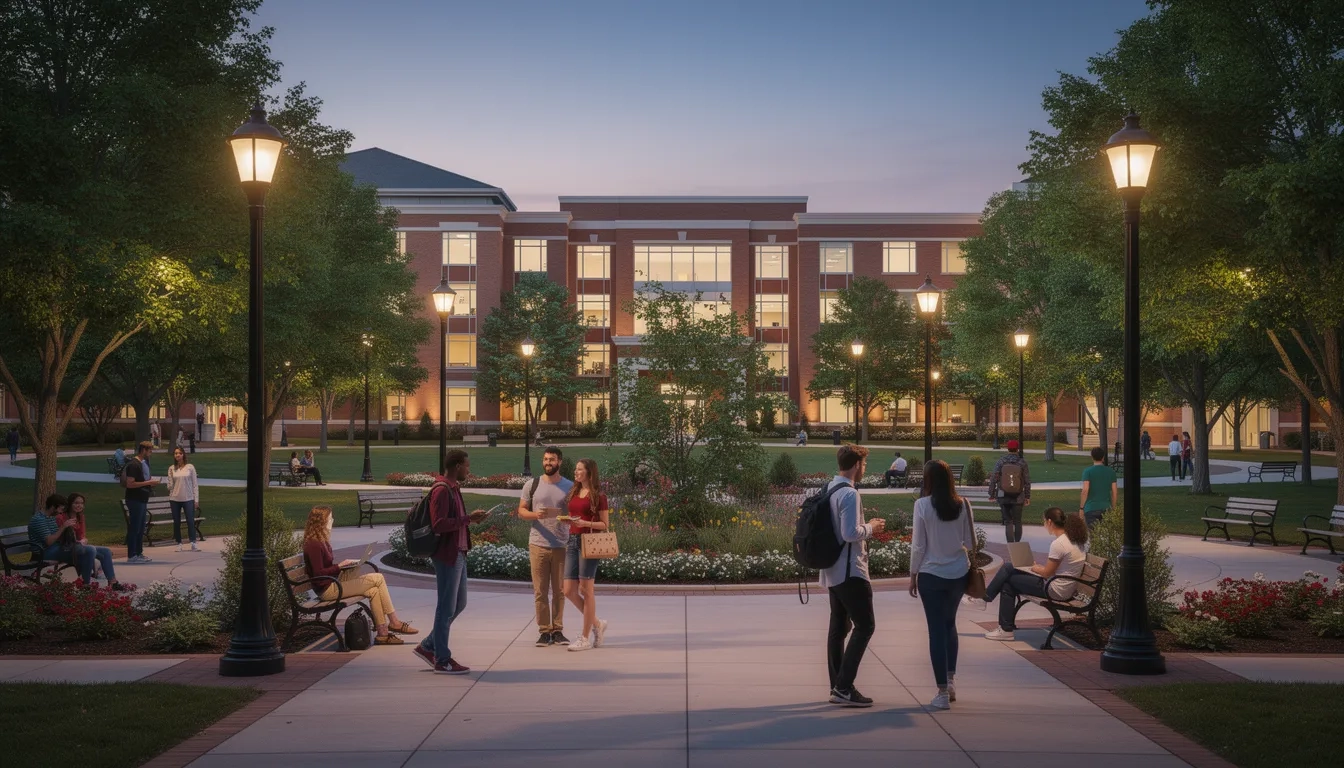
About 75% of WashU undergraduates live on campus, primarily in the South Forty — a residential complex built around nine separate residential colleges. Each college has its own staff, programming, and identity. For a university of roughly 7,600 undergraduates, this structure creates social communities that feel considerably smaller and more personal than the overall enrollment number suggests.
The Washington University Student Union controls a $3.6 million annual budget that's entirely student-governed. No administration approval required for most programming decisions. WILD (Work In, Live Dangerously), the semesterly outdoor concert on the quad, has brought performers including Chance the Rapper. Student Union leadership books it, funds it, and runs it — which says something about how much genuine autonomy students have over campus culture.
The university's 13 official a cappella groups are probably the most well-known quirk of WashU's social scene. One group, After Dark, performed on CBS News during the 2008 vice presidential debate that was hosted on campus. It's a specific, oddly delightful detail that captures something true about WashU's personality.
Greek life involves about 30% of students, spread across 10 national fraternities, 8 national sororities, and 8 historically Black Greek organizations. It's a meaningful part of social life for participants, but students outside Greek organizations consistently report feeling included in campus social life rather than excluded — a contrast worth noting if you've toured schools where Greek life is more culturally dominant.
Community service is embedded in the campus identity at a level beyond most schools. WashU consistently runs one of the largest collegiate Relay for Life events in the country, raising over $200,000 annually. With 50+ service-focused organizations and genuinely high participation rates, it reads less as resume-building and more as a shared campus value.
The St. Louis Factor
St. Louis is a better college city than its national reputation suggests, and I'll stand by that. Yes, it carries challenges common to many Midwestern urban centers. But it also has Forest Park (1,326 acres — technically larger than New York's Central Park), a world-class art museum with free admission, a real food culture in the Cherokee Street and Soulard neighborhoods, and sports allegiances around the Cardinals and Blues that run deep.
WashU sits directly adjacent to Forest Park, meaning students can walk into one of the best urban parks in the country without a car or shuttle. The university runs regular service into other parts of the city and has built employer partnerships across healthcare, biotech, and financial services — internship pipelines that rival what you'd find in larger markets.
Cost of living matters more than people admit when comparing universities. A two-bedroom apartment near WashU's campus might run $1,100-$1,400/month. The equivalent near a comparable Boston-area institution could run three or four times that. For students who want to live off-campus in junior or senior year, St. Louis makes that financially possible in a way that some coastal college cities simply don't.
Students from coastal cities often need about one semester to adjust to the Midwest. Most come around by year two. It's a real adjustment, not a dealbreaker.
Bottom Line
- Apply Early Decision if WashU genuinely tops your list. The gap between 25% ED and 8-10% unhooked RD is the largest strategic advantage in the application.
- Don't treat #21 as the full picture. For Olin Business, McKelvey Engineering, or Brown School of Social Work, the program-specific reputation places WashU above that composite rank.
- The financial aid model is genuinely strong: 100% of demonstrated need met, no loans, and merit scholarships through the Signature Scholars programs mean the real cost is often far below the sticker price.
- Build your application around depth. One sustained, coherent story — backed by specific knowledge of WashU programs — beats a broad application every time.
- St. Louis is an asset, not a compromise. Give it time before you write it off.
Frequently Asked Questions
Is WashU still test-optional?
Yes — WashU's test-optional policy runs through the 2027 application cycle. About 44% of recently enrolled students submitted no test scores. That said, strong scores (SAT 1500+ or ACT 33+) can still strengthen your application, particularly if other parts of your profile need support. If your scores fall in the middle 50% or above, submit them.
How does WashU compare to Vanderbilt, Duke, and Northwestern?
These four schools are genuinely comparable in selectivity and resources and are often grouped together in counselor conversations. Where WashU differentiates: its no-loan financial aid policy is more generous than Vanderbilt's standard aid model, and the St. Louis location creates different internship access (particularly in healthcare and biotech) than Durham or Evanston. The core academic experience — research opportunities, small class sizes, faculty access — is comparable across all four.
Is legacy status a meaningful advantage at WashU?
Yes, but it functions more as a tiebreaker than a guaranteed boost. WashU's admissions office describes legacy as one factor among many in close decisions — not a shortcut past academic or extracurricular expectations. Since the Supreme Court's 2023 decision brought legacy policies under renewed public scrutiny, WashU has been measured in how prominently it emphasizes legacy in its public admissions materials.
What makes a strong "Why WashU" essay?
Specificity. Readers can spot a template essay in the first paragraph. The strongest essays name a specific faculty member's research, a particular interdisciplinary course sequence, or a research initiative that exists only at WashU. Generic references to "a collaborative environment" or "strong community" won't move the needle. Spend real time on the WashU departmental websites — not just the admissions homepage — before drafting.
What is the South Forty, and will I like living there?
The South Forty is WashU's main undergraduate residential complex, divided into nine residential colleges. Most freshmen are placed there automatically. The college structure creates a smaller, more defined social community within the larger university — most students find it an easier social start than an undivided freshman dorm would be. Each college has its own programming, staff, and informal culture.
Can transfer students realistically get into WashU?
Transfer admission is possible but selective. Competitive transfer applicants typically show a 3.7+ college GPA and a clear, specific reason for transferring beyond "I didn't get in the first time." Available spots vary significantly by school — engineering and business tend to have fewer openings than arts and sciences. The application process mirrors the freshman process in its emphasis on demonstrated fit and specific academic interest.
Sources
- WashU Acceptance Rate: Class of 2030 Admissions Statistics – AdmissionSight
- WashU Acceptance Rate Analysis 2025 – AdmitStudio
- Washington University in St. Louis Student Life – Wikipedia
- Scholarships – WashU Financial Aid
- WashU Financial Aid – QuestBridge
- Washington University in St. Louis Admissions & Housing Guide – UniversityLiving