AI Tutoring Platforms: Can They Replace Human Teachers?
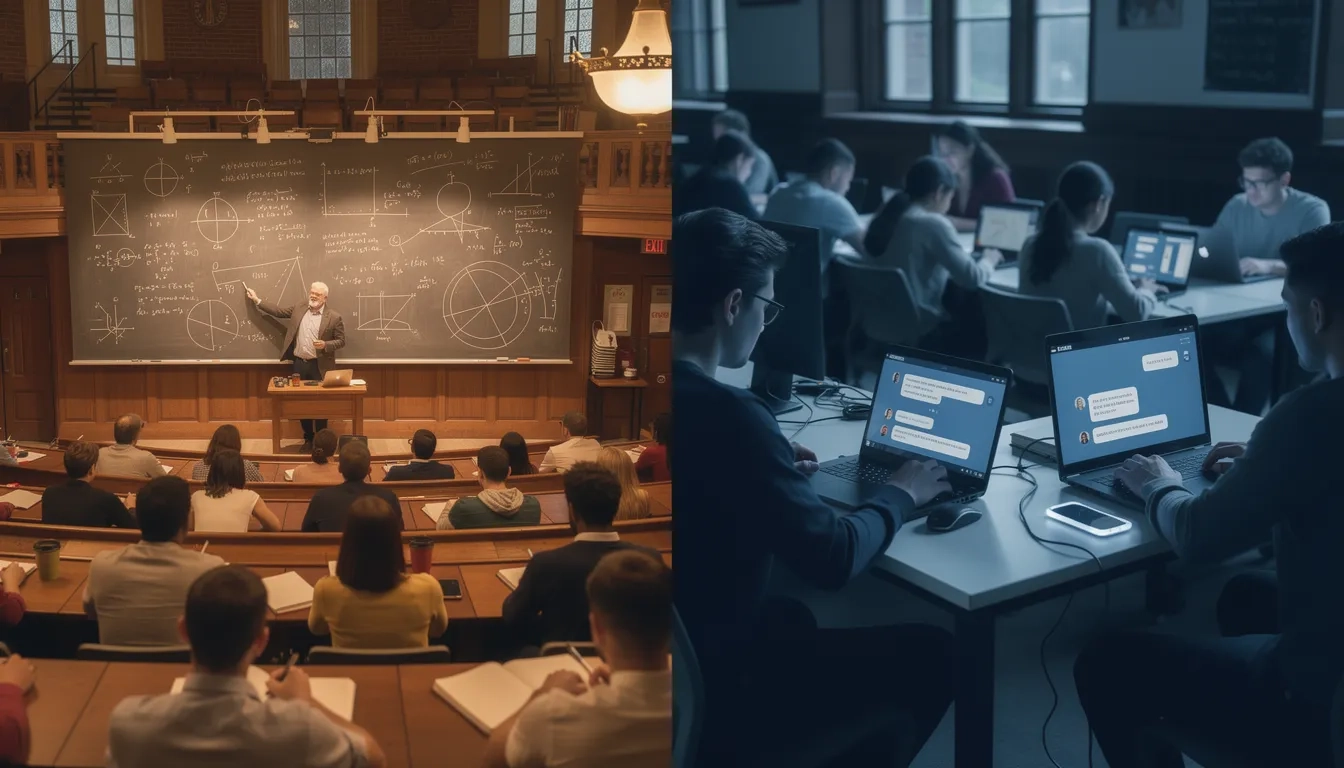
In June 2025, a team of Harvard physicists published a study that made a lot of educators uncomfortable. They split 220 undergraduates into two groups: one attended a standard active-learning lecture, the other worked with an AI tutor on the same physics material. The AI group finished in 49 minutes instead of 60, hit median post-test scores of 4.5 compared to 3.5 for the classroom group, and showed an effect size between 0.73 and 1.3 standard deviations — huge by educational research standards. The "AI will replace teachers" headlines followed within days. They missed the more interesting story.
What the Harvard Experiment Actually Showed
The Kestin et al. study, published in Scientific Reports, is one of the more rigorous tests we have. Randomized design. Blind grading. Same content, same time window. An AI tutor genuinely outperformed human-led classroom instruction in a controlled setting. That's not something to wave away.
But the study was conducted on introductory physics — a domain where answers are objectively correct or incorrect, and where the path from confusion to understanding is narrow enough to script. The AI tutor asked Socratic questions, adapted pacing in real time, and gave instant feedback at each step. It was purpose-built for exactly this kind of problem.
It did not help any student decide whether to drop the course. It didn't notice that someone in the back row hadn't eaten since yesterday.
The Case for AI Tutors
Set the Harvard result aside and look at the longer arc. James Kulik and James Fletcher reviewed 50 studies in 2016 and found that intelligent tutoring systems could match the success of human tutors in structured domains — and that was before large language models existed. The Brookings Institution has since catalogued four randomized controlled trials showing that AI-enhanced tutoring platforms consistently deliver substantial learning gains.
Now those systems can hold a conversation. Khanmigo (Khan Academy's AI tutor) walks a student through a quadratic equation step by step, asks why they made a specific error, and rephrases the explanation if the first attempt doesn't land. The J-PAL Poverty Action Lab at MIT is currently running large-scale trials on Khanmigo to measure its impact across diverse student populations — one of the more serious research efforts in this space.
Carnegie Learning's MATHia, which has been in classrooms long enough to generate multi-year outcome data, consistently shows students who use it for a full academic year outperforming comparable peers on standardized math assessments.
What makes these systems worth taking seriously:
- Infinite patience. An AI will explain the same concept 17 times without any shift in tone or frustration.
- No-judgment zone. Brookings researchers found students in AI tutoring contexts report feeling more comfortable asking questions they'd be embarrassed to ask a teacher.
- Always available. A student stuck on a proof at 11:30 PM on a Sunday now has somewhere to go.
- Genuine individualization. Good AI tutoring systems adapt to the specific misconception a student holds, not just whether they got an answer right or wrong.
"Many platforms offer individualization only — adjusting difficulty level. True personalization means diagnosing why a student made an error and addressing that specific gap." — Brookings generative AI in tutoring analysis
Where AI Tutors Fall Flat
AI tutoring fails in proportion to how much a subject requires human judgment. Mastering polynomial factoring? AI handles it well. Learning to write a persuasive essay about a morally contested topic? The AI can flag structural issues, but it struggles to tell a student that their argument would land harder if they acknowledged the other side first. That's judgment. Not pattern matching.
There are also practical failure modes that don't get enough attention. Large language models hallucinate. A student using a general-purpose chatbot for chemistry homework might receive a confidently worded but wrong explanation for why an exothermic reaction releases heat. Purpose-built systems like MATHia constrain outputs tightly enough to minimize this. Generic AI tutors do not.
The dependency problem is real too. Research flagged by Brookings (Krupp et al., 2023) found that students who use AI without structured guidance show limited long-term retention. They get the answer and skip the productive struggle that actually builds memory. They feel like they're learning. They're often not.
And then there's the part no technology has figured out: emotional context. A good human tutor notices when a student is somewhere else, asks about it, and sometimes discovers the student's home situation has collapsed. AI systems have no mechanism for this. They can't feel the room, and education happens in rooms.
The Equity Argument
This is where the conversation gets genuinely complicated. The United States faces a real teacher shortage — tens of thousands of unfilled teaching positions, with rural and low-income districts hit hardest. These communities aren't waiting in a stable situation for a better policy to arrive. They're running on rotating substitutes, split classes, and teachers covering subjects outside their training.
AI tutoring is one of the few scalable interventions that doesn't require hiring humans who don't exist. A student in rural Mississippi whose school has had no qualified algebra teacher for two years isn't well-served by being told to wait for a human. An AI system that covers Algebra II reliably is a real upgrade over that status quo.
The 2025 RAND Corporation survey found that 54% of students and 53% of teachers in the United States now use AI for school. That adoption is not evenly distributed — and the pressure is greatest in districts that can least afford to wait.
But the counterargument deserves weight. Students in under-resourced environments frequently need more human support, not less. Unstable home lives, food insecurity, learning differences, and limited parental academic support are problems that no AI system is equipped to address. Deploying AI as a cost-cutting mechanism in low-income schools while leaving resource gaps unfilled would be a policy failure dressed up as innovation.
Hybrid Models: Where the Real Gains Are
A 2025 evaluation by the American Institutes for Research found that a hybrid approach (AI-driven practice combined with human oversight and coaching) produced effect sizes of 0.42 for elementary students — higher than AI-only or human-only approaches in the same study context.
That result is consistent with what the theory would predict. The AI handles repetitive, feedback-intensive skill-building while the human handles everything the AI cannot: motivation, relationship, complex explanation, and the moments when a student needs someone to tell them they're capable of more than they think.
Think of it like GPS and a driving instructor. GPS is better than any human at turn-by-turn navigation. But you wouldn't send a 16-year-old to learn parallel parking with only a GPS.
Here's how the approaches compare across the dimensions that matter:
| Dimension | AI Tutor | Human Tutor | Hybrid Model |
|---|---|---|---|
| Availability | 24/7 | Scheduled only | Mostly flexible |
| Patience and consistency | Unlimited | Variable | High |
| Emotional support | None | High | High |
| Accuracy in structured domains | High | High | High |
| Accuracy in open-ended tasks | Lower | High | High |
| Cost at scale | Low | High | Medium |
| Hallucination risk | Present | None | Low |
| Long-term student engagement | Variable | Usually high | High |
The table tells a clear story. AI wins on availability, cost, and consistency. Humans win on emotion, open-ended reasoning, and engagement. Combined, they outperform both.
The Replacement Question, Honestly Answered
Here's my position: AI tutoring will not replace teachers in any meaningful general sense. But it will replace significant chunks of what teachers currently spend time doing — and that's actually a good outcome.
A teacher spending hours each week grading repetitive algebra worksheets is not doing their best work. That is genuinely AI work. A teacher noticing that a struggling student lights up when the conversation turns to science fiction, then building that connection into the next writing assignment — that's human work. Nothing in the current AI toolkit touches it.
The writing is on the wall for some parts of the traditional tutoring business, though. One-on-one paid tutoring for SAT math prep, basic grammar correction, or vocabulary drilling faces real pressure from AI tools that do those things well and cost a fraction of private tutoring rates ($23,847 per year in some high-demand markets). That market will contract.
But the broader teaching profession? The research doesn't support alarm. What it supports is adaptation.
Bottom Line
- Use AI tutoring for structured practice in math, science, and language learning. The Harvard and Carnegie Learning data show real gains. This is where AI earns its keep.
- If you're running a school or district, pilot a hybrid model before committing to AI-only solutions. The AIR research suggests hybrid outperforms either extreme.
- Don't read "AI outperformed a lecture in one physics study" as "AI can replace teachers." The Kestin et al. result is exciting and specific. It is not a general verdict.
- The teacher shortage is real, and AI can genuinely help in under-resourced settings. But it works best as a multiplier for human bandwidth, not as a substitute for human investment.
- Adoption is already happening. Over half of US students and teachers used AI for school in 2025. The question isn't whether AI enters classrooms. It's whether it's used thoughtfully.
Frequently Asked Questions
Can AI tutors actually replace human teachers in K-12 schools?
Not in any complete or near-term sense. AI tutors perform well in structured, skill-based domains like algebra and grammar, but lack the emotional intelligence, relational capacity, and contextual judgment that effective teaching requires. The 2025 RAND survey found over half of teachers already use AI as a daily tool — and "tool used by teachers" is very different from "replacement for teachers."
What does research show about AI tutoring compared to traditional instruction?
The results are more positive than most skeptics expect. The Kestin et al. Harvard study (June 2025) found effect sizes between 0.73 and 1.3 standard deviations in favor of AI tutoring over active learning in physics. Earlier meta-analyses (Kulik and Fletcher, 2016) found intelligent tutoring systems could match human tutoring in structured domains. For language learning specifically, a 2025 multilevel meta-analysis of 46 empirical studies found AI has a statistically significant impact with an effect of g = 0.74.
Is AI-generated tutoring content accurate and safe for students?
Depends entirely on the platform. Purpose-built systems like Carnegie Learning's MATHia constrain outputs to a defined curriculum, which dramatically reduces inaccuracy risk. General-purpose chatbots used as tutors carry real hallucination risk — confident, wrong explanations that a teacher or parent needs to catch. For academic content, domain-specific educational AI is far safer than a generic large language model.
How should students use AI tutoring tools to actually learn, not just get answers?
Use AI as a thinking partner, not an answer machine. The Krupp et al. (2023) research found that students who use AI to bypass the productive struggle of figuring something out retain significantly less than peers who work through problems first. Ask the AI why your answer was wrong. Ask it to explain the concept a different way. Treat it like a study partner, not a solution key.
Will AI tutoring help close the education equity gap?
It might help — but only with intentional deployment. AI can reach students in under-resourced areas where qualified teachers are scarce, and costs far less than private tutoring. The risk is that policymakers use AI tutoring as a justification for underfunding human support roles (counselors, social workers, mentors) that low-income students need most. The technology itself is neutral; the policy decisions around it are not.
Which AI tutoring platforms have the strongest evidence behind them?
Khanmigo has the broadest current research investment, with J-PAL at MIT running large-scale efficacy trials. Carnegie Learning's MATHia has the longest track record of published outcome data in K-12 math. Duolingo's AI features have strong evidence for language acquisition. The common thread among the well-evidenced platforms: they are built around specific curricula with constrained outputs, not generic large language model interfaces.
Sources
- What the research shows about generative AI in tutoring — Brookings
- AI-Powered Tutoring with Khanmigo — J-PAL Poverty Action Lab
- Review of Kestin et al.'s June 2025 Harvard Study on AI Tutoring — ETC Journal
- The Future of AI in Tutoring — TutorCruncher
- Two Emerging Strategies for Using AI in Tutoring — FutureEd