AI Tutoring vs Human Tutors: What the Research Actually Shows
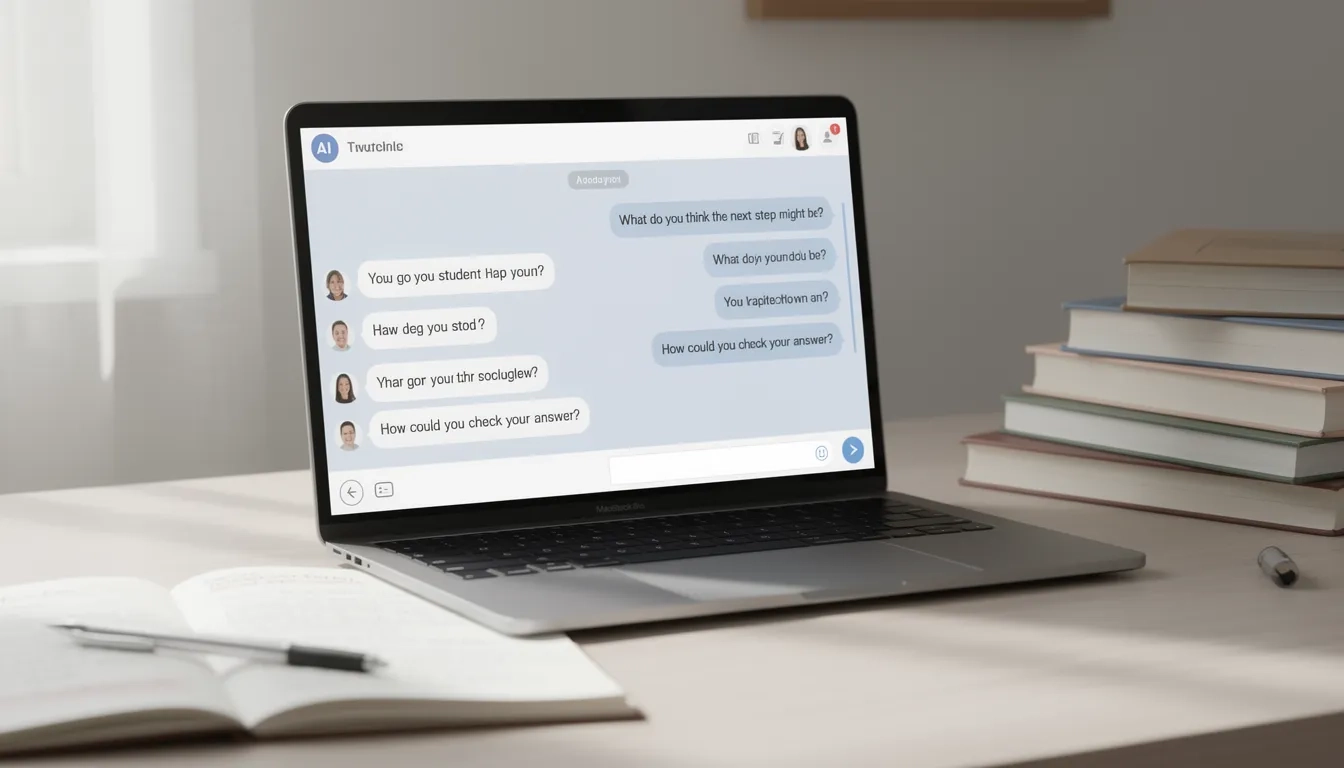
When a family's struggling pre-calculus student switched from a private tutor to an AI tool last fall, his parents expected a stopgap. By January, he'd passed his midterm with a B+. Total spend for the semester: $43.
That would have sounded like tech-bro pitch three years ago. Now we have actual randomized controlled trials from UK classrooms and American middle schools producing real numbers. And the honest picture is neither "AI replaces tutors" nor "AI is just a fancy homework machine." It's messier and more interesting than either camp admits.
What AI Tutors Actually Do
First, a misconception worth clearing up: most serious AI tutoring platforms aren't ChatGPT-with-a-textbook-prompt. The better ones use a Socratic approach. Instead of giving answers, they ask guiding questions.
Khan Academy's Khanmigo is designed to never solve a problem directly for a student. Ask it to complete a quadratic equation and it responds: "What do you notice about the coefficient here?" Then it waits. Google's LearnLM, Synthesis Tutor, and Duolingo Max operate on similar principles.
This isn't just philosophical. When students receive answers without working through problems themselves, retention drops sharply. The productive struggle — even when facilitated by software — builds durable learning that passive review doesn't achieve.
The access angle gets underplayed in most coverage. A student panicking at 10:47 PM before a chemistry exam has almost no human options. An AI tutor doesn't have a schedule, a cancellation policy, or a $120/hour minimum. Khanmigo grew from roughly 68,000 users in the 2023–24 pilot to over 700,000 in 2024–25, and that growth wasn't driven by marketing spend. It was driven by families who needed something that existed at 11 PM on a Tuesday.
AI tutors work best on structured subjects: math, coding, grammar, science vocabulary — places where correct answers are verifiable. When the subject requires judgment (literary analysis, college essays, spoken language), things get fuzzier quickly.
What Controlled Trials Found
The best evidence we have comes from two recent randomized controlled trials.
A 2024 study (published and widely covered through 2025) tested Google's LearnLM directly against human tutors with 165 UK secondary school students, aged 13–15, across five schools. Students were randomly assigned to receive static hints, human tutoring, or supervised LearnLM sessions. Results:
- Static hints: 65.4% solved problems on second attempt
- Human tutors: 91.2% success
- LearnLM: 93.0% success
The more telling number is knowledge transfer — correctly solving novel problems the students hadn't seen before. LearnLM students scored 66.2% versus 60.7% for human-tutored peers. The AI increased the probability of solving a brand-new problem correctly by 5.5 percentage points. That gap matters because knowledge transfer is the actual goal of tutoring, not just getting through tonight's worksheet.
The AI didn't just match human tutors in this trial. For knowledge transfer, it edged ahead.
Safety held up too. Supervising tutors reviewed every message LearnLM generated and approved 74.4% without edits. Across 3,617 total messages, reviewers found zero harmful content and only five factual errors — an error rate of 0.1%.
A separate study from Stanford and the National Bureau of Economic Research on Khanmigo's math tutoring found a 0.2 standard deviation improvement in learning outcomes. In education research, that's meaningful — roughly equivalent to shrinking class size by several students or adding four weeks of instruction.
One critical detail: the UK trial worked specifically because human tutors supervised the AI sessions. That's not a footnote; it's load-bearing.
Where Human Tutors Still Win
Before anyone cancels their tutoring contracts, the data has real caveats. And not small ones.
Emotional attunement is the clearest gap. When a 13-year-old breaks down because fractions make no sense to her, an effective tutor sets the worksheet down and figures out what's actually happening. Maybe she missed a week of school. Maybe there's test anxiety. Maybe something is wrong at home. An AI can detect frustration in short, hedging text responses. It cannot see wet eyes.
The UK trial confirmed this numerically: 19.5% of human tutor edits to LearnLM's responses addressed social-emotional nuance — situations where the AI's technically correct response was tonally wrong. It had the math right but missed the moment.
Motivation decay is another documented problem. Chatbot research consistently shows novelty drives early engagement, then fades. A student energized by Khanmigo in September may be phoning it in by February. Human tutors notice this and change approach — different problem formats, a different explanation, or simply acknowledging that calculus is genuinely hard and everyone struggles with it.
Complex cross-disciplinary diagnosis is the third gap. An AI can tutor photosynthesis well. It's harder for it to notice that a student's persistent confusion about plant biology actually stems from a weak chemistry foundation from two years earlier — and then restructure the curriculum on the fly to fix that gap. Experienced human tutors do this constantly, often without consciously articulating what they're doing.
High-stakes situations tilt strongly toward humans. College application essays, IB oral exams, competitive math olympiad prep, college interview practice — the judgment calls required are not reliably within AI's current capabilities.
The Cost Gap No One Wants to Talk About
Private tutoring is expensive in a way that excludes most families from the conversation entirely.
Private math tutoring in U.S. cities averages $70–$120 per hour. Test prep specialists in New York and San Francisco routinely charge $150–$200 per session. A student who meets with a tutor twice weekly from September through May will spend somewhere between $2,500 and $8,000. That's not a typo — it's the cost of a used car.
AI tutoring platforms mostly run $10–$50 per month. Khanmigo is $4/month for students.
The phys.org study that tracked 350+ seventh-graders: 88% came from socioeconomically disadvantaged families. For most of them, consistent private human tutoring wasn't an alternative that got rejected — it was never an option at all. AI tutoring, in that context, isn't a downgrade. It's a replacement for nothing.
| Option | Approx. Monthly Cost | Availability | Strongest Use Case |
|---|---|---|---|
| AI tutor (Khanmigo, LearnLM) | $4–$50 | 24/7, on-demand | Practice, homework, concept review |
| Group human tutoring | $100–$300 | Scheduled sessions | Structured test prep |
| Private human tutor | $280–$2,000+ | Scheduled sessions | High-stakes, complex subjects |
| Hybrid (AI daily + weekly human) | $150–$600 | Flexible | Best overall outcomes |
The relevant comparison isn't "which performs better in a controlled trial." It's "which actually exists as an option for this student."
The Hybrid Model Is the Honest Answer
The clearest finding from recent research: neither tool alone is the ceiling.
A phys.org study followed over 350 seventh-graders for a full school year. Students in a human-AI hybrid program outperformed AI-only peers by 0.36 grade levels by year's end. The advantage scaled with time-on-task — the more students engaged, the bigger the gap grew. That's a real academic difference, not a rounding error.
The practical version of this model:
- Student uses AI daily for 30–45 minutes — homework help, concept practice, problem sets
- Once per week, a human tutor reviews AI-flagged weak areas, handles motivation, and checks in emotionally
- AI generates data. Human interprets it.
This approach cuts human tutoring costs by roughly 75% compared to fully private sessions, while producing outcomes better than either approach alone. Consistency (which AI handles well) combined with mentorship (which machines cannot replicate) turns out to be a genuine formula, not a compromise.
The UK trial surfaced an unexpected side finding: three of the five supervising tutors reported professional growth from reviewing LearnLM's Socratic dialogue. They started incorporating the AI's question-asking patterns into their own tutoring practice. The learning went both directions.
The honest barrier to this model is coordination, not technology. A family with two working parents and three kids doesn't easily set up daily AI sessions plus weekly video calls with a tutor. For many students globally, AI-only is the realistic option — and for that use case, the evidence is increasingly encouraging.
How to Actually Choose
Here's a decision framework built from the actual research rather than marketing copy:
Start with AI if:
- The subject has verifiable correct answers — math, coding, grammar, science vocabulary
- The student is self-motivated or responds well to game-like progress feedback
- Budget is a binding constraint
- The primary need is practice volume, not conceptual breakthrough
Prioritize a human tutor if:
- The subject requires nuanced, evaluative feedback: writing, foreign language speaking, debate
- The student has learning differences (ADHD, dyslexia) that require real-time behavioral adaptation
- A high-stakes outcome is approaching: SAT, IB exams, college applications
- The student is struggling emotionally or motivationally, not just academically
Use the hybrid if:
- The student has plateaued with AI but the family can't sustain full private tutoring
- Accountability matters as much as content knowledge
- The subject combines structured skills with applied reasoning (AP science courses, for example)
My take, stated plainly: for most K-12 students on standard subjects, start with a quality AI tutor. Give it four to six consistent weeks. If learning stalls or motivation drops, add a human tutor for targeted sessions — now equipped with real data about exactly where the gaps are. You'll spend less money and walk in with better diagnostic information than most first sessions produce anyway.
The worst outcome is paying $120 per hour for a human tutor who spends the first several sessions figuring out where the student actually is. AI tutoring skips that phase entirely. Use that information.
Bottom Line
- For structured subjects and budget-constrained families, AI tutors now perform comparably to human tutors on the metrics that matter — and recent RCTs suggest they edge ahead on knowledge transfer specifically.
- For high-stakes situations, emotionally struggling students, or subjects requiring judgment, human tutors hold a meaningful edge that isn't close to disappearing.
- The strongest evidence favors a hybrid approach: AI for daily practice volume, human for weekly guidance and motivation. The phys.org study puts the additional gain at 0.36 grade levels over AI alone across a school year.
- Start with AI. Add human support when you hit its limits. That sequencing wastes less money and produces better outcomes than guessing upfront.
Frequently Asked Questions
Is AI tutoring actually safe for children?
The 2024–25 UK classroom trial reviewed 3,617 AI-generated tutoring messages from sessions with students aged 13–15 and found zero harmful content and only five factual errors across the entire dataset. Supervised deployment — with a responsible adult periodically reviewing sessions — appears to be a reliable safety framework.
Can AI tutors handle all subjects, or mainly STEM?
AI tutors perform most reliably on structured subjects with verifiable answers: math, coding, grammar, and science facts. For writing, foreign language speaking, and subjects requiring nuanced evaluation, performance is more uneven. Khanmigo has expanded into essay feedback, but most practitioners treat those features as still developing rather than production-ready.
Isn't AI tutoring just for struggling students?
This is a common misconception. Advanced students often benefit significantly because AI tools let them move faster than a classroom allows — exploring adjacent concepts, going deeper, working ahead without waiting for the rest of a class to catch up. The 0.2 standard deviation gain from the Khanmigo study wasn't confined to low-achieving students.
How can I tell if an AI tutor is actually teaching rather than just handing over answers?
Look for tools built around Socratic methods — they should ask guiding questions, not produce completed solutions. Khanmigo's design principle is explicit: it never solves problems directly. If an AI tool consistently generates complete answers immediately, it's a homework-completion tool disguised as a tutor. Entirely different product, entirely different outcome.
What should I actually look for when hiring a human tutor alongside AI?
Focus on tutors skilled at motivation, emotional reading, and cross-topic diagnosis — precisely the gaps AI leaves open. A strong human tutor in a hybrid setup doesn't need to re-explain every concept; they need to identify why a student is stuck, keep engagement alive, and adapt on the fly. That's a different skill profile from a pure subject-matter expert.
Is a $4/month AI tutor really comparable to a $120/hour human tutor?
On narrow metrics like second-attempt problem-solving rates and knowledge transfer, recent RCTs say yes — sometimes ahead. But the comparison omits context: high-stakes subjects, sustained motivation, emotional support, and complex cross-disciplinary reasoning all favor humans. The $4/month option is genuinely remarkable for what it does well. It doesn't do everything a great tutor does. Those two things can both be true.
Sources
- AI tutoring can safely and effectively support students: An exploratory RCT in UK classrooms
- Adding human guidance to AI tutors enhances benefits for students, study finds
- AI tutoring outperforms in-class active learning: an RCT in an authentic educational setting
- Khanmigo: Khan Academy's GPT-4 AI Tutor Scaling Education
- Personalized Learning in an AI Era: Why Human Support Drives Better Results