Air Force Academy: Programs, Rankings, and What Cadet Life Is Actually Like
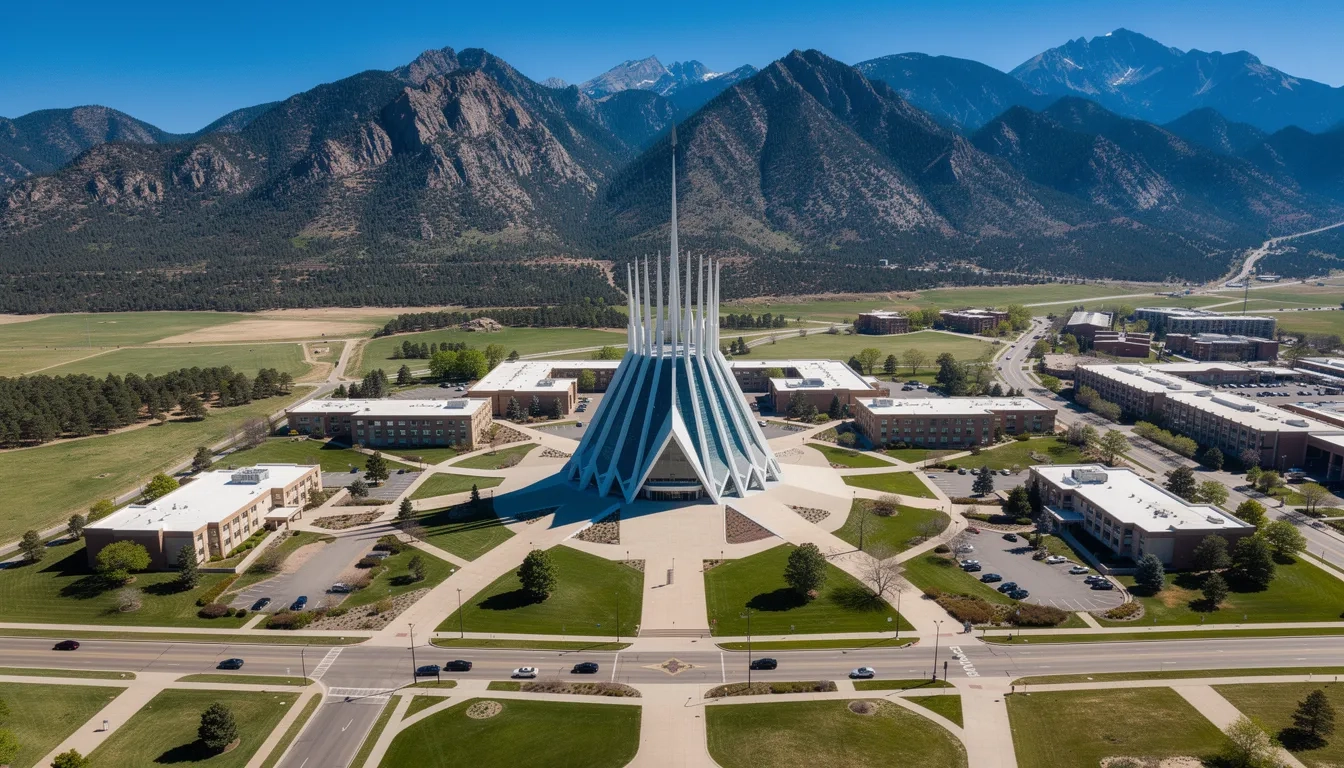
Every year, around 9,000 students compete for roughly 1,100 spots at the United States Air Force Academy in Colorado Springs. The acceptance rate hovers between 10–19%. But statistics like that obscure the real story — because USAFA isn't competing with Harvard or MIT for the same applicants. It's offering something no civilian university can match: a fully funded four-year education, a monthly stipend, and a guaranteed commission as an officer in the Air Force or Space Force. The trade-off is real and we'll get to it. First, let's talk about what you're actually getting.
What Sets USAFA Apart From Any Civilian University
The obvious answer is the military component. The less obvious answer is that USAFA is simultaneously a top-5 national liberal arts college AND one of the strongest undergraduate engineering programs in the country. Those two things rarely go together.
U.S. News & World Report's 2026 rankings placed the Academy #5 among National Liberal Arts Colleges — up from #8 in 2025, #18 in 2022, and a remarkable climb from #39 back in 2020. That six-year rise isn't a statistical quirk. It reflects genuine changes in faculty quality, class sizes, and graduation outcomes.
The student-faculty ratio is 8:1. About 60% of classes have fewer than 20 students. Most large research universities run ratios around 15:1 or 18:1, with introductory courses that pack 300 students into tiered lecture halls. USAFA doesn't have lecture halls like that. It has small seminars where a cadet actually has to show up prepared — and where the professor knows your name by week two.
One thing most applicants get wrong: cadets receive a Bachelor of Science degree regardless of their chosen major. Even history and political science majors complete a mandatory technical core in sciences and engineering. That's not a footnote — it shapes the entire academic identity of every graduate.
Academic Programs: What You Can Actually Study
The core curriculum accounts for roughly 60% of a cadet's coursework. The remaining 40% goes toward a declared major. USAFA offers 32 academic majors across four divisions: engineering, basic sciences, social sciences, and humanities.
Most popular majors at USAFA:
- Aerospace Engineering
- Systems Engineering
- Computer Science
- Management
- Political Science
- Biology and Biomedical Sciences
Engineering is the crown jewel. According to the Academy's 2026 U.S. News results, USAFA's engineering programs rank #7 nationally among schools that don't offer doctoral degrees. Aerospace Engineering came in at #5. Civil, electrical, and mechanical engineering each landed at #6. These aren't flukes — the rankings have held at this level for several consecutive years.
Beyond coursework, cadets participate in federally funded research programs that collectively exceed $60 million annually. The Institute for Information Technology Applications, the Eisenhower Center for Space and Defense Studies, and the Air Force Humanities Institute all accept cadet researchers alongside active-duty officers and civilian faculty. Most undergraduates don't access real research until graduate school. At USAFA, it's built into the experience.
The cyber program deserves specific attention. USAFA's competition team won the 2019 NSA Cyber Exercise and the Atlantic Council's Cyber 9/12 Strategy Challenge — the same year. The Class of 1968 established a dedicated $500,000+ endowment to fund the team's ongoing operations. That kind of alumni investment signals how seriously the institution takes this field, not just as a competition club but as a pipeline for future cyber officers.
Rankings: The 2026 Numbers in Context
| Ranking Category | USAFA Position | Change vs. 2025 |
|---|---|---|
| National Liberal Arts Colleges | #5 | Up from #8 |
| Top Public Schools | #2 | Stable |
| Undergraduate Engineering (no PhD) | #7 | Stable |
| Aerospace Engineering | #5 | Stable |
| Civil Engineering | #6 | Stable |
| Electrical Engineering | #6 | Up 3 spots |
| Mechanical Engineering | #6 | Stable |
The overall U.S. News score of 94 out of 100 reflects three primary factors: peer reputation among university presidents, graduation and retention rates, and student-faculty ratio. USAFA excels on all three.
The 92% four-year graduation rate is worth pausing on. At most selective universities, that number would be impressive. At USAFA, it means 92% of cadets who survived six weeks of Basic Cadet Training, the honor code, mandatory physical conditioning, and a heavily prescribed core curriculum crossed the finish line in exactly four years. That speaks to both the selection process and the institutional support system.
Admissions: The Part Most Guides Gloss Over
Getting into USAFA is not just a matter of test scores. There is a step most civilian college prep resources miss entirely: the Congressional nomination requirement.
Every applicant needs a nomination from a U.S. Senator, House Representative, or the Vice President. Each congressional district can have roughly five cadets enrolled at any given time. A student with a 1500 SAT and varsity team captain credentials can still be shut out if their district is at capacity or if they don't secure a nomination through the competitive local process.
The nomination process, in order:
- Identify your U.S. senators and House representative
- Submit separate applications to each congressional office (timelines vary by office — some open in spring of junior year)
- Compete for the nomination through interviews and written materials
- Receive either "principal" or "qualified alternate" status
- Wait for the Academy to match nominations with admissions decisions
The medical and physical requirements add another layer. The Candidate Fitness Assessment includes six events: basketball throw, pull-ups, shuttle run, sit-ups, push-ups, and a one-mile run. Admitted classes average competitive scores across all six. A candidate who's running a sub-7:30 mile should start a dedicated training program well before junior year — the spring of sophomore year isn't too early.
Academically, the Academy looks for class ranks in the top 15% and SAT/ACT scores in the 1250–1450 range. But USAFA actively weights demonstrated leadership — student government, team captains, Eagle Scout rank (a surprisingly common credential among admitted cadets), and community organizers. They are genuinely less interested in passive academic achievement than in evidence you've led people through something hard.
Cadet Life: From Doolie to Firstie
The four years at USAFA follow a clear progression. Freshmen are called "doolies" (from the Greek "doulos," meaning servant) — and that label reflects their actual position in the hierarchy. Seniors are "firsties." Those aren't just nicknames. They describe genuinely different experiences of the same institution as cadets earn increasing autonomy over four years.
It all starts with Basic Cadet Training, or BCT. Six weeks in the Colorado summer. First phase covers military fundamentals on campus: drill, customs and courtesies, physical conditioning, and the psychological adjustment of going from a high-achieving high schooler to the bottom of a demanding hierarchy. That adjustment is the point.
"Second Beast" sends cadets to Jacks Valley, five miles north of the main campus. They march in, erect a tent city, and live there for 18 days while conducting field training in land navigation, weapons handling, survival skills, and small-unit tactics.
The academic year runs on a structured daily schedule. Reveille around 0600. Morning formation. Classes through midday. Mandatory athletic time — either varsity practice or intramurals — in the afternoon. Mandatory study hours in the evening. Lights out between 2300 and 2400. Every cadet, every day, operating on essentially the same cadence.
The Honor Code is the culture's foundation. Adopted by the first graduating class in 1959, it reads simply: "We will not lie, steal, or cheat, nor tolerate among us anyone who does." Violations carry a presumption of disenrollment. There's no grade forgiveness policy, no "everyone bends the rules" culture. The code is enforced by cadets themselves through an honor board process — which is both its greatest strength and the source of most institutional controversy when edge cases arise.
The service commitment becomes formal on the first day of junior (second-class) year. Cadets commit to eight years: five years of active duty followed by three years in the reserves. This isn't buried in an enrollment agreement. It's a ceremony. And it's binding.
Athletics, Clubs, and Life Outside Training
USAFA fields 27 varsity sports teams in NCAA Division I — 17 men's and 10 women's. The Falcons compete primarily in the Mountain West Conference, with select programs in the Big 12, Atlantic Hockey, and West Coast Conference. Football at Falcon Stadium is a major campus event (the stadium also hosts graduation ceremonies, which tells you something about its cultural centrality).
Every cadet not participating in a varsity sport is required to compete in intramurals. This is not optional. The goal isn't just fitness — it's squadron cohesion. Cadets live, eat, study, and compete in sports as part of a squadron of roughly 110 people. That structure creates tight social bonds that most civilian college experiences don't replicate.
Notable extracurricular programs:
- Wings of Blue (the sport parachuting demonstration team)
- Cyber competition team (nationally ranked, endowment-backed)
- Powered and unpowered flight through the Academy airmanship programs
- Cadet Glee Club, drama ensembles, instrumental groups
- Clubs spanning mountaineering, Model UN, astronomy, and military history
The glider and powered flight programs are genuinely unusual for an undergraduate institution. Cadets can begin learning to fly while simultaneously taking Calculus III and attending 0600 formation. That combination is either the experience of a lifetime or too much to manage — and figuring out which category you fall into before you arrive is worth doing honestly.
About 10% of graduating cadets now commission into the U.S. Space Force (Space Delta 13 Detachment 1 activated on campus in November 2021). This opens pathways in satellite operations, orbital mechanics, and space systems that previous generations of Academy graduates simply didn't have available.
Bottom Line
USAFA is the right choice for people who want a legitimately rigorous education, a clear career path, and a community structure unlike anything a civilian university offers. But it asks something real in return — eight years of your post-graduation life, starting with five on active duty.
- Start the Congressional nomination process early. Some offices open applications in spring of your junior year of high school. Waiting until fall of senior year puts you behind.
- Build the technical baseline before you arrive. The mandatory science and engineering core surprises cadets who excelled in humanities-heavy high schools. Taking calculus and physics seriously in high school is not optional prep.
- Think carefully about the 8-year commitment before framing this as "free college." The value is real. So is the obligation.
My honest read: USAFA's climb from #39 to #5 in national liberal arts college rankings over six years reflects genuine institutional quality. If you want to fly, lead, work in cyber or space systems, or serve in the military — and you want a first-rate education underneath all of it — this institution has earned its reputation.
Frequently Asked Questions
Does the Air Force Academy actually cost nothing to attend?
No tuition, room, board, or fees. Cadets receive a monthly stipend (approximately $1,185 in recent years) for personal expenses. In exchange, graduates accept a five-year active duty service commitment upon commissioning as an officer.
Is a Congressional nomination really required, or is it just a formality?
It's genuinely required — not a formality. Each congressional district has a limited number of slots (roughly five cadets enrolled at any time), so competition for nominations is real. Academic excellence alone cannot get you admitted without one. Students with perfect credentials are rejected annually because they failed to secure a nomination first.
What happens if a cadet wants to leave before graduation?
Cadets who leave before completing their sophomore year typically owe no service or financial repayment. After that point, disenrollees may owe repayment of educational costs or a period of enlisted service, depending on the circumstances and how far along they are. The Academy counsels cadets on these specifics before the commitment ceremony at the start of junior year.
Is USAFA a good fit if I'm more interested in cyber or space than flying?
Yes, and this has become more true in recent years. Approximately 10% of graduates now enter the U.S. Space Force. The cyber program competes nationally and has dedicated funding. The Academy increasingly reflects the Air Force's full portfolio — satellite operations, electronic warfare, offensive cyber — not just aircraft. You don't need to want to fly to belong here.
What's "Recognition," and why do cadets talk about it so much?
Recognition is the formal ceremony marking the end of the fourth-class (freshman) year. Doolies who complete the year's training receive the "Prop and Wings" insignia and are accepted as full members of the Cadet Wing. It's the defining milestone of freshman year — after months of operating under strict fourth-class restrictions, Recognition represents a meaningful shift in status and autonomy.
How physically demanding is BCT compared to, say, Army boot camp?
BCT is intense but shorter than enlisted basic training — six weeks versus the Army's ten. The physical conditioning standard is high, but the program's goal is orientation, not breaking cadets down. That said, cadets who arrive without a baseline of cardiovascular fitness and upper-body strength consistently report BCT as their biggest shock. Running a 7:00 mile and completing 50 push-ups before arriving is a reasonable floor to aim for.