Amherst College: Programs, Rankings, and What Student Life Is Really Like
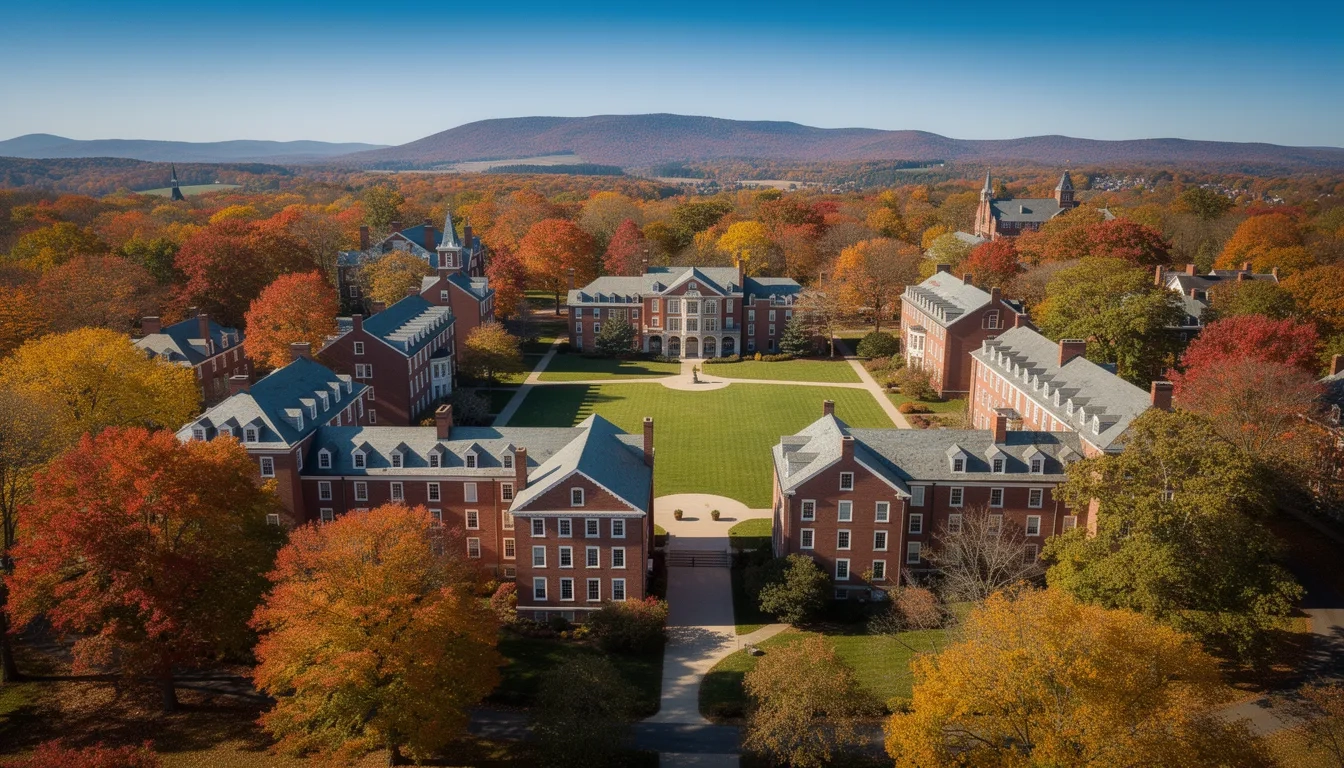
Amherst College enrolls 1,914 undergraduates. That's smaller than many American high schools. And yet it has ranked #1 in national liberal arts colleges ten separate times since US News began its rankings in 1987, produced six Nobel Prize laureates from its alumni, and built a $3.9 billion endowment (as of 2025) that funds financial aid packages with zero expected loan repayment. Small doesn't mean limited here. It means deliberate.
The School That Built Its Reputation by Subtracting
Most selective colleges add prestige over time: famous buildings, marquee research institutes, glossy amenities. Amherst went the other direction. It stripped things out.
No core curriculum. No distribution requirements. No legacy admissions preferences, which the school eliminated in 2021. No loans in financial aid packages, a policy Amherst pioneered before most schools acknowledged the student debt crisis publicly.
The case for subtraction becomes clear when you look at outcomes. The alumni list runs from President Calvin Coolidge to Nobel economist Joseph Stiglitz to Dan Brown (yes, the author of The Da Vinci Code). 11 MacArthur Fellows. More than 20 Rhodes Scholars. A Chief Justice of the Supreme Court. These aren't coincidental outcomes for a school of under 2,000 students — they reflect what happens when you put intellectually serious people in a place that trusts them to run their own education.
When Amherst dropped legacy preferences in 2021, the writing was on the wall for that practice across elite higher education. Amherst just moved first. Applications didn't suffer. Selectivity tightened.
Rankings: What the Numbers Actually Say
US News & World Report places Amherst at #2 among national liberal arts colleges in its 2026 edition, directly behind Williams College. It holds the same spot for Best Undergraduate Teaching. The Wall Street Journal and College Pulse's separate ranking puts Amherst at #8 overall, meaning it competes favorably against research universities with PhD programs, medical schools, and faculties ten times the size.
| Ranking Source | Position | Category |
|---|---|---|
| US News & World Report (2026) | #2 | National Liberal Arts Colleges |
| US News & World Report (2026) | #2 | Best Undergraduate Teaching |
| WSJ / College Pulse | #8 | Overall (all U.S. colleges) |
| Princeton Review | #6 | Best Financial Aid Nationally |
| Historical #1 finishes | 10 times | National Liberal Arts (since 1987) |
The 97% freshman retention rate is the ranking that matters most to me. Students who stay at the school they chose are students who feel genuinely challenged, connected, and supported. At most selective colleges, 5-8% of freshmen transfer or leave. At Amherst, that figure hovers around 3%.
Princeton Review rates professor accessibility at 92 out of 99. That tracks with the 6.6:1 student-to-faculty ratio and the fact that 66.9% of classes have fewer than 20 students. If you've ever been one of 300 students in a lecture watching a TA answer questions about the professor's textbook, you understand why this matters.
The Open Curriculum and How It Actually Works
Amherst's open curriculum is not the "flexible core" that many colleges advertise. It is genuinely open. No required courses beyond a single first-year writing seminar. No distribution mandates. Students choose from 42 majors and design their academic path from there.
The freedom is real — and so is the responsibility. Without external nudges, you have to know (or figure out) what you actually want to study. Students who drift without curiosity can spend two semesters in the intellectual equivalent of a holding pattern. Students who arrive with genuine questions get unusually direct access to pursue them.
The Five College Consortium expands the picture dramatically. Through a free shuttle system and integrated registration, Amherst students can enroll in 6,000 additional courses at Mount Holyoke, Smith, Hampshire College, and the University of Massachusetts Amherst. The consortium shares two joint academic departments — Astronomy and Dance — and connects students to a combined 8 million library volumes. A student who wants advanced coursework in, say, Japanese or structural engineering can often find it across town without paying extra.
Students may also design their own interdisciplinary major. This works best for students with a specific intellectual project in mind, not as a way to avoid committing to a field.
Academic Programs: What Students Actually Study
The most popular majors reflect both intellectual trends and post-graduation realities:
- Econometrics and Quantitative Economics — the most popular track, drawing students who want rigorous analytical training
- Mathematics and Computer Science — strong placements and growing enrollment
- Biology and Biochemistry — active pre-health pipeline with close faculty mentorship
- Neuroscience — Amherst was among the first schools to offer it as an undergraduate major
- English and Political Science — humanities enrollment remains healthy, not gutted like at many peer institutions
- Psychology — consistently well-attended with research opportunities built in
Amherst pioneered undergraduate neuroscience, American Studies, and Law/Jurisprudence as stand-alone fields decades before they became standard offerings. That early investment in interdisciplinary thinking is baked into the curriculum's DNA.
Student Life: 97% On Campus, 220 Organizations
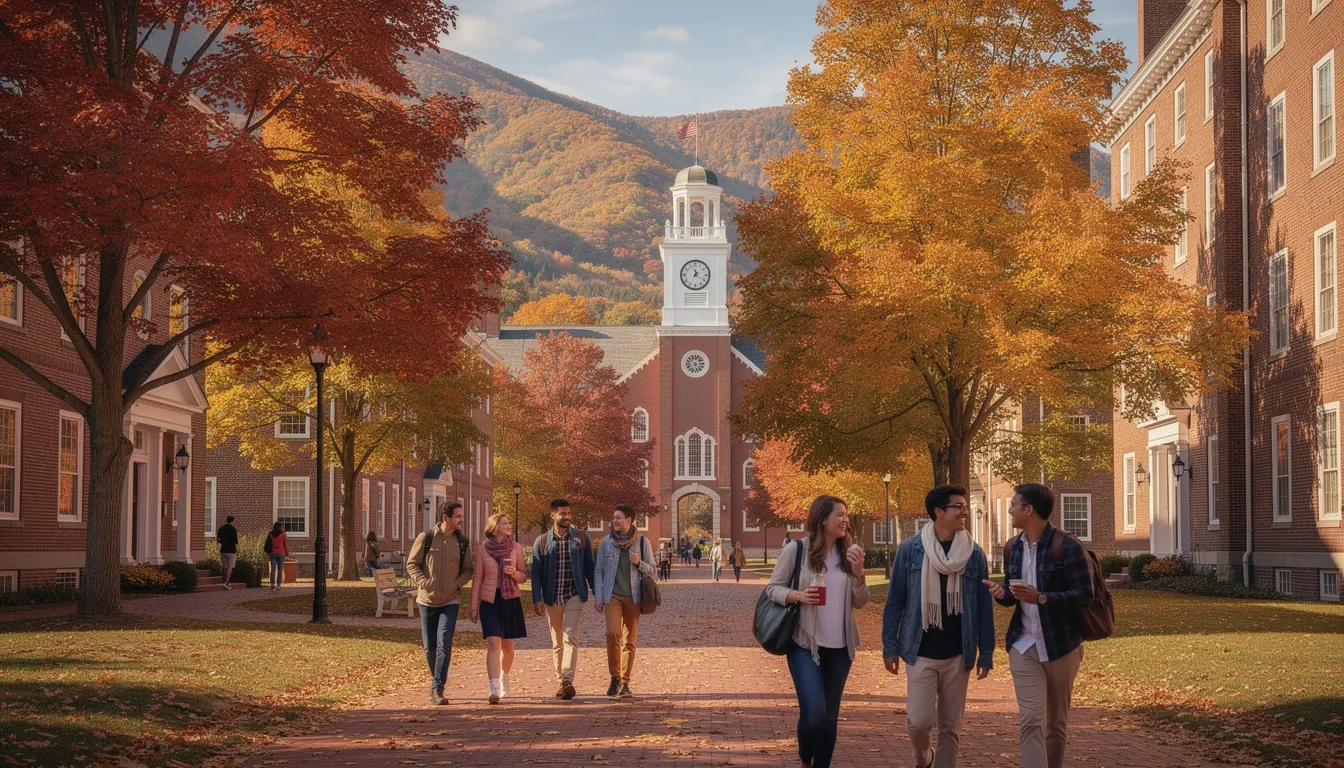
Nearly everyone lives on campus — 97% of the student body, with housing guaranteed for all four years. That single fact changes how community works. When most people go home to the same 1,000-acre campus every night, relationships build faster and run deeper than at schools where a large portion of students commute or live scattered across a city.
The 220+ registered student organizations span an enormous range. WAMH, the student-run radio station inside Keefe Campus Center, has been producing original programming for years. The Powerhouse, a former steam plant converted into a performance and events venue, hosts live music, film screenings, art shows, and pub nights. These aren't token amenities — they're spaces students built and actually use.
The student body draws from a wide geographic and international pool: about 85% of students come from outside Massachusetts, with 75 countries represented. On a campus of under 2,000, that creates a genuinely mixed community in ways that don't happen naturally at large flagship universities.
Athletics run at the Division III level, which means competitive sports without the scholarship machinery and sometimes perverse incentives of Division I programs. A notable share of Amherst students play varsity sports. The culture supports athletic involvement without making it a separate caste.
"Students describe their peers as academically and intellectually engaged individuals who collaborate because they know it's the best way to learn." — Princeton Review student surveys, 2025
The school's mammoth mascot, officially adopted in 2017 to replace the older "Lord Jeff" symbol (which honored a British general linked to documented biological warfare against Indigenous people), reflects an institutional capacity to examine uncomfortable history without defensiveness. Not every school handles that kind of reckoning gracefully.
Financial Aid: No Loans, No Legacy, No Kidding
The sticker price for 2025-26 runs to $90,670 per year, covering tuition, room, board, and fees. That number stops most families cold before they even open an application.
Stop.
The average need-based grant for first-year students reached $68,154 in 2025. For students who qualify for need-based aid, the average net cost drops to $19,328 per year — less than in-state tuition at many public universities. And Amherst's aid packages carry no loan expectation whatsoever. Every dollar of aid is a grant or work-study. No debt accumulates.
The school met 100% of demonstrated financial need for every admitted student. It can do this because a $3.9 billion endowment generates the returns to back the promise. This is not a marketing slogan. It's a structural commitment.
A few practical notes for families:
- Run Amherst's Net Price Calculator before deciding not to apply. The gap between sticker price and actual cost for middle-income families is often more than $40,000 per year.
- QuestBridge scholars can apply at no cost and potentially receive a full, four-year scholarship. Amherst is an active partner in the program.
- Financial aid packages can be appealed if family circumstances have changed meaningfully since the most recent tax filing.
Because Amherst eliminated legacy preferences entirely, family connections to alumni carry zero admissions weight. The financial playing field isn't perfectly level across American higher education, but Amherst has removed at least one thumb from the scale.
Getting In: What the Numbers Show
The acceptance rate sits at approximately 9%. Middle 50% SAT scores run 1470-1540; ACT scores run 33-35. Both are in the range of Dartmouth and Brown, schools with significantly larger name recognition and research profiles.
Amherst is test-optional and superscores both tests. Strong scores likely help at this level of selectivity, but the committee reads applications holistically with genuine attention to fit.
What matters beyond grades and scores:
- Rigorous courses relative to what your high school offers, not just strong grades in easier ones
- Evidence that you pursue ideas outside of class requirements
- Essays that engage specifically with Amherst's open curriculum model, not generic liberal arts enthusiasm
- Recommendations that address intellectual capacity, not just character or likability
One honest note: the open curriculum rewards self-direction. If you need external structure to stay engaged, the freedom here can become a liability rather than an asset. The strongest applicants can point to something they've pursued with sustained independent interest, whether academic, creative, or otherwise.
Bottom Line
- Amherst's open curriculum is genuinely rare. Few schools of this caliber let you build your own path from 42 majors plus 6,000 Five College courses, with no requirements standing between you and what you want to study.
- The financial aid is among the strongest in the country. Families earning under $75,000 annually typically pay less than they would at an in-state public university. Use the Net Price Calculator before assuming you can't afford it.
- The size is a feature. A 6.6:1 student-to-faculty ratio, 97% freshman retention, and professors who know your name by October are things large universities spend millions trying to simulate and rarely achieve.
- If you're a self-directed learner who wants small classes, real intellectual community, and a school willing to trust you with your own education, Amherst belongs at the top of your list.
Frequently Asked Questions
Is Amherst College hard to get into?
Yes — the acceptance rate is approximately 9%, with middle 50% SAT scores of 1470-1540 and ACT scores of 33-35. Amherst is test-optional and superscores both tests. Intellectual curiosity, rigorous course selection, and essays that reflect genuine engagement with the school's open curriculum tend to characterize admitted students.
How does Amherst's open curriculum actually work in practice?
There are no distribution requirements and no general education mandates beyond a single first-year writing seminar. Students choose from 42 majors and can cross-register for 6,000 additional courses through the Five College Consortium at no extra cost. Students may also design their own interdisciplinary major if they have a clear intellectual project.
Is Amherst affordable if your family isn't wealthy?
More affordable than the sticker price suggests. The school meets 100% of demonstrated financial need and provides no-loan aid packages. The average need-based grant for first-year students was $68,154 in 2025, reducing the average annual net cost to $19,328 for students receiving aid. QuestBridge scholars can potentially attend on a full scholarship.
What is the Five College Consortium, and does it actually add value?
It's a formal academic and social partnership among Amherst, Smith, Mount Holyoke, Hampshire College, and UMass Amherst. Students can take any of the 6,000 combined consortium courses at no additional charge and ride a free shuttle between campuses. The arrangement genuinely expands what a small school can offer, including shared academic departments in Astronomy and Dance and access to 8 million combined library volumes.
Did Amherst really eliminate legacy admissions?
Yes. Amherst removed legacy preferences in 2021, making it one of the first highly selective colleges to do so. Familial connections to alumni carry no weight in the current admissions process.
What is Amherst's social life like for students who aren't heavily into athletics?
With 220+ registered student organizations and 97% of students living on campus all four years, social life centers on the campus itself. The Powerhouse venue and Keefe Campus Center host a wide mix of events from radio broadcasting to live performances to film screenings. Some students note that athletic groups form a visible social cluster, but the breadth of organizations generally supports communities built around other interests as well.