Auburn University: Admissions, Rankings, and Student Life
Here's a number that surprises people: Auburn received 55,056 applications for its Class of 2028, admitted 25,284 students, and ultimately enrolled just 6,103. That's a 24% yield — roughly three out of four admitted students chose to go elsewhere. For Auburn, that's not a problem. It's just the reality of a school that draws genuine national interest but sits in a small Alabama city with a very specific culture. You either connect with it or you don't, and the data reflects that.
Who Gets Into Auburn — and What the Numbers Actually Mean
Auburn's acceptance rate sits at approximately 46%, which makes it moderately selective. That number confuses a lot of people. A 46% acceptance rate sounds easy compared to elite schools, but don't mistake "not Harvard" for "not competitive." The admitted pool has a weighted average GPA of 4.09, a 50th-percentile SAT of 1320, and a 50th-percentile ACT of 29.
What that GPA tells you is that most admitted students graduated near the top of their high school class, usually in AP or IB coursework. A 3.7 unweighted GPA in a genuinely rigorous schedule can get you in the door. A 3.4 with minimal challenging coursework probably won't, regardless of the acceptance rate headline.
Key admission stats to know:
- Weighted GPA (admitted average): 4.09
- SAT middle 50%: approximately 1200–1430
- ACT middle 50%: 26–32
- Total applicants (Class of 2028): 55,056
- Enrolled: 6,103
Auburn's test-optional policy — which started during COVID and became permanent — means you can apply without scores. But strong numbers still help, especially for merit scholarship consideration. If you're sitting at a 31 ACT, submit it.
Early action is where strategy matters. Auburn offers a non-binding EA option (typically mid-October deadline) that unlocks priority scholarship review. Students who apply early action get decisions faster and get first access to merit aid before the regular pool competes for the same dollars. If Auburn is anywhere on your college list, applying EA is the obvious call.
Where Auburn Actually Ranks — and Which Numbers to Trust
U.S. News & World Report's 2026 rankings place Auburn at No. 49 among public universities and No. 102 nationally. That's a solid position that puts Auburn comfortably ahead of many schools with larger reputations outside the South.
The rankings worth paying attention to, though, are the program-specific ones. Auburn has genuine pockets of national excellence that don't show up in the headline number:
| Program | Public Ranking | National Ranking |
|---|---|---|
| First-Year Experience | No. 7 | No. 39 |
| Supply Chain Management | No. 15 | No. 17 |
| Accounting | No. 18 | No. 40 |
| Nursing | No. 25 | No. 40 |
| Undergraduate Business | No. 31 | No. 51 |
| Undergraduate Engineering | No. 33 | No. 57 |
| Undergraduate Computer Science | No. 46 | No. 78 |
That supply chain ranking (No. 17 nationally) is the one I'd flag for serious attention. Auburn's Harbert College of Business built that program through deep partnerships with logistics, manufacturing, and aerospace companies clustered throughout the Southeast. If supply chain or operations management is your direction, Auburn isn't a fallback option — it's a destination school.
The 95% first-year retention rate tells a less obvious story. Most students who start at Auburn come back for sophomore year. That matters because retention is a proxy for campus satisfaction — students who don't feel at home leave. High retention at a large public school usually means the day-to-day experience actually delivers.
Auburn's six-year graduation rate sits at 82%, which is solid but not exceptional. UVA and Michigan hover around 93–94%. Worth building into your four-year plan.
The Real Cost of an Auburn Education
In-state students pay $13,318 in tuition and fees per year. Out-of-state: $36,022. Add room and board at an average of $14,998 for the 2024–2025 academic year, and you're looking at roughly $28,316 all-in for Alabama residents, and about $51,020 for students coming from out of state — before any scholarships.
Those are ceiling prices. The real calculation looks different.
Only 29% of first-year students receive need-based financial aid, which is low compared to many public flagships. Auburn leans more heavily on merit scholarships than need-based grants. The average net price for federal loan recipients clocks in at $24,297 per year, landing Auburn in a reasonable range for a research university of this caliber.
For out-of-state applicants, the move is to run Auburn's net price calculator before making any decisions based on the $36,000 sticker price. Strong academic applicants who qualify for the National Scholars Program or similar merit awards can bring their cost close to in-state levels. The gap between posted price and actual cost can easily run $12,000–$15,000 per year for competitive students.
Auburn's merit scholarship tiers are tied directly to the early action deadline. Apply late, and the top scholarship pools may already be allocated.
Campus Life: What Day-to-Day Actually Looks Like
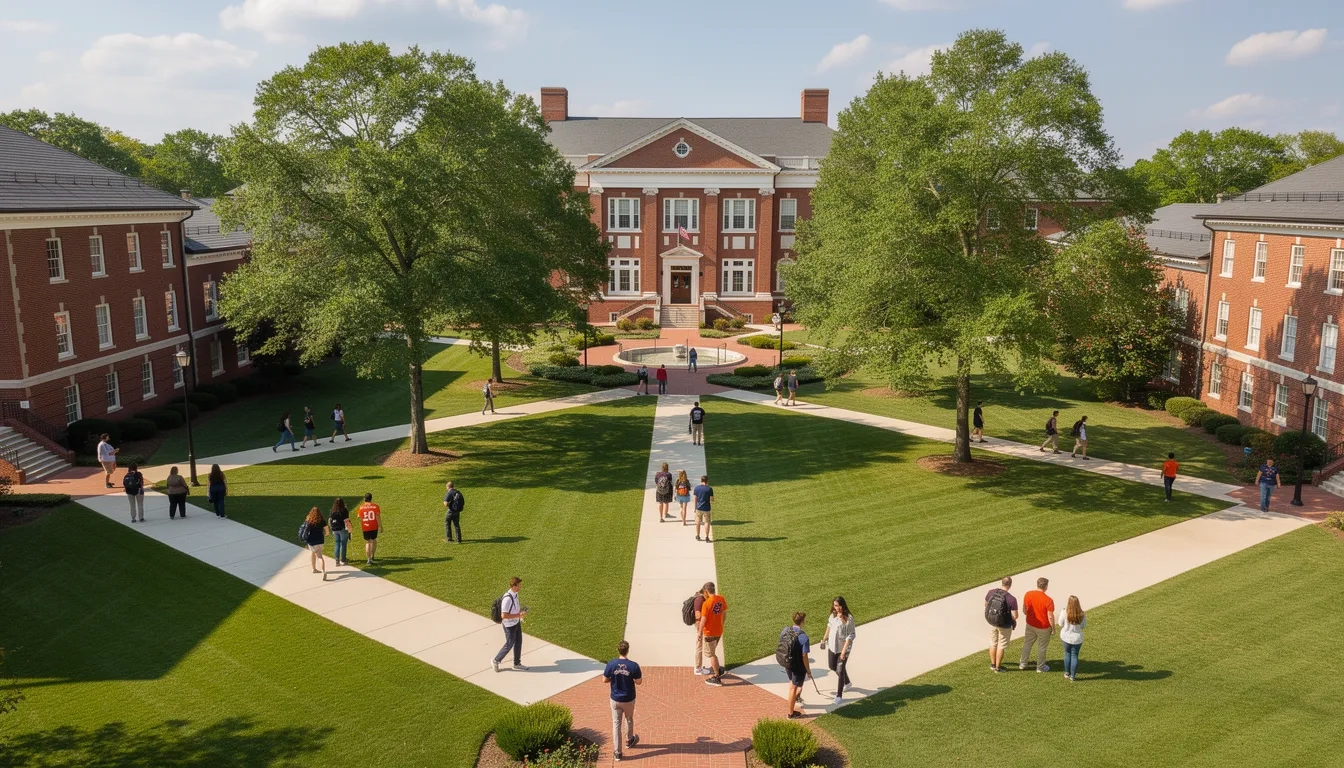
Auburn, Alabama has a population of roughly 76,000 (and about half of those are students or university-connected). The campus is the town. That creates an intensely focused social world — some students thrive in it, others feel it closing in after a year. Worth knowing before you commit.
The university runs 32 residence halls across five housing neighborhoods, all within walking distance of academic buildings. First-year students typically land in the Quad neighborhoods, which keeps the freshman social experience tightly clustered. Housing options range from traditional dorm rooms to suite-style to apartment-style units for upperclassmen.
Tiger Dining runs more than 35 venues across campus, including mobile options, and the system consistently ranks above average for a public university of Auburn's size. Plans announced in late 2025 include expanded food options at The Edge at Central Dining and new student housing construction on East Thach Avenue — the university is putting real money into the physical campus experience.
With over 400 registered student organizations, there's no shortage of ways to get involved:
- Greek life (one of the more active systems in the SEC)
- Intramural and club sports leagues
- Professional societies across every major discipline
- Cultural and service organizations
- A campus recreation facility with a full track, rock climbing towers, and group fitness studios
Greek life is prominent and shapes a visible portion of the social scene, but it's not required to have a full social life. The 400+ other organizations run parallel and are genuinely active.
Auburn Traditions: The Part That Actually Binds People
No honest look at Auburn skips the culture, because the culture is the product. The "Auburn Family" gets mentioned in every admissions brochure, and you'd be forgiven for rolling your eyes at it. But ask someone who went there, and they'll mean it.
War Eagle is Auburn's battle cry — not a mascot, not a team name, a battle cry. The phrase traces back to 1892 and a Civil War veteran's eagle that allegedly soared over the field during Auburn's first football game against Georgia, spurring a comeback victory. Nobody can fully confirm the story. Nobody really wants to. Every home game at Jordan-Hare Stadium (capacity 87,451) begins with a live eagle circling the field before kickoff. It's the kind of thing that reads as corny until you're actually standing in that stadium.
"War Eagle" rings from the Samford Hall clock tower every day at noon — not just game days, not just special occasions. Every single day.
Rolling Toomer's Corner after victories is the other tradition that defines Auburn's win culture. Students and fans flood the intersection of College Street and Magnolia Avenue and throw toilet paper into the oak trees there. The tradition has run since 1971. The original oaks died in 2013 after someone poisoned them (a notoriously dark chapter in college sports rivalry history) and Auburn replanted in 2015. The new trees now carry the tradition forward.
Hey Day, launched in 1947 to help World War II veterans re-integrate into campus life, still runs today. Students and faculty wear name tags and make a point of greeting strangers. Small ritual. Surprisingly effective at making a 30,000-student campus feel much more human.
Is Auburn the Right School for You?
My read: Auburn is a strong school with clear identities, and the students who thrive there typically know what they're coming for.
If you're targeting engineering, supply chain, accounting, nursing, or education, the academic quality matches or beats schools with bigger national names. The campus culture is warm and social in a distinctly Southern way, and football Saturdays are the kind of experience people build entire social lives around for years.
The tradeoffs are real. Auburn is in a small city, which limits the internship ecosystem and off-campus professional opportunities compared to schools in Atlanta, Nashville, or Charlotte. If your career plan involves walking into regional offices of major firms, the location works against you in ways that academic rankings can't fix. If you're heading into manufacturing, logistics, aerospace, or agricultural industries, the Southeast network Auburn has built is genuinely valuable.
The campus is also predominantly white and Southern, which matters differently for different students. Campus climate surveys suggest most students find the environment welcoming, but visiting and seeing it for yourself is more reliable than any survey data.
If your profile sits around a 4.0 and a 28–30 ACT, you're in the competitive range. Apply early action. Run the scholarship numbers. And visit the campus if at all possible — Auburn is one of those schools where you know whether it's right within an hour of being there.
Bottom Line
- Apply early action — Auburn's EA deadline is directly tied to merit scholarship consideration, and the best awards go to early applicants.
- Program-specific rankings matter more than the overall number — No. 17 nationally in supply chain management, No. 40 in nursing, and No. 57 in engineering are serious credentials.
- Don't price yourself out based on sticker cost — out-of-state students with strong academics can close a significant portion of the $36,022 gap through merit awards.
- The campus culture is real, not marketing copy — visit before committing. Auburn's identity is specific, and that specificity is either exactly what you want or exactly what you don't.
Frequently Asked Questions
Is Auburn University hard to get into?
Auburn's acceptance rate of approximately 46% makes it moderately selective, but the admitted pool is academically serious — average weighted GPA of 4.09, ACT middle 50% of 26–32. The percentage sounds accessible, but students without a rigorous high school course load often struggle to compete with the pool that actually applies.
Does Auburn require SAT or ACT scores for admission?
No. Auburn implemented a permanent test-optional policy. You can apply without submitting scores. That said, students with strong test results — particularly ACT 30 or above — may benefit from including them, both for holistic review and for qualifying for certain merit scholarship tiers that use scores as part of their criteria.
What is Auburn strongest academically known for?
The programs with the clearest national standing are supply chain management (No. 17 nationally per U.S. News 2026), accounting (No. 40), nursing (No. 40), and engineering (No. 57). These aren't reputational rankings — they reflect real employer pipelines and industry partnerships, particularly with manufacturing, logistics, aerospace, and healthcare organizations in the Southeast.
What is the War Eagle tradition, and is it really a big deal?
"War Eagle" is Auburn's battle cry, used as a greeting, a cheer, and a marker of school identity across the world. It originated (by legend) at Auburn's first football game in 1892. On game days at Jordan-Hare Stadium, a live eagle soars the field before kickoff — and the phrase plays from the Samford Hall clock tower every day at noon. It sounds like a bit much on paper. In person, it's genuinely the thread that connects the Auburn community.
How does Auburn compare to the University of Alabama for out-of-state students?
Both are solid SEC public universities at similar price points for out-of-state students (Alabama's out-of-state tuition is comparable). Auburn holds an edge in specific programs like supply chain and engineering, while Alabama has a stronger name recognition in finance and law. The real differentiator is culture — the two schools have deeply distinct campus personalities, and visiting both before deciding is worth the trip.
How prominent is Greek life at Auburn, and is it necessary to participate?
Auburn has one of the more active Greek systems in the SEC, and it's socially visible on campus. Rushing is common among incoming freshmen. But Auburn's 400+ other student organizations mean there's a clear social path outside Greek life — intramural leagues, professional organizations, cultural groups, and service clubs all have strong memberships. Greek life is the prominent track, not the only track.
Sources
- Auburn University continues national recognition in the 2026 U.S. News and World Report
- Auburn University Acceptance Rate, Ranking, & Tuition (2025) - College Transitions
- Spirit and Traditions | Auburn University
- Campus Services | Office of Undergraduate Admissions 2025
- New dining options, housing upgrades coming for Auburn students
- Auburn University Campus Life Statistics