Berklee College of Music: Programs, Rankings, and Student Life
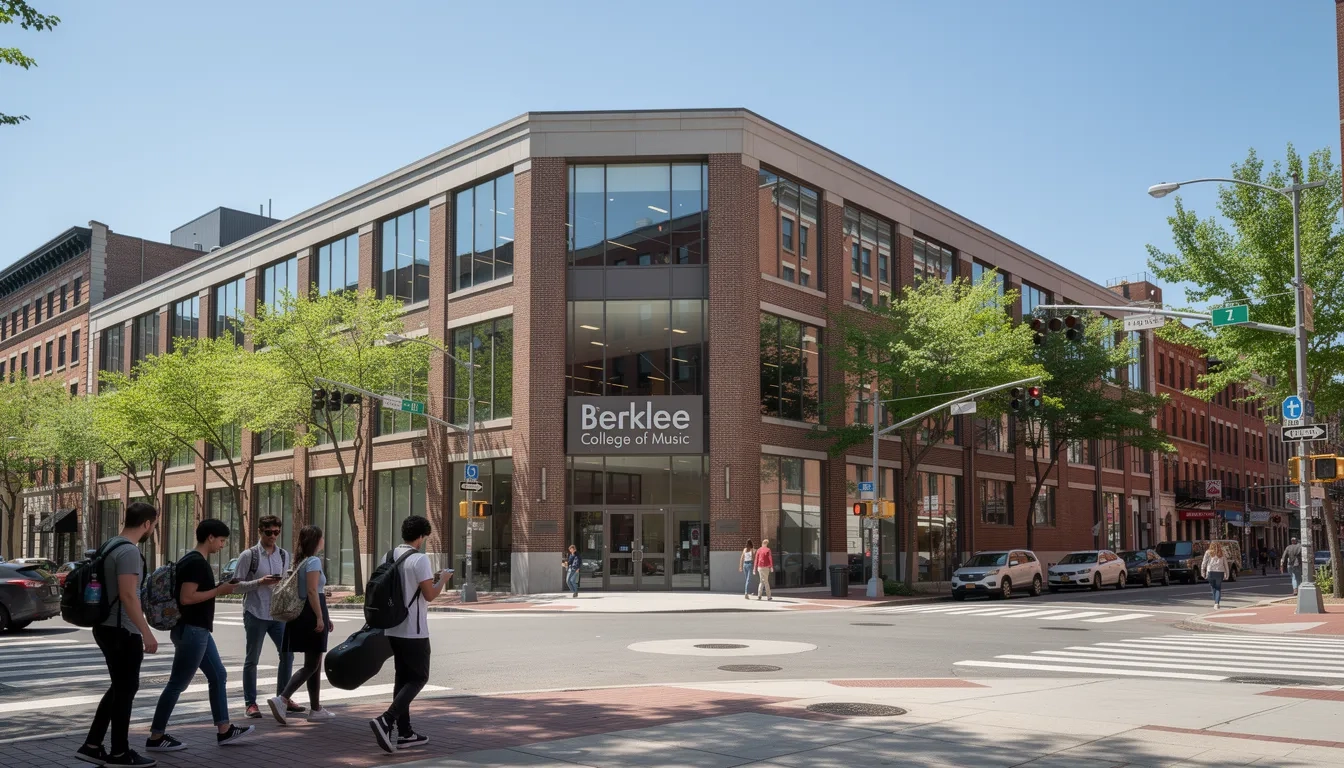
If you want proof that one school can genuinely shape the sound of popular music, consider this: Berklee alumni have collectively won 310 Grammy Awards. That's more than any other college on earth. Not a conservatory attached to a sprawling research university. An independent music school in Boston's Back Bay, founded in 1945 by a former Raytheon engineer named Lawrence Berk who believed jazz and popular music deserved serious academic attention.
A Brief History Worth Knowing
Berklee started as Schillinger House, a small school teaching a compositional system developed by Joseph Schillinger that applied mathematical structures to music. It became Berklee School of Music in 1954, achieved full college status in 1970, and spent the following decades stacking up "firsts" no other school had bothered claiming.
First college guitar major. In 1962. Which seems obvious now, but was genuinely unusual at the time.
The firsts kept coming: the first undergraduate film scoring degree in 1980, the first college music synthesis major in 1986, the first college songwriting major in 1987. Each one was Berklee reading the industry and moving before anyone else did. You could argue that's been their whole strategy — and it has worked.
In 2016, Berklee merged with Boston Conservatory, adding classical music and musical theater training under one institutional umbrella (the conservatory retains its own identity and programs within the Berklee family). They also run BerkleeNYC in New York and Berklee Online, which Newsweek named among America's Top Online Colleges in 2025.
Programs: What You Can Actually Study
Undergraduate options split into two degrees: the Bachelor of Music and the Bachelor of Arts. The BM is conservatory-style and performance-focused; the BA allows more general education flexibility. The major list is broad by design:
- Music Production and Engineering
- Performance (guitar, piano, bass, drums, voice, brass, strings, orchestral instruments)
- Songwriting
- Film Scoring
- Music Business/Management
- Contemporary Writing and Production
- Music Therapy
- Electronic Production and Design
Graduate programs are shorter and more targeted. The Master of Music in Global Jazz runs one year and splits time between Boston and Valencia, Spain. The Music Education master's takes two years and includes an autism specialization track — which is genuinely rare in music graduate programs. There are also one-year master's programs in Songwriting and Production and in Live Music Production and Design.
Berklee admits students three times per year — fall, spring, and summer — which gives applicants more flexibility than the September-only cycle at most schools.
No SAT or ACT required for any degree. Almost every program requires an audition, either live or recorded, which is where the real sorting happens.
Rankings: The Numbers That Actually Matter
The full picture is more nuanced than a single US News number suggests, so it helps to see everything together.
| Ranking Source | Recognition | Year |
|---|---|---|
| US News | #38 Regional Universities North | 2026 |
| US News | #8 Most Innovative Schools | 2026 |
| US News | #9 Best Undergraduate Teaching | 2026 |
| Hollywood Reporter | Top Music Schools (film scoring) | 2024 & 2025 |
| Billboard | Top Music Business Schools | 2024 & 2025 |
| Newsweek | America's Top Online Colleges | 2025 |
The "Regional Universities North" classification reflects US News methodology, not any limitation of the school. Berklee doesn't have sprawling doctoral research programs — it does music education, at scale. That's why it falls outside the "National Universities" bucket.
The teaching ranking matters more than the regional placement. Most classes run with fewer than 20 students, and the student-to-faculty ratio sits at 10:1. In a performance context, that access changes everything. The Hollywood Reporter and Billboard placements validate two specific programs — if film scoring or music business is your target, those rankings confirm you're not choosing Berklee on reputation alone.
The Real Cost — and What Aid Actually Covers
Tuition for 2025 is $52,040, rising to an estimated $53,872 for 2026-2027. Add housing, meals, and fees and the full cost of attendance climbs to around $75,678 per year. That number is real and worth sitting with honestly before applying.
But here's where things get more complicated — and more encouraging.
66% of undergraduates receive grants or scholarships. The average aid package comes in at $24,949 per student; for first-year students, the average non-need-based scholarship alone is $21,810. The Presidential Scholarship covers full tuition plus housing and meals, awarded based on audition performance, renewable across multiple years.
A few things most people overlook:
- International students are eligible for the same merit awards as domestic applicants — unusual for a U.S. private institution.
- Because merit aid ties directly to audition performance, a student with a 3.1 GPA who plays extraordinarily well can outcompete a 4.0 student who auditions poorly.
- Berklee meets 54% of demonstrated financial need on average. The gap matters, but the sticker price is not what most students pay.
The net price after aid, for those receiving need-based support, averages around $72,151. Still substantial. But the gap between list price and actual cost is real.
Getting In: The Audition Is Everything
The acceptance rate sits around 44%, based on the most recent cycle where 7,050 applicants applied and 3,069 were admitted. Selective, but not impossible.
The audition carries the actual weight. Requirements vary by major — performance applicants demonstrate technical proficiency and musicality on their instrument; music production applicants may submit recordings; songwriting applicants often present original compositions. Berklee publishes detailed audition criteria by major, and preparing specifically for those requirements is where applicants should put their energy.
Key dates for fall enrollment:
- Early Action: November 1 (non-binding)
- Regular Decision: January 15
- Spring enrollment: July 1
One non-obvious point: applying Early Action often means earlier access to scholarship consideration. Waiting until Regular Decision isn't doing you any favors on the financial aid side — not a guaranteed disadvantage, but not a neutral choice either.
Student Life: Boston, 104 Countries, and Late-Night Sessions
Berklee's campus is 25 buildings spread through Back Bay — woven into the city rather than separated from it by gates and quads. Students walk to jazz clubs, recording studios, live venues, and actual session work. Many got their foot in the door for internships and entry-level industry work before graduating simply by being present in Boston's dense music environment.
International diversity here is real, not a brochure claim. Students from 104 countries attend, with roughly 25% of the 8,369-person student body coming from outside the U.S. China, Canada, India, Brazil, and Colombia send the most students. Playing daily alongside someone who grew up with Brazilian choro or Indian classical music changes how you think about rhythm and structure in ways no curriculum engineers.
The social culture skews toward the musically obsessed. Late-night sessions in practice rooms, collaborative production projects that turn into actual releases, music theory conversations that run past midnight — that's the normal texture of Berklee social life. If that sounds like a feature, it is. If it sounds exhausting, that's worth knowing too.
There are no varsity sports. Berklee offers intramural leagues and fitness programs, but nobody comes here for athletics. What the school offers instead is the Berklee Performance Center, a 1,227-seat venue where student showcases regularly draw industry professionals looking for talent.
On-campus housing holds roughly 1,500 students. The rest find apartments in Back Bay and surrounding neighborhoods. Boston's rental market is competitive enough that planning off-campus housing before sophomore year is worth taking seriously.
The Stan Getz Library and Media Center serves as the primary academic library, with two additional libraries across campus — putting Berklee in the top 30% nationally for library facilities per student. The real resource advantage, though, is 40 recording studios and 9 music synthesis labs available to students across programs. At schools where music production students share two or three studios among dozens of majors, having 40 changes the pace of learning entirely.
Alumni and Career Outcomes
The alumni list reads like a record collection spanning the last six decades of popular music. Quincy Jones studied here before going on to produce Michael Jackson's most iconic albums. John Mayer left early but has credited Berklee's theory training as foundational to his songwriting. Esperanza Spalding became the first jazz artist to win the Grammy for Best New Artist, in 2011. Gillian Welch, Melissa Etheridge, Branford Marsalis, Diana Krall — the range of styles and eras represented is hard to match.
Then there's Howard Shore, who studied at Berklee before scoring all three Lord of the Rings films. That's not coincidence — it's a 44-year head start from offering the first undergraduate film scoring degree in American higher education.
The aggregate numbers: 108 Latin Grammys, 34 Emmy Awards, 8 Academy Awards, 7 Tony Awards. Alumni appear on 95% of major label rosters. Berklee's own alumni surveys show graduates working in performing arts and entertainment report higher career satisfaction than those who moved outside the field — which suggests the school is preparing students for careers they actually want, not adjacent ones they settle for.
Bottom Line
- Berklee is the right choice if contemporary music — performance, production, songwriting, film scoring, music business — is genuinely what you want to study, not a fallback or a hedge.
- The sticker price of $53,872 in tuition (2026-2027) is high, but 66% of undergrads receive aid averaging nearly $25,000. The Presidential Scholarship covers full tuition plus housing.
- Class sizes are small, the facility access is exceptional (40 recording studios, 9 synthesis labs), and the alumni network has documented pull across the industry.
- Prepare your audition specifically and seriously — it drives both admission and scholarship decisions simultaneously.
- If you're weighing Berklee against a music program at a larger university, the trade-off is focus: Berklee does music and only music. That's either exactly right for you or it isn't.
Frequently Asked Questions
Is Berklee College of Music hard to get into?
The acceptance rate is roughly 44%, which makes it moderately selective. The audition is the primary filter — applicants with strong musical preparation but average academic records are regularly admitted, while academically strong applicants who aren't prepared for the audition are not. Prepare your audition materials carefully and according to the specific requirements for your intended major.
How much does Berklee actually cost after financial aid?
The listed cost of attendance for 2024-2025 is approximately $75,678 per year. The average grant and scholarship award is $24,949, meaningfully reducing costs for the 66% of undergraduates who receive aid. The Presidential Scholarship covers full tuition plus housing and meals for the most competitive applicants. International students qualify for the same merit awards as domestic students.
What are Berklee's strongest programs?
Film Scoring and Music Production are consistently ranked near the top nationally — Hollywood Reporter named Berklee a top music school for film scoring in both 2024 and 2025. Music Business, Songwriting, and Performance also carry strong industry reputations. The graduate programs in Global Jazz and Music Education are smaller but well-regarded in their specific fields.
Does Berklee require SAT or ACT scores?
No. Berklee has no standardized testing requirement for any program, undergraduate or graduate. Admission decisions are based primarily on the audition, alongside application materials and academic transcripts. This applies equally to domestic and international applicants.
What is Boston Conservatory at Berklee?
Boston Conservatory merged with Berklee in 2016 and now operates as a conservatory within the Berklee family, focusing on classical music performance, musical theater, and dance — areas distinct from Berklee's contemporary music focus. Students apply to Boston Conservatory separately from the main Berklee programs, and it retains its own faculty, curriculum, and degree identity.
How does Berklee Online compare to the on-campus experience?
Berklee Online offers certificates and degrees in music production, songwriting, music business, and other fields, and was named among America's Top Online Colleges by Newsweek in 2025. The on-campus experience includes studio access, live ensemble performance, and direct industry networking in Boston that online programs can't replicate. For working musicians who can't relocate, Berklee Online offers legitimate credentials — but if you can go to Boston, go to Boston.