Bowdoin College: Admissions, Rankings, and Student Life
When Bowdoin College received 14,727 applications for its Class of 2030, the admissions office admitted exactly 962 students. That's a 6.53% acceptance rate — lower than Cornell, lower than Georgetown, lower than most schools people casually think of as "obviously selective." For a school of roughly 1,950 undergraduates tucked into Brunswick, Maine, that's a striking place to land.
A School That's Getting Harder to Get Into
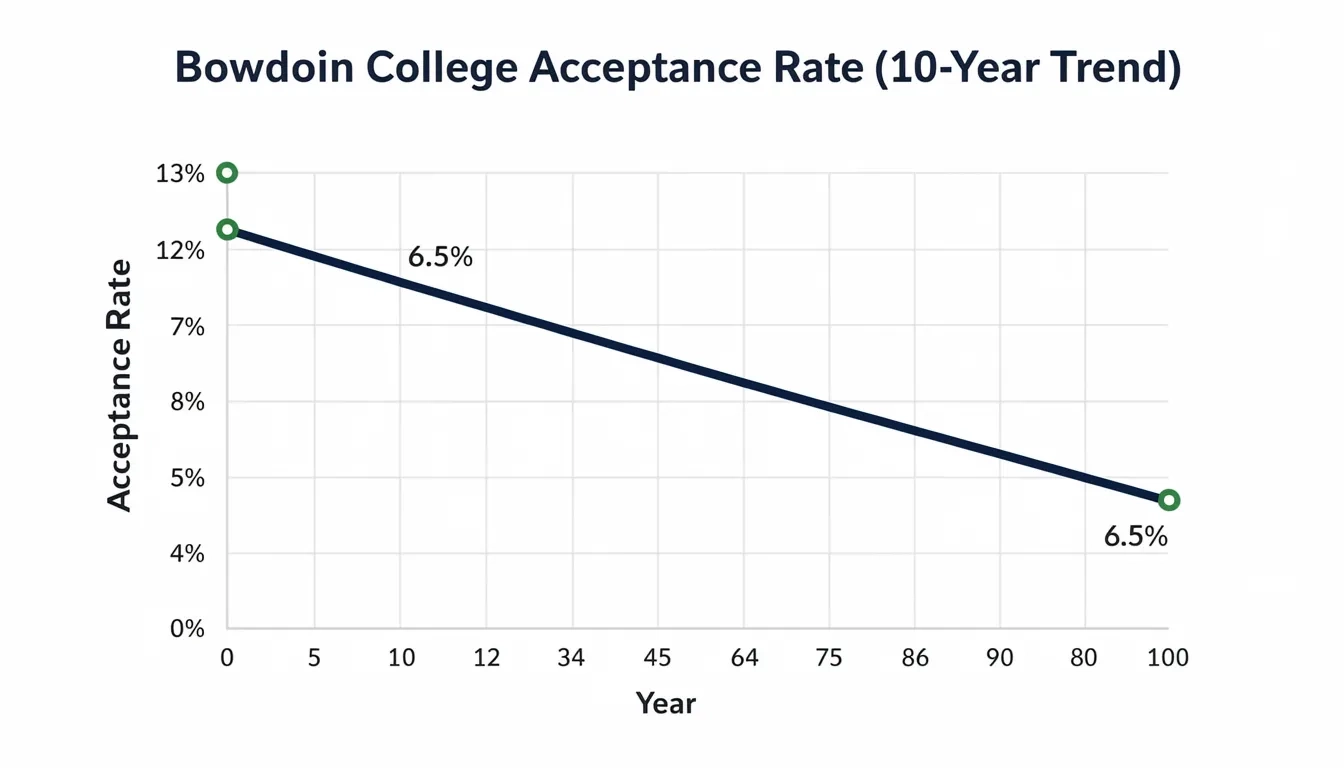
Bowdoin's acceptance rate has been nearly cut in half over the past decade. For the Class of 2021, the rate sat above 13%. By the Class of 2029, it had dropped to 6.8%. The Class of 2030 pushed it further to 6.53%, the lowest in the college's history.
The class size hasn't ballooned. Bowdoin admits roughly 950–960 students per year, a number that's stayed flat for years. What changed is the application volume, which hit an all-time high in the most recent cycle. Common App made applying easier. Test-optional policies encouraged more students to roll the dice on schools they might have skipped. And Bowdoin's reputation has spread well beyond New England.
Academically, the admitted class is formidable. 89% of enrolled students ranked in the top 10% of their high school class. The middle 50% SAT range sits at 660–750 for both verbal and math. These are scores that would be competitive at any institution in the country.
The gap between application volume and class size is, frankly, the whole story. Bowdoin isn't admitting fewer students because standards mysteriously rose. It's the same talent it always wanted, just drawing from a much larger pool.
What the Rankings Actually Say
U.S. News & World Report ranked Bowdoin #5 among national liberal arts colleges for 2026, placing it alongside Williams, Amherst, Swarthmore, and Pomona in the top tier of this category. Forbes ranked it 25th overall among all American colleges and universities — not just liberal arts schools — which puts it ahead of several large research universities by their methodology.
Here's how it compares to its closest peers:
| School | US News Rank (Lib Arts 2026) | Acceptance Rate | Approx. Class Size |
|---|---|---|---|
| Williams College | #1 | ~8% | ~550 |
| Amherst College | #2 | ~9% | ~470 |
| Swarthmore College | #3 | ~7% | ~430 |
| Pomona College | #4 | ~7% | ~420 |
| Bowdoin College | #5 | ~6.5% | ~490 |
| Middlebury College | #6 | ~14% | ~600 |
Notice something strange: Bowdoin is actually more selective than the schools ranked above it. This happens because U.S. News weighs many factors beyond admissions rates, but it's a useful data point — the applicant pool at Bowdoin is not softer than at Williams or Amherst.
The "Hidden Ivy" and "New Ivy" labels that get applied to Bowdoin aren't PR. The college has produced Rhodes Scholars, runs serious marine science research, and has sent graduates to lead all three branches of the federal government. It earns the reputation.
Early Decision vs. Regular Decision: The Math Matters
This is where strategy becomes concrete.
For the Class of 2030, the ED acceptance rate was 13.08% versus 5.32% for regular decision. That's not a marginal difference. Applying Early Decision more than doubles your odds compared to the RD pool.
Some of that gap reflects self-selection — ED applicants tend to be more focused and more prepared. Admissions offices know this too. But the numbers are the numbers.
A few things worth knowing about ED at Bowdoin:
- The commitment is binding: if admitted, you withdraw all other applications
- Bowdoin actively encourages prospective students to request early financial aid estimates before committing — so the binding nature doesn't have to mean financial uncertainty
- Only 5 students were admitted from the waitlist for the Class of 2029, making it functionally a long-shot in most cycles
The RD pool, at 5.32%, is genuinely brutal. Students who are serious about Bowdoin and have done the research should think hard about whether ED makes sense for them.
Financial Aid That Stands Out
Here's where Bowdoin separates from most of its peers.
Bowdoin is one of only about ten colleges in the United States that is both need-blind in admissions and meets 100% of demonstrated financial need for all four years — with no loans required.
Aid packages consist entirely of grants, scholarships, and a modest $2,400 annual on-campus work expectation. You don't graduate with debt Bowdoin created. Loans are available if families want to borrow to cover their own expected contribution, but Bowdoin doesn't build them into the package.
The numbers back this up. For 2026–2027, total cost of attendance runs approximately $97,900 — a number that initially makes families close the browser tab. But:
- The average annual aid award for incoming students is $72,000
- 51% of the most recent class received Bowdoin grant aid
- Scholarships range from $3,700 to $92,350 depending on demonstrated need
The engine behind all of this is a $2.92 billion endowment (as of 2025). Nearly half of it is permanently restricted by donors to financial aid — not a budget line that can be cut during a bad fiscal year, but a structural commitment baked into donor agreements.
One small signal worth mentioning: every enrolled student receives a MacBook Pro, iPad, and Apple Pencil, and can keep all of it for $1 upon graduation. It's a detail, but it tells you something about how the institution thinks about removing barriers.
What Student Life Actually Looks Like
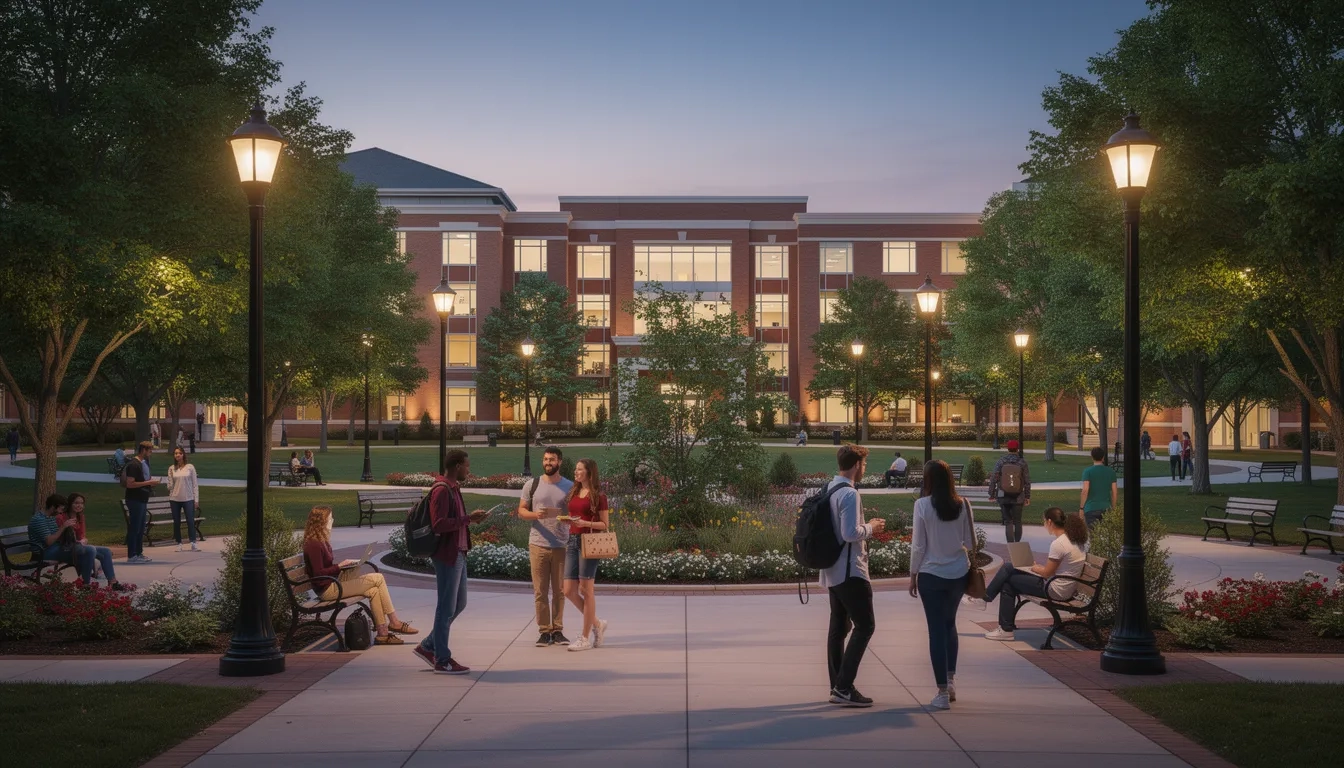
Bowdoin's 215-acre campus in Brunswick, Maine sits about 25 miles north of Portland, with Federal and Greek Revival architecture that looks exactly like your mental image of a classic New England college. But the surface aesthetics hide a social structure that's genuinely different from most schools.
There are no fraternities. Bowdoin phased them out in the late 1990s after years of debate, replacing them with eight college houses — residential and social communities that host events, build identity, and give students a place to belong that isn't Greek-affiliated. The transition was contentious at the time. It largely isn't anymore.
Dining is one of the genuinely famous things about Bowdoin. The Princeton Review has ranked the dining program #1 nationally multiple times. That's not an admissions brochure stat — it's a consistent student-driven verdict across years of independent surveys.
Beyond the table, campus life runs wide:
- 120+ student organizations, including the Bowdoin Outing Club (large and active, given the outdoor access Maine provides), an Organic Garden students actively farm, a Culinary Club, and the Asian Students Alliance
- Six a cappella groups, including the Meddiebempsters — founded in 1937, one of the oldest college a cappella groups in the country
- The Bowdoin Orient, the oldest continuously published college weekly newspaper in the United States, founded in 1871
- Annual traditions including Junior/Senior Ball, Spring Gala, and Student Nights at the Museum
The student body of about 1,951 draws from 54 countries. At that size (and with a student-to-faculty ratio around 9:1), professors know your name by week three. Classes are small. Relationships with faculty are accessible in ways that larger universities functionally can't offer.
Something that tends to surprise incoming students: the collaborative culture. Bowdoin has no reputation as a cutthroat, gunner-culture campus — unusual given how selective it is. Students and alumni consistently describe high peer support and low internal competition. The school that's hard to get into turns out to be quite generous once you're in.
Academics and What Bowdoin Does Differently
Bowdoin offers 30+ majors across the traditional liberal arts spectrum. The most popular by graduate count are Political Science (82 in 2021), Economics (61), and Biology (30), though the spread across departments is fairly even.
The distribution requirements touch six areas — natural sciences, quantitative reasoning, visual and performing arts, international perspectives, diversity, and social sciences — but there's no prescribed core curriculum of great texts. Students build their own path through those categories.
What makes Bowdoin genuinely unusual is its location. The Coastal Studies Center on Orr's Island — 120 acres of forest, wetland, and Atlantic shoreline, eight miles from campus — gives students direct research access to marine biology and ecology that most colleges can't replicate. The college also operates the Bowdoin Scientific Station on Kent Island in the Bay of Fundy, one of the longest-running seabird research sites in North America.
For history and Arctic studies, the Peary-MacMillan Arctic Museum on campus is dedicated to alumni Robert Peary and Donald MacMillan. It's a working research archive, not a trophy display.
Study abroad programs — co-sponsored and vetted by the college — include placements in Rome, Stockholm, Sri Lanka, and southern India. Financial aid extends to these programs too.
The alumni list is hard to match at a school this size. Reed Hastings (Netflix co-founder, Class of 1983), former Senate Majority Leader George J. Mitchell, Nathaniel Hawthorne, Henry Wadsworth Longfellow, and President Franklin Pierce (Class of 1824) all came through Bowdoin. That's not a typical liberal arts college alumni roster.
My read: Bowdoin is a better school than its #5 ranking suggests, at least for the student who thrives in a small, place-based, academically serious environment. The ranking rewards some factors (resources, research output) where large universities always win. But for undergraduate education specifically — faculty access, engaged peers, financial accessibility, and a campus built around your four years — the comparison gets much closer.
Bottom Line
- Apply Early Decision if you're serious. The 13.08% ED rate versus 5.32% RD is too large a gap to ignore. Start building your application in the spring of junior year so you're not scrambling in October.
- Run the net price calculator before assuming it's out of reach. Families earning under roughly $75,000 often find the actual cost close to zero. The $97,900 sticker price is largely irrelevant for families with demonstrated need.
- The culture is the whole point. No Greek life, collaborative peers, exceptional dining, outdoor access, and faculty who treat undergrads as the priority. If you need a large university's energy or a big research campus, look at different schools. If you want to be known in your department by sophomore year, Bowdoin delivers this consistently.
- The location is a feature, not a compromise. Brunswick isn't Boston, but it's 25 miles from Portland and two hours from Boston. Students who pick Bowdoin tend to want access to the Maine coast and mountains — and they get it.
- The degree carries weight. Employers and graduate schools recognize Bowdoin's name, and the alumni network punches well above the school's enrollment size.
Frequently Asked Questions
Is Bowdoin harder to get into than Ivy League schools?
By raw acceptance rate, yes — in many cases. Bowdoin's 6.53% for Class of 2030 is lower than Cornell (~8%), Brown (~7%), and Dartmouth (~6%). The applicant profiles overlap heavily with the lower-Ivy tier. Students applying to Bowdoin typically also apply to Dartmouth, Williams, and Amherst, and admissions offices know this.
Does applying test-optional hurt your chances at Bowdoin?
Bowdoin went test-optional in 1969 — one of the first in the country — and has maintained that policy for over 50 years. Not submitting scores carries no penalty. The practical question is whether your scores strengthen your application: if your SAT is above roughly 1400 or ACT above 32, submitting them is probably worth doing. Below those thresholds, many applicants choose not to submit, and the college evaluates them on everything else.
What GPA do you actually need to get in?
Bowdoin doesn't publish a GPA cutoff, but 89% of enrolled students ranked in the top 10% of their high school class. The realistic baseline is a strong transcript in demanding coursework. A handful of B's in genuinely hard classes won't sink an application. A high GPA in unchallenging courses almost certainly will — the rigor of your curriculum matters as much as the grades themselves.
Is Bowdoin's no-loans policy truly loan-free?
Yes, with a precise clarification. Bowdoin's financial aid packages contain no required loans. The package covers demonstrated need through grants, scholarships, and a $2,400 annual work expectation. Families can choose to borrow to cover their expected family contribution if they prefer, but Bowdoin doesn't build loans into the aid offer itself. This is a meaningful distinction from schools that advertise "generous aid" while quietly mixing grants and loans in the same package.
Why did Bowdoin get rid of fraternities?
Bowdoin phased out fraternities in the late 1990s following a decade-long debate about their compatibility with the college's values and the social exclusion they created. The college replaced them with eight college houses — residential communities that now serve as the main social anchors on campus. The transition was controversial at the time but is now simply how Bowdoin works. Most current students have no strong feeling about it either way; it's just the structure they entered.
How remote is Brunswick, Maine, really?
Brunswick is a functioning New England town, not wilderness. It has its own downtown, restaurants, and amenities. Portland, Maine (which has developed a nationally recognized food and arts scene over the past decade) is 25 miles south — under 30 minutes by car. Boston is reachable in roughly two hours by car or the Amtrak Downeaster train. Students who love skiing, hiking, kayaking, and coastal access find the location ideal. Students who need a city on their doorstep tend to look elsewhere.