Business Career Paths and Salaries: What to Expect in 2026
The median salary for business and financial occupations hit $80,920 in 2024, according to the Bureau of Labor Statistics. The national median for all jobs? $49,500. That $31,000 gap has been widening for a decade, and it raises an obvious question: which business path actually gets you there fastest?
The answer depends almost entirely on which track you choose. A healthcare administrator and an investment banking associate both hold business degrees. One earns $117,960. The other clears $300,000 in total compensation before turning 30. The difference isn't talent. It's trajectory.
Here's what you need to know to choose wisely.
The Six Core Business Tracks (and What They Actually Pay)
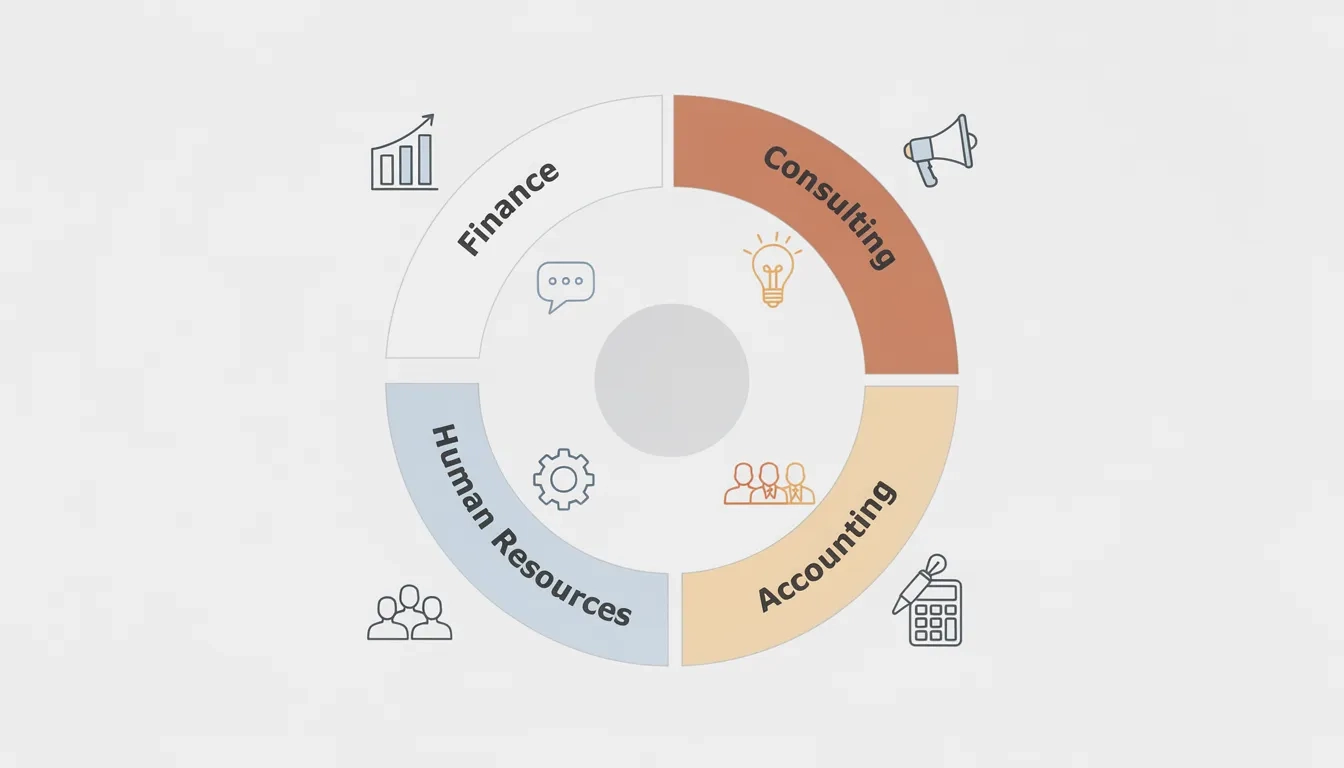
Business isn't one field. It's more like six loosely related careers sharing a diploma. The tracks differ dramatically not just in salary ceiling, but in how fast you climb and how transferable your skills become over time.
| Career Track | Entry-Level | Mid-Career | Senior / Manager | 10-Year Growth |
|---|---|---|---|---|
| Finance | $60K–$75K | $101,910 | $161,700+ | 6–15% |
| Management Consulting | $68K–$90K | $110K+ | $192,000+ | 9% |
| Marketing | $50K–$65K | $76,950 | $161,030 | 7% |
| Information Systems | $65K–$85K | $104,620 | $171,200 | 15% |
| Accounting | $50K–$65K | $81,680 | $120K+ | 5% |
| Healthcare Admin | $55K–$70K | $80K | $117,960 | 23% |
Source: U.S. Bureau of Labor Statistics, 2024
Healthcare administration deserves a second look. That 23% projected growth through 2034 is not a typo. Aging demographics and the push toward digital health have created a sustained shortage of qualified health service managers, and salaries are climbing to match.
Information systems management sits at a similar inflection point. A $171,200 median for experienced managers and 15% projected growth make it the highest-paying traditional business track without requiring a specialized technical degree. It's also the one most insulated from AI displacement, since the role is primarily about aligning technology strategy with business goals.
The accounting track, by contrast, shows the smallest projected growth at 5%. That doesn't mean it's a bad choice—it's stable, credentialed, and widely respected—but professionals entering accounting today should plan for the CPA credential early, since firms are increasingly price-competitive on uncertified work.
Finance: The Fastest Route to Six Figures
Finance remains the most direct path to high salaries early in a career, but the specific sub-track matters more than most people realize.
Commercial banking and corporate finance start strong but plateau in the $80,000–$120,000 range without a move into management. The ceiling is real, and most professionals hit it around year six or seven if they stay in individual contributor roles.
Investment banking runs on different logic entirely. First-year analysts at bulge-bracket firms (Goldman Sachs, JP Morgan, Morgan Stanley) typically earn $110,000–$130,000 in base salary, with bonuses pushing total compensation to $170,000 or higher. Associates—usually post-MBA—can clear $300,000. The tradeoff is severe and well-documented: 80-hour weeks are the standard, burnout is common, and most people exit the industry within three to five years by choice or otherwise.
Financial managers offer the more sustainable ceiling. The BLS reports a $161,700 median with 15% projected growth for professionals overseeing organizational finance. The typical route runs through a financial analyst role ($101,910 median) before moving into management. That analyst-to-manager transition is where most salary acceleration happens, often a $40,000–$60,000 jump in a single promotion cycle.
The financial analyst role is one of the most logical entry points in any business career. The analytical skills transfer across industries, and it gives someone time to build real expertise before they have to manage people or budgets at scale.
One thing many people miss: corporate finance roles exist at companies of every size, in every geography. The premium jobs (investment banking, private equity, hedge funds) cluster in New York and Chicago. But FP&A analysts, treasury professionals, and financial managers work everywhere, and the national median holds up even outside financial centers.
Consulting: High Ceilings, Narrow Funnel
Management consulting offers some of the highest salaries in business, but the selection process at the top is unforgiving.
Top-tier strategy consulting (McKinsey, Bain, Boston Consulting Group) pays incoming MBA graduates base salaries averaging $192,000 with signing bonuses around $35,000. MIT Sloan's 2025–2026 employment report put the median consulting salary for their graduates at $190,000. Those numbers drive a lot of career decisions.
What those numbers don't show: less than 5% of MBA applicants land at MBB. For undergraduates without a graduate degree, the numbers are tighter still. The realistic consulting market is much larger than three firms—mid-tier consultancies, boutique strategy shops, and in-house strategy teams all pay well, typically $80,000–$140,000 depending on seniority.
Early-career consultants without an MBA start around $68,993 on average (PayScale 2025 data) and reach $87,995 at mid-career. Senior consultants and principals clear $100,000+, but the jump to partner-track roles is where real compensation acceleration happens—and where most people face the choice between staying in consulting and going in-house.
The non-obvious point about consulting: the skills transfer unusually well. A consultant who leaves after five years for a Director of Strategy role at a company often earns more than a peer who stayed in consulting at the same level. Companies pay a premium for structured problem-solving built over years of client work.
Among MBA graduates tracked by major programs, consulting attracts 32.3% of placements, ahead of technology (23.3%) and finance (20.6%).
The MBA Question: Worth It or Not?
Here's my honest take: an MBA from a top-15 school still pays off financially. But the calculus has shifted enough that you should run the numbers before committing.
The global median MBA salary in 2026 sits at $125,000. Top U.S. school graduates average significantly higher: Harvard Business School graduates averaged $259,874 in total compensation; Wharton graduates averaged $246,813. Those numbers look compelling until you factor in cost.
A two-year full-time MBA at a top program runs $200,000+ in tuition and forgone income combined—and the payoff period typically extends 8–12 years, assuming you land the consulting or finance role the degree was designed to access.
Where an MBA makes clear sense:
- Career switchers who need credential legitimacy in a new field (engineering to consulting, nonprofit to finance)
- Professionals targeting partner-track roles at consulting or private equity firms
- Anyone whose undergrad institution limits recruiting access (the MBA as a brand reset, essentially)
Where it's questionable:
- Professionals already in finance or technology who can get promoted without it
- Those whose firms offer sponsored executive education as an alternative
- Anyone considering a one-year specialized master's (MS Finance, MS Analytics) that costs half as much and delivers faster
The elephant in the room is that AI fluency has become a parallel credential. GMAC's 2025 Corporate Recruiters Survey found that candidates demonstrating AI proficiency had a measurable hiring edge regardless of degree level. That's a shift worth paying attention to.
Where Business Skills Pay Most Right Now
Some fields are pulling business professionals up faster than others, and the leaders might surprise you.
Operations research and analytics is the one I'd flag most strongly. The BLS projects 21% growth through 2034 with a $91,290 median—but that median understates the real market. Companies paying premium rates for analytically trained professionals in supply chain optimization, pricing, and resource allocation routinely post $110,000–$140,000 for candidates with strong quantitative backgrounds. The demand here comes from structural changes in how companies make decisions, not cyclical hiring trends.
Healthcare administration remains the other standout. A $117,960 median with 23% projected growth makes it arguably the strongest risk-adjusted bet in the entire business career space. The ceiling is below investment banking, but the floor is high and the demand is structural.
ESG roles (Environmental, Social, Governance) have moved from buzzword to real career track. Average compensation currently sits around $82,971, but the field is young and growing quickly as regulatory pressure increases globally. Professionals who specialize here now will benefit from first-mover advantage as the category scales.
The Experience Curve: How Salaries Actually Progress
Business career salaries don't grow in a straight line. They stair-step, and the jumps come from specific triggers, not tenure alone.
Here's how the progression typically unfolds for a business administration graduate:
- Years 0–3 (Entry): $45,000–$65,000. Specialization matters enormously here. A finance concentration earns 20–30% more than a general management track at this stage.
- Years 4–7 (Mid-Career): $75,000–$110,000. The biggest salary jump comes from a promotion into a manager or lead role. Individual contributors frequently plateau at $80,000–$90,000 and stay there.
- Years 8–15 (Senior / Director): $110,000–$160,000+. Specialization advantage compounds. A Financial Manager median of $161,700 outpaces a comparable Marketing Manager by roughly 38%.
- Years 15+ (Executive): CFO, CMO, and COO roles at mid-to-large companies average $180,000–$400,000+. The BLS puts median CEO compensation at $206,680, though that figure skews heavily by company size—a regional distribution company pays its CEO very differently than a public technology firm.
The most common salary stall happens between years four and seven. Someone is competent enough that they're not pushed to upskill, but they haven't taken on meaningful management responsibility yet. People who avoid this plateau either actively pursue a manager role or build a specialized skill set—financial modeling, advanced analytics, M&A transaction experience—that commands premium pay even without a management title.
Certifications That Move the Needle
The right certifications change pay grades without a two-year degree program. The cost-to-payback math is usually favorable.
- CFA (Chartered Financial Analyst): Industry standard in investment management. At roughly $3,847 in total exam fees and study materials, charterholder status typically adds $15,000–$25,000 to analyst compensation. It's a multi-year commitment (the pass rate for all three levels combined is under 20%) but it's one of the clearest credential-to-salary correlations in business.
- CPA (Certified Public Accountant): Non-negotiable for public accounting; adds $10,000–$20,000 across accounting and finance roles more broadly.
- PMP (Project Management Professional): PMI's own research shows PMP holders earn 16% more than non-certified peers in project management roles. The exam costs under $800 for PMI members.
- SHRM-CP / PHR: HR certifications that carry consistent pay premiums in specialist and manager roles.
- Six Sigma Black Belt: Most relevant in manufacturing, logistics, and healthcare operations where process efficiency has measurable financial impact.
Most of these certifications pay for themselves within 12–18 months based on the salary differential alone—a much faster payback than any graduate degree.
Bottom Line
- Finance and information systems management offer the highest salary ceilings among traditional business tracks—$161,700 and $171,200 medians respectively—with strong growth through 2034.
- Healthcare administration is the sleeper pick: 23% projected growth and a $117,960 median make it the strongest risk-adjusted business track available today.
- The salary stall between years four and seven is real. Moving into management (or building deep specialization) is how you avoid it.
- An MBA from a top-15 school still delivers a financial return, but it's most defensible for career switchers and people targeting consulting or private equity—not as a general-purpose salary booster.
- Certifications like the CFA, CPA, and PMP cost under $5,000 combined and can add $10,000–$25,000 annually. For someone already in their target field, they often beat a master's degree on pure ROI.
The single most important decision you'll make early in a business career: choose a specialization deliberately, not by default. The gap between a general business graduate and one with a finance, analytics, or information systems concentration is $20,000–$40,000 per year within five years of graduating. That gap compounds.
Frequently Asked Questions
What is the average starting salary for a business degree graduate?
Entry-level business administration salaries typically run $45,000–$65,000, though the range shifts significantly by specialization. Finance and information systems concentrations tend to start 20–30% higher than general business or marketing tracks. Location compounds the difference: major metro areas like New York and San Francisco routinely run 15–25% above national medians for the same role.
Is an MBA worth the financial investment?
For career switchers targeting consulting, finance, or executive leadership, a top-15 MBA still delivers a positive financial return. Harvard and Wharton graduates average $246,000–$260,000 in total compensation. But the 8–12 year payoff window is long, and a specialized master's degree (one year, roughly half the cost) or targeted certifications often deliver better ROI for professionals already working in their target field.
Which business career has the fastest job growth right now?
Healthcare administration leads all traditional business tracks with 23% projected growth through 2034 per the BLS. Operations research analysts (21% growth) and information systems managers (15% growth) aren't far behind. All three benefit from structural demand—aging populations, AI adoption, and digital transformation—rather than economic cycles that could reverse.
Myth vs. Reality: Do you need an MBA to earn six figures in business?
You don't. Financial managers ($161,700 median), information systems managers ($171,200), marketing managers ($161,030), and sales managers ($138,060) all have BLS medians well above $100,000. Most of those roles are accessible with a bachelor's degree and the right experience. The MBA accelerates the timeline at elite firms, but it isn't the only path to high-earning business roles.
What certifications add the most salary value in business careers?
The CFA adds the most in raw dollar terms for finance roles—$15,000–$25,000 annually once chartered. The PMP adds 16% to project management salaries. The CPA is essentially required to advance in public accounting. The right cert depends on your track, but all three pay back their cost within 12–18 months on the salary differential alone, making them more efficient than graduate school for professionals already in their field.
Which business careers hold up best during economic downturns?
Healthcare administration and government/public administration tend to hold up best. Finance and consulting see hiring freezes and deal flow drops during recessions—investment banking in particular is highly cyclical. Accounting and HR roles are more stable because companies need compliance and headcount management regardless of economic conditions. Operations and supply chain roles have shown resilience as well, since efficiency becomes more valuable when margins compress.
Sources
- What Jobs Can You Get with a Business Degree – SNHU
- MBA Job Market 2025: Outlook, Trends, and Careers for Grads
- Best MBA Salaries in 2026: Career Growth & Top Schools
- 2025–2026 MBA Employment Report – MIT Sloan
- Careers in Business Administration: Roles, Pay, Outlook – Pathwise
- Business Career Outlook – U.S. Bureau of Labor Statistics