Butler University: Programs, Rankings, and Life in Indianapolis

Most people can't place Butler on a mental map without a hint. Yet anyone who has hired a recent Indianapolis graduate — or watched a certain March Madness Cinderella story play out — tends to raise an eyebrow in recognition. Butler University isn't Purdue or Notre Dame. It's smaller, quieter, and in some specific ways better-positioned to actually get you employed after graduation.
Why Butler Punches Above Its Weight
The 11:1 student-to-faculty ratio is the first number worth sitting with. With roughly 4,519 undergraduates on campus, every class feels closer to a seminar than a lecture hall. Professors have actual bandwidth to be mentors. Students arrive knowing their names will be called.
That ratio isn't just a brochure stat. It's baked into the curriculum. First-year students take a required community course connecting their coursework to Indianapolis — real service-learning tied to the city, not a watered-down orientation week.
Butler is ranked #1 among Regional Universities Midwest by US News for 2026. That headline alone doesn't tell the full story, but it's a useful anchor.
Academic Programs Worth Your Attention
The Lacy School of Business Overperforms
Here's where the numbers get genuinely surprising. In 2025, Poets&Quants ranked Butler's Lacy School of Business #8 nationally for academic experience — ahead of Wharton (Penn), Kelley (Indiana University), and Mendoza (Notre Dame). Sitting at #48 overall, the school's practical edge comes through when you look at specific categories.
Every Lacy student completes at least two internships before graduation. Not "encouraged to." Required to. The result: 98% of graduates are employed within six months, and many field multiple full-time offers before commencement. Eli Lilly, Deloitte, Roche, and Salesforce all recruit on campus regularly.
The school also ranked #1 for effectiveness of career advising and #2 for quality of teaching nationally. If you're evaluating business schools through a return-on-investment lens, Lacy belongs in the conversation.
Jordan College of the Arts
Butler's dance program ranks top 5 nationally. That's a striking claim for a 5,700-student university in the Midwest — but it holds. The Jordan College of the Arts integrates performance with academic rigor in a way that larger conservatories sometimes sacrifice for scale.
Theatre programs rank in the top 15% nationally. Music students have access to the Butler Arts and Event Center, which hosts full Broadway touring productions and the Indianapolis Symphony Orchestra. Students aren't just studying performances; they're often seated a few hundred feet away from them on a Tuesday night.
Pharmacy and Health Sciences
Butler's pharmacy program has been nationally recognized for decades. It leans toward clinical outcomes over pure research, which appeals to students who already know they want patient-facing careers. Undergrad science students also tap into research opportunities that at most schools require graduate enrollment to access.
College of Education
The College of Education has built a track record for producing teachers who stay in the profession. Classroom hours start early in the program — not in the final semester — which means graduates enter schools ready rather than overwhelmed by the adjustment.
Rankings: What the Numbers Actually Mean
Butler's top-line ranking is strong within its category. "Regional university" in US News terminology means a school that confers more master's degrees than doctoral degrees, with an emphasis on teaching over research output. That's not a disadvantage for most undergraduates — it just describes a different kind of institution.
| Ranking Source | Ranking | Category |
|---|---|---|
| US News 2026 | #1 | Regional Universities Midwest |
| Poets&Quants 2025 | #48 overall | Undergraduate Business Schools |
| Poets&Quants 2025 | #8 | Academic Experience (Business) |
| Poets&Quants 2025 | #1 | Career Advising Effectiveness |
| Dance Colleges Rankings | Top 5 | National Dance Programs |
| Performing Arts Schools | Top 15% | Theatre Programs |
One number worth flagging: 85% acceptance rate. Butler admitted 8,098 of the 9,467 students who applied in 2024. That accessibility could read as a weakness, but the graduate employment statistics suggest the school is delivering outcomes that more selective schools often claim and don't always produce.
"Our students don't just learn about business; they experience it firsthand, uniquely preparing them for long-term career success." — Craig Caldwell, Dean, Lacy School of Business
Campus Life: The 5,700-Student Sweet Spot
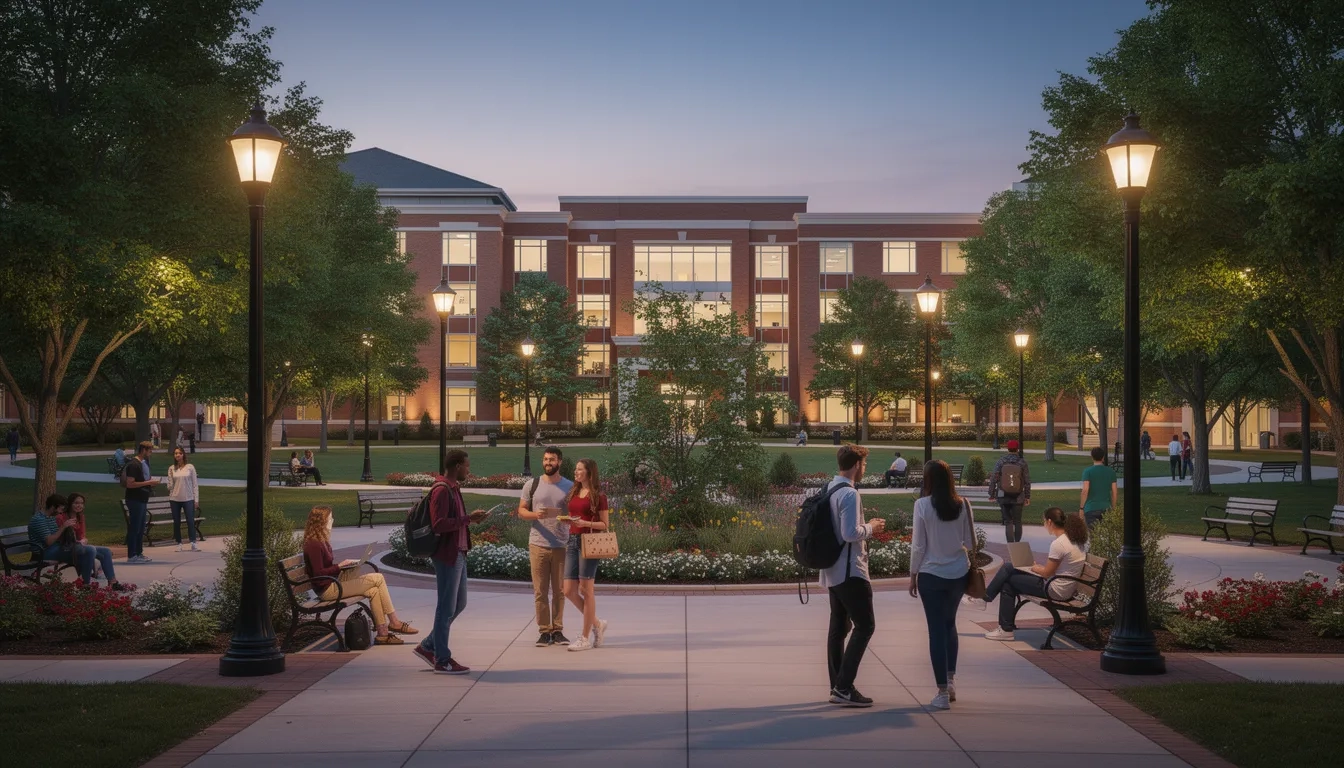
There's a particular energy on campuses in the 4,000–6,000 student range. You're not anonymous, but you're not suffocating either. Butler hits that window almost exactly.
More than 94% of students participate in some organized campus activity. Over 150 student organizations cover everything from a nationally competitive mock trial team to a well-regarded student newspaper (The Butler Collegian, founded in 1919). Greek life pulls in about 35% of undergraduates — present, but not so dominant that students outside it feel like outsiders.
Housing keeps most first-year and sophomore students on campus, which matters more than people realize. The Health and Recreation Complex (HRC) is a genuine fitness facility, not the storage-closet gyms that fill space in older residence halls. Most buildings sit within a walkable ten minutes of each other.
Butler's Bulldogs compete in the Big East Conference. Basketball draws real crowds. The program's Final Four runs in 2010 and 2011 under Brad Stevens (now president of the Boston Celtics) gave the university a national sports profile that still echoes, especially on game days in Hinkle Fieldhouse — one of the most historic arenas in college basketball, built in 1928.
A fair caveat: some students report that social life can feel cliquish, particularly for those who don't join Greek organizations. It's worth factoring in if you're someone who builds community outside formal group structures.
Indianapolis as a Second Campus
Indianapolis doesn't get the cultural credit it deserves. Sitting just five miles from Butler's front gate, it's one of the more livable large cities in the country for students and new professionals.
Career access is the headline advantage. The city ranks among the top ten destinations for new graduates in the U.S., with one specific distinction: jobs are available and housing is affordable simultaneously (a combination that's genuinely rare). Major employers — Eli Lilly, Cummins, Rolls-Royce, Salesforce — maintain large Indianapolis operations. That's why Butler's mandatory internship requirement doesn't feel like a burden; the placements are local.
The city's cultural scene also runs deeper than its reputation suggests:
- Newfields (the Indianapolis Museum of Art campus) holds a world-class permanent collection
- The Children's Museum of Indianapolis is the largest in the world
- Zagat named Indianapolis one of America's most exciting food cities, with Broad Ripple — the neighborhood just north of campus — offering a walkable stretch of independent restaurants
- Five professional sports teams, including the Colts (Lucas Oil Stadium) and Pacers/Fever (Gainbridge Fieldhouse), within easy reach
For students who travel home frequently, Indianapolis International Airport — 20 minutes from campus and consistently rated among North America's best airports — removes a logistical headache that urban campuses in bigger cities can't solve.
The Cost Equation
Sticker price: $47,560 in annual tuition for 2025. Total cost of attendance (room, board, fees included) lands around $69,950. That's private university pricing — comparable to DePaul or Creighton, well below Notre Dame, but not a bargain on its face.
The offset matters here. 92% of undergraduates receive grants or scholarships, with an average award of $25,750 per student. Most students aren't paying the sticker price.
| Cost Scenario | Estimated Annual Cost |
|---|---|
| Full cost of attendance (no aid) | ~$69,950 |
| Average after grants and scholarships | ~$44,200 |
| Students qualifying for stacked aid | Potentially lower |
Butler's merit scholarships extend well into the mid-range of academic profiles, not only to 4.0 students. Students who start scholarship research in spring of their junior year — rather than waiting for an acceptance letter — typically build a far more accurate financial picture before committing. The net price calculator on Butler's admissions site gives a reliable estimate in a few minutes and is worth running early.
Who Should (and Shouldn't) Choose Butler
Butler suits you well if:
- You want hands-on career preparation, especially in business, education, or performing arts
- A tight-knit campus where anonymity is essentially impossible sounds appealing, not threatening
- Indianapolis as a launch pad for your career (and your internship portfolio) is an asset
- You prefer professors whose primary job is teaching, not managing a research lab
Butler may not be the right fit if:
- You want a large research university where 400-level courses are taught by faculty with global reputations in their fields
- You're targeting careers in finance, tech, or media that depend heavily on coastal recruiting pipelines
- Your academic strengths sit in deep STEM areas where R1 universities have infrastructure Butler can't replicate
- Greek life as a social organizing principle is something you'd rather avoid entirely
The honest assessment: for students with a clear sense of direction, Butler over-delivers relative to its price point and prestige. The Lacy School's career outcomes data alone — 98% placement, mandatory dual internships, named recruiters on campus — competes with schools charging the same tuition at considerably weaker results. Students chasing research reputation or coastal networks will find better fits elsewhere. That's not a criticism of Butler; it's just a different kind of school for a different kind of goal.
Bottom Line
- Business students should take Lacy School's #1 career advising ranking and guaranteed dual-internship structure seriously — these are structural advantages that outlast any single year's US News placement.
- Arts students (especially dance and theatre) should visit the Jordan College of the Arts before deciding. The combination of performance access and academic depth is rare at this school size.
- Run the actual net cost math before ruling Butler out on price. With 92% of students receiving aid and merit scholarships distributed broadly, the real number is often far from $69,950.
- Indianapolis is an underrated asset. The city's job density, affordability, and cultural infrastructure compound over four years in ways that students from coastal backgrounds often don't anticipate until they arrive.
Frequently Asked Questions
Is Butler University a good school for business?
By several specific measures, it's excellent. Poets&Quants ranked Butler's Lacy School #8 nationally for academic experience in 2025, ahead of Wharton and Notre Dame's Mendoza in that specific category. The mandatory two-internship requirement and 98% six-month placement rate make it one of the more outcome-focused undergraduate business programs in the country.
What is Butler University most known for academically?
Butler carries three primary areas of distinction: the Lacy School of Business (career preparation and teaching quality), the Jordan College of the Arts (especially dance, ranked top 5 nationally), and the College of Pharmacy and Health Sciences. Its College of Education also has a strong regional reputation for producing career-ready teachers.
Is it hard to get into Butler University?
Butler's acceptance rate is 85%, which makes it far more accessible than most private universities with comparable tuition. In 2024, roughly 8,098 of 9,467 applicants were admitted. It's a moderately selective school — competitive preparation helps, but Butler isn't chasing a low acceptance rate for prestige purposes.
How does Butler University's location in Indianapolis affect the student experience?
Significantly and mostly positively. The campus sits five miles from downtown, giving students access to a real job market (Eli Lilly, Cummins, Salesforce all have major operations nearby), a legitimate restaurant and arts scene, and professional sports. Indianapolis ranks 10th among the best cities for new graduates in the U.S. specifically because jobs are plentiful and housing remains affordable.
Is Butler University worth the cost?
For career-focused students, particularly in business or the arts, the evidence suggests yes. The net price after aid averages around $44,200 annually, and the employment outcomes — especially from Lacy School — compare favorably to peer institutions at similar price points. For students pursuing paths that depend on research infrastructure or coastal recruiting networks, the calculus changes.
Does Butler have a strong campus community?
Most students describe it as tight-knit to a fault. Over 94% participate in some organized campus activity, and the manageable size means you know your professors and your classmates. The trade-off is that social life can feel stratified around Greek life, which draws about 35% of undergraduates. Students who prefer building social connections outside formal organizations sometimes find the initial adjustment harder than expected.
Sources
- Butler University - US News Best Colleges
- Butler's Lacy School of Business Achieves Top National Ranking for Academic Experience
- Living in Indy | Butler University
- Butler University 2026 - Research.com
- 2026 Butler University Rankings - Niche
- What Major Offerings Define Butler University's Academic Reputation - CollegeVine