California Graduate Salary 2026: What New Grads Actually Earn
Fresh out of college in California, you might expect a competitive salary — and you probably will get one. But "competitive" means something very different depending on whether you graduated with a computer science degree heading to the Bay Area or a communications degree landing in Sacramento. The gap between those two outcomes is wider in 2026 than it has been in years, and the data makes that split impossible to ignore.
The National Baseline and Why California Tends to Beat It
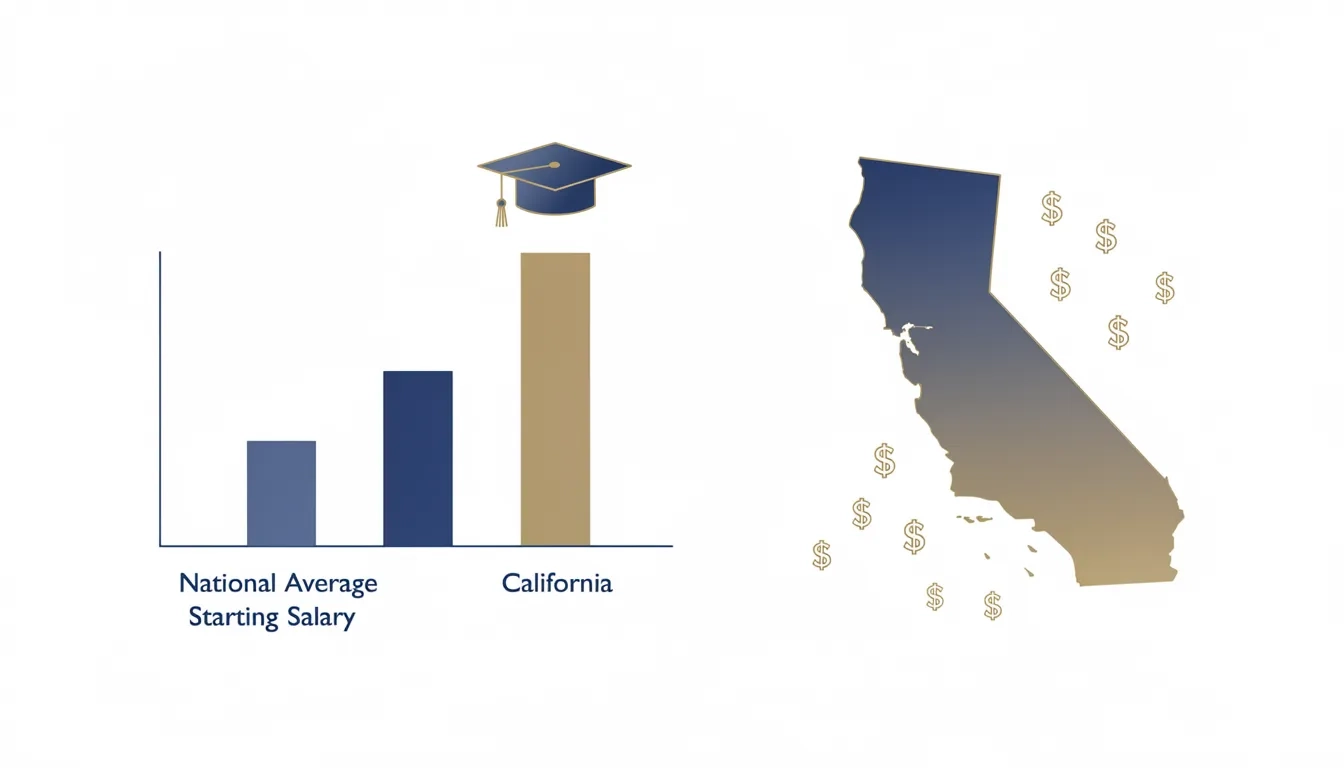
According to the National Association of Colleges and Employers (NACE) Winter 2026 Salary Survey, the average starting salary for a four-year college graduate sits at approximately $69,600 nationally. That's a modest 1.3% increase from 2024. Nothing dramatic.
California graduates generally land above this figure. The state's overall median income is $56,940, but entry-level workers in San Francisco earn a median of $104,400, almost 50% above the national new-grad average. San Jose trails slightly at $95,508. Los Angeles comes in at $72,384, still above the NACE benchmark.
The reasons are structural. California's tech-heavy economy pulls entry-level wages up across the board, even in non-tech sectors competing for the same talent pool. A junior marketing coordinator in San Francisco earns more than her counterpart in Kansas City simply because local employers can't anchor pay to a national average when their engineers are being poached at twice the rate.
What Your Major Is Actually Worth in 2026
The NACE data is blunt about this. Computer science graduates are sitting at an average starting salary of $81,535 nationally, up 6.9% year over year. Physical scientists are actually projected the highest, at $82,766 — a 10.2% jump. Engineering graduates cluster in the high $70,000s to low $80,000s.
Social sciences is the lone outlier going the wrong direction. Starting pay dropped to $66,155, down from $67,316 the prior year. That's the only major category in the survey projecting a decline for 2026.
| Major Category | Projected 2026 Starting Salary | YoY Change |
|---|---|---|
| Physical Sciences | $82,766 | +10.2% |
| Computer Science | $81,535 | +6.9% |
| Engineering | ~$78,731+ | +3.1% |
| Business | ~$76,000 | Increase |
| Mathematics & Statistics | ~$69,802 | Slight increase |
| Communications | ~$58,000 | Slight increase |
| Social Sciences | $66,155 | -1.7% |
| Visual / Performing Arts | ~$42,900 | Flat |
Apply a California premium of roughly 15–25% to these national figures depending on location. A computer science graduate landing at a Bay Area tech firm won't see $81,535. They'll see $120,000 to $160,000 in base salary, sometimes more before stock is counted.
Software Engineering: The Number That Skews Everything
Let me be direct: entry-level software engineering in California distorts every salary average you'll encounter. The figures vary wildly by source, and that variation reflects a genuine divide in the market, not sloppy data collection.
According to Indeed, the California average for entry-level software engineers is $73,512. ZipRecruiter puts it at $103,490. Glassdoor ranges from $115,553 to $187,227. All three are accurate for different slices of the same market.
The lowest range captures roles at small companies, non-tech industries hiring their first developer, or positions far outside major metros. The Glassdoor high end reflects FAANG and near-FAANG roles, where a new grad at Google at the L3 level (their entry-level engineer designation) regularly sees total compensation exceeding $200,000 when RSUs vest.
San Francisco specifically: the average entry-level software engineer salary on Glassdoor is $187,914, with a 25th–75th percentile range of $151,674 to $237,012. That's not an anomaly reserved for a handful of lucky hires. That's the going rate for anyone running the Big Tech recruiting circuit in 2026.
The real question for a CS grad this year isn't "will I make good money?" — it's "which tier of the market am I targeting, and what's my realistic shot at breaking into it?"
Geography Within California: One State, Four Pay Markets
California is not a single salary market. It's closer to four or five, and the spread is large enough to affect major life decisions like where to rent, whether to buy, and how aggressively to pay down student loans.
Here's how entry-level compensation stacks up across the major regions:
- San Francisco / Bay Area: $104,400+ median across all fields; entry-level tech roles often start at $130,000+
- San Jose / Silicon Valley: $95,508 median, heavily weighted toward tech and semiconductor roles
- Los Angeles: $72,384 median, strong across entertainment, healthcare, and a rapidly expanding tech scene
- San Diego: $71,436 median, with notable clusters in biotech and defense contracting
- Sacramento: $57,000 median, anchored largely by state government employment
The SF premium is real. So is the cost. Median rent in California is $2,800 per month. In San Francisco proper, a one-bedroom typically runs $3,300–$3,800. The state's median home price is $910,160 — a figure that, on a $120,000 starting salary, sits well outside the 3x income rule most lenders apply.
Purchasing power, not headline salary, is the number that actually governs your life. A $90,000 salary in Sacramento often stretches further than $130,000 in San Francisco for anyone who isn't planning to rent forever.
The Degree Premium Hasn't Gone Away
There's been real noise over the past few years about whether a four-year degree is still worth it financially. The salary data doesn't support abandoning higher education. What it does support is being deliberate about which level and which field.
| Degree Level | Average Annual Salary |
|---|---|
| High School Diploma | ~$40,560 |
| Associate's Degree | $46,800 |
| Bachelor's Degree | $66,000 |
| Master's Degree | $80,600 |
| Professional / Doctoral | $101,400 |
Each step up adds roughly $15,000–$20,000 in average annual earnings. Over a 40-year career, men with a bachelor's degree earn approximately $900,000 more than high school graduates; women, $630,000 more (based on Census Bureau figures analyzed by ThinkImpact).
But the table obscures something important. The MBA in 2026 has a complicated return on investment. Stanford GSB and Haas at UC Berkeley still command massive salary jumps, regularly pushing total comp past $200,000 upon graduation. Mid-tier programs? The debt-to-income math gets murky fast, especially against California's $2,800 average rent. Anyone considering a full-time MBA outside the top dozen programs should run the numbers carefully before signing.
Industries Actually Hiring New Grads in California
The NACE survey found that at least 60% of employers plan to hire new grads in finance, mechanical engineering, and computer science roles. Accounting and business administration also crossed the 50% mark.
What's contracting: communications, social sciences, and humanities-adjacent roles. This isn't a 2026 discovery — it's been building for a decade. The difference now is that the gap has widened to the point where it can't be explained away by a bad year or a slow economy.
A few California-specific industries worth watching:
- Biotech and Life Sciences (San Diego, Bay Area): Entry-level research associate and lab scientist roles typically start at $65,000–$85,000. Hiring has been steady even as tech went through layoff cycles.
- Defense and Aerospace (Los Angeles, San Diego): Northrop Grumman, Lockheed Martin, and Raytheon all have major California campuses actively hiring new engineering graduates at $75,000–$95,000. Security clearance eligibility adds significant long-term salary leverage.
- Entertainment and Media (LA): The writing is on the wall. AI disruption is compressing entry-level roles in traditional media and content production. Production assistants and junior marketing roles often start well below the California median.
The $26K vs. $139K Problem (And What the Real Number Is)
Here's something that trips up a lot of job seekers doing salary research: the "new graduate" median on Salary.com for California comes in at $26,186 annually. That $13/hour figure isn't wrong — it's just measuring a specific, narrow job title called "New Graduate" that aggregates clinical rotations, campus employment, and part-time internship-adjacent roles.
On the other end, Glassdoor reports a median of $129,563 for recent college graduates in California. That swings in the opposite direction, skewed by tech and finance professionals who are more likely to fill out voluntary salary surveys.
The most grounded baseline for full-time California entry-level work across all fields sits between $55,000 and $75,000, drawing from ZipRecruiter's fresh graduate average of $55,602 and adjusting upward for California's consistent premium over NACE national figures. Tech and finance roles sit above this band. Education, arts, and public sector roles typically fall below it.
Neither extreme cited in headlines tells the full story. The truth lives in the middle.
Bottom Line
California graduate salaries in 2026 follow a clear logic once you strip away the noise.
- Your field of study is the biggest variable. Computer science and physical sciences grads enter at $80,000+ nationally, with Bay Area premiums pushing total comp past $150,000 at major tech employers. Social science and arts grads face a measurably harder market this year.
- City choice is a genuine financial decision, not just a lifestyle preference. San Francisco pays more but costs dramatically more. San Diego and Sacramento offer better purchasing power for non-tech fields.
- Advanced degrees pay off selectively. STEM master's programs and elite MBAs show clear salary premiums. Mid-tier professional degrees warrant hard scrutiny of the debt load before enrolling.
- Ignore the $26K and $139K headlines. The honest range for full-time entry-level work in California is $55,000–$95,000 for most fields, with tech and finance creating significant upward outliers.
The single most actionable insight from all of this: specialization is being rewarded and generalism is being penalized. California's job market in 2026 is making that distinction sharper than ever, and the salary data backs it up clearly.
Frequently Asked Questions
What is the average starting salary for new graduates in California in 2026?
For full-time roles across all disciplines, expect roughly $55,000–$75,000 as a practical baseline. Computer science and engineering graduates entering Bay Area tech firms commonly start at $120,000–$160,000 in base salary. Education, arts, and social services roles typically fall in the $40,000–$60,000 range. The national NACE average of $69,600 represents a reasonable floor for four-year degree holders entering professional roles.
Are California graduate salaries actually higher than the national average after cost of living?
In raw dollar terms, yes — often by 15–40% depending on city. But California's cost of living consistently erodes that advantage. Median rent at $2,800/month and home prices above $910,000 mean that real purchasing power for a grad in Sacramento often beats that of a higher-earning grad in San Francisco. The salary premium is real; whether it translates to better financial outcomes depends on spending patterns and housing decisions.
Which majors pay the most for Class of 2026 graduates?
According to the NACE Winter 2026 Salary Survey, physical sciences ($82,766) and computer science ($81,535) lead nationally, with engineering close behind in the high $70,000s. In California, these figures get amplified further by the density of tech and biotech employers competing for the same talent. Social sciences ($66,155) and the visual and performing arts (around $42,900) sit at the bottom.
Is a master's degree worth the investment for California graduates in 2026?
For STEM fields and the top-ranked business programs, the data says yes. A master's in computer science or data science from a UC campus can push starting salaries from $120,000 to $160,000+. For mid-tier MBA programs, the calculation is less clear — factor in two years of California living costs and foregone salary before committing. The degree premium is real at the top; it fades quickly as you move down the rankings.
Why do salary figures for California graduates vary so much between websites?
Different platforms measure different things. Salary.com's "New Graduate" category tracks a specific job title that includes part-time and internship-level roles. Glassdoor skews toward tech and finance respondents who are more motivated to submit data. NACE figures come from employer surveys and carry the most methodological rigor for tracking true entry-level full-time hiring. Treat any single number skeptically and triangulate across sources.
Should new graduates prioritize salary or location when choosing where to work in California?
For tech and biotech fields, the Bay Area's network density and career trajectory benefits are hard to replicate elsewhere — the long-term upside often justifies the short-term cost squeeze. For fields where entry salaries don't scale with California's costs (education, social work, non-profit), the financial case for the Bay Area weakens considerably. San Diego and Sacramento both offer meaningful career opportunities at a cost of living that makes saving money in your 20s actually feasible.
Sources
- Class of 2026 Salary Projections Are Promising — NACE
- Employers Project Salary Increases for Most New Graduates — Inside Higher Ed
- 2026 Average College Graduate Salaries — ThinkImpact
- New Graduate Salary in California — Salary.com
- Average Salary in California: 2026 Insights — Playroll
- Entry Level Software Engineer Salary in California — Indeed
- Fresh Graduates Salary in California — ZipRecruiter