College ROI Report: Which Schools and Majors Actually Pay Off
The gap between the highest-paying and lowest-paying college majors amounts to over $3.4 million in lifetime earnings. Not a rounding difference. A retirement account. And the school you attend shifts that math almost as much as the subject you study.
How College ROI Actually Gets Calculated
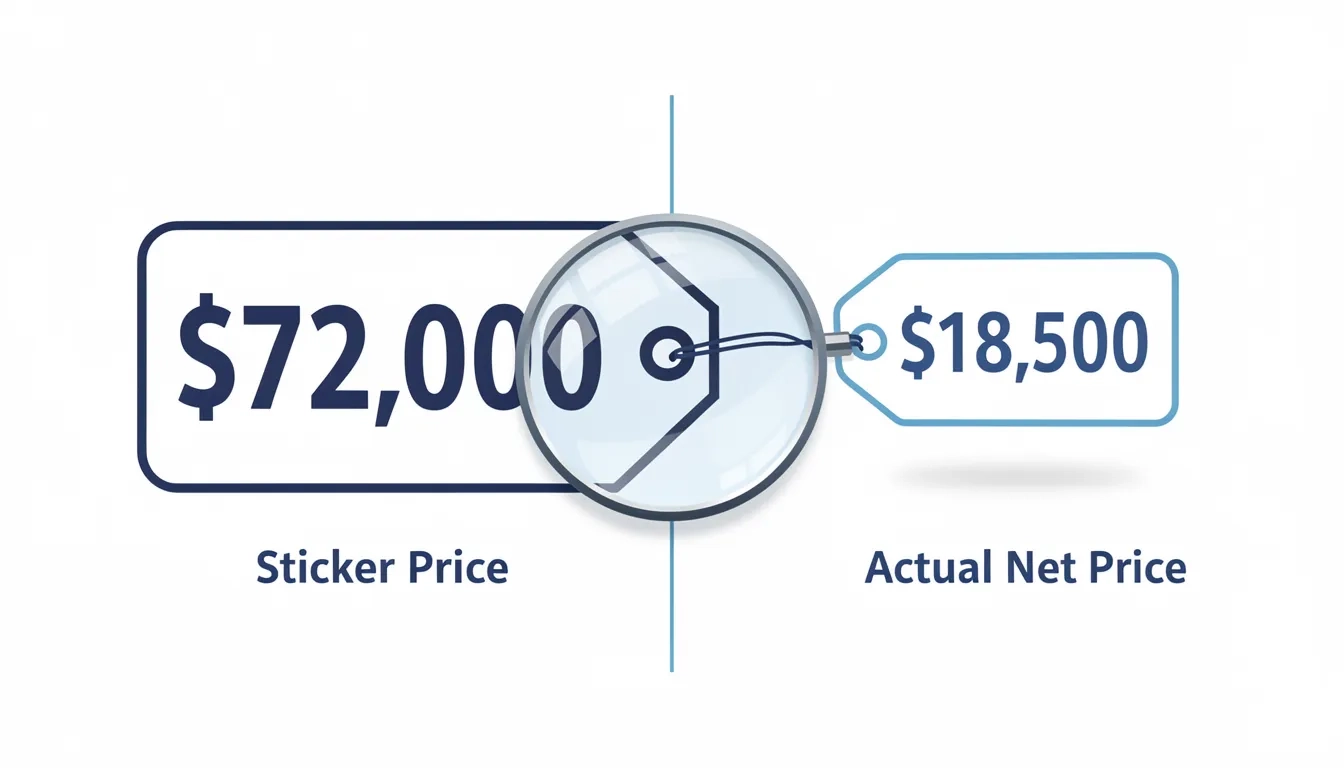
Most families compare schools by sticker price. That's the wrong number.
Georgetown University's Center on Education and the Workforce ranked more than 4,600 colleges by return on investment, using federal College Scorecard data. Their methodology: median earnings at six, eight, and ten years post-enrollment, minus average net price paid by aid recipients. ROI is then measured across 10, 15, 20, 30, and 40-year horizons — the same net present value logic an investor applies to any long-term asset.
The Federal Reserve Bank of New York puts the median ROI for a bachelor's degree at roughly 12.5%, which clears the 8% benchmark most financial planners use for strong long-term investments. But that median hides enormous variance. Some schools and degrees outperform most equity portfolios. Others barely beat a savings account.
Here's where the common assumption breaks: an expensive school is not automatically a worse investment. A school charging $65,000 per year with generous need-based aid, a 95% graduation rate, and $130,000 median starting salaries can decisively beat a $20,000-per-year school where 40% of students never finish.
Georgetown's research found that graduation rates show the strongest positive correlation with ROI at bachelor's degree-granting institutions — stronger than STEM concentration, selectivity, or cost alone.
That single finding reshapes the whole conversation. A cheap school with a 45% graduation rate is a financially risky bet. An expensive school with a 97% graduation rate and strong need-based aid can be the better deal.
The Schools That Top the Charts
Ranked by 40-year net present value (the most meaningful long-range measure), specialized STEM and health sciences institutions dominate. The pattern is consistent: graduate fast, into high-demand work, with minimal debt.
| School | 40-Year NPV | Median Starting Salary |
|---|---|---|
| Univ. of Health Sciences & Pharmacy (St. Louis) | $4,562,000 | $116,360 |
| Harvey Mudd College | $4,506,000 | $112,500 |
| MIT | $4,484,000 | $126,438 |
| Albany College of Pharmacy | $4,447,000 | $121,000 |
| Franklin W. Olin College of Engineering | $4,160,000 | $90,500 |
| Stanford University | $3,872,000 | — |
| Carnegie Mellon University | $3,855,000 | — |
| Bentley University | $3,830,000 | — |
MIT's figures deserve a closer look. Nearly 88% of the Class of 2025 graduated debt-free (the school replaces all loans with grants for financial aid recipients). Sticker price sits at $62,396 per year — but most qualifying families pay a fraction of that, which explains why MIT consistently lands near the top of ROI tables despite appearing expensive.
Princeton works the same way. Students receiving aid pay an average of $10,555 per year, then earn over $110,000 annually a decade after graduating. That 10-to-1 return on annual cost is difficult to beat anywhere.
Among public schools, Georgia Tech in Atlanta has held the top ROI spot for three consecutive years. At roughly $12,682 per year in-state, engineering and computing graduates leave with modest debt and step into one of the strongest hiring markets in the country. Brooklyn College jumped from seventh to first in Forbes' 2025 student ROI rankings — not because its graduates out-earn Ivy League alumni, but because tuition is low enough that solid career outcomes produce compelling returns.
The pattern: you can reach high ROI from either end of the cost spectrum. Either attend a school whose graduates earn exceptional salaries, or attend somewhere affordable enough that ordinary salaries produce strong returns.
What Your Major Does to the Math
School matters. Major often matters more.
Here's the current salary data by field (starting vs. mid-career pay):
- Petroleum Engineering: $83,000 → $176,000 mid-career (112% growth)
- Computer Science: $78,000 → $142,000
- Computer Engineering: $76,500 → $138,000
- Electrical Engineering: $74,000 → $134,000
- Chemical Engineering: $73,500 → $132,000
- Finance: $62,000 → $119,000 (92% growth)
- Nursing (BSN): $60,000 → $85,000, with near-zero unemployment
- Economics: starts modestly, but grows 97% by mid-career
Two fields that catch people off guard: economics and mathematics. Both start below most engineering majors. Both catch up fast — and in finance, consulting, and tech often blow past them — because the skills transfer into industries where compensation accelerates hard after year five.
Then there's philosophy. Philosophy majors see 107% salary growth from entry to mid-career, highest of any humanities field. A disproportionate share go to law school or management consulting, and both pay well. The major is not the asset; the analytical training is.
The Hidden Variable Most Families Miss
Only about 55% of students at four-year institutions pay anything close to published tuition. Everyone else receives institutional aid that substantially changes the cost calculation.
Georgetown's methodology uses average net price for aid recipients rather than sticker price — which is why elite schools that look financially terrifying often produce better ROI than mid-tier privates charging high rates for average outcomes.
A working process for evaluating real ROI:
- Pull the average net price from College Scorecard for every school on your list, not the published rate
- Run each school's net price calculator — outcomes can vary by $20,000 or more between schools with identical sticker prices
- Multiply net price by your realistic time-to-graduation, not four years flat — five or six years adds $30,000 to $100,000 to true cost
- Look up median earnings at six years post-enrollment for that school's programs on the Scorecard
Most families do steps one through three. Step four is where the most predictive data sits — and where most people stop doing research and start trusting brochures.
Certificates and Associate Degrees Are Underrated
The bachelor's degree is not always the right call. Georgetown's data makes this case directly.
Certificates and associate degrees beat bachelor's degree ROI in the 10-to-20-year window, for students who complete them quickly in high-demand technical fields. Pharmacy technician credentials, verified coding programs, and trade-specific certificates can produce $55,000–$80,000 salaries after 18 months of training — years before a four-year graduate enters the job market.
The tradeoff is real: bachelor's degrees typically pull ahead at 30 to 40 years as earnings compound and management roles open up. But that advantage shrinks when a student takes five years to finish, carries $90,000 in debt, and enters a field with limited salary growth.
The honest question for anyone choosing between two-year and four-year programs: what does the earnings curve look like in this specific field, not on average? In healthcare and technology trades, the gap between sub-baccalaureate credentials and bachelor's-level earnings is smaller than most people expect.
The 25% Problem
Here's the number the higher education industry doesn't advertise loudly: roughly one in four college graduates experiences little to no positive financial return from their degree.
This group clusters around familiar patterns. They often attended schools with graduation rates below 50%, borrowed against uncertain career outcomes, or entered fields where graduate supply outpaced employer demand. Some graduated into weak labor markets — the Federal Reserve Bank of New York has documented that entering the workforce during a downturn suppresses earnings for 10 to 15 years afterward, a phenomenon economists call "scarring."
No single factor guarantees a bad outcome. But the highest-risk combination is: expensive school, low-demand field, weak graduation rate. Any one of those alone is manageable. All three together and the numbers rarely work out.
A Framework for Your Own Decision
The right school for someone pursuing electrical engineering in Texas looks nothing like the right school for someone studying social work in Vermont. But the decision structure holds across both:
If you already know your field:
- Search College Scorecard for median earnings at ten years post-enrollment in that specific program
- Choose the school with the best graduation rate and lowest net price in that field — brand name is secondary
If you don't know your field yet:
- Prioritize schools with strong internal transfer policies, diverse program offerings, and high graduation rates
- Avoid locking in major-specific debt before you've completed a full semester of actual coursework
If cost is the binding constraint:
- In-state public schools (especially strong regional flagships) reliably deliver the best risk-adjusted ROI
- Georgia Tech in-state produces graduates who earn a median $23,847 more annually at ten years out than graduates from comparable regional state schools
My take: the "prestige at any price" argument is mostly wrong, and the "just go somewhere cheap" argument undersells what a strong institution does for network access, internship pipelines, and career mobility over decades. The data supports something in between — get the best graduation rate and strongest career outcomes for the lowest net cost you can actually achieve. That's the formula.
Bottom Line
- Graduation rates are the single strongest ROI predictor. A school where students consistently finish outperforms one with a strong brand but poor completion data.
- Net price is the number that matters — run the net price calculator for every school before comparing costs. Sticker prices are marketing.
- Major selection can swing lifetime earnings by $3.4 million. Engineering, computer science, pharmacy, and economics lead on financial returns. Philosophy and economics surprise people if graduate or professional school is part of the plan.
- Public schools at in-state rates — especially Georgia Tech and Brooklyn College — consistently rank among the best ROI options without elite price tags.
- For two-year vs. four-year decisions: check the specific field's earnings curve, not aggregate statistics. In healthcare and technology trades, sub-baccalaureate credentials close the gap faster than most people expect.
Frequently Asked Questions
Is a college degree still worth it financially?
For most students in most fields, yes. The Federal Reserve Bank of New York calculates a median ROI around 12.5% for bachelor's degrees, above most long-term investment benchmarks. The risk sits with the roughly 25% of graduates who attend expensive schools, fail to finish, or enter low-demand fields carrying heavy debt.
Which college major has the best ROI?
Engineering fields — particularly petroleum, computer, and electrical — show the strongest starting salaries and long-range earnings trajectories. Computer science graduates start at around $78,000 and reach $142,000 mid-career. Economics and mathematics often close the gap through finance and consulting, despite lower starting pay.
Myth vs. reality: does an expensive private college always mean worse ROI?
Myth. It depends entirely on the net price you actually pay. MIT and Princeton charge sticker prices above $62,000 per year but offer financial aid that brings average costs to roughly $10,000–$15,000 for qualifying families, producing excellent long-term returns. Mid-tier privates that charge high rates and deliver average outcomes frequently lose to flagship state schools on net present value.
Does the college's brand name matter for earnings?
Less than it used to, outside the true elite tier. Georgetown's data shows graduation rates and field of study correlate more directly with long-term earnings than institutional prestige. A computer science degree from Georgia Tech regularly outperforms the same credential from a less specialized private school at twice the price.
What's the fastest path to a positive college ROI?
Graduate on time, keep net price low, and choose a field with strong employment rates and real upward salary mobility. Students who take six years to finish a four-year degree, at list price, in a low-demand field face the steepest climb to break even. Time-to-graduation is an underrated variable in the cost calculation.
Are certificate and trade programs better value than a four-year degree?
In the 10-to-20-year window, Georgetown's research shows certificates and associate degrees frequently match or exceed bachelor's degree ROI because of lower cost and shorter completion time. Bachelor's degrees typically pull ahead by year 30 to 40. The right choice depends on the specific field and your intended career trajectory, not the credential type alone.