Education Career Salaries: Teaching vs. Administration Compared
The average school principal in the U.S. earns $104,070 a year. The average teacher earns $74,495. On paper, that's a $29,575 raise for moving from classroom to corner office — enough to make the decision feel obvious.
It's not obvious. The salary difference is real, but the full picture involves 60-hour weeks, an additional master's degree (sometimes two), giving up the daily classroom connection many educators genuinely love, and a career path that can take 10–15 years to pay off. Some teachers who moved into administration say the money didn't compensate for what they lost. Others say it was the best professional decision of their lives.
Which camp you land in depends entirely on what you're optimizing for.
How Teacher Pay Actually Works
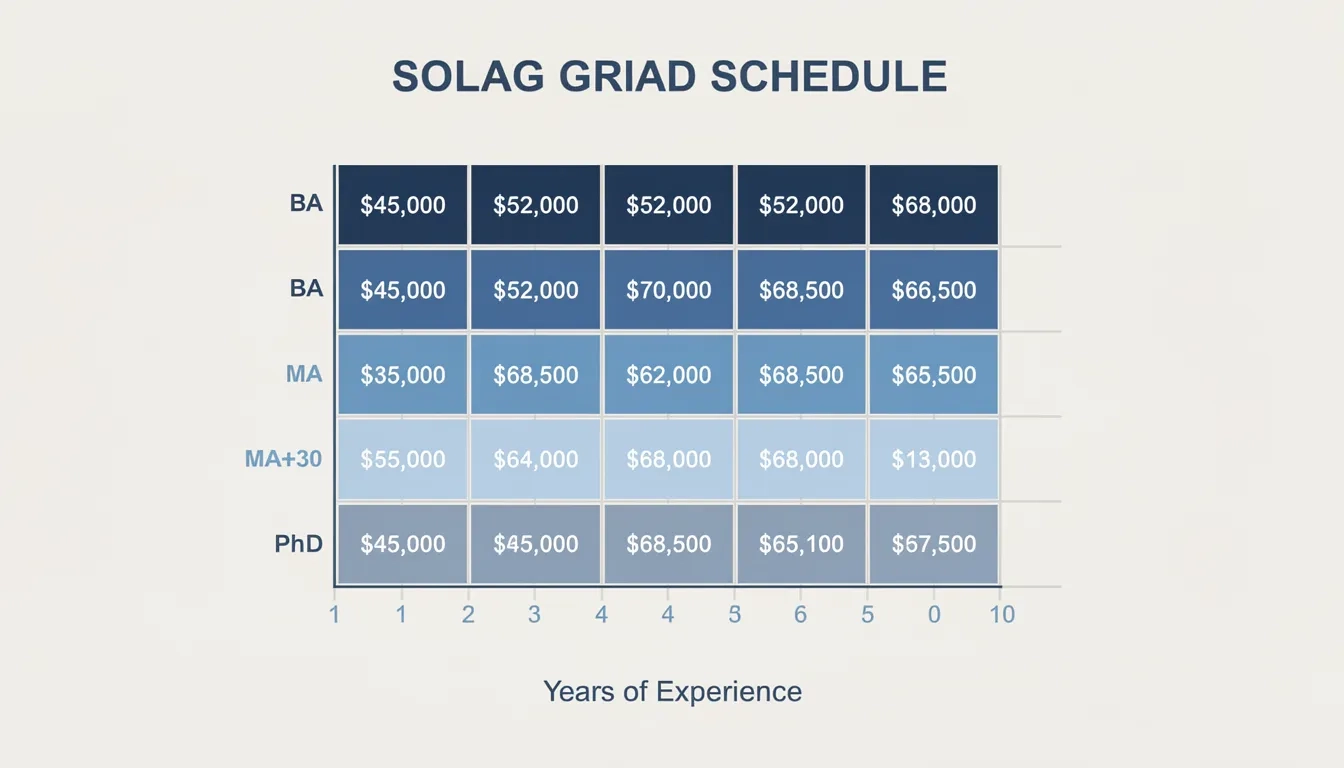
Most public school teachers are paid on what's called a step-and-lane salary schedule — a grid where your pay is determined by two factors: years of service (steps) and educational attainment (lanes). It's predictable and transparent, but it removes individual negotiation from the equation almost entirely.
Here's the typical structure:
- Entry-level teachers with a bachelor's degree start around $48,112 nationally (NEA, 2024–25)
- Each additional year of service adds a "step" — usually $500–$2,000 depending on the district
- Earning a master's degree moves you to a higher lane, adding $3,000–$8,000 annually
- Most schedules top out somewhere between year 20 and year 30
The practical effect is significant. A teacher who started at $48,000 in 2005 might be earning $72,000–$80,000 today — after two full decades in the classroom. That's real growth, but the ceiling is visible from day one.
Geography reshapes everything. California teachers average $103,552 a year — the highest in the nation, per NEA's 2025 data — while Mississippi teachers average just $54,975. That's the same credentials, the same daily workload, and a $48,577 income gap based purely on which side of a state line you're standing on.
Union representation adds another layer. Teachers in states with collective bargaining earn, on average, 24% more than counterparts in non-union states. A Mississippi teacher relocating to California isn't just changing scenery — she's potentially rewriting her entire earnings trajectory.
"Teachers earn 27% less, on average, than similarly educated professionals in other fields" — NEA, 2025. That professional pay penalty has barely budged despite recent salary increases.
The Administration Ladder: From AP to Superintendent
School administration isn't one job. It's a career ladder with distinct rungs, each carrying its own compensation range, credential requirements, and day-to-day reality.
Assistant Principal is usually the first step out of the classroom. National averages cluster around $80,000–$95,000 depending on district size and state. The role involves discipline management, scheduling, staff oversight, and a mountain of compliance work. Most APs are also year-round employees — summers off are largely gone from this point forward.
Principal is where the BLS's most current data applies: a median annual wage of $104,070 as of May 2024. That's the midpoint. Principals in wealthy suburban districts or large urban systems often clear $130,000–$150,000, while rural district leaders may sit closer to $75,000. The salary comes with being the public face of the building — every parent complaint, budget shortfall, and local media call routes to you.
Superintendent is where the numbers shift into a different tier entirely. According to Research.com's 2026 analysis, superintendent salaries range from roughly $148,000 to well over $220,000 nationally. Large-district superintendents in California and New York frequently earn $300,000 or more — with outliers reaching $545,618 in Washington state. Getting there typically requires a doctoral degree (Ed.D.) and 15–20 years of progressive experience. It also comes with board politics, contract negotiations, and community scrutiny that make the principal's job look calm.
Side-by-Side: The Numbers
| Role | Median Annual Salary | Education Required | Typical Years to Reach |
|---|---|---|---|
| Teacher (national avg.) | $74,495 | Bachelor's + teaching cert | Starting role |
| Instructional Coach/Coordinator | $66,000 | Master's often preferred | 3–8 years |
| Assistant Principal | $80,000–$95,000 | Master's in admin | 5–10 years |
| Principal | $104,070 | Master's in admin | 8–15 years |
| Central Office Director | $110,000–$140,000 | Master's or Ed.D. | 10–18 years |
| Superintendent | $160,000–$220,000 | Ed.D. expected | 15–25+ years |
One thing that table won't tell you: instructional coaches and coordinators often earn less than experienced classroom teachers. A 15-year teacher in a high-cost state might already be at $85,000; the instructional coordinator role she's considering pays $66,000. The lateral move to a hybrid leadership role can be a pay cut. That surprises most people who haven't run the numbers.
What You Give Up When You Move Up
Here's what nobody puts in the job posting: the hidden costs of moving into administration are significant and not fully reflected in salary figures.
Summers disappear first. Teachers receive roughly 10–12 weeks off annually (even if part of that goes to curriculum work or professional development). Most administrators work 11–12 months, with maybe two or three weeks of vacation. For many educators, that summer break is what makes the salary trade-off of teaching sustainable — it creates space for a side job, a side business, family time, or plain recovery from a demanding year.
The stress profile changes completely. Teachers manage classrooms, student behavior, and parent communication. Hard work. But administrators layer on: staff evaluations, district politics, budget cuts, facility crises, legal compliance requirements, media inquiries, board presentations, and being reachable 24/7 during any school emergency. Education Week's 2025 research found that while teacher burnout is genuine and persistent, principal burnout may be worse — school leaders are exiting the profession at accelerating rates in several states.
Then there's the degree cost. Moving from teacher to administrator requires a master's in educational leadership or administration — typically $20,000–$45,000 over two years. A superintendent position usually expects an Ed.D., which can run $40,000–$80,000 and add three to five more years. If you spend 15 years in administration, the math works. If you leave after four years because the role wasn't what you expected, it often doesn't.
The Long-Term Math: Pensions, Benefits, and What Salary Surveys Miss
Straight salary comparisons skip two variables that matter enormously in public education: pension structures and what actually lands in your bank account after deductions.
Most public school employees participate in defined-benefit pension plans. The structure rewards long tenure heavily — a teacher with 30 years in the classroom often retires with 60–75% of her final salary as a pension, paid monthly for life. The same is true for administrators. But since administrators' final salaries are higher, the pension multiplier compounds in their favor. A principal retiring after 30 years at $104,070 might receive $62,000–$78,000 annually in retirement; a teacher at $74,495 might receive $44,000–$56,000.
The long-term advantage runs to administration. But there's a catch that catches a lot of people off guard.
In many states, transitioning from a teaching position to an administrative one resets pension credit — or requires buying back service years at real cost. Illinois and New Jersey both operate separate pension systems for teachers and administrators. Moving between them without careful planning can genuinely reduce lifetime retirement income, even if the working salary was higher. Before making any career transition, a direct call to your state's teachers' retirement system to ask about portability is not optional. It's essential.
Benefits are more comparable across both tracks. Health insurance, dental, and vision at employer-subsidized rates are standard on both sides. That piece of total compensation is frequently underweighted in salary comparisons.
Who Should Make the Move
My honest read of the data: the financial case for moving into administration is real but smaller than it looks, and the workload case against it is larger than most people expect.
The case for staying in the classroom:
- If you're in California, New York, or Washington with 15+ years of experience, you may already be earning $85,000–$100,000. The gap between you and a first-year assistant principal could be $5,000–$15,000 — not $30,000. Not worth trading summers for.
- If you genuinely love the daily student relationship, no salary number fills that absence. Many teachers who left for administration say this plainly.
- If your district is strongly unionized, your step-lane schedule has a clear, predictable path to a comfortable retirement.
The case for moving into administration:
- If you're in a low-wage state where teacher salaries top out in the low $60s, the administrator salary jump is proportionally much larger — and worth pursuing if the leadership work appeals to you
- If you find individual classroom work limiting and want to shape school-wide policy, curriculum, or culture at scale, administration fits
- If your state has strong pension portability between teaching and administrative service, the long-term math favors the move
A practical framework for deciding:
- Calculate the real gap using future projections. Compare your estimated teacher salary in year 10 — not your current salary — against assistant principal starting pay in your specific district.
- Factor in degree cost and break-even timeline. If a master's in educational leadership costs $35,000, how many years of higher admin salary does it take to recover that investment?
- Call your state pension office. Ask one direct question: "If I move from a teaching position to an administrative one, what happens to my accumulated service credit?" The answer varies by state and can shift the entire financial analysis.
- Shadow a principal for a month before committing to a degree program. The job looks different from inside a classroom than it does from the hallway. One month of observation costs nothing. A degree program costs years.
Bottom Line
- The salary ladder is real. Teachers average $74,495. Principals average $104,070. Superintendents commonly earn $160,000–$220,000. Each step up requires more credentials, more years, and more administrative weight.
- The trade-offs are also real. Administration means year-round work, longer hours, political exposure, and giving up the classroom dynamic that drew most educators to the profession.
- Run the pension math before you decide. In many states, a teaching-to-administration transition affects retirement benefits in non-obvious ways. The 30-year picture matters more than this year's paycheck.
- The highest salary isn't always the best outcome. A teacher earning $92,000 in New York with 18 years in, summers free, and a classroom she loves may be in a genuinely better position than a principal earning $115,000 while working 60-hour weeks with two weeks of vacation per year. The numbers don't tell you what the job feels like from the inside.
Frequently Asked Questions
Do school principals make significantly more than experienced teachers?
At the national median, yes — principals earn about $30,000 more. But the gap narrows significantly for experienced teachers in high-wage states. A 15-year California teacher can earn $90,000–$100,000, leaving only a $10,000–$15,000 gap between her and a first-year assistant principal. The difference is largest in Southern and Midwestern states where teacher salaries top out around $60,000.
Does getting a master's degree make financial sense for teachers who don't plan to go into administration?
In most districts, yes. A master's degree triggers a lane change in the step-and-lane schedule, typically adding $3,000–$8,000 per year to base salary. Over a 20-year career, that's $60,000–$160,000 in additional earnings. The break-even on a $30,000 master's program usually hits in about 4–6 years — solid math if you plan to stay in teaching long-term.
Is it a myth that administrators and teachers work similar hours?
Largely, yes. Most teachers work 10–15 hours beyond their contracted week on average. Administrators routinely work 50–60+ hours, including evenings for board meetings, weekend events, and year-round schedules without summer breaks. The salary premium partially compensates for this, but the workload increase is not marginal — it's structural.
What's the fastest realistic path from classroom teacher to principal?
Most states require a master's in educational leadership (2–3 years), followed by experience as an assistant principal before a principal appointment. Moving quickly, the realistic minimum is 5–7 years from classroom to principalship. A decade is more common. Anyone promising a faster route is typically selling a credential, not a career.
Do teachers or administrators get better retirement packages?
Both typically participate in defined-benefit pension plans, but administrators retire on higher final salaries, producing proportionally larger lifetime pension payouts. The risk for career-changers is pension portability — some states treat teaching and administrative service credit differently, which can reduce lifetime retirement income even if your working salary was higher. This deserves direct research before any transition.
What education roles offer better pay without fully leaving the classroom?
Department heads, curriculum specialists, and instructional coaches offer a middle path. High school department chairs typically receive stipends of $3,000–$8,000 per year on top of base teacher salary. Instructional coordinators average around $66,000 nationally but can reach $80,000–$90,000 in higher-wage districts. These roles keep one foot in classroom culture while building the leadership experience that makes an eventual administrative move more competitive.
Sources
- NEA Educator Pay Data 2026
- BLS Occupational Outlook Handbook: Elementary, Middle, and High School Principals
- Teacher Pay 2026 — NEA Today
- Education Administrator Salary — PayScale
- How to Become a School Superintendent: Salary and Job Outlook — Research.com
- Fewer Teachers Plan to Quit, But Pay and Burnout Are Still Major Issues — Education Week