Emory University: Admissions, Rankings, and What Campus Life Actually Looks Like
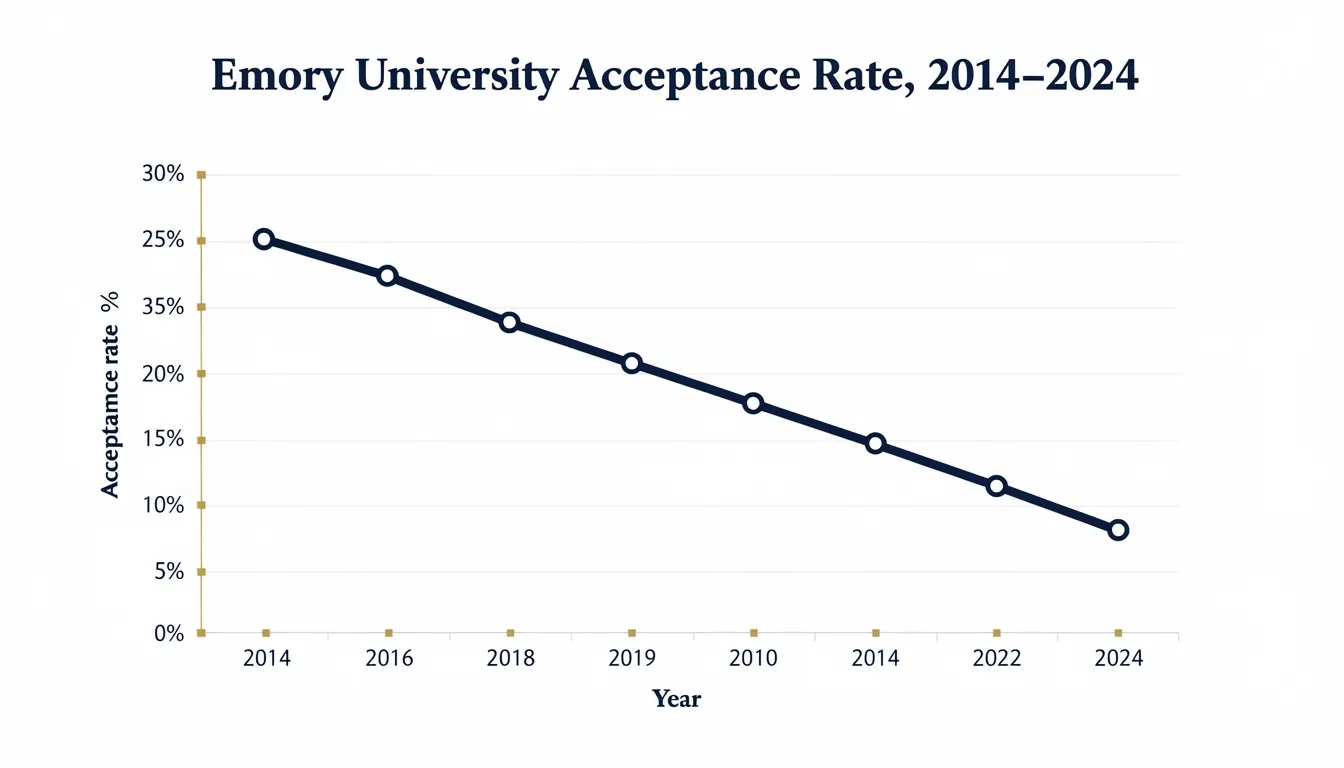
43,269 applications landed at Emory's admissions office for the Class of 2030. That's a record. It came from a university that, until recently, many Americans outside the Southeast couldn't locate on a map. Emory isn't Harvard. It isn't Stanford. But by the numbers, it's nearly as hard to get into — and the question of why is more interesting than the acceptance rate itself.
The Numbers Behind the Name
Emory's acceptance rate has been in near-continuous decline for over a decade. For the Class of 2024, about 28,517 applications arrived. By the Class of 2029, that number had grown to 34,614, with only 3,562 offers going out — producing a 10.3% overall acceptance rate. The Class of 2030 then broke every prior application record at 43,269 submissions.
US News & World Report ranks Emory #24 among National Universities in 2026, while WalletHub ranked it #1 for Best College Social Environment in 2025. The QS World University Rankings place it at #182 globally. That's an unusual combination for a school most outsiders associate with driven pre-med students.
Here's how Emory stacks up against its closest peer institutions:
| University | US News 2026 Rank | Overall Acceptance Rate |
|---|---|---|
| Emory University | #24 | ~10.3% |
| Georgetown University | #22 | ~13% |
| Wake Forest University | #35 | ~21% |
| Tulane University | #44 | ~13% |
| University of Miami | #55 | ~17% |
Emory is harder to get into than most of its US News neighbors, despite ranking below several of them. That gap reflects something real: a school whose reputation has grown faster than ranking methodology can fully capture.
What Emory Actually Looks For
The middle 50% SAT range for the enrolled Class of 2029 was 1480–1540, with a median score of 1510. ACT scores ran 32–35. But here's what surprises most applicants: only 43% of enrolled students submitted SAT scores, and a mere 20% submitted ACT scores. Emory's test-optional policy has genuine weight — it isn't just marketing language.
Grades and course rigor carry the most influence. The average unweighted GPA among admitted students was 3.84. A full 80% of the enrolled class ranked in the top 10% of their high school class. Interestingly, only 17.4% had perfect 4.0 GPAs — meaning the typical admit is a student with exceptional coursework and near-perfect grades, not necessarily a flawless transcript.
Emory's officially listed "Very Important" admission factors:
- Rigor of secondary school record
- Academic GPA
- Letters of recommendation
- Extracurricular activities
- Character and personal qualities
- Talent and demonstrated ability
Standardized test scores fall one notch lower in the "Important" category, alongside essays and volunteer work. The enrolled class profile shows this hierarchy plays out in actual decisions, not just on paper.
Early Decision: The Biggest Lever Applicants Have
Short answer: it works, and it works a lot.
For the Class of 2029, ED I applicants were admitted at 23.2% versus 10.3% overall. For the Class of 2030, the ED I rate climbed to 29%. That's approximately three times the odds of applying regular decision. Emory will note that academic and holistic standards are identical across rounds — technically accurate. But the numbers don't lie.
The binding nature of ED matters practically. You cannot compare financial aid offers if you've committed before receiving them. Students who need to evaluate scholarship packages from multiple schools should apply regular decision and accept the lower odds. That's the sensible call for families where aid is the deciding factor.
If Emory is a clear first choice and your financial circumstances allow binding commitment, Early Decision I is by far the most effective tool available to any applicant.
An often-overlooked entry point is Oxford College (Emory's two-year liberal arts campus 38 miles east of Atlanta, in Oxford, Georgia). Oxford runs its own admissions process, typically with a somewhat higher acceptance rate than the main campus. Students complete two years there before transitioning to the Atlanta campus for junior and senior year — with access to all Emory degrees. Competitive applicants who want a real shot at the Emory experience should research Oxford seriously.
The waitlist is a different story entirely. For the Class of 2028, only 109 of the 3,355 students who confirmed their spot on the waitlist ultimately received admission. That's a 3.25% waitlist conversion rate. Not impossible — but not a strategy to build a college list around.
Life Inside the Emory Bubble
WalletHub's #1 social environment ranking would catch anyone off guard who pictures Emory as a pressure-cooker of MCAT prep and pre-law anxiety. The campus is active in ways the ranking actually reflects. 325+ student organizations span cultural groups, improv comedy, consulting clubs, research societies, advocacy organizations, and a lot in between. About 20% of students join Greek life — present enough to have a social presence, restrained enough that it doesn't define the school's identity.
All first and second-year students live on campus across 12 residence halls. That mandatory residential period matters more than it first sounds: study groups form faster, friendships run deeper early, and students build a genuine sense of place before they have the option to drift off campus. Nine dining locations keep the daily logistics manageable.
A few student life specifics worth knowing:
- Volunteer Emory is the largest student-run organization on campus, organizing 20 to 30 weekly service trips into the Atlanta metro area. More than 83% of Emory students volunteered last year through organized programs.
- Athletics operates at the NCAA Division III level across 19 varsity sports, with no athletic scholarships. Students compete because they genuinely want to — that changes the culture around sports compared to what you'd find at a major SEC school.
- Arts programming includes 330+ events annually, plus easy access to Atlanta venues like the Alliance Theatre and the High Museum of Art.
- More than 50% of the incoming first-year class participated in pre-orientation programming in 2025 — an unusually high rate that reflects early buy-in from students before classes begin.
Atlanta Is Not Just a Backdrop
A lot of universities market their city location without meaningfully connecting students to it. Emory's connection to Atlanta has receipts.
Over 3,000 internship opportunities exist in the metro area, and many are accessible starting in sophomore year — not senior year. That's an unusually early launchpad. The Centers for Disease Control and Prevention's headquarters sits 4 miles from campus. For public health students (and Emory's Rollins School of Public Health consistently ranks among the top three in the country), that proximity translates into real research placements, not classroom simulations.
Fortune 500 companies with major Atlanta operations include Home Depot, Delta Air Lines, Coca-Cola, and UPS. Goizueta Business School has built recruiting pipelines into finance, consulting, and technology firms over decades — infrastructure that newer programs simply cannot replicate yet. The 22-mile Atlanta Beltline trail connects 45 neighborhoods, and students who actually use it describe a city that's genuinely walkable in patches, even if it's not New York.
The honest trade-off: Atlanta is not a traditional college town. There's no adjacent Main Street that functions as Emory's social center, and MARTA (Atlanta's rail system) is useful but limited compared to coastal transit networks. Students who thrive here treat the city as a resource they actively mine. Students who expect the city to come to them sometimes feel disconnected from it.
The Academics: What You're Paying For
Emory's student-to-faculty ratio is 8:1. For a research university ranked in the national top 25, that's genuinely rare. Seminars and upper-division courses run small enough that faculty relationships form in ways that look more like a liberal arts college than a flagship state school. Students consistently note that professors remember their names past week three.
The Summer Undergraduate Research Experience (SURE) places undergraduates in faculty-supervised projects for an entire summer across STEM fields, humanities, social sciences, and the arts. Independent research grants are also available to Emory College students who want to pursue work that doesn't fit a standard lab structure. These aren't perks reserved for a handful of standout students — undergraduate research is embedded into the academic culture.
| Metric | Emory Data |
|---|---|
| Student-to-faculty ratio | 8:1 |
| First-year retention rate | 96% |
| Six-year graduation rate | 91.1% |
| Majors and minors available | 140+ |
| Need-based aid students receiving full packages | 99.7% |
The financial aid figures deserve real attention. Emory meets 100% of demonstrated need, and 99.7% of students who qualified received full packages. With a sticker price that exceeds $85,000 annually, Emory can end up less expensive than it appears for families with lower or moderate incomes. The gap between published cost and actual cost depends entirely on your financial profile — running the Net Price Calculator before ruling Emory out is worth 15 minutes of anyone's time.
The pre-health pipeline is among the most developed at any undergraduate institution in the country. Emory's medical school shares the same campus. Emory Healthcare's hospital network provides shadowing opportunities. The proximity to CDC creates research placements that most comparable undergraduate programs cannot offer. Students who arrive pre-med and stay on that track have infrastructure behind them that genuinely differentiates the experience.
Bottom Line
Emory is harder to get into than the name recognition suggests, and the selectivity trend hasn't plateaued. A few things to act on:
- Apply ED I if Emory is your top choice and your finances allow commitment. The 23–29% ED I rate versus the ~10% overall rate is the clearest signal in the data.
- Don't over-index on test scores. The median SAT is 1510, but fewer than half the enrolled class submitted scores. Strong grades in rigorous coursework carry more weight than a perfect standardized test result.
- Look seriously at Oxford College as an entry pathway. It's the same Emory degree, with a two-year residential liberal arts experience first — and the competition for admission is more manageable.
- Treat Atlanta as an academic asset, not just a location. The CDC access, 3,000+ internships, Goizueta pipelines, and pre-health infrastructure are features of the education, not amenities next door to it.
- The 8:1 ratio and 91% graduation rate are earned. They reflect sustained investment in student support, not just favorable demographics.
My honest read: Emory occupies a valuable position — a genuinely elite academic experience without the suffocating cultural intensity that surrounds Ivy applications. For students who want research access, faculty relationships, a real city, and a class that's curious rather than cutthroat, it's a better fit than its ranking number suggests.
Frequently Asked Questions
What GPA do I need to get into Emory University?
There's no published minimum, but the average unweighted GPA among enrolled students in the Class of 2029 was 3.84, with 80% of admits ranking in the top 10% of their high school class. Rigor of coursework matters alongside the GPA itself — a 3.9 in less challenging classes is a weaker signal than a 3.8 across multiple AP or IB courses.
Is Emory actually affordable despite the high sticker price?
It can be. Emory meets 100% of demonstrated financial need, and 99.7% of students who qualified for need-based aid received full packages for the enrolled Class of 2029. For families with household incomes under $75,000, the actual cost can fall well below the $85,000+ sticker price. Running the Net Price Calculator on Emory's website gives a realistic estimate before sticker price becomes a deterrent.
Does applying Early Decision really improve my odds at Emory?
Yes, significantly. ED I applicants to the Class of 2029 were admitted at 23.2%, compared to 10.3% overall. For Class of 2030, that ED I rate climbed to 29%. The trade-off is binding commitment before seeing financial aid offers — for families who need to compare packages, regular decision is the more practical choice despite the lower odds.
What is Oxford College at Emory, and is it worth considering?
Oxford College is Emory's two-year residential liberal arts campus located in Oxford, Georgia. Students spend their first two years at Oxford, then transfer to the main Atlanta campus for junior and senior years — earning the same Emory degree. Oxford typically has a somewhat higher acceptance rate than the Atlanta campus, making it a legitimate and underused pathway into the full Emory experience.
How strong is Emory for pre-med students?
Emory is genuinely strong for pre-health pathways. The university operates its own medical school and hospital system on campus, providing shadowing and research access from freshman year. The CDC's headquarters is 4 miles away. Pre-health advising is extensive. Students who commit to the track have institutional support that most peer schools cannot match.
Is Emory's social scene really as strong as the rankings suggest?
WalletHub's #1 Best College Social Environment ranking (2025) reflects a campus with 325+ organizations, strong Greek life participation without Greek life dominance, and a service culture where 83% of students volunteered last year. The caveat is that Atlanta requires active engagement — students who rely on the campus bubble for all social activity miss the city's biggest advantage. The scene is what you make of it, more than most schools.
Sources
- Emory Admissions 2024-2025: 10.3% Rate, SAT 1480-1540 — Cosmic College Consulting
- Emory Acceptance Rate & Admissions Statistics — AdmissionSight
- Life on Emory's Atlanta Campus — Emory University
- Emory University Class of 2030 Admissions Statistics — Ivy Coach
- Emory Acceptance Rate Hits Record Low: Class of 2030 — Oriel Admissions