Engineering Salary by Specialization: What Each Field Actually Pays
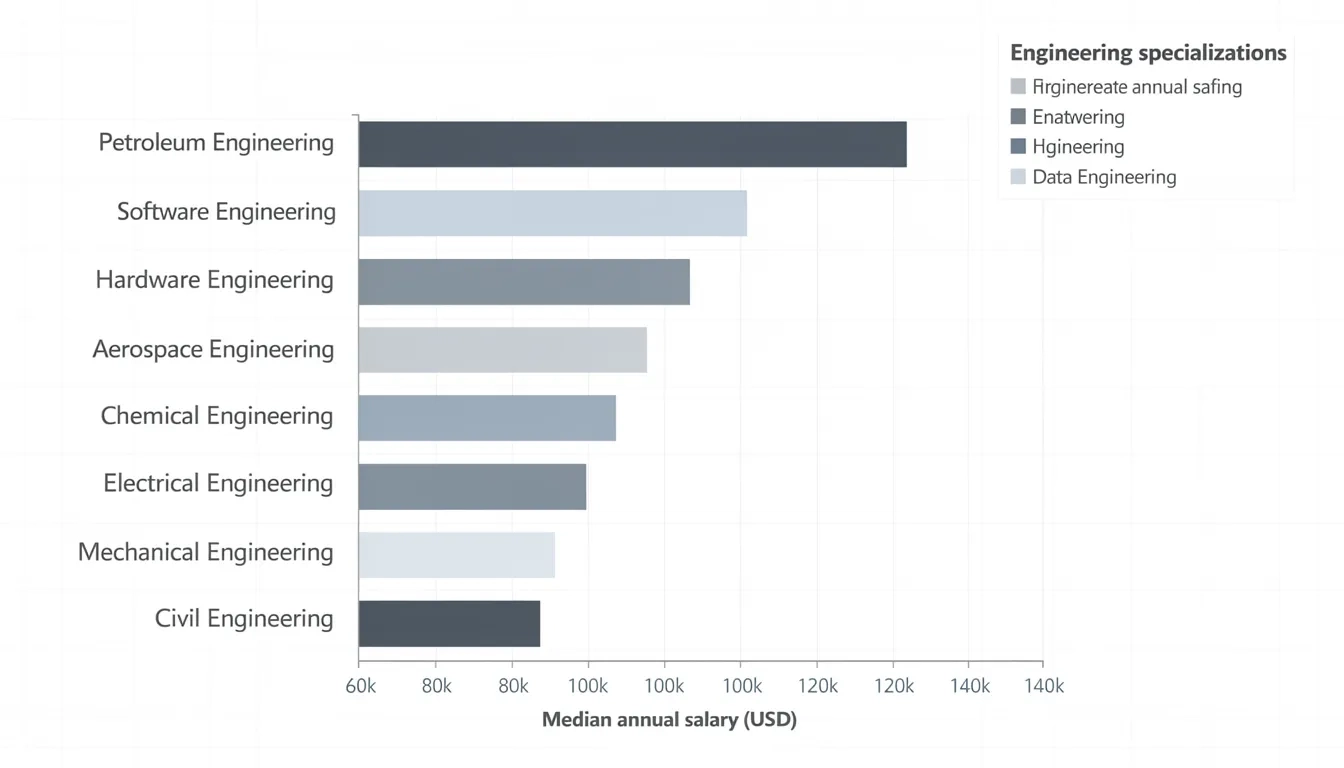
The gap between the highest-paying engineering specialization and the lowest is roughly $80,000 per year in mean salary. That's not a negotiation problem. It's not a company-selection problem. It's baked into the field you chose. Michigan Technological University's 2026 salary report, drawing from BLS May 2023 data, puts computer hardware engineers at a $156,770 mean annual salary while robotics engineers average $95,446. Same four-year commitment. Wildly different paycheck.
If you're choosing a specialization, considering a mid-career switch, or simply wondering why your colleague in a different discipline earns so much more, the breakdown below will answer it.
The Full Salary Picture by Specialization
Start with the numbers. Here's where each major engineering field sits, using BLS data compiled by Michigan Technological University alongside figures from the University of North Dakota's compensation analysis:
| Specialization | Entry-Level | Mean Annual | Top 10% |
|---|---|---|---|
| Engineering Management | $86,000 | $175,710 | $239,200+ |
| Computer Hardware Eng. | $76,707 | $156,770 | $223,820 |
| Software Development | $70,115 | $144,570 | $211,450 |
| Aerospace Engineering | $76,293 | $141,180 | $205,850 |
| Chemical Engineering | $73,837 | $128,430 | $182,150 |
| Electrical Engineering | $74,654 | $120,980 | $175,460 |
| Biomedical Engineering | $68,808 | $115,020 | $165,060 |
| Environmental Engineering | $63,391 | $110,570 | $161,910 |
| Mechanical Engineering | $69,925 | $110,080 | $161,240 |
| Civil Engineering | $64,502 | $107,050 | $160,990 |
| Robotics Engineering | $81,743 | $95,446 | $137,000 |
Two things stand out immediately. Engineering management — which most people don't think of as a specialization — pays more than any purely technical field. If you have any pull toward leadership, that single data point is worth revisiting before you assume the technical track is your best financial move.
The other thing: the "top 10%" column tells a different story than the mean. Getting from $70,000 to $144,570 as a software developer takes years of consistent performance. Getting from $144,570 to $211,450 often takes a single strategic job change to the right company stage.
The BLS puts the median annual wage across all engineering fields at $91,420, against $48,060 for all U.S. occupations. Engineering as a whole is well-compensated. The debate is which flavor.
Why Software and Hardware Keep Winning
The tech industry has a compensation philosophy unlike anything else in engineering. Google, Meta, and Amazon routinely build total packages 40–60% above base salary once stock grants and bonuses are layered in. A software engineer on a $140,000 base at a public tech company can realistically reach $230,000 in total annual compensation once RSU vesting and performance bonuses are counted (each new grant cycle compounds this, so the effect accelerates over time).
Hardware engineers benefit from the same pull. They design the chips running the AI models everyone is frantically funding. Demand for chip architects and VLSI engineers spiked after 2022, and supply hasn't caught up. NVIDIA aggressively hired across hardware disciplines even during the broader tech layoff period — which tells you something about where the perceived value sits.
Software engineering's projected job growth is 25% through 2033. That's a field expanding fast enough to absorb new graduates and career switchers simultaneously without suppressing wages. Most engineering fields can't say that.
The Petroleum Paradox
Here's a situation nobody fully explains before you commit to a petroleum engineering degree. The median salary is $135,690 per year. Top earners working Texas's oil-and-gas extraction sector average $158,980 in that state specifically. The salary ceiling approaches $322,624 at the high end, which is higher than virtually any other engineering discipline.
And yet petroleum engineering is contracting. The BLS projects just 2% job growth, and the long-term trend runs against fossil fuel infrastructure build-out. Renewable energy isn't replacing these jobs one-for-one — it's creating different jobs in different specializations, mostly electrical and environmental engineering.
This doesn't make petroleum engineering a bad choice. But it's a field where you want to enter young, build savings aggressively, and plan a pivot by your late 30s rather than assuming stability for three full decades. The writing has been on the wall since 2020 at the latest, and pretending otherwise doesn't change the structural math.
The Data Engineering Sweet Spot
If strong pay combined with real job growth is what you're after, data engineering deserves serious attention. The field's median sits at $129,716 per year according to the University of North Dakota's analysis, with a ceiling stretching to $177,500 at well-funded companies. Those numbers don't look as dramatic as aerospace or petroleum on first read.
Data engineering is growing at 36% through 2033 — the strongest pay-to-growth ratio of any engineering specialization tracked by the BLS.
That growth comes from a convergence of AI investment, cloud infrastructure build-outs, and virtually every company simultaneously trying to consolidate its data pipelines. The result is hiring that consistently outpaces available talent. Companies can't find enough people who actually know what they're doing, which keeps salaries elevated.
For candidates who can work across SQL, Python, cloud platforms like AWS or Databricks, and basic machine learning workflows, offers accelerate fast. A data engineer with five years of solid experience at a financial services firm or mid-size tech company frequently clears $160,000. The skills also transfer widely across industries, so you're not locked into any one sector's hiring cycles the way a petroleum or aerospace engineer often is.
Same Degree, Very Different Paycheck
The specialization isn't the only variable that matters. Which industry you work in can shift your salary by $60,000 or more within the same engineering discipline.
Chemical engineers illustrate this most starkly:
- Oil and gas extraction: $181,010 average
- Computer equipment manufacturing: $138,490 average
- Pharmaceutical manufacturing: approximately $115,000 average
Same degree. Same technical knowledge base. Sixty-six thousand dollars of difference depending on employer type.
Geography stacks on top. California software engineers can reach $227,753 at the high end. Engineers across the Upper Midwest earn meaningfully less: North Dakota averages $107,662 annually, Minnesota around $99,657 per year. Remote work has started to compress the geographic gap for software and data roles. But field-based disciplines like civil, petroleum, and environmental still see location drive the package almost as much as the specialization itself.
Skills That Break the Pay Ceiling
Within any specialization, certain technical skills act as multipliers on your base salary. Compensation analysis from The Interview Guys puts numbers on the premiums engineers are actually receiving:
- AI and machine learning capabilities: +$20,000 to $40,000 annually
- Cybersecurity expertise: +$25,000 to $50,000 annually
- Cloud architecture credentials: +$15,000 to $30,000 annually
- Data science and analytics: +$20,000 to $35,000 annually
Leadership and management fluency add another layer:
- People management and engineering leadership: +$20,000 to $50,000
- Project management certification (PMP or equivalent): +$10,000 to $20,000
- Cross-functional business fluency: +$15,000 to $30,000
The practical implication is underappreciated. A mid-career mechanical engineer who builds real AI integration skills — generative design, simulation automation, sensor data pipelines — can out-earn a software engineer who stopped learning in 2019. The specialization gets you into the room. The skills you layer on determine how far you go once inside.
How Experience Reshapes the Rankings
Entry-level salaries don't predict where each field ends up long-term. The salary trajectory over 10 to 15 years varies dramatically between specializations.
Robotics engineering actually looks competitive at entry level ($81,743) compared to software ($70,115) and civil ($64,502). That gap inverts sharply by senior levels. Senior software engineers at major tech firms routinely earn $160,000 to $300,000+ including equity. Senior robotics engineers land in the 90th percentile around $137,000. The reversal is stark.
Why the divergence? In software, dominant employers are venture-backed and revenue-scale driven, so equity is a central compensation mechanism. In robotics, the industry skews manufacturing-adjacent, where salary structures follow traditional engineering pay bands rather than tech comp philosophy. Robotics is positioned to get dramatically more interesting as autonomous systems industrialize at scale, but the salary infrastructure hasn't followed yet.
The general experience arc:
- 0–2 years: Specialization matters less; most fields cluster between $63,000 and $86,000 at entry
- 5–8 years: A 40–60% salary increase is typical; skills and specialization choices diverge sharply from here
- 10+ years: Field selection compounds; software and hardware engineers with equity clear $200,000+ while traditional engineering disciplines generally stay in the $130,000–$165,000 range
My read: if you're choosing a specialization on earning potential right now, the risk-adjusted answer is data engineering or software engineering. Both offer strong current pay, exceptional growth, and skills that transfer across industries. Software, in particular, has compensation structures including equity upside that no traditional engineering field comes close to matching. Petroleum pays more today but requires betting that fossil fuel infrastructure stays well-funded through your entire career. For most people starting out now, that's too much to wager.
Bottom Line
- Engineering management leads all specializations at $175,710 mean salary, but most engineers who reach it do so by first mastering a technical field, not by targeting management from day one.
- Software and computer hardware dominate total compensation when equity and bonuses are included. A $144,570 software base routinely becomes $200,000+ in total package at public tech companies.
- Data engineering is the strongest risk-adjusted pick heading into 2026: $129,716 median, 36% projected job growth, and skills that stay relevant regardless of which AI platform eventually dominates.
- Petroleum engineering has the highest raw salary ceiling but declining job security. Enter only with a financial plan that includes a mid-career transition by your late 30s.
- Your industry sector and location can move your pay by as much as your specialization choice. A chemical engineer in oil-and-gas extraction earns 57% more on average than one in pharmaceutical manufacturing.
Frequently Asked Questions
What is the highest-paying engineering specialization overall?
Engineering management clears $175,710 in mean annual salary, with top earners exceeding $239,200. Among purely technical specializations, computer hardware engineering leads at $156,770 mean, followed by software development at $144,570 and aerospace engineering at $141,180, per BLS data compiled by Michigan Technological University.
Is petroleum engineering still worth pursuing in 2025?
The pay is real: median $135,690, with Texas oil-and-gas engineers averaging $158,980. But the BLS projects only 2% job growth, and the energy transition creates genuine long-term career risk. It makes sense if you're entering in your 20s with a concrete plan to pivot before the next decade, and can handle employment volatility tied to commodity price swings.
Do civil or mechanical engineers really earn that much less than software engineers?
Compared to tech-adjacent fields, yes — civil averages $107,050 and mechanical $110,080, versus $144,570 for software. But the gap in the top 10% is smaller than averages suggest: civil engineers at that bracket earn $160,990, within $50,000 of software's $211,450. The floor is lower, but senior practitioners in traditional fields aren't as far behind as the headline numbers make it appear.
Can learning machine learning actually add $40,000 to an engineering salary?
In the right role, yes. The premium is most pronounced when you combine traditional engineering with data-driven systems: a manufacturing engineer building predictive maintenance models, a hardware engineer on AI accelerators, or a chemical engineer running ML-assisted process optimization. For civil engineers whose core work stays analog, the premium is minimal or nonexistent.
What is the fastest path from $80,000 to $150,000 in engineering?
Three realistic routes: develop skills in a higher-paying adjacent specialization (particularly data engineering or cloud architecture), join a company where equity is a meaningful compensation component, or make the shift into engineering management. Mid-career engineers who pivot from mechanical or civil into data engineering tend to close most of the gap within three to four years.
Does a master's degree significantly increase engineering salaries?
It depends heavily on the field. In aerospace and chemical engineering, a master's typically adds $10,000–$20,000 at entry level and accelerates promotion timelines. In software, the market cares far more about demonstrable skills and project portfolio than credentials. A strong GitHub record and solid system design fundamentals frequently outperform an MS from a mid-tier program in tech hiring.