The Enrollment Cliff Is Here: What It Means for Higher Ed
Every freshman missing from a fall 2026 cohort was born during the Great Recession. That's not a metaphor — it's just calendar math. In 2007 and 2008, as unemployment spiked and household incomes collapsed, U.S. birth rates fell sharply. Eighteen years later, those missing births are missing freshmen, and admissions directors at small colleges across the Midwest and Northeast are living the consequences in their yield reports.
This demographic arithmetic has been visible for a long time. The question was always whether higher education would adapt before the numbers actually arrived. For many schools, the answer is now becoming clear.
Where the Cliff Actually Comes From
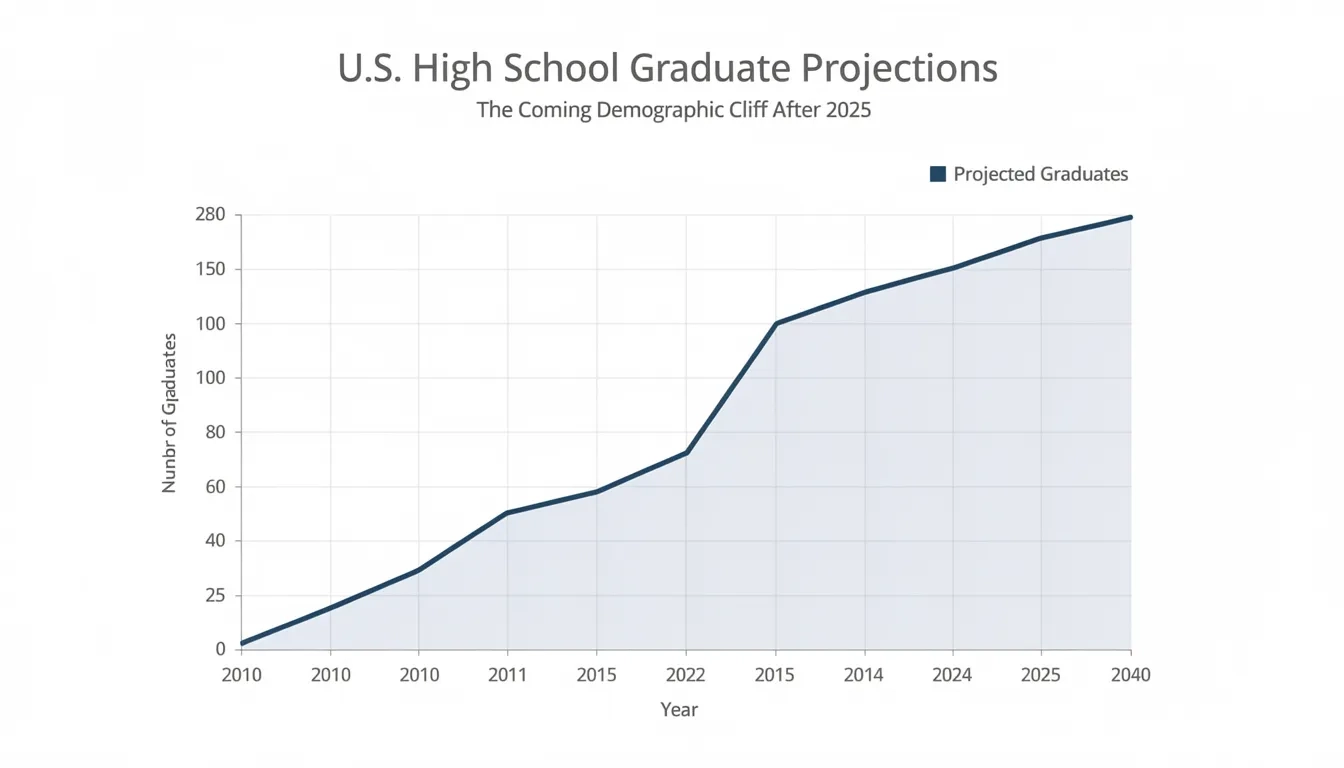
The Western Interstate Commission for Higher Education (WICHE), which tracks these demographic trends with unusual precision, projects that U.S. high school graduates peaked at roughly 3.9 million in 2025 and will decline from here.
The projections aren't guesses — they're counting people already born. Nathan Grawe, an economist at Carleton College and the author of Demographics and the Demand for Higher Education, projects that the college-age population will shrink approximately 15% between 2025 and 2029. By 2041, there will be roughly 576,000 fewer graduating seniors per year than at the current peak.
That's not a cyclical dip. It's a structural change to the customer base, and no amount of enrollment marketing fixes a demographic shortage.
The Geography of Pain
The damage doesn't land evenly across the country. Birth rate declines clustered in the Northeast, Midwest, and Mountain West. The South kept growing. So what gets called "the enrollment cliff" is really a series of overlapping regional crises running at different speeds.
WICHE's regional projections show a stark divergence:
| Region | Projected Change in High School Graduates by 2041 |
|---|---|
| West | -20% |
| Northeast | -17% |
| Midwest | -16% |
| South | +3% |
A small liberal arts college in Vermont is not in the same market as a growing state university in Texas. For the Vermont school, every competitor in its region is fishing in a smaller pond. Tuition discounting intensifies. Yield rates drop. The financial model starts to crack.
There's a demographic composition shift layered on top of the raw numbers. White students will decline by about 26% as a share of high school graduates by 2041, while Hispanic students will grow by 16% and multiracial students by 68%. Colleges historically built around white suburban feeder pipelines — without bilingual advising, first-generation support infrastructure, or financial aid packages competitive for lower-income families — face a compounding problem. The students exist. They just don't see themselves in the brochure, and many institutions haven't given them a reason to look.
What Closures Actually Look Like
Numbers about hypothetical future closures feel abstract until the list starts building in real time.
At least 16 nonprofit colleges announced closures in 2025, matching the 2024 total and well above pre-pandemic norms. Since 2020, at least 49 colleges have closed or announced closures, with 40 more completing or announcing mergers — displacing roughly 53,440 students at private nonprofits in that five-year stretch alone.
The Federal Reserve Bank of Philadelphia modeled the scenarios and found that under severe enrollment decline, up to 80 colleges could close per year. Huron Consulting Group put a longer-term number out there: close to 400 schools disappearing over the next decade, redistributing around $18 billion in endowment funds.
"Closures are coming at a pace we haven't seen since the Great Recession." — Ted Mitchell, President, American Council on Education
Two 2025 merger announcements illustrate what well-managed exits look like. Albany College of Pharmacy and Health Sciences in New York is merging with Russell Sage College in 2027. Rosemont College in Pennsylvania is merging with Villanova University that same year. These aren't desperate schools scrambling to survive — they're institutions that read the forecast early and chose their terms while they still had negotiating power. That distinction matters enormously. Waiting until finances force the conversation produces far worse outcomes.
Mergers done early preserve options. That's worth repeating.
The International Student Wild Card
Between 2021 and 2024, international student growth helped many research universities offset domestic enrollment losses. It felt like a sustainable buffer. Then 2025 arrived.
The Trump administration's sweeping visa policy changes, combined with aggressive immigration enforcement creating a chilling effect on prospective students abroad, are projected to cut international enrollment by roughly 150,000 students for 2025–26. That's a 30–40% drop in new international students. The Institute of International Education reported that graduate international enrollment fell 12% and non-degree international enrollment dropped 17% in fall 2025.
The financial translation: approximately $1.1 billion in lost revenue and around 23,000 jobs tied to international student spending already at risk or gone.
For research universities that depend on international graduate students to staff labs and teach sections, this is a second crisis landing on top of the demographic one. Two major headwinds, arriving simultaneously. Schools that treated international enrollment as a structural replacement for domestic demographic decline — rather than a cyclical supplement — built themselves onto a fragile foundation.
Who Actually Benefits
Here's what gets buried in the gloom: the enrollment cliff creates winners too. Not many, but real ones.
Elite selective universities are counterintuitively positioned to see more applicants. Grawe's demographic research projects a 14% increase in demand at highly selective institutions by 2029. The students who apply to those schools tend to come from demographic groups less affected by the birth rate drop. These schools can fill their classes from a reduced national pool without much disruption at all.
The South is the obvious regional winner. Universities in Texas, Florida, Georgia, and North Carolina have population growth behind them. A school operating with demographic tailwinds faces a fundamentally different strategic environment than one in enrollment-declining territory.
Community colleges sit in an interesting middle position. Their traditional market — recent high school graduates seeking affordable credentials — shrinks like everyone else's. But community colleges sit closest to the massive adult learner opportunity, and they often already have the flexible scheduling infrastructure that adult learners need. The schools in this sector that actively recruit working adults, rather than waiting for 18-year-olds, are already seeing the payoff.
The differentiation between institutions that survive this decade and those that don't will not be accreditation status or institutional prestige. It will be whether they built a business model that doesn't require an 18-year-old demographic that no longer exists at 2019 levels.
37.6 Million People the System Left Behind
Here's the number that should be reshaping enrollment strategy at every institution: 37.6 million Americans between the ages of 18 and 64 have some college credit but no degree. They started. Life intervened — a job offer, a medical bill, a child, a financial shock. They never came back.
This population is enormous. It's larger than the entire traditional-age college-going cohort in the country. Many are highly motivated (they've watched their own careers plateau without credentials and know exactly what they're missing) — they just need a model built for their actual lives, not a model designed for a residential 19-year-old.
What does that model actually require?
- Genuinely asynchronous scheduling — not just evening sections on a fixed calendar, but courses built from the ground up for people who work 50 hours a week
- Credit for prior learning so adults aren't forced through introductory courses covering skills they already have
- Stackable credentials — a certificate that counts toward a degree, rather than an all-or-nothing four-year commitment upfront
- Transparent employment outcomes so adults paying tuition out of pocket know precisely what the credential is worth in the job market they're targeting
Western Governors University built its entire model around these principles and now serves hundreds of thousands of students annually. Southern New Hampshire University ran essentially the same playbook for its online expansion, growing from a few thousand students to a national institution. These became enrollment leaders precisely because they stopped designing programs for the residential 19-year-old.
Schools that figure out adult learner recruitment over the next five years will build a structural advantage that compounds. Schools still waiting for the traditional pipeline to refill are betting on a demographic trend that WICHE's projections say isn't coming back at 2019 levels.
What Colleges Actually Have to Change
Adaptation doesn't happen by press release or strategic planning retreat. Here's what actually separates institutions that stabilize from those that don't.
Financial model diversification is the first lever. Schools getting more than 80% of revenue from tuition have no cushion when enrollment drops 8%. Research revenue, employer training partnerships, online program income, and healthcare affiliations all create options that pure tuition dependence doesn't. Shared service arrangements with peer institutions can reduce operating expenses by 6–10% — not a rescue, but real margin in a tightening environment.
Recruitment geography has to expand. Schools that historically drew from a 200-mile radius need to go farther or build genuinely digital pipelines. Western and Southern markets have more prospective students per square mile than most Northeastern colleges have historically considered worth pursuing.
The demographic composition shift also demands a dedicated response. Hispanic-serving institutions have spent decades building exactly the infrastructure that all colleges now need: bilingual advising, family-inclusive communications, wraparound financial support, clear credential-to-employment pathways. There's no reason to invent this from scratch when the model already exists and has been proven to work.
Program alignment with the labor market is non-negotiable. About 53% of students who cite affordability as their primary reason for not attending college are implicitly asking whether the credential is worth the cost. Schools that can demonstrate clear wage outcomes and that build curriculum with employers who will actually hire graduates have a credibility argument that generic degree programs simply can't make.
None of this is fast. Some requires governance changes that move slower than demographics. But the schools doing this work now — while they still have enrollment buffers — have options that schools waiting for the next admissions cycle will not.
Bottom Line
The enrollment cliff isn't an abstract future threat. It's a present structural shift, and a few things should actually change how institutions act:
- Model financial scenarios at 10%, 20%, and 30% enrollment drops. Know your break-even. Schools that understand their exposure can plan; schools that don't are just hoping the numbers stay flat.
- The adult learner market is real, but requires genuine operational change — not a landing page for "working adults." Stackable credentials, prior learning credit policies, and employer partnerships are table stakes.
- Mergers done early preserve leverage. Albany College of Pharmacy and Rosemont made their moves while they still had negotiating power. Waiting until finances are desperate means worse terms and fewer willing partners.
- Regional differentiation isn't optional. A Sun Belt school and a rural New England school are in different markets and should not be making the same strategic bets.
My read: the schools that survive this decade will look meaningfully different from what we currently call a "traditional college." That's not a loss — it's an adaptation. The schools insisting on the old model while the student population contracts around them are making a choice. They just may not realize they're making it.
Frequently Asked Questions
Is the enrollment cliff happening now, or is it mostly a future problem?
It's both. Demographic decline is already visible in enrollment data at small and mid-sized schools across the Midwest and Northeast, and at least 16 nonprofit colleges announced closures in 2025. The steepest drops are still ahead, with WICHE projecting the most significant losses between 2026 and 2033.
Won't international students fill the gap left by declining domestic enrollment?
They helped offset losses between 2021–2024, but that buffer has shrunk sharply. Graduate international enrollment fell 12% in fall 2025 following visa policy changes, and projections suggest 30–40% fewer new international students for 2025–26. Treating international enrollment as a permanent structural substitute for domestic demographic decline is a high-risk bet with limited runway.
Are elite schools like Harvard or MIT at any real risk?
No — they're actually projected to see increased demand. Grawe's research projects a 14% rise in applications at highly selective institutions by 2029, because their applicant pool disproportionately comes from demographic groups less affected by the birth rate decline. The crisis concentrates at small, tuition-dependent colleges with regional draw and thin financial margins.
What does the enrollment cliff mean for college tuition prices?
Expect contradictory pressure. Some struggling schools will raise sticker prices to compensate for fewer students, while simultaneously offering larger merit scholarships to compete for the smaller pool. Students who can be flexible about institution type and location will likely find better net prices than five years ago — because schools need them more.
What is the single most important thing a small college should do right now?
Run the financial model honestly before you need to. Know exactly at what enrollment level the budget breaks. Then build genuine adult learner infrastructure — asynchronous scheduling, prior learning credit, employer partnerships — rather than waiting for the demographic tide to turn. And start conversations with potential merger partners before desperation sets the terms.
Is this equally bad everywhere, or are some states basically insulated?
It varies a lot by state. Texas, Florida, Georgia, and North Carolina have growing populations and are largely insulated from the worst of it. Maine, Vermont, West Virginia, and parts of the upper Midwest face the steepest projected drops. National averages significantly understate the severity of the regional crisis in hard-hit states.
Sources
- What Is the 2026 Enrollment Cliff? - EDMO
- Impacts of the Enrollment Cliff in 2025–2026 - AGB
- Closed Colleges: List of Closures, Mergers, and Trendline - BestColleges
- Enrollment Cliff Strategies for Community Colleges - Carnegie Higher Ed
- 'A perfect storm' — more colleges at risk as enrollment falls - CNBC
- US College Enrollment Decline – 2026 Facts & Figures - College Transitions