Gallaudet University: Programs, Rankings, and Student Life
In March 1988, Gallaudet University students shut their campus down for eight straight days. No classes. No mail in or out. The board had selected a hearing president — again — over two deaf finalists, and students said no. By day eight, Dr. I. King Jordan was named the first deaf president in the school's 124-year history. That protest directly shaped the language of the Americans with Disabilities Act signed two years later. No other university in America has a founding mythology quite like that.
A University Built Around One Community
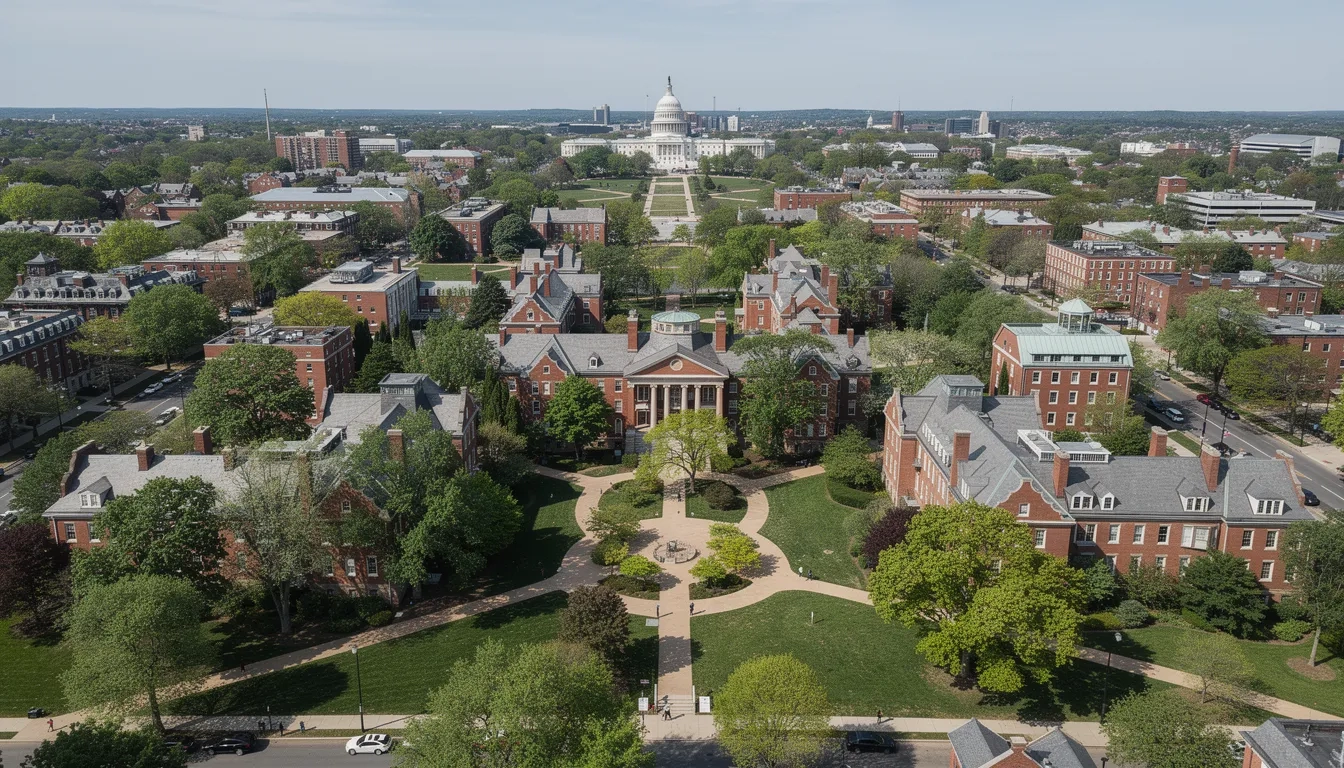
Gallaudet sits on 99 acres in northeast Washington, D.C., a short Metro ride from Union Station. Abraham Lincoln signed its charter in 1864, authorizing it to grant college degrees — making it the oldest institution of higher education for deaf and hard of hearing students in the world, and still the only one where every part of campus life is designed around deaf culture.
The number that tells you the most: 90% of faculty are fluent in ASL. Class discussions, office hours, and hallway conversations all happen bilingually in ASL and English. Even the buildings follow a design philosophy called DeafSpace, developed by architect Hansel Bauman alongside Gallaudet's own design team, which maximizes natural light and open sightlines so that signed conversations can flow without visual obstruction. Olof Hanson — an 1873 Gallaudet alumnus widely considered the first deaf architect in the United States — anticipated these ideas when he designed a campus dormitory in the 1890s.
With around 919 undergraduates and an 8:1 student-to-faculty ratio, the campus is intimate in a way that large research universities cannot replicate. Students are not numbers in a lecture hall.
Academic Programs: More Breadth Than You'd Expect
Gallaudet runs over 50 majors and 30 minors across the College of Arts and Sciences, the College of Professional Studies, and the College of Education and Human Development. The breadth surprises many people encountering the school for the first time.
The five most popular undergraduate majors:
- Business Administration
- Visual and Performing Arts
- Communication Studies
- Physical Education and Recreation
- Psychology
What genuinely sets Gallaudet apart from every other institution are programs that exist nowhere else. The university offers the world's only B.A., M.A., and Ph.D. track in Sign Language Interpretation delivered in a fully ASL-immersive environment. Students don't just study interpretation in the classroom — they practice it while living it every day, which is not something a hearing campus can replicate.
The Deaf Studies program sits at the intersection of linguistics, history, and cultural anthropology. Faculty are active researchers shaping how the broader academic world thinks about deaf identity. The Laurent Clerc National Deaf Education Center, housed on campus, holds the largest deaf archival collection in the world — including silent films recorded by George Veditz in 1913 that captured early ASL for posterity before it could be lost.
Graduate programs in education are particularly strong:
| Program | Degree | Accreditation |
|---|---|---|
| Teacher Preparation in Deaf Education | M.A. | CAEP, DC State Ed. Agency |
| Early Childhood Education (Deaf) | M.A. | CAEP |
| Deaf Education Specialist | Ed.S. | — |
| Transformational Leadership in Deaf Education | Ed.D. | — |
| Sign Language Interpretation | M.A. / Ph.D. | — |
The Ed.D. in Transformational Leadership deserves specific attention. It's built for working professionals in deaf education who want to move into administrative roles — superintendents, program directors, regional coordinators. The pipeline for that career trajectory is thin nationally, and Gallaudet is the primary institution producing people qualified to fill it.
Rankings: What the Numbers Say (and Don't Say)
Gallaudet's 2026 U.S. News & World Report rankings:
- #198 overall among 436 National Universities
- #62 in Social Mobility among National Universities
- #18 in Best Value among National Universities
The overall number is the first thing people Google. Don't stop there.
The Social Mobility ranking is the one worth paying attention to. It measures how well an institution serves students from lower-income backgrounds and translates that into real economic outcomes. Landing 62nd nationally in a field of 436 schools is a strong result — not a participation trophy. It reflects actual movement for students who arrive without generational wealth.
"Gallaudet ranked 18th in Best Value among National Universities in the 2026 U.S. News rankings." — Office of the President, Gallaudet University
Here's the honest critique about rankings: placing Gallaudet next to Georgetown or Ohio State on a 1-to-200 scale is a category error. There is no peer institution. The school exists in its own category, serving a community no other university fully serves. The ranking reflects how a generalized methodology handles a specialized institution — useful context, but not the full picture.
Tuition, Costs, and What You'll Actually Pay
Published 2025-2026 costs:
- Undergraduate tuition and fees: $19,654
- Graduate tuition and fees: $21,508
- Total on-campus cost of attendance (room, board, fees): approximately $42,746
Those numbers look steep at first pass. The aid picture changes them substantially. Gallaudet reports that 95% of enrolled students receive grants or scholarships, with an average award of $23,924. The average net price for students receiving need-based aid drops to around $20,522 per year.
That's below out-of-state tuition at many state flagship universities. Worth noting: 96% of Gallaudet's student body comes from outside the state, so essentially everyone arrives without in-state pricing anywhere. The effective cost, after aid, tends to be lower than prospective families initially assume.
Acceptance rate sits at 61%. The admissions process evaluates academic preparation alongside ASL proficiency or demonstrated commitment to learning the language. Students who aren't yet fluent can still apply — but they should arrive ready to develop fluency fast, since the campus runs bilingually by default.
Student Life: What the Campus Actually Feels Like
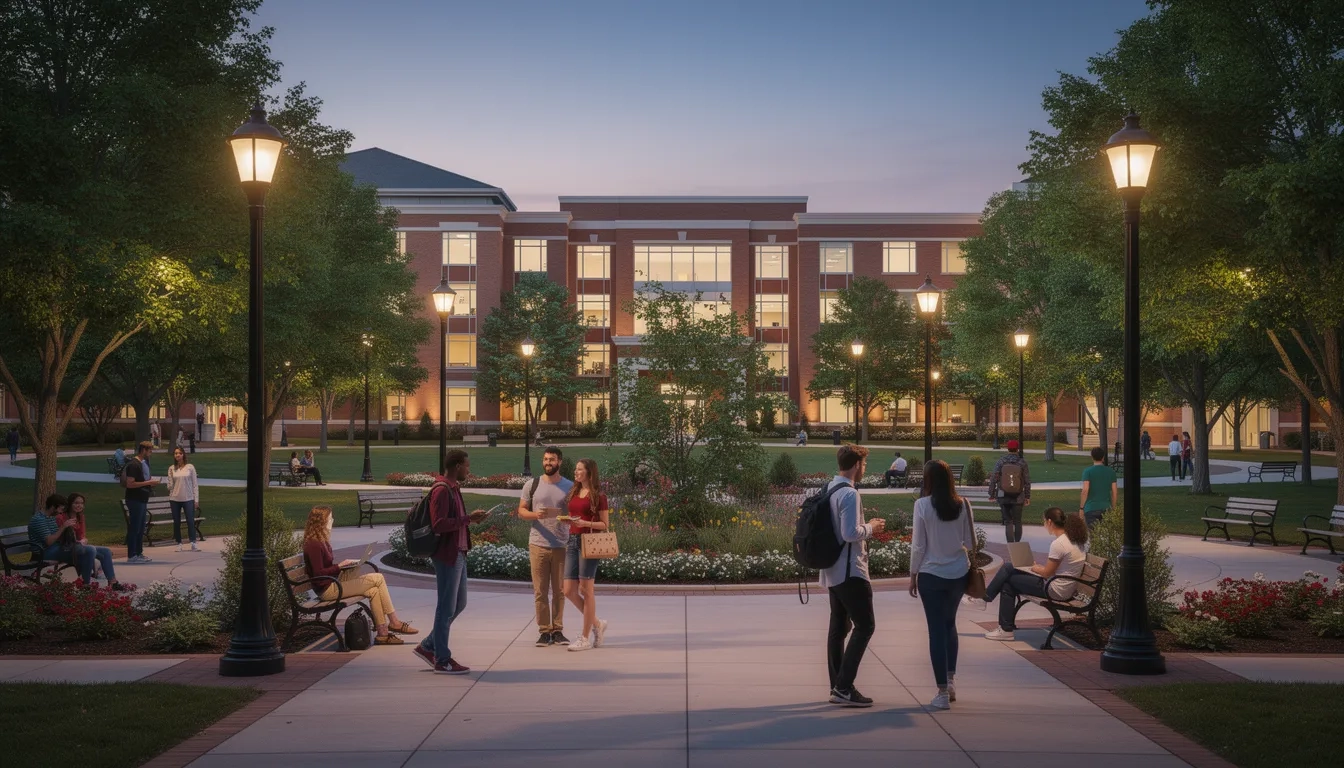
The most common thing Gallaudet students describe when they arrive for the first time: it's the first environment where they haven't needed to request an interpreter. No sitting in the front row to lip-read. No asking someone to repeat themselves three times. No accommodation paperwork before the semester even starts. That shift — from being the student who requires access support to simply being a student — is hard to quantify, but it changes daily life entirely.
Campus infrastructure reflects this reality. The National Deaf Life Museum preserves cultural artifacts, historical films, and community records connecting students to a centuries-long deaf cultural tradition. The Merrill Learning Center (the main library) operates 90 hours weekly with dedicated study rooms and research support.
DPN Week — the annual tradition commemorating the 1988 Deaf President Now protest — is part history lesson, part community celebration. It gives students a clear sense of the activism that produced the institution they're attending, and it's a tradition that hearing universities simply cannot replicate.
Student organizations include:
- Black Deaf Students Association
- Asian Pacific Islander Association
- Students Against Mass Incarceration
- Honor societies across academic departments
- Identity- and culture-based clubs spanning more than a dozen groups
With 96% of students coming from out of state and over 100 countries represented, the campus carries a distinctly international character. The shared language of ASL creates common ground across national and cultural backgrounds in a way that a hearing campus environment typically doesn't produce.
Athletics: 17 Teams and One Structural Advantage
Gallaudet fields 17 NCAA Division III varsity sports teams — men's and women's across football, basketball, volleyball, swimming, soccer, track and field, and wrestling. The Bison compete in the Capital Athletic Conference.
Something rarely discussed in recruiting materials: crowd noise is simply irrelevant at Gallaudet games. Opposing teams try to disrupt communication with stadium volume — it doesn't work. Gallaudet players coordinate through visual signals, and no amount of noise from the stands changes that (a fact opponents who haven't thought it through tend to learn quickly on the field).
The football program carries a specific piece of American sports history. Quarterback Paul Hubbard is widely credited with inventing the football huddle in 1892, pulling players together so opposing teams couldn't read their signed plays. The huddle spread to hearing programs within a few seasons and has been standard across the sport ever since.
The alumni record extends well beyond athletics. Troy Kotsur, a Gallaudet graduate, won the Academy Award for Best Supporting Actor in 2022 for CODA — the first deaf man to receive an acting Oscar. Lauren Ridloff became the first deaf woman to appear in a Marvel film. Nyle DiMarco, activist and media figure, attended Gallaudet. These aren't coincidental outcomes. The school has produced people who change public perception of what's possible for deaf individuals, which has been part of its purpose since Lincoln's signature in 1864.
Bottom Line
Gallaudet is a specialized institution that does one thing better than anywhere else in the world: it creates a fully accessible, bilingual academic environment for deaf and hard of hearing students. The rankings tell part of the story — particularly the Social Mobility and Best Value numbers — but the most important facts don't appear on any ranking list.
What prospective students should take away:
- Apply even if cost looks prohibitive. With 95% of students receiving aid and an average net price around $20,522, the real cost is dramatically lower than the sticker.
- Look closely at the graduate programs. The Ed.D. in Transformational Leadership and the doctoral Interpretation track are one-of-a-kind nationally — that's not a claim, it's a verifiable fact.
- Factor in the environment, not just the curriculum. For many students, four years somewhere that doesn't require accommodation requests is a fundamentally different experience than what they've known.
- Skip the peer comparisons. Gallaudet has no true peer. Evaluate it on whether it serves what you're actually looking for.
The question isn't whether it outranks Georgetown. The question is whether you want four years at the institution that invented the football huddle, produced an Oscar winner, helped write the ADA, and still stands alone in the world.
Frequently Asked Questions
Can hearing students attend Gallaudet University?
Yes, with conditions. Hearing students may enroll in certain graduate programs, particularly in areas like interpretation, education, and linguistics. All students — hearing or deaf — are expected to be bilingual in ASL and English, or actively working toward fluency. The campus operates bilingually by default, so hearing students who arrive without ASL will need to develop it quickly.
What is the Deaf President Now protest, and why does it matter today?
In 1988, students shut Gallaudet down for eight days after the board appointed a hearing president over two deaf finalists. They had four demands: a deaf president, removal of the hearing chair of the board, a 51% deaf board majority, and no retaliation against protesters. All four were met. The protest is considered a landmark moment in disability rights history, and its influence is visible in the ADA language signed into law in 1990. DPN Week keeps that history active on campus every year.
Does Gallaudet offer online programs?
Gallaudet does offer some online and hybrid course options, particularly through its continuing education and professional development channels. The ASL Connect program, for instance, provides online ASL courses to a wider audience. However, the residential, on-campus experience is the core of what Gallaudet offers — online enrollment is a supplement, not a primary path.
What careers do Gallaudet graduates typically pursue?
Graduates work across a wide range of fields — business, education, counseling, the arts, government, and nonprofit work. Deaf education and sign language interpretation are natural pipelines given Gallaudet's specialized programs, but many graduates move into general professional careers. Troy Kotsur's Oscar and Lauren Ridloff's Marvel role illustrate that creative and entertainment industries are also well-represented among alumni outcomes.
Is Gallaudet University regionally accredited?
Yes. Gallaudet is accredited by the Middle States Commission on Higher Education. Teacher education programs hold additional accreditation from CAEP (Council for the Accreditation of Educator Preparation) and are approved by the DC State Education Agency. Graduate Interpretation programs reflect the institution's decades of research leadership in the field.
How does DeafSpace design actually affect daily campus life?
DeafSpace is an architectural philosophy, not just an aesthetic choice. Wide hallways allow two people to walk and sign simultaneously. Classrooms are arranged so students can see both the instructor and each other without turning awkwardly. Lighting avoids harsh contrast that makes facial expressions harder to read. The result is a physical environment where ASL conversations happen naturally, rather than constantly working against the architecture — something most campus buildings were never designed to accommodate.
Sources
- Gallaudet University's 2026 U.S. News & World Report Rankings Announced
- Gallaudet University 2026 – Programs, Rankings & Key Facts | Research.com
- Gallaudet University Student Life 2026 | Research.com
- The Campus That Changed the World: How Gallaudet Redefined What It Means to Be Heard | Hearview
- Gallaudet University – Tuition, Cost of Attendance & Financial Aid | College Tuition Compare
- Deaf Studies | Gallaudet University
- Student Life at Gallaudet University
- Deaf President Now – Wikipedia