Hamilton College: Admissions, Rankings, and What Campus Life Actually Looks Like

Hamilton College sits in a strange blind spot in the college admissions conversation. It's ranked #14 among national liberal arts colleges by US News in 2026, has a $1.5 billion endowment serving roughly 2,000 students, and fields 663 varsity athletes in the most competitive Division III conference in the country. And yet most high school seniors could name Middlebury or Bowdoin faster. That gap in name recognition is exactly why Hamilton deserves a harder look.
Where Hamilton Stands in the Rankings
The short version: Hamilton is a legitimate peer of Williams, Amherst, and Swarthmore in terms of academic caliber, even if the name doesn't carry the same instant recognition. Here's what the major ranking systems show for 2025-2026:
| Ranking Organization | Rank | Category |
|---|---|---|
| US News & World Report (2026) | #14 | National Liberal Arts Colleges |
| Forbes (2025) | #15 | Liberal Arts Colleges |
| Washington Monthly (2025) | #29 | Liberal Arts Colleges |
Rankings shift year to year, so no single number tells the whole story. What doesn't shift: the $1.5 billion endowment (2025 figure), which for a school of 2,000 undergrads translates to roughly $750,000 in institutional wealth per student. That money funds financial aid generously, keeps class sizes small, and supports the kind of research and programming that makes small-college academics actually work.
Hamilton competes in NESCAC (the New England Small College Athletic Conference), alongside Williams, Amherst, Bowdoin, Middlebury, and Bates. Membership in NESCAC signals something about standards, both academic and athletic. Schools in the conference have consistently appeared at the top of liberal arts college rankings for decades.
The college was founded in 1793 as the Hamilton-Oneida Academy and received its college charter in 1812, named after Alexander Hamilton. It merged with its sister school Kirkland College in 1978, becoming coeducational. That history matters less than what it produces today: a deeply connected alumni network and an institutional culture that's had 230-plus years to refine itself.
Admissions: What the Numbers Actually Mean
The acceptance rate trajectory at Hamilton tells you more than the single current number. The Class of 2026 set a record-low acceptance rate of 11.8% from 9,899 applications. The Class of 2029 came in at 13.6%, from 8,904 applications, with 1,210 students admitted and 485 enrolling.
That yield rate (485 enrolled from 1,210 admitted) is something worth sitting with. It means many admitted students chose elsewhere, which is typical for a school competing with Ivies and highly-ranked peers for the same applicant pool. Hamilton isn't anyone's "backup" — but it also isn't always the final choice when someone gets into Williams or Dartmouth.
Test score ranges for the Class of 2029:
- SAT middle 50%: 1440–1510
- ACT middle 50%: 33–34
These put Hamilton in the same range as Tufts, Davidson, and Colby. The scores aren't Ivy-level, but they're not forgiving either. A 1420 SAT is going to feel like a stretch without compensating strengths elsewhere.
Who makes up the Class of 2029:
- 33% U.S. students of color
- 16% first-generation college students
- 8.3% international students
- Representing 24 countries and 39 states, Washington D.C., Puerto Rico, and the Northern Mariana Islands
Hamilton offers Early Decision, and applying ED is the single most actionable lever applicants control. ED acceptance rates at schools like Hamilton historically run 15–30 percentage points higher than regular decision rates. If Hamilton is genuinely your first choice, the math strongly favors applying early.
One honest note on holistic review: because Hamilton's curriculum has no distribution requirements, admissions officers are reading applications looking for evidence of genuine intellectual curiosity and the capacity to direct your own learning. Students who write vague essays about "wanting to explore many interests" often hurt themselves. Specificity wins.
The Open Curriculum Is the Defining Academic Feature
At most colleges, "open curriculum" is marketing language dressed up to mean "we have fewer requirements than before." At Hamilton, it's the actual structure of the degree. There are no distribution requirements. No mandatory science course if you're a literature major, no forced social science sequence for an engineer-track student. You can graduate from Hamilton without taking a single math class.
The open curriculum means that when you choose Hamilton, you're choosing it for what you want to study — not because you're filling in boxes someone else drew. Admissions knows this, and your essays need to reflect it.
Even peer schools like Williams and Amherst have distribution requirements. Hamilton's commitment to student-directed learning is genuinely rare at this selectivity level.
The flip side is real. Students who arrive without intellectual direction can drift. The open curriculum demands self-awareness that some 18-year-olds don't yet have. Hamilton pairs the open curriculum with an academic advising system to prevent students from graduating with awkward holes in their education, but the system only works if you engage with it honestly.
One consistent emphasis cuts across every department: writing. Hamilton has a long institutional reputation for writing instruction, and this shapes how courses are taught regardless of subject. Political science papers, biology lab reports, economics problem sets — writing quality matters everywhere. If strong writing is a skill you want to develop (and you should, for basically any career), this emphasis is real and worth factoring into your college search.
On the professional side, Hamilton has dual-degree engineering programs with Columbia University and Dartmouth College. The college also announced new 4+1 graduate partnerships in 2026 with Washington University in St. Louis, the University of Pennsylvania, and the University of Chicago, letting students complete both a Hamilton BA and a graduate or professional degree on an accelerated timeline.
Campus Life in a Town of 2,000
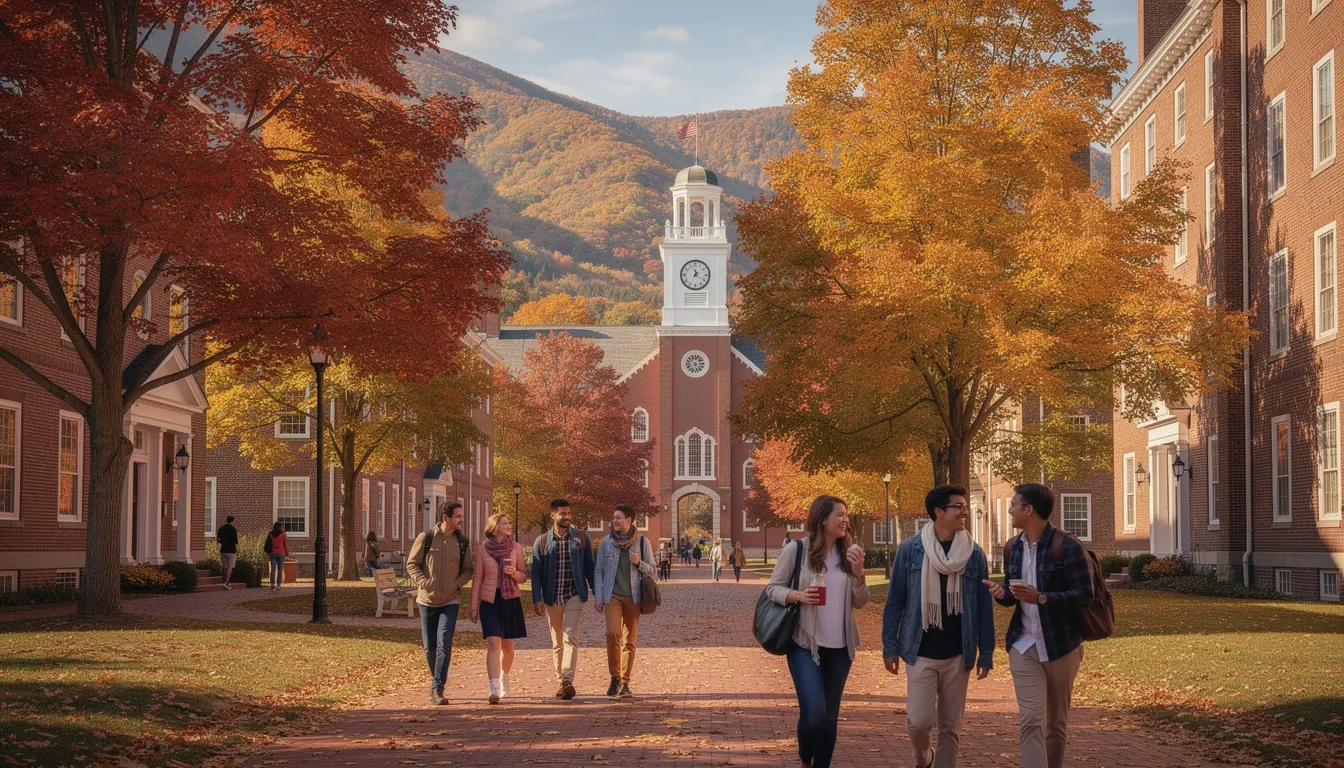
Clinton, New York has a population of roughly 2,000 people, approximately equal to Hamilton's student body. This is the elephant in the room that every honest conversation about Hamilton has to address directly. The campus is genuinely beautiful, sitting on College Hill overlooking the village with views toward the Adirondacks. But isolated is the right word, and that isolation shapes everything about how students spend their time.
The upside is that students are present. Hamilton hosts over 1,500 events annually: concerts, lectures, gallery openings, film screenings, debates, comedy shows, and athletic contests. The Wellin Museum of Art is a legitimate cultural resource, not a decorative lobby installation. The college sponsors over 200 clubs and organizations, and because there's no college town to disappear into on weekends, students actually show up to these things.
Hamilton has no Greek life. The college eliminated fraternities and sororities years ago, which changes the social structure in ways incoming students should understand. There are no fraternities organizing the weekend social calendar or sororities creating tiered social hierarchies. Social life is organized around residential communities, clubs, and athletic teams instead. Some students find this far more equitable than the Greek system at peer schools. Others miss the structure.
The outdoor access is a genuine selling point. Hamilton's Outdoor Leadership program connects students to hiking, paddling, and biking routes near the Adirondacks with minimal logistical friction. Rogers Glen serves as a field lab for environmental science and biology coursework. The proximity to Adirondack Park is an underrated perk for students who want outdoor experience built into their college years.
The honest critique from students: the social scene can be cliquish, and when you want to get off campus, your options are thin. Utica is 10 miles away and doesn't offer much of a college-town experience. Syracuse is an hour's drive. If you need urban energy to recharge, Hamilton will frustrate you. If you thrive in tight-knit communities and find your entertainment in the people around you, it works well.
Athletics: 35% of Students Compete Varsity
The athletic culture at Hamilton is more embedded in daily campus life than most people expect from a small liberal arts school. About 35% of students compete in varsity athletics, which is high by any measure. The 663 student athletes (352 men, 311 women) compete in NCAA Division III, meaning no athletic scholarships but serious, high-level competition.
NESCAC is the conference, and it's widely considered the most competitive Division III conference in the country. Beating Williams in a NESCAC title game is a genuine accomplishment. Winning a national championship is rare enough to be a significant institutional moment.
Hamilton's Women's Lacrosse team won the school's first national title in any sport back in 2008. More recently, the Men's Hockey team captured their first-ever NCAA Division III national championship in 2026, capping years of sustained program investment. For a school of 2,000 students, two national championships across different sports reflects something real about athletic culture.
Beyond varsity, Hamilton offers club and intramural sports for students who want competition without the time commitment of a varsity season. Given that 35% of students are already on varsity rosters, the campus athletic culture is pervasive.
Financial Aid: Run the Calculator Before You Assume
The published cost of attending Hamilton for 2025-26 sits around $85,000 per year (tuition, room, board, fees combined). That number scares families before they do the math.
With 55% of students receiving financial aid and a $1.5 billion endowment behind it, Hamilton meets 100% of demonstrated financial need with no gap between what the institution says you need and what it actually delivers. That's a meaningful distinction from schools that "meet need" through loan-heavy packages that leave families with real debt.
The 16% first-generation enrollment in the Class of 2029 suggests the financial aid engine is doing actual work here, not just attracting wealthy families who want a boutique college experience. Noble Prize-winning neuroscientist Paul Greengard, a Hamilton alumnus, represents the kind of intellectual lineage the school draws on for donor support to keep this aid structure functioning.
Use Hamilton's Net Price Calculator before dismissing the school on cost. The sticker price and the actual price for your family can differ by $40,000 or more per year.
Bottom Line
Hamilton is an honest-to-goodness elite liberal arts college that happens to lack the marketing budget of Amherst or the name recognition of Williams. If you know what you're looking for, that gap is an opportunity.
- Apply ED if Hamilton is genuinely your first choice. The acceptance rate difference is real, and ED applicants signal the kind of intentionality that resonates with Hamilton's admissions philosophy.
- Write specific essays. The open curriculum means Hamilton wants to see evidence that you know what you want to learn and why. Generic curiosity won't cut it.
- Run the Net Price Calculator early. Hamilton meets 100% of demonstrated need, and the real cost may surprise you.
- Visit and stay overnight if possible. Your gut reaction to Clinton's isolation will tell you more about fit than any ranking.
- If you're a recruited athlete, understand Division III. No scholarships, but NESCAC competition is elite — factor that against Division I or II offers accordingly.
The strongest case for Hamilton is specific: a 2,000-person community with an endowment that punches above its weight, faculty hired to teach (not primarily to publish), a curriculum that trusts you to direct your own learning, and an athletic culture that pulls a third of the student body into genuine competition. That combination is harder to find than it looks.
Frequently Asked Questions
Is Hamilton College an Ivy League school?
No. The Ivy League is a specific athletic conference — Harvard, Yale, Princeton, Columbia, Penn, Brown, Dartmouth, and Cornell. Hamilton is a top-14 national liberal arts college that competes in NESCAC, a separate conference that includes Williams and Amherst. It draws applicants from the same pool as Ivies but operates under a different framework entirely.
What GPA do you need to get into Hamilton?
Hamilton doesn't publish a GPA cutoff, and the college has operated test-optional in recent admissions cycles. The SAT middle 50% (1440–1510) and ACT middle 50% (33–34) suggest the academic baseline is high. Most admitted students sit in the 3.8–4.0 unweighted GPA range, but the open curriculum means admissions genuinely evaluates intellectual curiosity and writing ability alongside grades.
Does Hamilton have Greek life?
No. Hamilton eliminated fraternities and sororities years ago. The social scene runs through residential communities, clubs, and athletic teams. Students who expect a traditional Greek social structure will need to recalibrate their expectations — or choose a different school.
How does the open curriculum work in practice?
There are no distribution requirements of any kind. You design your four-year academic plan in consultation with an advisor. The one consistent expectation across all majors is writing-intensive coursework, reflecting Hamilton's institutional commitment to writing as a core academic skill. Outside of your major requirements and that writing emphasis, the curriculum is yours.
Is Hamilton worth the cost for full-pay families?
At around $85,000/year all-in, Hamilton is in the same price range as Colby, Middlebury, and Vassar. For full-pay families, the calculation comes down to fit and outcomes: does the open curriculum, the tight-knit community, and the NESCAC peer group match what your student needs? For families who qualify for aid, the answer is often clearer — Hamilton meets 100% of demonstrated need with no gap.
How competitive is the NESCAC athletic conference?
Extremely competitive for Division III. NESCAC includes Williams, Amherst, Bowdoin, Middlebury, Colby, Bates, Trinity, Wesleyan, and Connecticut College. Division III athletes don't receive athletic scholarships, but the competition level is often described as equivalent to mid-major Division I programs. Hamilton's 2026 Men's Hockey national title was won against this backdrop.