Harvey Mudd College: Programs, Rankings, and Student Life
There are roughly 900 students at Harvey Mudd College at any given time. That's smaller than most American high schools. Yet the school places #2 in undergraduate engineering nationally, ranked #1 on PayScale's College ROI list in 2024, and sent its Class of 2025 into the workforce with a median starting salary of $124,999.50. For a college most people couldn't locate on a map, that's a hard track record to argue with.
Harvey Mudd isn't a secret exactly. But it's consistently underrepresented in the college conversation because it doesn't fit the "big research university vs. small liberal arts school" framing most families default to. It's genuinely both — by design, not accident.
Academic Programs: A Short List That Goes Deep
Harvey Mudd offers seven majors: biology, chemistry, computer science, engineering, mathematics, physics, and an independent studies option. On top of those, six joint degrees exist — CS-Mathematics, Chemistry-Biology, Mathematical-Computational Biology, Mathematics-Physics, CS-Physics, and a newer climate-focused interdisciplinary path.
That's the complete list. The intentionally narrow menu surprises prospective students. But the model is deliberate depth, not sprawl. Here's the less obvious piece: every student completes a serious Humanities, Social Sciences, and Arts (HSA) curriculum that accounts for roughly a third of total coursework. An engineering major reads primary philosophy texts and works through economics theory in ways that most engineering schools never enforce.
The first two years run on a Common Core shared by all students: biology, chemistry, computer science, mathematics, and physics. All five, regardless of your intended major. A future mathematician and a future biologist take the same grueling first-year sequence together. Baptism by fire, basically. But the result — a graduating class with genuine cross-disciplinary fluency — is what distinguishes Mudd from narrow technical institutes.
The 8:1 student-to-faculty ratio (105 tenured or tenure-track professors for ~913 students) makes the education feel different in practice. Professors know your name. The Princeton Review's 2026 guide ranked Harvey Mudd #1 for "Most Accessible Professors," which just confirms what the math already implies. About 200 students carry out research in faculty labs each summer, and many begin that work before the end of freshman year.
Rankings: The Numbers That Actually Matter
Harvey Mudd's 2026 U.S. News rankings placed the school at #10 among national liberal arts colleges — its first-ever appearance in the top 10, jumping two spots from the prior year. The school tied with Carleton College and the United States Military Academy at West Point.
But the program-specific rankings tell the sharper story.
| Program | 2026 Rank | Context |
|---|---|---|
| National Liberal Arts Colleges | #10 | First top-10 appearance in school history |
| Undergraduate Engineering (non-PhD schools) | #2 | Up 1 place year-over-year |
| Mechanical Engineering | #3 | Undergraduate-only institutions |
| Electrical Engineering | #4 | Undergraduate-only institutions |
| Computer Engineering | #4 (tied with Bucknell) | Undergraduate-only institutions |
| Computer Science | #25 | Highest-ranked undergrad-only CS school in the U.S. |
| Most Innovative Schools | #13 | Liberal arts college subcategory |
| Undergraduate Research | #14 | Liberal arts college subcategory |
The CS ranking deserves context. Position #25 looks middling until you realize that every school ranked above Harvey Mudd in computer science runs doctoral programs. Research output from PhD students inflates CS rankings considerably. Strip out PhD-granting institutions and Harvey Mudd sits at the top of undergraduate computer science in the country.
Princeton Review's 2026 guide also awarded: #1 for Most Accessible Professors, #2 for Best Career Placement among private schools, and #2 for Best Value among private schools without financial aid. Harvey Mudd's graduation rate of 94% sits among the highest for any school with this level of academic intensity.
The Clinic Program: Real Work Before Graduation
Harvey Mudd's Clinic Program is probably its most underappreciated feature, and I'd argue it's one of the best undergraduate capstone experiences in American STEM education. It started in 1963, making it one of the oldest industry-sponsored student project programs in the country. The concept was unusual at the time: assign real companies' real problems to student teams and count the work toward graduation.
Since then, the program has completed 2,032 projects for 626 sponsor organizations. Recent sponsors include Amazon Lab126, CrowdStrike, Google, Microsoft, NASA, Medtronic, and Sandia National Laboratory. These aren't courtesy partnerships or guest-lecture series. Sponsors pay to participate and many return year after year because the teams deliver usable work.
The mechanics are straightforward: teams of four or five juniors and seniors spend a full academic year on a single technical problem for one sponsor. A faculty advisor guides the team; the sponsor provides a liaison and context. Students present final results directly to the company at year's end. It satisfies a graduation requirement, so this is universal — not an optional add-on for overachievers.
Specialized tracks have expanded the program over the years:
- Climate Clinic (launched 2023-24): renewable energy and sustainability challenges
- Global Clinic: international projects built around cross-cultural technical collaboration
- Social Justice Clinic (established 2018): nonprofit and community organization partners focused on environmental and educational access issues
The Clinic explains a significant portion of Harvey Mudd's career placement numbers. By graduation, students have already spent a year on a genuine industry project with a real company stakeholder. That's a different credential than "completed a senior project."
Student Life: What 913 People Build Together
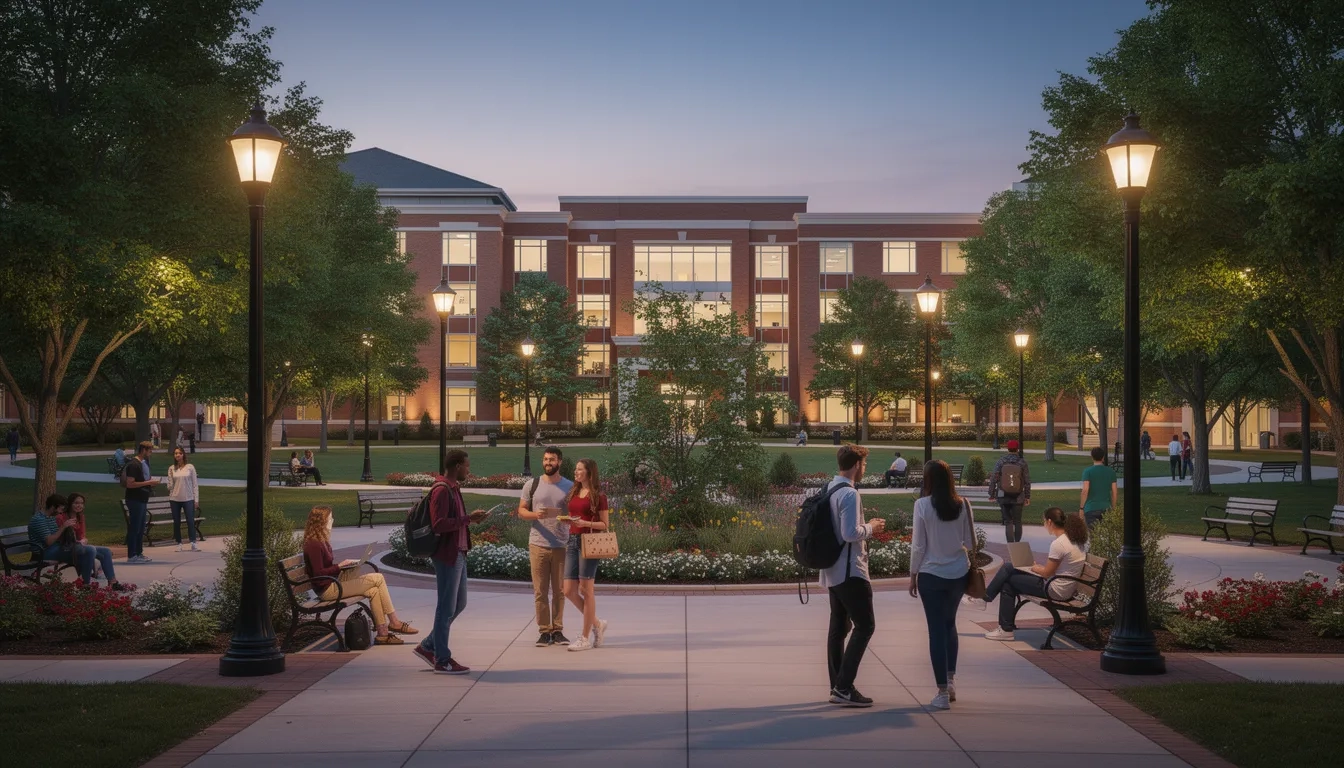
Nine hundred and thirteen students is small enough that you recognize most faces on campus within a semester. That scale shapes culture in ways hard to replicate at larger institutions. The environment is tight, self-aware, and — based on student reviews consistently — more fun than outsiders expect from an intense STEM school.
The Honor Code anchors daily campus life. Students commit to maintaining integrity in all academic and community matters, and the faculty builds the curriculum around that trust: take-home exams, unproctored finals, collaborative problem sets. The code doesn't hold together because students fear punishment. It holds because students feel genuine ownership of the system. Cheating is uncommon not because it's impossible, but because the community has internalized the norm.
Campus traditions lean toward deliberate absurdity:
- Inner tube water polo: played in the campus pool with an intentionally chaotic ruleset
- Crib races: freshmen build and race homemade baby cribs across campus each year
- Campus pranks: Harvey Mudd has a documented history of elaborate, good-natured stunts — sometimes involving neighboring Claremont campuses as willing targets
- Mudd Fam Meals: faculty, staff, and students remaining on campus over spring break share communal dinners across class years
In September 2025, Harvey Mudd received the Mental Health and Well-Being Award from Insight Into Academia magazine (the largest diversity and inclusion publication in higher education), one of 70 institutions recognized in that year's issue. The award cited peer mentor groups through the Office of Institutional Diversity, mental health first aid training required for all student mentors and proctors, and the Mudd Fam Meals program specifically.
98% of students live on campus all four years. Dorms don't segregate by class year, so a first-year student lives alongside seniors from day one. That mixing accelerates the community formation that makes the campus feel cohesive rather than fragmented.
Athletics run through the Claremont-Mudd-Scripps (CMS) joint program with Claremont McKenna College and Scripps College, competing in NCAA Division III across 20 intercollegiate sports, plus club teams in rugby, rowing, and ultimate frisbee. For a school with under 1,000 students, the athletic depth is real.
The Claremont Consortium Advantage
Harvey Mudd sits within The Claremont Colleges, a cluster of seven institutions (five undergraduate colleges plus Claremont Graduate University and Keck Graduate Institute) sharing a compact 1.5-square-mile area in Southern California, 35 miles east of Los Angeles. The other undergraduate schools are Pomona, Claremont McKenna, Scripps, and Pitzer.
Cross-enrollment is open and free. A Harvey Mudd student can take art history at Pomona, film studies at Scripps, or political theory at Claremont McKenna without paying extra tuition. Library systems and research databases are shared across all seven campuses. Dining facilities are accessible to all.
This architecture solves Harvey Mudd's most visible limitation. The narrow major list is intentional, but if you want environmental policy, East Asian history, or organizational behavior, you can get it through the consortium. The result is thousands of additional course options without changing Harvey Mudd's STEM identity.
The social dimension matters just as much. The "5C" social scene means parties, clubs, and friend groups cut across institutional lines constantly. Mudd students aren't isolated inside a bubble of 900 people — they have walking access to a community of roughly 9,000 undergraduates.
The honest caveat: you still spend most of your academic life at a small, intense STEM institution. If you need the scale and variety of a large research university on a single campus, the consortium patches some gaps but not all. Eyes open going in.
Costs, Aid, and What Graduates Earn
The sticker price is real. Tuition for 2025-26 is $72,699, with room and board adding $23,434. Total cost of attendance runs roughly $89,000-$93,000 per year depending on personal expenses. No point minimizing that number.
The net price changes the calculation. Harvey Mudd meets 100% of demonstrated financial need, and 96% of students who qualify for need-based grants receive them. The average net price (what families actually pay after grants) runs between $37,600 and $45,300 per year depending on income. For low-income students, that figure drops to $17,340. Median student debt at graduation sits at $25,000 — modest for a school with this sticker price.
The returns are well-documented. From Harvey Mudd's Class of 2025 outcomes report:
- Median starting salary: $124,999.50
- 60.9% entered the workforce directly after graduation
- 28.8% went to graduate or professional school
- Typical mid-career earnings: $138,690
A student paying the average aided net price of roughly $37,600 per year spends about $150,400 over four years. Then they graduate into a $125,000 starting salary. The math is favorable in ways that justify PayScale's repeated #1 ROI ranking.
Harvey Mudd meets 100% of demonstrated financial need — which means the $93,000 sticker price is largely irrelevant unless your family has no demonstrated need at all.
For applicants, the overall acceptance rate is 13%, with Early Decision running higher at 19%. Average admitted students carry a 3.88 GPA and score around 1520 on the SAT or 35 on the ACT. The admissions process isn't purely numbers-based — research experience, mathematical ability, and genuine intellectual curiosity carry real weight alongside grades.
Bottom Line
Harvey Mudd is the right school for a specific kind of student: someone who wants serious STEM depth, doesn't want to trade away intellectual breadth, and is willing to work harder than they thought possible in exchange for a tight community and unusually strong career outcomes.
- Run the net price calculator before ruling it out on sticker price. 96% of need-based aid applicants receive grants, and Harvey Mudd meets 100% of demonstrated need.
- Apply Early Decision if it's your first choice. The ED acceptance rate (19%) is meaningfully higher than the regular rate (13%).
- Take the Clinic Program seriously. Two years of it, with real sponsors and real deliverables, is a professional head start that most schools can't match.
- Use the consortium aggressively. Cross-enroll at other Claremont Colleges, join 5C clubs, and build a social network beyond Mudd's 913 students.
The school isn't for everyone. The Common Core is genuinely hard, the campus is small, and there's no hiding behind anonymity. But for students who fit the profile, it's one of the highest-return undergraduate investments in the country.
Frequently Asked Questions
Is Harvey Mudd only for engineering students?
No — and this is one of the most common misconceptions. Harvey Mudd's seven majors include biology, chemistry, computer science, mathematics, and physics alongside engineering. Every student also completes a required Humanities, Social Sciences, and Arts curriculum. The school trains scientists and mathematicians just as much as engineers.
How hard is it to get into Harvey Mudd?
The overall acceptance rate for 2026 entry was 13%, with Early Decision running at 19%. Average admitted students have a 3.88 GPA and score around 1520 on the SAT or 35 on the ACT. The admissions process is not purely numbers-based — Harvey Mudd also looks seriously at research experience, mathematical ability, and evidence of genuine intellectual engagement outside the classroom.
Does Harvey Mudd offer graduate or PhD programs?
No. Harvey Mudd is exclusively an undergraduate institution. This is actually relevant to its rankings: every school ranked above Harvey Mudd in the U.S. News computer science list runs doctoral programs whose research output inflates scores. For undergraduate-only programs, Harvey Mudd is the top-ranked CS school in the country.
What exactly is the Clinic Program?
The Clinic Program is a year-long capstone experience where teams of four to five juniors and seniors solve a real technical problem for a real company or organization. Sponsors include firms like Google, NASA, CrowdStrike, and Medtronic. The program has been running since 1963 and has completed over 2,000 projects. It's a graduation requirement for all students, not an elective.
Can Harvey Mudd students take classes at other Claremont Colleges?
Yes, and it's free. Harvey Mudd belongs to The Claremont Colleges consortium alongside Pomona, Claremont McKenna, Scripps, and Pitzer. Students can enroll in courses at any of the five undergraduate colleges at no additional cost, which substantially expands the range of available subjects beyond Harvey Mudd's focused STEM curriculum.
Is Harvey Mudd actually worth the cost?
The data makes a strong case that it is — for students who receive aid. Harvey Mudd meets 100% of demonstrated financial need, and the median starting salary for the Class of 2025 was $124,999.50. For families at or near average aid levels, four years costs roughly $150,000 in total, and graduates enter a salary range that covers that quickly. Students paying closer to sticker price face a harder calculation.