How Internship Experience Shapes Your Starting Salary
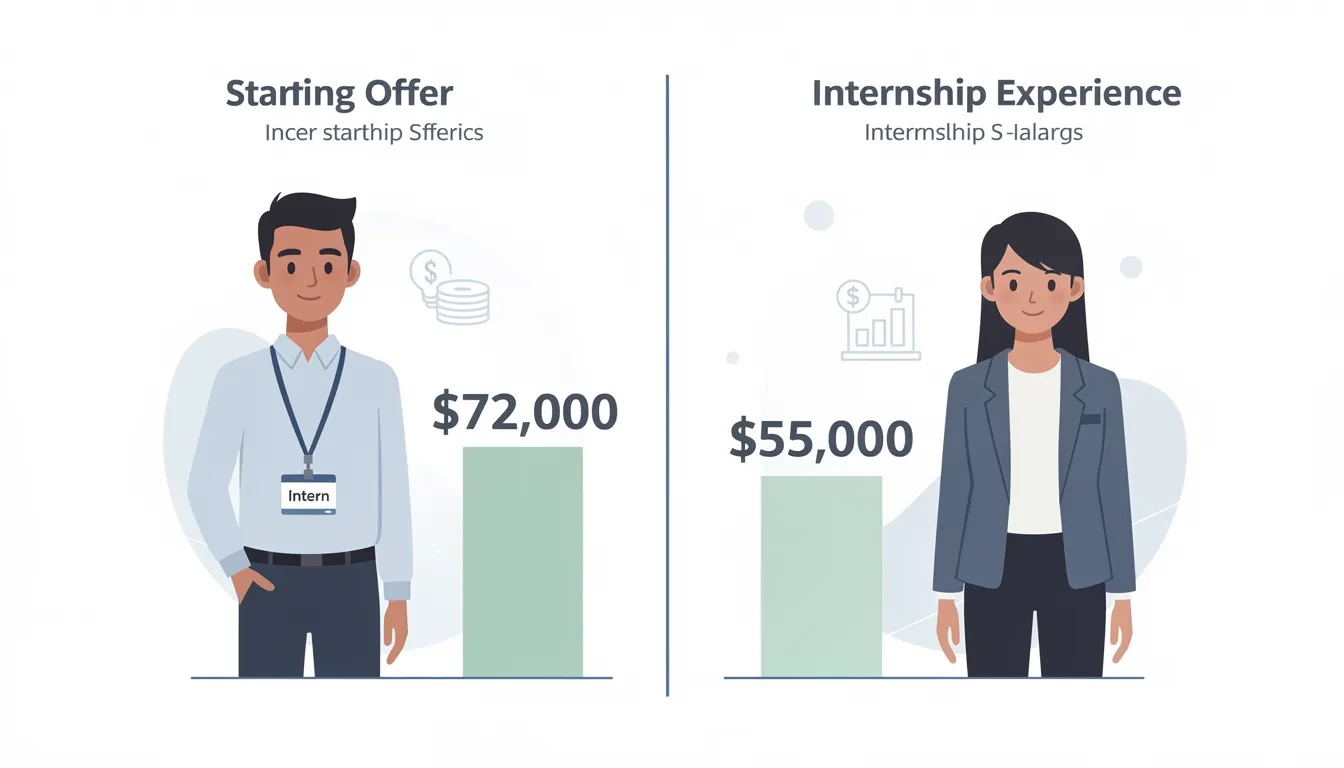
There's a $13,000 difference sitting in plain sight. A marketing graduate with two summer internships lands a starting offer around $55,000. Her classmate (same degree, same school, same graduation date) walks away with $42,000. According to NACE's 2024 research, students who completed paid internships earned starting salaries roughly 20% higher than peers who graduated without any. That gap doesn't close at year one. It compounds through annual raises, performance bonuses, and future job offers that all anchor to your current salary. By the time you're three years into a career, that initial $10,000 to $13,000 premium has grown considerably wider.
The Salary Premium Is Bigger Than You Think
The gap between interns and non-interns shows up immediately and in measurable ways. Research compiled by Prosperity for America drawing on NACE surveys puts the average starting salary for graduates with internship experience at $47,470, compared to $37,330 for those without. That $10,140 difference represents months of student loan payments.
NACE's 2025 salary data for the Class of 2025 shows the overall average starting salary at $76,251, up from $74,778 the prior year. Within that figure, candidates with internship track records consistently land toward the upper end of salary bands. Engineering graduates clock in at $78,731 this cycle. But the key isn't just about field — it's about where you land within any given field's range.
The premium doesn't stop at base pay. Interns who convert to full-time employees often skip the early "prove yourself" phase that external hires spend their first year navigating. They arrive with existing relationships, institutional knowledge, and a track record. That accelerates promotion timelines. A $10,000 starting advantage that also delivers a 12-month head start on your first promotion is not a small thing.
Recruiters know this math too. Employers planned to bring in 3.9% more interns in 2025-26 compared with 2024-25, according to NACE's 2026 Internship & Co-op Report. Companies keep expanding these pipelines because they work.
Why Employers Pay More for Converted Interns
Think about hiring from a manager's view. Every external hire is a bet. You're predicting that interview performance, a GPA, and a reference check will translate into real output. An intern who's already done meaningful work on your team? That bet has already paid off.
Reduced hiring uncertainty is the real driver of the salary premium. Companies price return offers competitively because they've already absorbed training costs and know exactly what they're getting. Over 70% of interns receive a job offer from their host organization, according to internship outcome data. Of those who get offers, about 80% accept. That acceptance rate tells you the offers are priced to compete.
The advantage extends beyond the internship company itself. Employers screening resumes treat internship experience as a strong endorsement signal. Someone else already vetted you, trained you, and trusted you with real work. That travels. Research on job search outcomes shows success rates improve by 85% after completing an internship, largely because those candidates clear early screening filters that trip up graduates without any work history.
Conversion to full-time happens at a 66.4% rate across all internships, but that figure masks wide variation by industry and program quality. Understanding what drives conversion — not just that it happens — is what separates candidates who use internships strategically from those who treat them as boxes to check.
Paid vs. Unpaid: A Distinction That Actually Matters
Not all internship experience carries the same weight. This is the elephant in the room that most career guides skip past.
Paid internships are 52% more likely to lead to full-time positions than unpaid ones. Part of that is selection effect — paid programs tend to sit at larger companies with established talent pipelines and real hiring budgets. But it also reflects the nature of the work. Paid interns typically handle more responsibility, work closer to standard hours, and get treated more like actual employees rather than temporary helpers.
The salary difference at graduation reflects this directly. Paid interns expect roughly $10,000 more annually than their unpaid counterparts upon graduation. Unpaid still beats no internship experience for hiring outcomes, but the financial premium is softer and less consistent.
Paid internship experience signals to future employers that another organization thought your work was worth market-rate compensation. That signal carries real weight during screening.
There's an equity dimension here worth naming. Many unpaid internships concentrate in media, the arts, and nonprofits — fields where the work is real but the pay isn't. Students from lower-income households often can't afford to take them, which narrows who gets access to the experience premium in those industries. If you have a genuine choice between a paid opportunity and an unpaid one in the same field, the paid one delivers more on nearly every measurable outcome.
The Return Offer as Your Negotiating Floor
Here's where internship experience gets tactically interesting. A return offer from your internship host doesn't just give you a job. It gives you a number — and that changes every salary conversation that follows.
Salary negotiation depends heavily on anchors (this is sometimes called anchoring in negotiation psychology, and the research on it is quite clear). Without an existing offer, you're negotiating against a salary band you can't see. With a concrete number in hand, you're negotiating against your documented market value. It's a fundamentally different dynamic.
One concrete example makes this vivid. A candidate who secured a full-time offer at $80,000 from their internship host used that figure when interviewing at their first-choice company. The result was an immediate $85,000 counter without extended back-and-forth. The internship didn't just open the door. It earned an extra $5,000 before the first day of work.
A few caveats here. Most companies won't negotiate on return offers themselves — those are already priced to retain you. The real play is using the offer externally. And some employers have strict salary band policies that limit movement regardless of competing offers. Still, having a verified market price shifts you from "entry-level candidate asking for more" to "professional with documented value," which is a much stronger starting position.
Research from Career Employer also notes that settling for a salary well below market rate at your first full-time role can hurt earning potential for years, since annual raises and future offers both anchor to where you started. Getting that initial number right matters more than most people realize.
How Industry Shapes the Size of the Boost
The internship premium isn't uniform. Where you intern matters almost as much as whether you intern.
| Industry | Typical Intern Pay | Full-Time (With Internship) | Full-Time (Without) |
|---|---|---|---|
| Big Tech | $7,500–$8,000/month | $75,000–$90,000 | $60,000–$70,000 |
| Finance / Investment Banking | $10–$55/hour | $85,000–$110,000 | $65,000–$80,000 |
| Top-Tier Consulting | Varies by firm | $95,000–$110,000 | Very limited pathways |
| Engineering | $20–$30/hour | $78,731 avg (NACE 2025) | Significantly lower |
| Marketing / Communications | $15–$20/hour | $55,000–$65,000 | $42,000–$50,000 |
Big tech sets the absolute ceiling. Meta pays interns around $8,000 per month. Amazon sits at roughly $7,725. Google comes in at approximately $7,500. Those aren't rounding-error differences from market — they're the deliberate cost of locking up talent that companies intend to convert. Full-time hires from those pipelines consistently start at $75,000 to $90,000, compared to non-intern peers in similar roles starting at $60,000 to $70,000.
Top-tier consulting operates differently from every other industry. McKinsey's intern-to-full-time conversion rate exceeds 90%. At Bain, the figure runs comparably high. The internship there isn't an advantage — it's the primary recruiting mechanism. Students who want these careers and skip the internship aren't just missing a salary boost. They're largely cutting themselves out of the process altogether.
Making Your Internship Count for Maximum Pay
Most students approach internships passively. Show up, do the assigned work, collect the reference, hope for the best. That leaves real money on the table.
The goal is conversion — turning the internship into a full-time offer with a number you can negotiate. Conversion is not random. The factors that drive it are specific and learnable.
- Build visible work, not just completed work. Managers recommend interns they remember. Presenting project updates to stakeholders, asking for feedback in week three rather than week ten, and volunteering for cross-team work all signal you're thinking about a future at the company.
- Start earlier than feels necessary. Students who secure their first internship during sophomore year rather than junior year arrive at graduation with twice as many opportunities to compare. That calendar advantage is consistently underestimated.
- Do more than one. Two strong internships outperform one. The second one compounds — you arrive with context, earn more responsibility faster, and the compensation offer is typically stronger. NACE's 2025 Guide to Compensation for Interns and Co-ops shows the average hourly wage for bachelor's-level interns at $23.04, but interns with prior paid experience frequently land above that floor.
- Ask about conversion rates before accepting. Ask the recruiter directly: what percentage of your interns receive full-time offers? A company at 20% is a fundamentally different opportunity than one at 70%. Most recruiters will answer this honestly.
Co-op programs deserve a separate mention. A six-month co-op at a major employer — the kind Northeastern University and several engineering-focused schools have made central to their academic model — delivers faster skill accumulation than two shorter summer stints. You push past the ramp-up period and into real ownership. The full-time offer quality reflects that depth.
One more thing that gets overlooked: you can negotiate the internship offer itself. Larger companies often have fixed intern pay bands, but smaller and mid-sized firms frequently have room to move. Citing NACE's published averages or Levels.fyi data for tech roles gives you a concrete anchor. Asking about flexibility never hurts — and it's excellent practice for the negotiations ahead.
Bottom Line
Internship experience is not resume decoration. It's a direct wage premium, a hiring filter bypass, and a salary negotiation tool — and the effect starts on day one and compounds for years.
- Prioritize paid over unpaid. The $10,000 graduation premium and 52% better full-time conversion rate make this call clear when you have real options.
- Treat each internship as a 10-week job interview. The return offer becomes your floor for every salary negotiation that follows, at that company and everywhere else.
- Start earlier than feels necessary. Building real internship experience in sophomore year expands your options dramatically by senior year.
- Match industry to ambition. Tech and finance deliver the largest absolute premiums. Consulting internships are frequently the only reliable on-ramp to full-time roles at top firms.
Companies that run formal internship pipelines have already done this math. Identifying strong candidates early and paying a small conversion premium is cheaper than expensive external hiring with uncertain outcomes. Run the same math from your side.
Frequently Asked Questions
Does one internship really make a meaningful salary difference?
Yes. Even a single paid internship leads to roughly 20% higher starting salaries compared to graduating with none, according to NACE's 2024 research. The effect is most pronounced in tech, finance, and engineering, where internship pipelines are deeply integrated into full-time hiring. One strong internship with a conversion offer also gives you a salary anchor for negotiating with any other employer.
Is an unpaid internship worth doing if no paid options are available?
It depends on the company's conversion track record. Unpaid internships are 52% less likely than paid ones to lead to full-time positions, and the salary premium at graduation is meaningfully smaller. If the company has a documented history of converting interns and operates in a field where unpaid programs are standard (certain nonprofits, arts organizations, media outlets), it may still be worth it. Otherwise, a paid part-time role or structured freelance work often builds more hiring leverage.
Can I actually negotiate a return offer from my internship company?
Most companies don't negotiate on return offers — they're already priced to retain you, and HR typically has limited flexibility on internally calibrated bands. The more effective play is using the return offer externally: interview at your top-choice companies, mention you have an existing offer, and let that anchor the conversation. That's where the real negotiating room exists.
What's the salary difference between a co-op and a standard summer internship?
Co-ops (typically six months) generate stronger full-time offers on average because you move past the initial learning curve and into real project ownership. Schools with structured co-op programs like Northeastern report consistently above-average early-career employment and salary outcomes. If your program offers a co-op track and your field has strong employer partnerships, it usually outperforms multiple shorter stints for both salary and career trajectory.
Do multiple internships matter, or does the first one do most of the work?
The second internship compounds the first. You arrive with context and skills, earn more responsibility faster, and typically receive a stronger compensation offer. Two paid internships in relevant roles usually yield a measurably better starting salary than one. The key is quality — two internships at companies with no conversion track record add less value than one well-chosen placement where you have a genuine shot at a full-time offer.
Is it too late to do an internship if I'm already a junior or senior?
Not at all, though the runway is shorter. A junior-year summer internship with a fall return offer puts you in a strong position before your senior recruiting cycle begins. A senior who secures a spring internship with a deferred full-time start date is also common, especially in finance and consulting. The salary data doesn't meaningfully change based on when you intern — what matters is that the experience is paid, substantive, and ideally converts.
Sources
- How Internships and Co-ops Influence Starting Salaries After Graduation – College Recruiter
- 162+ Internship Statistics For 2025 – Prosperity for America
- Class of 2025 Salary Projections Mixed – NACE
- Average College Starting Salary Projections 2025 – BestColleges
- Negotiate Your Salary After Internship 2025 – Career Employer