Jobs That Will Be Replaced by AI: A Risk Analysis for 2026
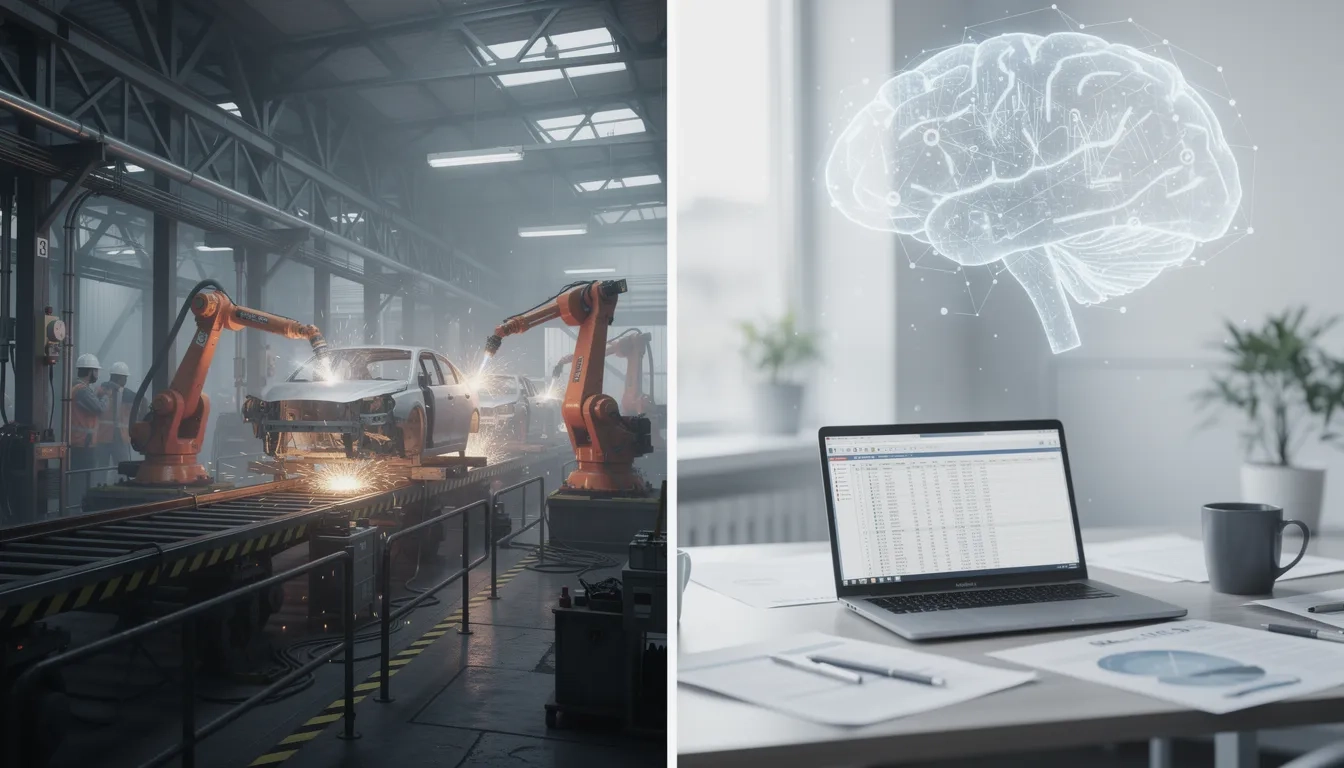
For most of industrial history, automation came for the hands first. Looms replaced weavers. Tractors replaced farmhands. Robots replaced assembly line workers. The pattern was so consistent that economists built mental models around it: machines do repetitive physical work, humans do thinking work. That model is now wrong.
Generative AI inverted the order. The roles facing the sharpest displacement pressure in 2025 and 2026 are not warehouse pickers or truck drivers. They're junior software developers, paralegals, financial analysts, and data entry clerks. The thinking work is going first. This is the thing that makes the current moment genuinely different from every previous wave of automation.
Why This Wave Is Different From Every One Before It
Previous automation targeted physical repetition. A robot arm performs the same weld 10,000 times a day. A conveyor belt moves boxes. The economic logic is straightforward: machines outperform humans on speed, consistency, and cost for defined physical sequences.
Generative AI targets cognitive repetition. Any task that involves reading inputs, applying a ruleset, and producing a structured output is now fair game. That covers an enormous slice of what knowledge workers actually do all day.
MIT's Work of the Future Lab found that when AI automates enough tasks within an entry-level role, companies don't always create a new job title for what's left. Instead, they redistribute remaining work upward to senior staff. Headcount at the junior level shrinks without ever appearing in a headline about layoffs.
This is how the disruption hides. It doesn't look like a factory closing. It looks like slower hiring, smaller incoming analyst classes, and teams that somehow function with three people where they once needed six.
How Researchers Actually Measure Automation Risk
Before looking at which jobs are most exposed, it's worth understanding how researchers calculate risk in the first place. Two approaches dominate the literature, and they produce very different numbers.
Task-based analysis breaks a job into its component tasks, then assesses which tasks AI can perform. This is more realistic than treating jobs as monolithic units. Anthropic researchers found that for computer and math occupations, large language models can theoretically handle 94% of discrete tasks — but in actual professional use, Claude covers only about 33% of those same tasks. There's a significant gap between what AI can do and what it's being deployed to do right now.
Exposure indices measure how frequently a worker's tasks overlap with AI capabilities, without predicting full job elimination. The Stanford AI Index uses this approach and identifies knowledge workers as disproportionately exposed compared to manual laborers, reversing a 200-year pattern.
The honest takeaway: most credible researchers are measuring exposure and displacement pressure, not predicting precise headcounts. Anyone offering exact percentages with false confidence is filling gaps with extrapolation.
The Jobs Facing the Most Pressure
The World Economic Forum's 2025 Future of Jobs Report surveyed employers across 55 economies and identified the fastest-declining roles with unusual specificity. The pattern is clear.
| Occupation | Risk Level | Primary AI Threat |
|---|---|---|
| Data Entry Clerks | Very High | Document processing, OCR, LLMs |
| Bank Tellers & Cashiers | Very High | Transaction automation, chatbots |
| Postal Service Clerks | Very High | Routing algorithms, digital comms |
| Administrative Assistants | High | Scheduling, email drafting, coordination |
| Paralegals & Legal Associates | High | Contract review, research synthesis |
| Junior Financial Analysts | High | Financial modeling, report generation |
| Medical Transcriptionists | Very High (already displaced) | Speech-to-text, NLP |
| Customer Service Reps | High | AI chatbots, sentiment routing |
| HR Recruiters (screening) | High | Resume parsing, candidate ranking |
| Junior Software Developers | Moderate-High | Code generation, debugging |
Medical transcription is worth pausing on. It's not a future risk. It's essentially already gone — roughly 99% of medical transcription work has been automated. That happened quietly, over about four years, with almost no public attention.
Data entry clerks face perhaps the most acute near-term pressure. AI systems can now process over 1,000 structured documents per hour with error rates below 0.1%. A human data entry clerk can't compete on those metrics, and there's no adjacent task they can absorb.
Goldman Sachs economists estimate that 6 to 7% of U.S. jobs face direct displacement if AI adoption accelerates — about 9 million roles. Globally, they project exposure equivalent to 300 million full-time positions, though "exposure" doesn't mean all those jobs vanish overnight. It means the economics of each role change significantly.
The Entry-Level Pipeline Problem
Here's the structural concern that doesn't get enough attention: what happens to career development when the entry-level layer disappears?
Junior roles have historically served as training grounds. A first-year paralegal learns to read case law by reviewing hundreds of documents. A junior analyst learns financial modeling by building models that senior analysts then refine. These aren't just jobs. They're the mechanism by which professions reproduce expertise across generations.
When AI handles the entry-level tasks, companies don't hire as many juniors. Federal Reserve researchers have tracked this in real-time: workers aged 22–25 experienced a 13% employment decline in AI-exposed roles since late 2022. That's not layoffs. That's fewer entry points into the profession.
The structural concern isn't today's unemployment rate — it's a narrowing pathway that could leave the next generation of senior professionals with nowhere to start.
This is the longer-game risk. In ten years, some fields may find themselves short of mid-level talent because the junior pipeline through which people traditionally developed expertise has constricted. You can't skip the first three years of legal research and directly become a partner.
Jobs That Are Holding Up (And Why)
Not every role is under pressure. Some occupations have structural characteristics that make them genuinely difficult to automate, not just difficult right now, but difficult by design.
Roles that remain resilient tend to share one or more of these traits:
- Physical presence and dexterity in unstructured environments — plumbers, electricians, HVAC technicians. AI can't turn a wrench inside a wall cavity, and these jobs exist inside an infinite variety of physical situations that can't be scripted.
- High-stakes relational judgment — therapists, social workers, certain medical roles. Patients are already resistant to AI-delivered mental health care, and legal liability structures create strong institutional pressure to keep humans in the loop.
- Creative originality with real-world stakes — senior creative directors, architects, trial lawyers. AI can generate a first draft, but the human responsible for the output still has to stand behind it in contexts where being wrong has expensive consequences.
- Complex manual trades — construction, skilled trades, surgical specialties. The U.S. construction sector currently reports a 94% worker shortage. AI is not filling that gap.
Teaching is an interesting case. AI can deliver content. It cannot replicate the relational dynamics of a teacher who knows which student is struggling at home and adjusts accordingly. The role will change, but mass displacement seems unlikely given class sizes, legal requirements around credentialing, and the social functions schools serve.
The Demographic Story Nobody Talks About Enough
The risk here is not evenly distributed. Not even close.
Women face nearly three times the automation risk of men globally — a 4.7% displacement probability versus 2.4% — according to labor research cited by the International Labour Organization. The reason is occupational concentration: women are overrepresented in administrative, clerical, and data processing roles, which happen to be exactly where AI exposure is highest.
Anthropic's researchers found something counterintuitive. The workers facing the highest AI exposure in their model earn 47% more than average and are nearly four times as likely to hold graduate degrees. AI is not coming for low-wage manual work first. It's coming for mid-to-upper knowledge work — the professional middle class.
That's a different political and economic story than "robots take factory jobs." Factory closures hit specific geographies and demographics. AI hitting educated, relatively well-paid knowledge workers is something that affects a much broader swath of the electorate, which is partly why the policy conversation has finally gained some momentum.
What the Labor Market Data Says Right Now
In the first half of 2025 alone, 77,999 tech job losses were directly attributed to AI, according to tracking from workforce data providers. And 49% of U.S. companies using ChatGPT reported replacing some workers with the tool. These are not projections. They're observed events.
But here's the other side of that data. The WEF's 2025 report projects 170 million new roles created by 2030 against 92 million displaced — a net gain of 78 million jobs. AI and machine learning specialists, big data engineers, and fintech developers are among the fastest-growing roles in percentage terms.
The jobs being created are not equivalent replacements for the jobs being lost. A displaced data entry clerk doesn't automatically become an AI trainer or a prompt engineer. The skills gap is real: WEF estimates that 39% of workers' existing skill sets will be transformed or obsolete by 2030.
Some argue the "net positive" framing is too optimistic because it assumes displaced workers can reskill fast enough and access the new roles. History suggests that transition is slower, messier, and geographically uneven than top-line projections imply. I think the skeptics have the better argument here. The Industrial Revolution did eventually create more jobs than it destroyed — but the people it displaced in 1830 didn't benefit from that.
The honest position: we're probably not headed for permanent mass unemployment, but we're almost certainly headed for a sustained period of painful transition that the labor market and social safety net are not currently built to handle.
Bottom Line
- Stop treating this as a future problem. Medical transcription is already automated. Entry-level hiring in finance and law is already contracting. The displacement is present tense.
- The highest-risk roles share a pattern: structured inputs, rule-based processing, document-heavy output, limited judgment required. If your job is mostly "read this, apply these rules, produce that," take the risk seriously.
- Entry-level exposure is the sleeper issue. Even if your senior role is safe, the junior pipeline feeding it may be narrowing in ways that create talent shortages five to ten years out.
- The skills that protect you are the ones AI can't easily replicate: physical presence in complex environments, high-stakes relational judgment, creative accountability, and institutional trust. Develop those deliberately.
- Don't wait for your employer to build a plan for you. The 39% skills obsolescence figure means the burden of reskilling will fall on workers more than institutions, at least in the near term.
Frequently Asked Questions
Will AI fully replace jobs, or just automate parts of them?
Both, depending on the role. For most jobs, AI is automating specific tasks rather than eliminating the title entirely — at least at first. But when enough tasks get automated, companies tend to shrink headcount rather than reassign people, particularly at entry levels. The result looks like slower hiring and smaller teams rather than dramatic mass layoffs.
Which jobs are safest from AI automation?
Roles that require physical dexterity in unpredictable environments (electricians, plumbers), high-stakes relational judgment (therapists, surgeons), or complex creative accountability (senior architects, trial lawyers) are the most resistant. These share a common thread: the stakes for being wrong are high, the environment is unstructured, and the human presence carries legal or relational weight that AI can't substitute.
Isn't AI also creating new jobs? Won't that offset displacement?
Yes — the WEF projects a net gain of 78 million jobs globally by 2030. But the new roles (AI specialists, data engineers, fintech developers) require different skills than the displaced ones (data entry, administrative support, basic financial analysis). The transition is real, and history shows it plays out over decades and isn't evenly distributed. Net positive aggregate numbers can mask serious disruption for specific workers and communities.
Is it true that AI is replacing educated workers more than low-wage workers?
Anthropic's 2025 research found that workers with the highest AI exposure earn 47% more than average and are nearly four times as likely to hold graduate degrees. This reverses the traditional automation pattern where physical, lower-wage roles were hit first. Generative AI's strength is text, code, analysis, and documentation — exactly what knowledge workers do.
What should I do if my job is high-risk?
Identify which specific tasks in your role AI is replacing versus which ones still require your judgment. Then move aggressively toward the judgment-heavy work. Lateral moves into AI-adjacent roles (prompt engineering, AI quality review, human-in-the-loop oversight) are increasingly viable. The goal isn't to out-compete AI at document processing. It's to develop skills where AI needs a human co-pilot.
Is the "AI will destroy all jobs" narrative overblown?
Yes, for the near term. Mass permanent unemployment is unlikely given historical patterns of technology creating new categories of work. But "overblown" doesn't mean "not serious." Real people in real roles are seeing slower hiring, wage compression, and narrowing entry points right now. The outcome probably won't be apocalyptic — but it will be disruptive enough that treating it as distant hype is a mistake.
Sources
- Future of Jobs Report 2025 – World Economic Forum
- How Will AI Affect the Global Workforce? – Goldman Sachs
- Anthropic Research: A Great Recession for White-Collar Workers? – Fortune
- AI Job Displacement: What the Data Actually Shows – MindStudio
- 77 AI Job Replacement Statistics 2026 – DemandSage
- How Will AI Affect Jobs 2026–2030 – Nexford University