LSU Admissions, Rankings, and Student Life: What You Need to Know
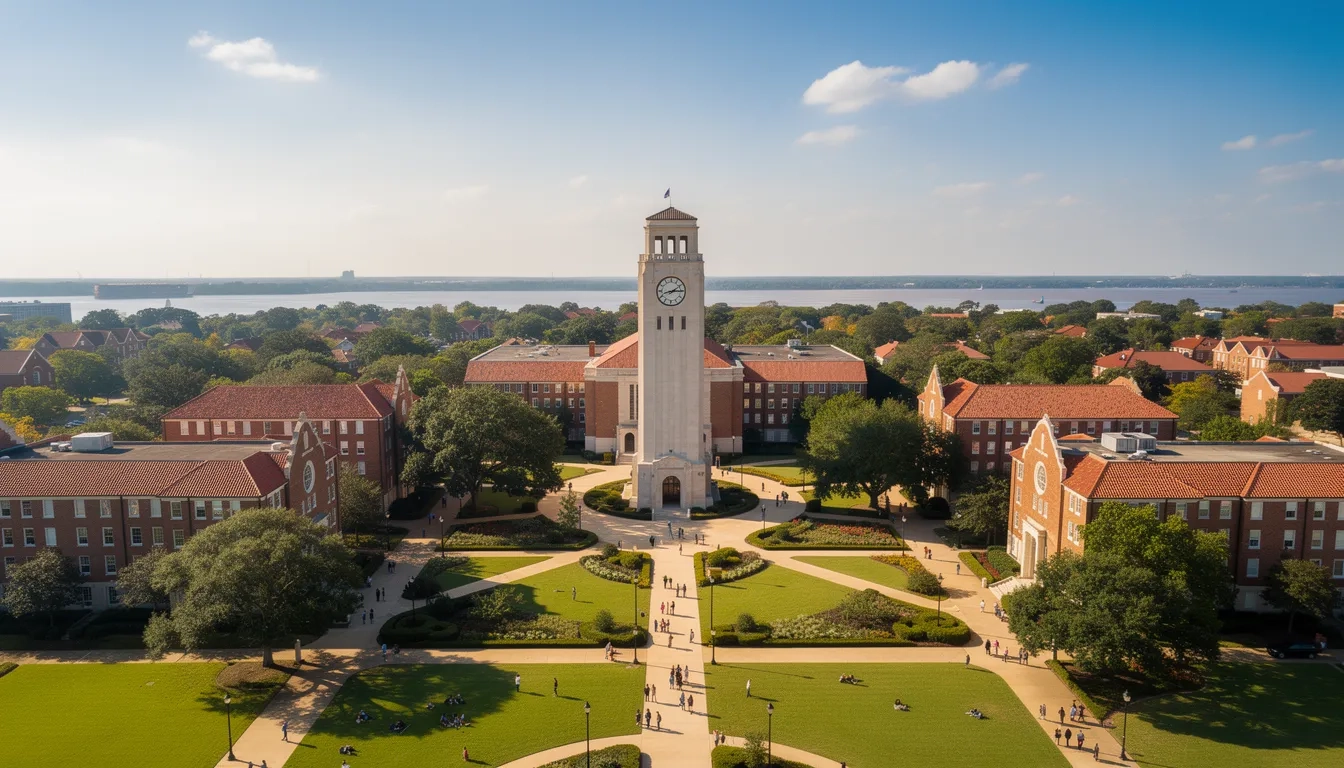
LSU received 54,687 applications for a recent fall class. To put that in perspective, it's more than Vanderbilt, Tulane, and University of Richmond see combined for their own entering classes. Yet the acceptance rate sits around 73 percent. That combination — enormous demand, moderate selectivity — puts LSU in a genuinely interesting spot: a school that draws first-choice applicants by the tens of thousands but still hasn't cracked the prestige tier in national rankings.
The gap between LSU's popularity and its ranking position is the most useful frame for understanding the school. Once you see that, most of the other questions — is it worth applying? is it a "real" research university? what is the social scene actually like? — become easier to answer.
LSU Admissions: What Getting In Actually Requires
The numbers tell a more selective story than the acceptance rate headline suggests. Of the 54,687 students who applied for a recent fall class, 37,945 were admitted and 8,243 enrolled. That means roughly 1 in 6 admitted students chose somewhere else — not nothing for a state flagship.
Students who earned admission recently averaged an ACT superscore of 26.5 and a high school GPA of 3.82, both records for incoming classes at the time. The floor is accessible. The ceiling, especially for merit aid, is more competitive than most people assume when they see "73% acceptance rate."
Key admissions data:
| Metric | Range / Figure |
|---|---|
| Acceptance rate | ~73% |
| High school GPA (incoming avg) | 3.82 |
| ACT middle 50% | 24–30 |
| SAT middle 50% | 1,180–1,340 |
| Application fee | $50 (via Common App) |
| Admissions format | Rolling; test optional |
LSU runs rolling admissions, meaning applications are reviewed as they arrive. That creates a real incentive to apply early — not because competition is intense, but because merit scholarships draw down on a first-come basis. The Merit Award Program starts at $2,000 per year for students with a 3.0 GPA and a 28 ACT, scaling upward to full in-state tuition waivers for top-tier applicants.
One thing applicants consistently misread: "test optional" doesn't mean scores don't matter. If your ACT lands at 28 or above, submitting it moves you into higher scholarship consideration. If it falls below 24, you're likely better off keeping it off the application. The test-optional policy gives you flexibility, not a free pass.
How LSU Ranks Across Different Systems
Rankings are a blunt tool, but worth understanding so you can read them critically.
US News placed LSU at #169 among national universities for 2025, five spots better than the year before. That puts it solidly in the mid-tier of large public research universities — behind SEC flagships like Georgia (#48) and Florida (#67), but on a steady upward track over the past several years.
The Wall Street Journal's 2026 Best Colleges list told a different story: #1 in Louisiana, ahead of Auburn, Arkansas, Alabama, South Carolina, and Kentucky. The WSJ methodology surveyed approximately 120,000 students and recent alumni, weighting graduate salaries, graduation rates, teaching quality, and career preparation. LSU also placed in the top 80 universities nationally for Social Mobility — meaning how well it converts lower-income students into strong career outcomes — which puts it in the top 15% of all ranked schools.
Globally, QS ranked LSU at #851 for 2026 and Times Higher Education placed it in the 601–800 band. These numbers reflect research output relative to older, better-endowed institutions worldwide, not campus experience.
"The Wall Street Journal ranked LSU #1 in Louisiana ahead of schools with higher US News scores — a reminder that what gets measured depends entirely on what you're trying to measure."
The honest pattern: LSU underperforms in research prestige rankings and overperforms in student outcome surveys. For anyone who plans to work in the Gulf South after graduation, the outcome-weighted rankings are probably more relevant.
Academics: Real Strengths and Real Caveats
The Honors College operates almost like a separate institution within the university. Honors students get small-seminar courses, priority registration, and research access more typical of highly selective schools. The bar is meaningfully higher than general admission — typically a 32+ ACT and 3.8+ GPA. Students who qualify and don't apply to Honors are leaving a better undergraduate experience on the table.
Outside Honors, the first two years are large-lecture heavy, which is standard for a research flagship with 34,242 undergraduates. The College of Engineering and College of Agriculture consistently draw strong faculty. Coastal and environmental sciences benefit directly from LSU's physical setting — studying wetland ecology here means fieldwork in actual Louisiana wetlands, not a textbook.
Where LSU's research reputation is most solid:
- Petroleum and chemical engineering, tied to a century of Gulf Coast industry relationships
- Coastal and environmental science, with real-world field access most peer schools can't replicate
- Cybersecurity — the National Security Agency designated LSU a National Center of Academic Excellence in Cyber Operations, a designation given to only a handful of universities nationally
- Business — E.J. Ourso College of Business earned Princeton Review recognition as an outstanding MBA program, and the university's Bloomberg Global Trading Challenge team finished 20th worldwide and 6th in North America
A $160 million NSF grant for the FUEL energy transformation initiative signals that federal funders see LSU as serious infrastructure for energy transition work. The National Academy of Inventors ranked LSU in the top 56 universities for U.S. utility patents in 2023. These are not vanity stats.
The caveats are also real: large introductory courses, advising loads in popular majors, and on-campus housing that students consistently describe in reviews as dated and sometimes overcrowded. Know this going in.
Campus Life: More Than the Stadium
Tiger Stadium holds 102,321 fans — the seventh-largest stadium in the world and the second-largest in the SEC. The Athletic ranked it the best college football venue in the country. On a night game Saturday in October, with the crowd at capacity, the noise is something that has no peer in college football.
But the football reputation tends to overshadow everything else happening on campus. LSU has 400+ registered student organizations, with 46% of undergraduates participating in at least one. Students logged 88,485 service hours in a recent year. That's a campus culture that shows up beyond the tailgate.
Signature LSU traditions:
- Mike the Tiger (currently Mike VII): a live Bengal tiger mascot who lives in a 15,000-square-foot natural habitat on campus near the stadium — yes, really, and it's genuinely wonderful
- The Golden Band from Tigerland: one of the largest and most celebrated marching bands in the SEC, particularly known for its Saturday night pregame performance
- Mardi Gras Mambo: a campus-wide Mardi Gras celebration in February, because this is Louisiana and some things are simply non-negotiable
- Fall Fest and Welcome Week: structured first-week events designed to plug incoming students into organizations before the semester gets going
The TigerLink platform connects students to organizations across any interest — competitive engineering teams, performance arts, pre-professional clubs, club sports. Finding community outside the football-and-Greek axis is completely possible. It just takes more intention at a school this size.
Greek Life and the Social Scene
LSU's Greek system is large and active, running through four governance bodies: the Interfraternity Council (IFC), the Panhellenic Council for sororities, the National Pan-Hellenic Council (NPHC) for historically Black fraternities and sororities, and the Multicultural Greek Council (MGC).
On game days, Greek organizations hold tent cities on the Parade Grounds that stretch across the full lawn. For many students, especially in the first two years, Greek life is the primary social organizing structure.
Going Greek is not the only path. The UREC Student Recreation Center draws thousands of non-Greek students who prefer intramural basketball or lap swimming. The 46% organization participation rate points to healthy non-Greek community building.
My honest read on the social scene: if you arrive expecting your community to assemble itself, you'll be lonely by October. At 34,000 undergrads, nothing self-organizes. Students who join something in the first three weeks — anything — and go back more than once tend to build social lives quickly. The ones who don't join anything tend to feel like they're on the outside looking in for a full semester before doing something about it.
Baton Rouge: The Full Picture
Baton Rouge is Louisiana's state capital, with a metro population of roughly 456,000. It's not a college town the way Charlottesville, Virginia or Oxford, Mississippi are college towns. It's a real city with real-city dynamics.
The upside is significant. Baton Rouge has internship and employment infrastructure that smaller college towns simply can't offer — state government, petrochemical industry, hospitals and medical systems, and a growing tech sector. The food scene is exceptional in a way that consistently surprises students arriving from outside the South. New Orleans is roughly 79 miles away, close enough for regular weekend trips to one of the most singular cities in America.
The downsides are real and worth knowing. Baton Rouge has historically struggled with violent crime in some neighborhoods, and the transit infrastructure is thin. Students without cars should research housing location carefully rather than assuming they can manage without one. The area immediately surrounding campus is generally safe, but navigating the broader city on foot or bus is harder than it looks on a map.
Cost of living is low by national standards. Off-campus apartments near LSU run well under comparable housing in Austin, Nashville, or Charlotte, which compounds into real savings across four years.
Is LSU the Right Fit? A Practical Framework
Here's a direct take rather than a hedge.
LSU is a strong choice if you:
- Plan to work in Louisiana, Texas, or the Gulf South after graduation — the alumni network is dense where it matters most
- Are a Louisiana resident who qualifies for merit aid — in-state tuition around $12,000 per year makes the value case very hard to argue against
- Want a research university with genuine momentum in energy, environmental science, or cybersecurity
- Thrive in high-energy campus cultures where sports, Greek life, and large-scale tradition are central to the experience
Worth reconsidering if you:
- Need small class sizes and consistent faculty contact from the first semester
- Are academically strong but haven't explored the Honors College specifically — general admission and Honors are different enough that the choice matters
- Are moving from out of state primarily for the football reputation without accounting for the city's infrastructure realities
Bottom Line
- Apply early. LSU's rolling admissions and scholarship distribution reward early movers. If you wait until December, you're competing for what's left in the merit pool.
- Look at the Honors College separately. If you qualify, the experience is meaningfully different from general admission — smaller classes, research access, priority registration.
- Interpret rankings by methodology. LSU's Wall Street Journal #1-in-Louisiana ranking, built on graduate outcomes and student satisfaction, reflects something the US News #169 doesn't.
- Plan your social integration. Join something before Week 3 ends. The school is large enough that community requires a deliberate first move.
- Research your housing and transportation options before committing to anything off campus — Baton Rouge is a real city, not a walkable college town.
Frequently Asked Questions
What GPA and test scores do I realistically need to get into LSU?
The published minimum GPA is 3.0, but incoming students recently averaged 3.82. The middle 50% ACT range is 24–30; the equivalent SAT range is 1,180–1,340. LSU is test optional, so a strong score (28+) helps for merit aid, while a weak score is better left off the application entirely.
How do LSU's merit scholarships work, and who qualifies?
LSU's Merit Award Program uses a combination of GPA and ACT score. A 3.0 GPA with a 28 ACT earns $2,000 per year; the top tier offers full in-state tuition. Since awards are distributed on a rolling first-come basis as applications arrive, there's a genuine cost to applying late in the cycle.
Is the US News #169 ranking misleading — is LSU actually a stronger school than that suggests?
For specific programs and post-graduation outcomes in the Gulf South, yes. The Wall Street Journal's methodology, which weights graduate salaries and student satisfaction, placed LSU first in Louisiana ahead of schools with higher US News numbers. The NSA's Cyber Operations designation and the National Academy of Inventors top-56 patent ranking point to research programs that outperform their prestige ranking. US News measures inputs like endowment and peer reputation; those metrics disadvantage newer, growing programs.
What is campus social life like at LSU if you're not into football or Greek life?
Genuinely active — as long as you're intentional about finding it. With 400+ organizations and 46% undergraduate participation, there's infrastructure for almost any interest. The UREC recreation center is a major non-Greek social hub. The challenge is scale: you have to show up and keep showing up, because at 34,000 students, nothing organizes itself around you.
How does Baton Rouge compare to other SEC college towns for student experience?
It's a bigger, more complex city than most SEC college towns, which cuts both ways. More internship and employment opportunities, a significantly better food scene, and easy access to New Orleans are real advantages. Thinner transit infrastructure, higher property crime in some neighborhoods, and a car-dependent layout are genuine drawbacks. Students who research their housing location and come prepared tend to love it; those who arrive expecting a small-town feel often find the adjustment harder.
Does LSU have strong academic programs outside of engineering and business?
Yes. Coastal and environmental sciences are among the strongest in the country given the university's direct field access to Louisiana wetlands and Gulf ecosystems. The mass communication school (Manship School) has a strong regional reputation. The new NSA cybersecurity designation elevates the computer science and information assurance programs. The Honors College gives high-achieving students access to research and seminar experiences that cut across all disciplines.