Average MBA Salary by School Tier: What the Data Actually Shows
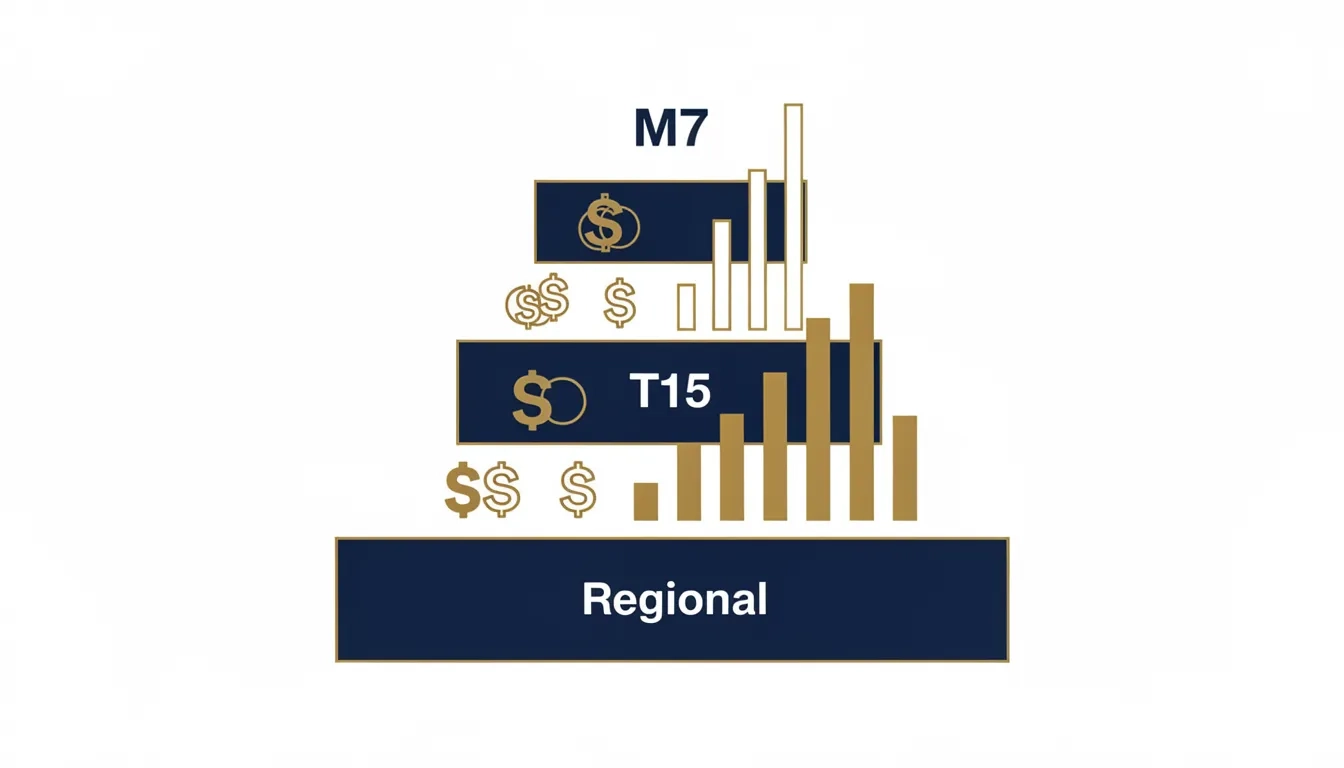
The gap between Stanford's MBA program and a mid-ranked regional school isn't just a prestige gap. In pure dollar terms, 2024 employment data compiled by Poets&Quants shows Stanford GSB graduates averaged $268,490 in first-year total compensation (base salary plus signing bonus). Programs ranked in the bottom quarter of the 133 full-time MBA programs tracked by U.S. News averaged $60,576. That's the same credential, two years of your life, and a difference of more than $200,000 a year.
The numbers don't lie. But they also don't tell the whole story.
What "Tier" Actually Means for Your Paycheck
Business school rankings get complicated fast. Different publications weight different factors, and employers don't always agree with journalists. That said, a few tier groupings have become widely accepted in admissions consulting and recruiting.
The M7 — Harvard, Stanford, Wharton, Booth, Kellogg, Columbia, and MIT Sloan — sit at the top. These programs have historically controlled the pipelines into McKinsey, Bain, BCG, Goldman Sachs, and the major tech companies' leadership rotational programs. Below them, T15 schools (Dartmouth Tuck, Duke Fuqua, Michigan Ross, NYU Stern, Yale SOM, Berkeley Haas, Virginia Darden) still place graduates in top roles but often compete harder for the same limited seats. T25 programs (Georgetown McDonough, UT Austin McCombs, UNC Kenan-Flagler) skew regional and are strongest within specific industry niches. Then there are online and part-time programs, which mostly serve people accelerating existing careers rather than switching fields.
The tier system matters for one reason above all: on-campus recruiting access. McKinsey doesn't visit 400 schools. They visit roughly 20. That shortlist doesn't change much from year to year, and it correlates almost directly with tier.
If you want MBB consulting or bulge-bracket banking, your school's recruiting relationships aren't a soft factor. They're the entire ballgame.
Salary by School Tier: The Full Breakdown
Here's how first-year total compensation breaks down across tiers, based on 2024 employment reports and GMAC research:
| Tier | Representative Schools | Median Base Salary | Typical Signing Bonus | Median Total Comp |
|---|---|---|---|---|
| M7 | Stanford, HBS, Wharton, Sloan, Booth, Kellogg, Columbia | $185K–$210K | $30K–$50K | $215K–$268K |
| T15 | Tuck, Fuqua, Ross, Stern, Haas, Darden, Yale SOM | $150K–$175K | $25K–$40K | $183K–$202K |
| T25 | McCombs, McDonough, Kenan-Flagler, Owen | $110K–$145K | $20K–$35K | $130K–$165K |
| Regional/Online | State schools, online programs | $75K–$105K | $10K–$25K | $85K–$120K |
Stanford leads all programs at $268,490 median total comp. Harvard followed at $221,800, MIT Sloan at $214,450. On the lower end of the top 30, WashU Olin reported a median base of $126,773.
A few programs punch above their tier. NYU Stern, technically T15, reported $202,000 in median total comp, which rivals Columbia (M7 at $198,996). The reason: Stern's deep Wall Street recruiting relationships, built over decades right in Manhattan. Geography sometimes outweighs ranking, particularly for finance-track students who want to stay in New York City.
The Industry Variable That Reshapes Everything
School tier isn't destiny. What function you go into after graduation shifts your compensation range more than most applicants realize when they're weighing offers.
Consulting and finance are where the tier premium runs largest. McKinsey, Bain, and BCG (the "MBB" firms) pay identical base salaries regardless of school — $190,000 base in 2024 — but they recruit primarily from M7 programs and very selectively from T15. Goldman Sachs and the major private equity firms operate the same way. If MBB is the goal, your school tier directly controls whether you get an interview.
Tech is where the gap compresses. Amazon, Google, Meta, and Microsoft recruit from a far broader set of schools. A Booth grad and a McCombs grad joining Amazon's product management team may receive nearly identical total compensation packages, especially once restricted stock units are factored in. RSUs can make tech total comp dwarf consulting packages at any tier.
Here's how the salary gap by function breaks down across tiers:
- Consulting track: $35,000–$50,000/year gap between M7 and T15
- Investment banking: $20,000–$40,000/year gap (both tiers get interviews, but M7 wins the ratios)
- Tech/product management: $10,000–$25,000/year gap, smaller and more variable
- General management and operations: Often no statistically meaningful difference by tier
General management varies the most by geography and company size. A regional MBA grad who stays in their metro area and moves into operations can earn $95K–$115K, which is legitimate compensation, often with far less debt than an M7 graduate carrying $200K in loans.
Signing Bonuses: Not Small Print
Most coverage of MBA salaries focuses on base. That's misleading. Signing bonuses at top programs add real money to first-year earnings, and they're often overlooked in headline comparisons.
Across the 30 schools tracked by Poets&Quants in 2024, Washington Foster reported the highest average signing bonus at $39,283. Rochester Simon came in lowest at $26,470. But those figures average across all functions. In consulting specifically, signing bonuses routinely run $30,000–$35,000. In finance, they can hit $50,000 or more at top firms.
Consider a Wharton grad entering consulting: $185,000 base plus a $35,000 signing check puts first-year cash at $220,000 before any year-end performance bonuses. Those year-end bonuses at MBB firms average another $40,000–$70,000. The base salary line you see in employment reports is almost always just the starting gun — especially at programs with strong consulting and finance placement.
This is why comparing "base salaries" across schools without accounting for bonus rates and industry mix produces misleading conclusions.
The ROI Question
Here's the elephant in the room: does the salary premium from an M7 program actually justify the cost?
Stanford's MBA runs roughly $80,000–$90,000 in annual tuition. Total program costs — tuition, living expenses, lost salary during the two years — often exceed $300,000. An M7 degree might add $70,000–$100,000 in annual salary compared to a solid T25 program. Run that math over five years and the M7 grad potentially nets $350,000–$500,000 more in cumulative earnings. After accounting for higher loan payments and interest, the break-even point typically falls somewhere in years three to five.
But most analyses comparing M7 to T25 ignore opportunity cost entirely. A T25 program might cost $80,000 total versus $200,000+ for M7. That difference in loan burden matters enormously if you want to join a nonprofit, start a company, or work in a field with lower compensation ceilings.
The right question isn't "which school pays more?" It's "which school pays more relative to its total cost for the specific career path I want?"
GMAC's research on top global programs reinforces that the premium is real worldwide. INSEAD graduates averaged $217,822 in total compensation. London Business School came in at $217,389. The tier system isn't a purely American phenomenon.
When Tier Matters Less Than You Think
There are careers where the M7 premium nearly disappears, and applicants underestimate this.
Entrepreneurship is the biggest one. If you're returning to school to build a company, your eventual income depends on the company, not the diploma. Y Combinator has funded founders from state schools, community colleges, and every tier of MBA program. The network from a top school genuinely helps, but it's not the primary input into startup success.
Returning to a previous employer compresses the gap too. Many programs have strong corporate sponsorship pipelines where students go back to their pre-MBA company at a promotion. In those cases, the school brand matters less than the firm's internal salary bands.
Geographic specificity is underrated. A student who wants to stay in the Pacific Northwest and join a regional healthcare company will find that University of Washington's Foster School has better local recruiting relationships than a Boston-based M7 school that barely shows up in Seattle hiring seasons. Regional brand recognition is real and often undervalued.
My take: for consulting and finance, the tier premium is genuine and measurable. For tech and general management, T15 programs often deliver competitive outcomes at meaningfully lower total cost. The people who get burned are those who pay M7 tuition for career paths where the tier premium doesn't actually apply.
Bottom Line
- Consulting and investment banking: tier is not a soft factor. Wharton reported a 93.1% job offer rate within three months of graduation in 2024. Some T25 programs dipped below 75%. That gap in offer access reflects recruiting structure, not student quality.
- Tech and general management: T15 and strong T25 programs often deliver competitive outcomes at substantially lower cost. The salary-to-tuition ratio frequently favors them over M7.
- Total compensation always beats base salary as a comparison metric. Signing bonuses, year-end performance bonuses, and equity can add $50,000–$100,000 to first-year earnings above the headline base figure.
- Mid-career compression is real. The tier gap is largest in year one and often narrows within five to seven years. Strong performers from lower-tier programs regularly pass coasting M7 grads by year eight or ten.
- Before choosing a program, pull the school's official employment report and map specific recruiting pipelines against your target employers. That document tells you who hired last year's class. That's your actual data.
Frequently Asked Questions
What is the average starting salary for MBA graduates overall?
Across the 133 ranked full-time MBA programs that reported data to U.S. News, the average base salary plus signing bonus for 2024 graduates was $121,324. That number includes many regional and lower-tier programs that pull the figure down. Among just the top 10 programs, the same average was $207,434.
Do M7 MBAs always out-earn T15 graduates?
Not in every industry. An MIT Sloan grad and a Michigan Ross grad joining similar product management roles at the same tech company may receive nearly identical total compensation packages. The M7 premium is most pronounced in consulting and bulge-bracket finance, where firm-level recruiting is tightly school-constrained. In tech, the gap shrinks considerably.
Is an MBA still worth it financially in 2025?
For career-switchers targeting consulting, finance, or tech leadership roles, the math generally still works, especially at M7 and T15 programs. GMAC's research shows MBA graduates often experience salary increases exceeding 100% within three years of completion. For people already on a strong career trajectory in their existing field, the opportunity cost of leaving the workforce for two years often outweighs the benefit of the credential.
What's the biggest misconception about MBA salary data?
Treating median base salary as the "MBA salary." At Stanford GSB, the reported median base for 2024 was around $185,000, but median total first-year compensation, including signing bonus, reached $268,490. That $83,490 gap isn't fine print. For consulting and finance tracks, it's standard. Always look at total compensation figures in employment reports, not base alone.
How should I actually compare MBA programs for salary outcomes?
Pull each school's official employment report — most publish them publicly, usually in PDF form. Focus on three numbers: median base salary, the percentage of graduates receiving signing bonuses, and the three-month employment rate. Then factor in total program cost. The ratio of median total comp to total tuition cost gives you a rough value signal that base salary alone doesn't capture.
Does MBA concentration affect salary within a tier?
Yes, significantly. Finance and consulting concentrations at M7 schools produce the highest total compensation. Marketing and general management concentrations at the same M7 programs often land closer to what T15 finance-track grads earn. Within any tier, the function you target at graduation matters roughly as much as the school's ranking when it comes to first-year compensation.
Sources
- Data Dive: 2024 MBA Salaries, Bonuses & Job Placement Rates at 30 Top-Ranked B-Schools — Poets&Quants
- MBA Salaries: 20 Business Schools with the Highest Graduate Earnings — GMAC
- MBA Salary by School 2026: M7, Top 25 & Online Program Data — CareerReturns
- See Which MBA Programs Lead to the Best Return on Investment — U.S. News
- Average MBA Salaries in the World — MBA Crystal Ball