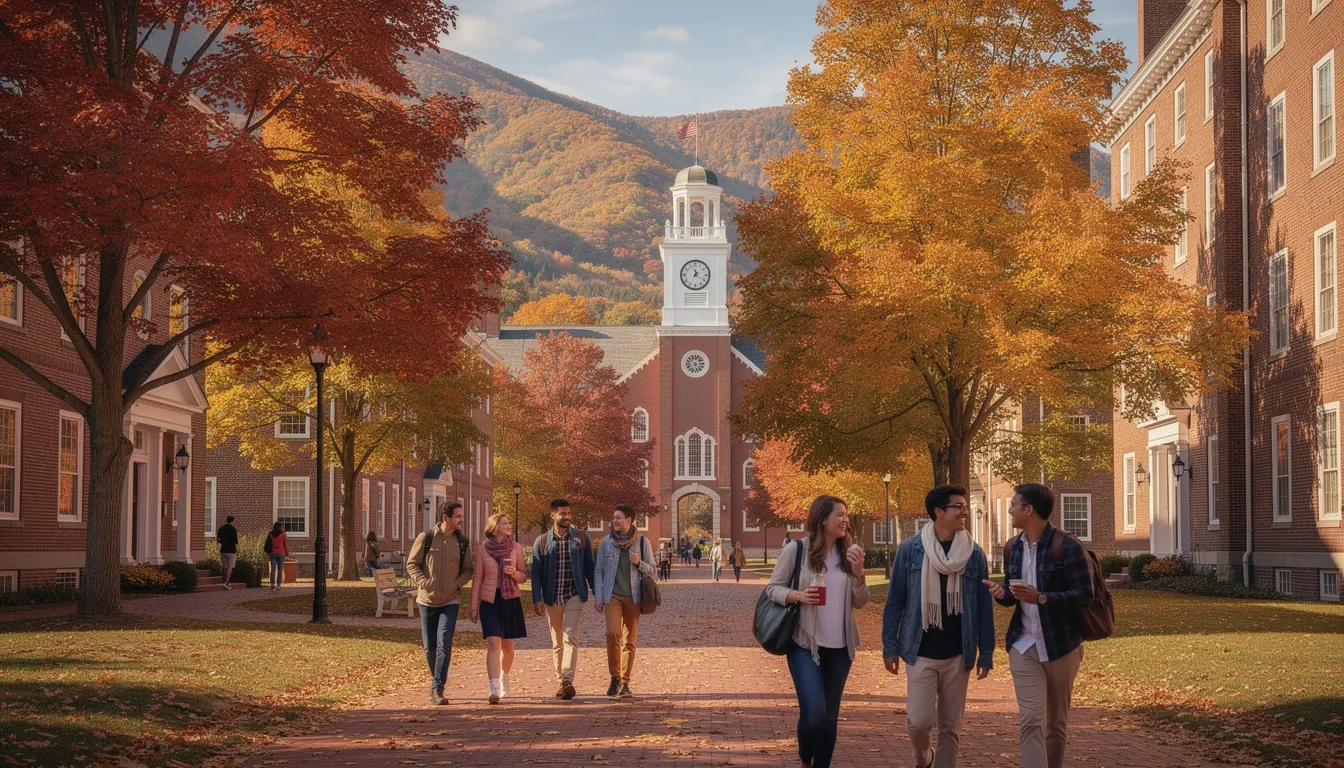
Middlebury College: Programs, Rankings, and Student Life
When Middlebury College slid from 11th to 19th in the 2025-2026 U.S. News & World Report national liberal arts rankings, the campus newspaper ran the story with an almost-defensive headline. Fair enough. Eight spots in a single year is unusual. But once you look at what actually drives the methodology — and what Middlebury offers that no algorithm captures — the anxiety starts to feel misplaced.
The school still graduates 93% of its students within six years, holds a $1.73 billion endowment, and saw a 12% admissions rate for its Class of 2028. The drop is real and worth understanding. So is the school underneath it.
The Academic Programs That Actually Set Middlebury Apart
Environmental Studies is where Middlebury's legacy is genuinely unmatched. The college launched the first undergraduate Environmental Studies program in the United States in 1965, decades before sustainability became a campus branding exercise. That head start shows: the major pulls students who want fieldwork in the Green Mountains, access to the Bread Loaf campus's 30,000 acres of working forest, and faculty who are publishing researchers, not just lecturers recycling old slides.
International Studies and English round out the academic identity. Middlebury's 45 majors span the humanities, social sciences, and hard sciences — but the school's reputation travels furthest in those three.
The 4-1-4 academic calendar is a structure most applicants gloss over. It shouldn't be. Fall and spring semesters run normally, but January is its own thing entirely: one course, one month, zero distractions. Students use it to tackle subjects entirely outside their major — documentary filmmaking, organic chemistry catch-up, thesis writing, off-campus internships. The forced focus is genuinely rare. There are few places in American higher education where a professor can spend four weeks going deep on exactly one question with a small class of students who signed up voluntarily and have nothing else to do.
Then there's the Language Schools — arguably Middlebury's most famous export.
The Middlebury Language Schools date to 1915, when the School of German launched with 11 students. Today they enroll around 1,350 students each summer across 12 languages. Every participant signs a binding "Language Pledge" committing to speak only the target language for the entire session, every hour of every day. No English at dinner. No English to your roommate at midnight when you're fumbling for a word in Mandarin.
It sounds punishing. The outcomes are not. The U.S. State Department, military language programs, and international organizations have all drawn from this immersion model for decades. Middlebury's approach is the gold standard because total immersion with zero escape hatches actually works in a way that three-hours-a-week classroom study doesn't.
Reading the Rankings Honestly
The U.S. News drop has a specific explanation, and it's worth laying out clearly rather than waving it away.
| Ranking Metric | Middlebury (2025-2026) |
|---|---|
| U.S. News National Liberal Arts | #19 (tied with Grinnell, Washington & Lee) |
| Princeton Review Academic Rating | 99/99 |
| Princeton Review Green Rating | 99/99 |
| Princeton Review Selectivity | 97/99 |
| NESCAC Team Championships | #1 (33 total) |
The social mobility score — which measures how effectively the school serves lower-income students — fell to tied-120th. Financial resources per student dropped to 45th. Both metrics reflect real institutional choices rather than a sudden academic collapse.
Professor Jason Mittell of Middlebury's film and media culture department said plainly in The Middlebury Campus that the decline reflects "increasing enrollment, larger classes, and decreased financial support." That's honest internal critique, not spin.
"Middlebury's reputation as a highly regarded liberal arts and sciences institution has not changed." — Dean of Admissions Nicole Curvin, fall 2024
Both things are true simultaneously. The methodology has structural quirks — pandemic enrollment bumps, the test-optional shift, and counting Language School students in endowment-per-student calculations all contributed to the number. And some internal indicators did genuinely weaken. The takeaway isn't "ignore the drop" but "don't treat one ranking list as your decision oracle."
Getting In: What the Admissions Numbers Mean
Middlebury accepted 15% of applicants for the Class of 2026 (1,955 students from 13,028 applications). The Class of 2028 saw a 12% rate. That's creeping toward territory where applicants need to think carefully and apply deliberately.
For students who choose to submit test scores under the test-optional policy, the middle 50% range sits at 1450-1550 SAT and 33-35 ACT. Those are numbers you'd find at schools ranked considerably higher on pure selectivity lists.
Things worth knowing before you apply:
- Need-blind admissions for domestic students means financial need won't work against you
- The average financial aid grant of $57,078 is substantial at a school where tuition, room, and board runs close to $79,800 annually
- 94% of enrolled students come from out of state — Middlebury genuinely draws nationally rather than regionally
- The student body represents all 50 states and 74 countries across an undergraduate enrollment of roughly 2,760
The selectivity is real. So is the financial commitment to meeting demonstrated need. Families who assume an $80,000 sticker price is the actual price often don't look closely enough at what aid packages look like for admitted students.
Campus Life and the Vermont Reality
Let's be direct: Middlebury is in a small Vermont town of roughly 8,800 people. Burlington is 38 miles north. This is not incidental — it shapes everything.
On-campus life is unusually self-contained by design. About 95% of students live on campus, organized through a residential Commons system. There are no traditional fraternities or sororities. Social life forms around house communities, athletic teams, and 200+ student organizations rather than Greek chapters.
The Princeton Review captures the culture: students generally "choose not to go into cities on weekends because they would hate to miss what's going on on-campus." You can read that as charming or claustrophobic — it depends entirely on what you want from college.
Outdoor culture isn't optional so much as ambient. The college owns the Snow Bowl ski area 13 miles from campus. Cross-country skiing, hiking, ice climbing, and fatbiking on the Bread Loaf trails aren't novelty weekend activities — they're what people actually do on Tuesday afternoons when the weather cooperates. For students who grew up in cities and imagined college as a more urban extension of that life, the adjustment is real.
Winter in Vermont is long and dark and genuinely cold. The right students call it beautiful. The wrong ones transfer.
Athletics: Serious Competition Without the Scholarships
Middlebury competes in NCAA Division III's New England Small College Athletic Conference (NESCAC), which means no athletic scholarships. Students play because they want to, and they really want to: 28% of undergraduates participate in varsity sports across 31 teams.
In NESCAC — a conference that includes Williams, Amherst, Bowdoin, and Colby — Middlebury leads all member schools with 33 team national championships. The athletic culture runs wide as well as deep. Club and intramural sports absorb a large share of the student body. On a campus without Greek life as a social organizing principle, sports fill that community-building role more completely than at most schools.
The Bread Loaf campus also hosts the Bread Loaf Writers' Conference, founded in 1926, which brings novelists, poets, and editors to campus each summer. It's one of the oldest and most prestigious literary gatherings in the country (Robert Frost taught there for years), and it gives the college an intellectual gravity that extends beyond the academic year.
Sustainability as Infrastructure, Not Slogan
Middlebury's green rating of 99/99 from the Princeton Review reflects something more concrete than a mission statement. The college committed to carbon neutrality in 2016 and opened a biomass gasification plant in 2009 that reduced campus carbon output by approximately 40%. The Environmental Studies program isn't just academically strong — the campus itself functions as a working case study.
The C.V. Starr-Middlebury Schools Abroad program operates at 38 sites globally, and the Middlebury Institute of International Studies in Monterey, California serves as a graduate-level sibling for students interested in language policy, international trade, and nonproliferation studies. For undergraduates, the abroad network means you can continue language immersion in the country where your target language is actually spoken.
Alumni and Long-Term Outcomes
Middlebury's alumni roster doesn't cluster in a single industry. Roger Easton (class of 1943) was a principal inventor of GPS — a fact that doesn't come up nearly enough in conversations about the school's scientific legacy. Dan Schulman (class of 1980) led PayPal as CEO. Eve Ensler (class of 1975) wrote The Vagina Monologues, which has been performed in over 140 countries. Ari Fleischer (class of 1982) served as White House Press Secretary under George W. Bush.
The strongest alumni concentrations show up in environmental organizations, international NGOs, publishing, and education — all of which track directly to the school's academic identity.
The 93% six-year graduation rate is the number I'd point to above almost anything else when evaluating long-term outcomes. The national average for four-year colleges sits around 63%. A 30-point gap is not statistical noise — it means students who choose Middlebury mostly finish, which is a harder outcome to manufacture than any single ranking position. It also reflects a student body that arrived prepared and a faculty that stays engaged through graduation.
Who Actually Fits Here
I'll give you a direct answer: Middlebury fits students who are genuinely curious, comfortable with academic intensity, and open to a social life organized around campus and the outdoors rather than a surrounding city. The Princeton Review's academic rating of 99/99 isn't decorative. Courses are demanding, professors are accessible and serious, and an 8:1 student-to-faculty ratio means you can't hide in lecture halls.
If you're looking for Greek social infrastructure, urban energy, or a school that feels like a launching pad to a major city, Middlebury will feel like a mismatch. That's not a criticism. It's just a genuine difference in what colleges are trying to do.
The students who describe Middlebury most enthusiastically share one trait: they didn't need convincing that Vermont in January was a feature. They arrived looking for exactly that.
Bottom Line
- Top programs: Environmental studies, international studies, and the Language Schools are legitimately class-leading. The Language Pledge immersion model is unmatched anywhere in U.S. higher education.
- Rankings: The U.S. News drop to #19 reflects real changes — enrollment growth and reduced per-student spending — more than an academic collapse. Note the signal without overreading it.
- Admissions: At 12% acceptance, apply with focus. Need-blind admissions and an average grant of $57,078 mean the net cost looks very different from the $79,800 sticker price for many families.
- Campus culture: The Vermont setting, no Greek life, and 95% on-campus housing create an unusually tight community. Know whether that appeals to you before applying — it's not for everyone, and it absolutely is for some.
- Outcomes: A 93% six-year graduation rate and alumni spread across environmental fields, global organizations, and creative industries suggest the Middlebury investment holds up over time.
Frequently Asked Questions
Is Middlebury College's ranking drop a sign the school is declining?
Not quite. The 2025-2026 U.S. News drop from #11 to #19 reflects specific methodology factors: pandemic-era enrollment growth, inclusion of Language School students in financial calculations, and a weaker social mobility score. Faculty resources remain in the top 10 nationally, graduation rates are still 93%, and the 12% acceptance rate is at a historic low. Watch the trend over multiple years rather than reading a single ranking cycle as a verdict.
What is the Language Pledge at Middlebury, and who is it for?
The Language Pledge is a binding commitment that Language School participants sign before the summer session begins — agreeing to speak only their target language for the entirety of the program, including social settings, meals, and off-hours. It's designed for serious language learners: students applying to government and diplomatic roles, international graduate programs, or anyone who needs genuine fluency rather than conversational basics. Casual language learners often find it more intense than they expected.
Does Middlebury give good financial aid?
For domestic students, yes. Middlebury uses need-blind admissions, meaning financial need doesn't affect admission decisions. The average financial aid grant runs $57,078 per year. With full costs around $79,800, many middle-income families pay significantly less than the sticker price. International students are considered on a need-aware basis, so the calculus differs slightly.
What is Middlebury's winter term, and can students use it for anything they want?
Winter term runs through January and requires enrollment in exactly one course. The curriculum mixes standard departmental offerings with unusual interdisciplinary courses, independent study, internships, and senior thesis work. It's structured — you need to enroll in something — but the range is genuinely wide. Many students use it to try a field they've never studied or finish major research projects without the distraction of a full course load.
Is Middlebury too isolated for most students?
That depends entirely on the student. Middlebury, Vermont has a population of about 8,800. Burlington is 38 miles away. Students who thrive here genuinely embrace the campus-centered, outdoors-focused lifestyle — skiing, hiking, club sports, and on-campus events fill the social calendar. Students who arrived hoping for urban proximity tend to feel the isolation acutely. It's one of the more honest self-selection questions in the liberal arts college search.
How does Middlebury compare to other NESCAC schools like Williams and Amherst?
All three are highly selective liberal arts colleges with strong academics and no athletic scholarships. Williams and Amherst typically rank higher on U.S. News. Middlebury leads NESCAC in total team national championships (33) and has a distinctly stronger language and international studies identity. Williams edges out on endowment per student. Amherst and Williams both have open curriculum systems; Middlebury has distribution requirements. The differences are real but marginal at the academic level — fit, location, and specific program strength matter more than the ranking gap.