Naval Academy: Programs, Rankings, and What Student Life Actually Looks Like
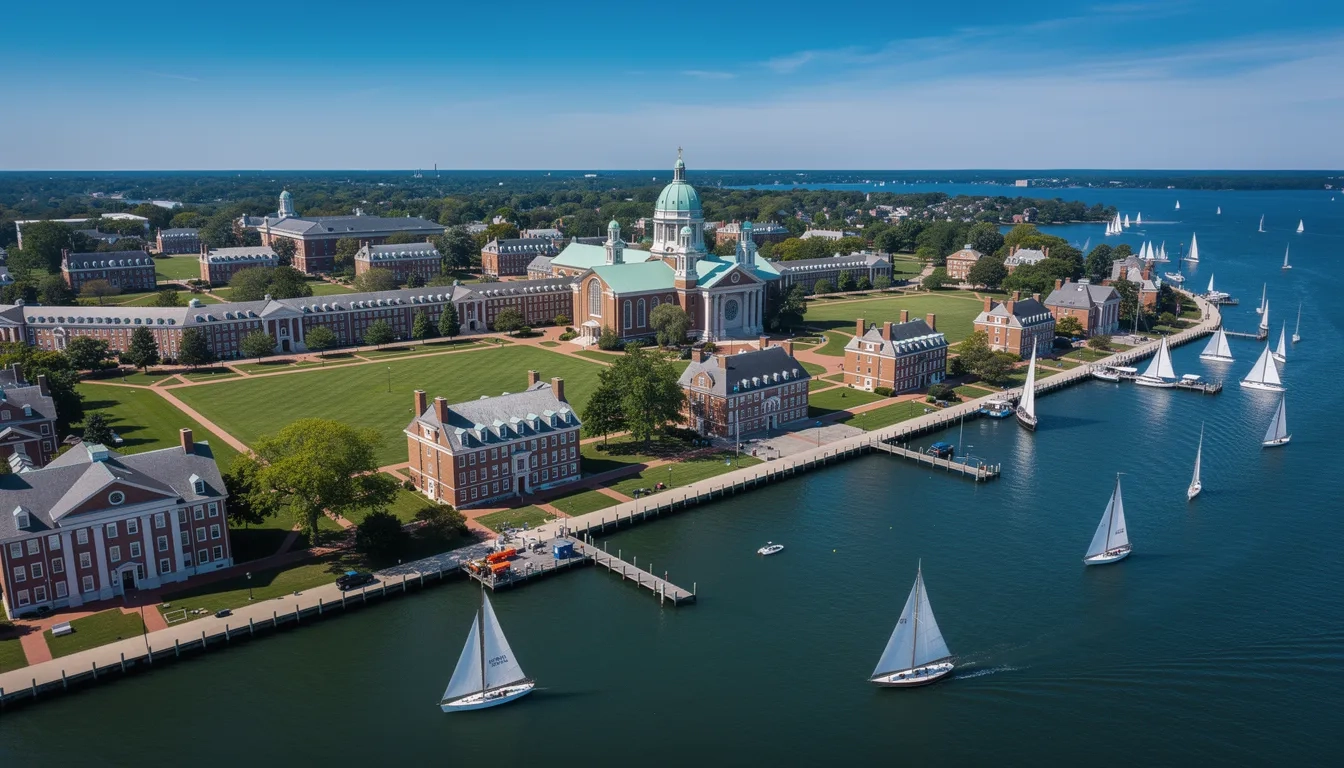
There's a college where tuition is free, every graduate earns a commission as a military officer, and the first seven weeks of freshman year involve no social media, no movies, and waking up before dawn every single day. That's the United States Naval Academy — and for the roughly 1,400 students who get in each year (out of more than 15,000 applicants), it's one of the most transformative undergraduate experiences in the country.
This isn't your typical college guide. If you're considering USNA, or just curious about how the place actually works, here's the real picture: the rankings, the academics, the admissions maze, and what daily life looks like when you're a midshipman in Annapolis.
What Sets the Naval Academy Apart From Other Top Schools
The Naval Academy sits on 338 acres along the Severn River in Annapolis, Maryland. It's beautiful, and it's nothing like a normal campus.
Every student is a uniformed military officer-in-training. They're called midshipmen, not students. They live in Bancroft Hall, the world's largest single dormitory (it houses all 4,474 undergrads in one massive building). They eat meals in formation. They earn a monthly stipend of around $1,185 instead of paying tuition.
But the biggest structural difference is the obligation. Graduate from USNA and you owe five years of active-duty service as a commissioned ensign in the Navy or second lieutenant in the Marine Corps. That's the trade: a genuinely elite education, fully funded, in exchange for your early career.
For people who want to serve, this is an incredible deal. For people who don't, it's not the right school — no matter how impressive the rankings are.
Rankings: Where USNA Actually Stands
US News & World Report ranks the Naval Academy #3 among national liberal arts colleges in its 2026 edition, behind only Williams and Amherst. Among public schools specifically, it ranks #1. That's not a technicality — the comparison is fair, because USNA genuinely competes with elite liberal arts institutions on faculty quality, class size, and academic rigor.
The 8:1 student-to-faculty ratio makes most mid-tier research universities look overcrowded. The four-year graduation rate sits at 92%, well above the national average of roughly 62% for four-year colleges.
The Center for World University Rankings (CWUR) has separately ranked USNA among the top U.S. institutions for quality of education and alumni employment outcomes. Those aren't vanity metrics. Naval Academy graduates consistently land in federal agencies, defense contractors, Fortune 500 leadership tracks, and elite graduate programs after completing their service commitment.
A few comparison points:
| Metric | Naval Academy | Average Top-50 Liberal Arts College |
|---|---|---|
| Tuition | $0 (stipend provided) | ~$60,000/year |
| Student-Faculty Ratio | 8:1 | 10:1 |
| 4-Year Graduation Rate | 92% | ~85% |
| Acceptance Rate | 9.3% | 15–30% |
| Undergraduate Enrollment | 4,474 | 1,800–3,500 |
Academic Programs: 26 Majors, Heavy on STEM
The Naval Academy offers 26 majors, all leading to a Bachelor of Science degree — even the humanities ones. That's an interesting quirk: USNA treats every field as fundamentally analytical, which shapes how courses are taught across the board.
The academic divisions break down like this:
Engineering and Sciences (17 majors)
- Aerospace Engineering
- Mechanical Engineering
- Electrical Engineering
- Nuclear Engineering
- Ocean Engineering
- Naval Architecture and Marine Engineering
- Robotics and Control Engineering
- Computer Engineering
- Computer Science
- Cyber Operations
- Data Science
- Operations Research
- Chemistry
- Mathematics
- Oceanography
- Physics
- General Science
Humanities and Social Sciences (4 majors)
- English
- History
- Political Science
- Foreign Area Studies
Language and Cultural Studies
- Arabic
- Chinese
Economics
- Quantitative Economics (with a Mathematics/Economics track)
A hard institutional rule shapes the mix: at least 65% of midshipmen commissioning into the Navy must hold STEM degrees. That policy has been in place since the Class of 2013 and reflects a deliberate decision to keep the officer corps technically literate as naval warfare becomes more software-dependent.
The most popular major by degrees awarded in 2023 was Quantitative Economics (148 degrees). Engineering disciplines collectively accounted for 361 degrees. No matter your major, you're required to complete core coursework in engineering, mathematics, seamanship, navigation, and leadership development. A history major at USNA still takes calculus, physics, and naval engineering.
"An Engineering degree from the Naval Academy, operational experience, and leadership from military service sets you up for careers from leading project teams for defense contractors to management positions within Fortune 500 businesses." — USNA School of Engineering and Weapons
All programs carry MSCHE accreditation, and engineering and computing programs are separately accredited by ABET.
The Admissions Gauntlet: Harder Than It Looks on Paper
The 9.3% acceptance rate from the 2023-2024 cycle sounds competitive, but the real challenge isn't just getting your application right — it's the nomination process.
Every applicant must receive a formal nomination from one of the following:
- Their U.S. Senator (two senators per state)
- Their U.S. Representative
- The Vice President of the United States
- The President (for children of active-duty, reserve, or retired military parents)
This step alone filters out thousands of otherwise-qualified candidates. Congressional offices receive far more nomination requests than slots available. Many applicants spend months building relationships with their representatives' offices, submitting essays, attending interviews, and competing against other constituents.
Beyond the nomination, the standard profile for admitted midshipmen looks like this:
- SAT scores: 600-650 math, 600-650 evidence-based reading/writing (middle 50%)
- ACT scores: 25-28 composite range
- Strong class rank and academic record
- Demonstrated athletic and leadership experience
- A qualifying medical exam through the Department of Defense Medical Examination Review Board (DoDMERB)
- A Physical Aptitude Examination (PAE) — you're literally graded on your physical fitness before you arrive
The rolling admissions process rewards early applicants. The Academy evaluates files as they arrive, and top candidates receive early offers. Starting the nomination process in junior year of high school isn't just a strategy — it's practically a requirement.
Student Life: What a Day Actually Looks Like
Here's a typical weekday schedule for a midshipman during the academic year:
- 5:30 a.m. — Optional personal fitness (not optional in spirit for most)
- 6:30 a.m. — Reveille; all midshipmen out of bed
- 7:15 a.m. — Meal formation
- 7:55 a.m. – 11:45 a.m. — Academic classes (four 50-minute periods)
- 12:05 p.m. — Noon meal formation
- 12:50 – 1:20 p.m. — Company training
- 1:30 – 3:30 p.m. — Two more class periods
- 3:45 – 6:00 p.m. — Varsity/intramural athletics, extracurriculars, drill
- 6:30 – 7:15 p.m. — Evening meal
- 8:00 – 11:00 p.m. — Mandatory study period
- Midnight — Taps
That's not a schedule. That's a program. There's almost no unstructured time, especially for plebes (freshmen).
Plebe Summer is where it all begins. Before the academic year starts, incoming freshmen spend seven weeks in an intensive military indoctrination program. No phones, no TV, no free time. The day starts before dawn with an hour of physical training and ends well after sunset. Recruits learn close-order drill with rifles, basic seamanship, small arms, first aid, the customs and traditions of naval service, and the USNA honor code.
The purpose isn't punishment — it's rapid cultural immersion. By the time the rest of the brigade returns from summer assignments, plebes are expected to function as junior members of a military organization. The attrition during and after Plebe Summer is real; not everyone makes it.
That said, the camaraderie forged during those weeks is something former midshipmen consistently describe as permanent. There's a reason USNA alumni networks are legendarily tight. You share something few people experience.
Sports are not optional. Every midshipman participates in athletics, whether varsity (USNA fields 30 NCAA Division I sports), club, or intramural. The Navy-Army football game (played annually since 1890) is the most-watched event on the calendar and one of the oldest college football rivalries in the country.
Summers aren't vacation. Midshipmen rotate through fleet cruises, aviation familiarization flights, Marine Corps training, and leadership positions overseeing the next class of Plebe Summer recruits. By senior year, a midshipman has logged genuine operational experience that most ROTC students won't match until years into their careers.
Career Outcomes: Five Years of Service and Beyond
Graduation day at the Naval Academy comes with a commission, not just a diploma. Every graduate becomes a Navy ensign or Marine Corps second lieutenant.
From there, the paths diverge:
- Surface Warfare: Serving as an officer aboard destroyers, cruisers, or aircraft carriers
- Submarine Warfare: Nuclear-qualified submarine officers (requires additional training at Nuclear Power School)
- Naval Aviation: Reporting to flight training at Pensacola or Corpus Christi
- Marine Corps: Leading infantry or other specialty units
- Special Warfare: Some graduates pursue Navy SEAL or EOD pipelines
- Engineering Duty Officer: Technical management of ship design and maintenance
- Civil Engineering Corps: Infrastructure and construction projects worldwide
After completing the five-year commitment, the alumni trajectory varies widely. Many stay in for full careers. Others use the discipline, leadership, and technical credentials to move into defense contracting, federal agencies, finance, or tech. McKinsey, Goldman Sachs, and Google have all hired USNA graduates; the combination of a rigorous STEM or economics degree and five years of actual leadership responsibility is a genuinely differentiated resume.
Graduate school is also common. USNA alumni have strong representation at programs like MIT, Harvard Kennedy School, and the Naval War College.
Bottom Line
- If you want a free, elite education and you're willing to serve, USNA is one of the best academic deals in the country — full stop. The 92% graduation rate, 8:1 faculty ratio, and #3 national liberal arts ranking aren't marketing; they reflect a genuinely rigorous institution.
- Start the nomination process early. Junior year of high school is when to contact your Congressional representatives. Waiting until senior fall is too late for most.
- The lifestyle commitment is real. The daily schedule, Plebe Summer, mandatory athletics, and military culture mean this is not a conventional college experience. Know that going in — or you'll be miserable.
- STEM is the dominant track, but economics and humanities graduates thrive too, particularly those headed toward staff roles, intelligence, or post-service careers in finance and policy.
- The single most important thing for applicants: secure your nomination before obsessing over your GPA or test scores. Without it, nothing else matters.
Frequently Asked Questions
Does the Naval Academy really cost nothing?
Yes — tuition, room, and board are fully covered by the federal government. Midshipmen also receive a monthly stipend (currently around $1,185) to cover personal expenses like uniforms and supplies. The trade-off is the five-year active-duty service commitment after graduation. If you leave before completing your degree, you may owe money back to the government.
Is the nomination process really that hard to get?
It's competitive, but not impossible. Each member of Congress can have up to 5 midshipmen enrolled at USNA at any given time. That means there are roughly 10 possible congressional nominations per congressional district (two senators plus one representative), plus nominations available through the Vice President and military channels. Start early, visit your representative's office in person, and don't apply to only one office.
What's the biggest misconception about Naval Academy academics?
Many people assume USNA is mainly a military training program with some coursework tacked on. It's the reverse. The academic program is the core, accredited to the same standard as peer institutions and demanding enough that a 92% graduation rate is considered a strong outcome. Midshipmen pull real all-nighters studying thermodynamics and differential equations, not just drilling.
Can you play sports at the Naval Academy if you're not a varsity athlete?
Every midshipman is required to participate in athletics year-round. If you're not on a varsity team (USNA competes in 30 NCAA Division I sports), you'll participate in club or intramural sports. There's no opt-out — physical fitness is part of the institution's mission, not an extracurricular.
How does post-graduation service work, and can you leave the military afterward?
After graduating and completing commissioning, every USNA graduate serves a minimum of five years on active duty. After that, you can separate and transition to civilian life, continue in the reserves, or pursue a full military career. Many graduates who separate end up in fields like defense contracting, federal law enforcement, finance, or consulting, where military leadership experience is a specific hiring advantage.
What GPA and test scores do I actually need?
The middle 50% SAT range is 1200-1300 (combined), and ACT is roughly 25-31. But test scores are one part of a holistic review that also includes physical fitness scores, leadership activities, recommendations, and the congressional nomination. Admitted midshipmen tend to have strong class ranks — think top 20% of their high school class — but a perfect GPA without a nomination gets you nowhere in this process.