How Part-Time Work During College Shapes Your Career
Working a retail shift at 7 AM before an 8 AM class is nobody's idea of a good time. But it turns out, that bleary-eyed hustle might be one of the better career investments a student can make.
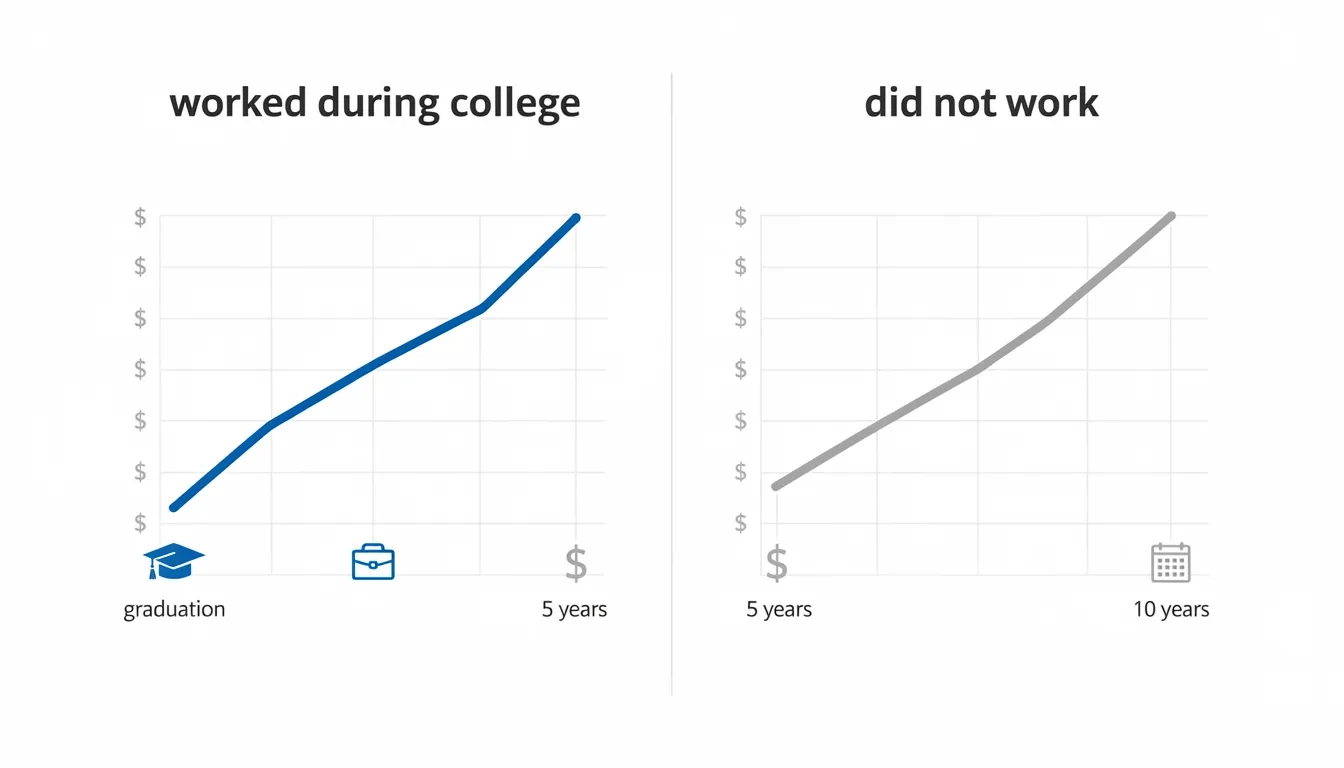
A study analyzing over 163,000 students across a large public university system found that undergraduates who worked during college earned significantly more in the years after leaving school. Students who earned between $15,000 and $25,000 from working during enrollment saw their post-graduation annual incomes rise by roughly $9,593 to $10,179 compared to similar students who didn't work. Those who earned more than $25,000 while enrolled saw a premium of $18,155 to $20,625 per year. The researchers described this benefit as approaching "the earnings increase associated with completing a degree."
That's not a minor footnote. It's the kind of finding that should make any college student reconsider whether their part-time job is getting in the way of their education, or actually building it.
The Earnings Premium Is Real — and It Compounds
The research on this is unusually consistent. Unlike a lot of education studies where the signal gets muddied by who chooses to work versus who doesn't, the PMC analysis used sophisticated statistical controls (augmented inverse-probability weighting) to account for demographics, GPA, major, and prior earnings. The earnings gap held.
The career wage premium is driven by duration, not just hours logged in any single semester. Students who worked for 2–3 continuous years during college earned $6,069 to $6,751 more annually than non-working peers in their first post-graduation year. Those who worked for under a year saw more modest gains of $1,258 to $2,883.
The benefits held across both genders and racial/ethnic groups. They held for community college students and four-year university attendees alike. They even held for students who never finished a degree.
The post-college wage premium from consistent work experience approached the earnings increase associated with completing a degree — suggesting employers weigh demonstrated work history alongside credentials when hiring from non-elite institutions.
This matters because it means the career value of working during college isn't just resume padding. Something structural is happening in how employers assess candidates.
Where the Career Lift Actually Comes From
So what's driving that earnings gap? A few things, and they're worth separating because they're not equally valuable.
Skills-based hiring is reshaping entry-level recruiting. According to NACE's Job Outlook 2026 survey, 70% of employers now use skills-based hiring for entry-level positions, up from 65% the year before. What this means in practice: a student with documented experience managing customers, hitting targets, or coordinating schedules has concrete evidence to point to in an interview, not just a diploma and a transcript.
The soft skills developed through part-time work — reading a room, handling a difficult interaction, adapting when a shift falls apart — are the exact reflexes that entry-level managers struggle to teach new hires from scratch. Companies spend real money on onboarding to close that gap. A candidate who already has these instincts is cheaper to bring up to speed, and hiring managers know it.
Professional networking starts earlier than most students expect. Working students build real relationships: supervisors who become references, colleagues who migrate into different industries, managers who remember solid performers when openings appear. Among students who had no work experience in college, 42% report low confidence in their networking abilities — a deficit that shows up concretely in how long their post-graduation job search takes.
The other thing part-time work does, less glamorously, is teach students what they don't want. A semester doing data entry for a mid-size firm is low-cost research into whether a desk-bound office environment would slowly kill you.
The 20-Hour Line You Don't Want to Cross
Here's where the story gets more complicated, because the same research that praises working during college also documents its costs.
The Penn Wharton Budget Model, drawing on nationally representative 2018 data, found that 27% of full-time students and 71% of part-time students worked at least 20 hours per week. The academic consequences at that threshold are real. At four-year universities, students working consistently throughout enrollment earned grades 0.41 standard deviations below non-working peers. At community colleges, the gap was 0.24 standard deviations. Full-time employed community college students were 16 percentage points less likely to transfer to a four-year institution compared to peers who didn't work at all.
The employment effect also stretched time-to-degree. Working students spent roughly 24 additional months as undergraduates, on average.
| Hours/Week | Academic Impact | Career Impact |
|---|---|---|
| 0–10 | Neutral to positive | Modest gains; strong resume foundation |
| 10–15 | Neutral | Strong career signal, manageable GPA |
| 15–20 | Slight negative | Good earnings premium; watch grades |
| 20+ | Significant GPA drop; graduation delays | Higher earnings premium, but degree risk |
None of this means students shouldn't work. Most students who work do so because they have to — to cover rent, support families, or reduce loan debt. The data isn't a moral judgment; it's a constraint map. The goal is staying under 15 hours per week when possible, and treating 20 as the threshold that demands caution.
Not All Jobs Are Created Equal
A retail job and a research assistantship both count as "work during college," but they don't return equal career dividends.
On-campus positions tend to produce better academic outcomes than off-campus jobs at comparable hours. The flexibility around exam periods, proximity to academic resources, and the fact that on-campus supervisors are typically aware of student schedules all contribute. For first-year students still figuring out how much they can handle, an on-campus job is a lower-risk starting point.
Internships are a different category entirely. NACE data shows that eligible interns are converted to full-time hires at around a 60% rate when positions are available. That's not coincidence; employers use internships as extended working interviews. A student who completes two summers of relevant internship experience before senior year has substantially shortened their post-graduation job search before it begins.
Field-relevant work produces the steepest return. A nursing student working as a hospital technician, a computer science student doing part-time development for a local business, an education major tutoring after school — these jobs build domain-specific knowledge that classroom instruction can't replicate and create references who can speak to professional competence, not just academic performance.
The rough hierarchy of career ROI:
- Internship in your target field — highest return, frequently converts to an offer
- On-campus, field-adjacent role — strong academic stability plus relevant exposure
- On-campus, any role — good schedule fit, builds transferable professional skills
- Off-campus, field-relevant job — high career value, monitor hours carefully
- Off-campus, general work — earnings premium still real, softer career signal
The Hidden Long Game: Professional Identity
Here's something the earnings regressions don't fully capture.
Students who work during college develop what researchers call a professional self-concept earlier than those who don't. They understand workplace norms, performance expectations, and organizational dynamics before encountering them in a high-stakes environment. That head start isn't just about knowing how to behave in a meeting. It's about confidence in professional settings — and recruiters pick up on that quickly.
Hiring managers regularly describe a difference in how candidates who've worked present themselves versus those who went straight from coursework to applications. Working students have already made predictable early-career mistakes in a low-consequence setting. They've taken feedback without shutting down. They've navigated a difficult coworker or a bad manager and still delivered.
Professional maturity compounds across a career, not just in the first post-graduation year. The student who spent three years managing competing demands has built a muscle that classmates who only ever studied haven't touched yet. My read of the evidence: this is the most underrated benefit of working during college, because it doesn't show up cleanly in salary data but shapes every professional interaction for years.
There's also the practical financial dimension. The National Center for Education Statistics puts average federal student loan debt for recent four-year graduates at around $29,400. Students who worked consistently during college often carry less because wages covered living expenses — and sometimes tuition — directly. Starting a career with $10,000 less in debt is worth more than it looks when compounded over repayment periods.
Common Mistakes Students Make
Most students who work during college get the broad strokes right but miss the details that matter.
Taking any available job instead of the right one. In the rush to earn income, students sometimes accept the first position without considering whether it builds anything beyond a paycheck. Fifteen hours a week is a real time commitment — it should return something for your career direction, not just your rent.
Waiting until junior or senior year to get experience. The earnings data is clear that duration matters. Students who work continuously for 2–3 years see post-graduation earnings gains roughly 2.5 times larger than those who worked for only one year. Starting in freshman year, even 8–10 hours per week on campus, compounds career value across all four years and gives you earlier access to references and professional relationships.
Keeping school and work in separate mental compartments. The students who extract the most value from working during college find ways to connect the two. A marketing student managing social media for a campus organization has a real portfolio piece. An engineering student debugging code for a professor's research lab has hands-on experience and a faculty reference in one role. The job doesn't have to be unrelated to be an asset — but it takes intention to make the connection.
Bottom Line
Working during college pays off. The earnings premium is well-documented, the skills case is strong, and the skills-based hiring trend is moving in working students' favor. But the payoff depends on doing it intelligently.
- Stay at or below 15 hours per week when your career target depends heavily on GPA — medicine, law, competitive graduate programs. The academic costs above 20 hours are real and documented.
- Choose field-relevant or on-campus work over higher-paying but career-neutral jobs when you have the financial flexibility to make that choice.
- Start freshman year, not junior year. Two to three years of consistent experience yields earnings and career benefits that one year cannot replicate — and the professional relationships you build early follow you further.
- Think about what story each job tells, not just what it pays. The internship that pays $14/hour in your target industry is often worth more long-term than the restaurant job paying $19.
The single most important takeaway: working during college is not just a financial compromise that occasionally helps your career. For most students, it's direct preparation for professional life that no classroom can substitute for.
Frequently Asked Questions
Does working during college actually improve post-graduation salaries?
Yes, and the effect is well-documented across a large sample. A study of over 163,000 students found that those who earned $15,000–$25,000 from jobs during college saw first-year post-graduation incomes rise by roughly $9,593–$10,179 compared to similar non-working peers. The premium scales with both the total amount earned and the number of years worked consistently — students with 2–3 years of experience see nearly double the earnings gains of those who worked for under a year.
How many hours per week can I work without hurting my GPA?
Most research points to 10–15 hours as the effective ceiling for minimizing academic damage. Students working under 15 hours per week often perform comparably to non-working peers, sometimes better because the schedule forces more structured time management. Above 20 hours, GPA impacts become significant — at four-year universities, consistent employment above that threshold correlates with grades roughly 0.41 standard deviations below non-working students, according to the Penn Wharton Budget Model analysis.
Is an internship better than a regular part-time job?
For career outcomes specifically, yes. Internships in your target field consistently outperform general part-time work because they build domain-specific skills, generate stronger professional references, and frequently convert to full-time offers — NACE research shows eligible interns are retained as full-time employees at around a 60% rate when positions are available. That said, a multi-year consistent part-time job still produces meaningful career advantages over no work experience at all.
Does it matter if the job is related to my major?
More than most students assume. Field-relevant work builds domain knowledge and signals genuine commitment to a career path in ways that general work cannot. But unrelated jobs still build transferable professional skills — communication, handling difficult situations, meeting performance expectations under pressure — that show up in how candidates present themselves in interviews. Unrelated work beats no work, but relevant work beats unrelated work.
Is it a myth that working during college hurts academic performance?
Partly. At low-to-moderate hours (under 15 per week), working often has neutral or mildly positive academic effects — partly because employed students manage their time better out of necessity. The myth is the blanket claim that any employment hurts grades. The reality is conditional: below 15 hours, the evidence doesn't support that concern; above 20 hours, it does.
What if I genuinely have to work more than 20 hours out of financial necessity?
Then the goal shifts to protecting your GPA strategically within that constraint. Take slightly lighter course loads in high-work semesters. Concentrate demanding courses in terms when you can reduce hours. Look for on-campus or remote positions that offer more flexibility around exams and deadlines. The research shows even students working high hours and not completing a degree still saw post-graduation earnings gains from having worked — so the situation isn't binary.