Pomona College: Admissions, Rankings, and What Life is Actually Like
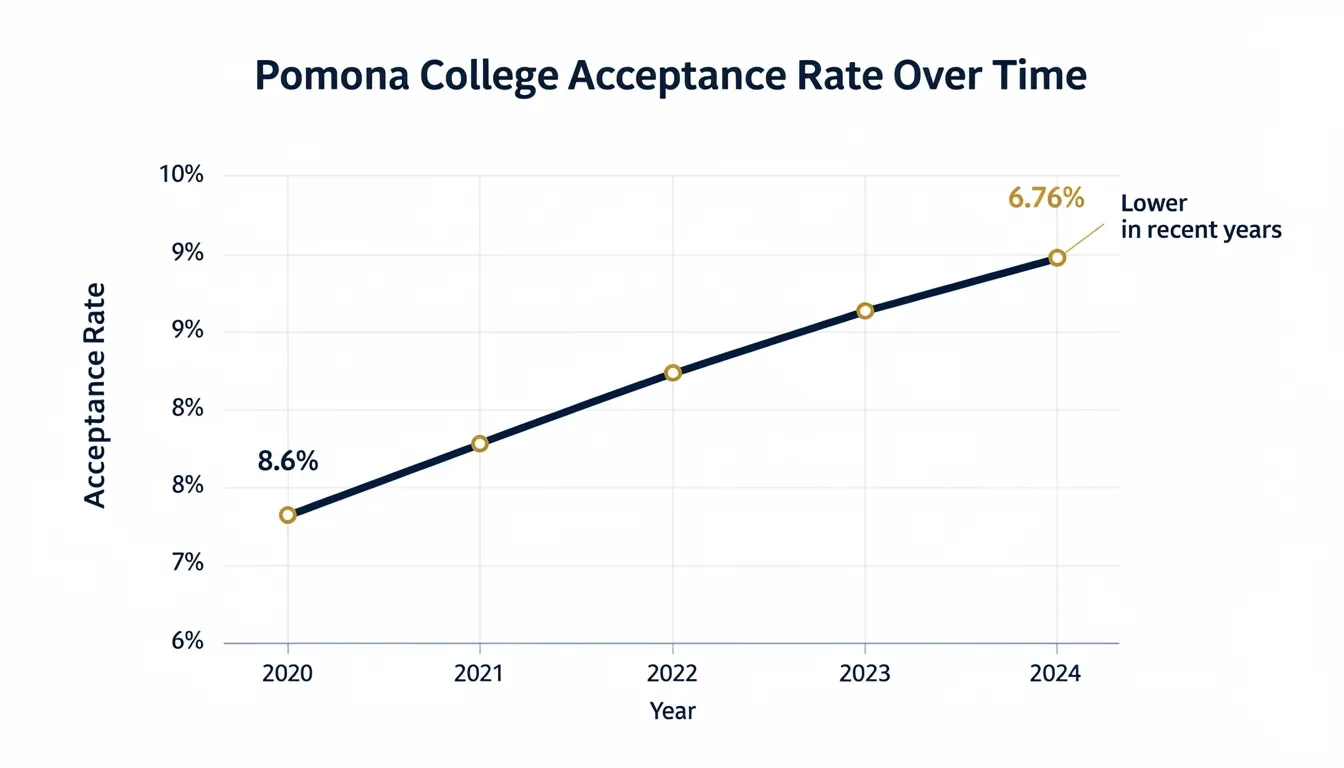
Pomona College admitted 861 students from 12,470 applicants for the Class of 2029. That's a 6.9% acceptance rate, which makes it the most selective liberal arts college in the United States. Not most selective in California. Most selective in the country. And yet most high schoolers have only a vague idea of what Pomona actually is, let alone what it's like to go there.
That gap between prestige and public awareness is, oddly, part of Pomona's identity.
How Selective Has Pomona Become?
The trajectory is stark. In 2020, Pomona's acceptance rate sat at 8.6%. By the Class of 2027, it had fallen to 6.76%. The most recent cycle landed at 6.9%, essentially flat, but the applicant pool grew from around 9,000 a decade ago to over 12,000 today.
The numbers that matter most for prospective students:
- Overall acceptance rate (Class of 2029): 6.9%
- Early Decision acceptance rate: approximately 13-14%
- SAT middle 50% range: 1480–1520 (combined)
- ACT middle 50% range: 33–35 composite
- Students receiving financial aid (2024-25): 55%, average award of $67,027
That ED rate deserves attention. Applying Early Decision roughly doubles your odds compared to Regular Decision, which is consistent with what you see at Williams, Amherst, and other highly selective liberal arts colleges. The catch is that ED is binding — you commit before seeing your financial aid package. More on that below.
One important nuance: Pomona is test-optional but not test-blind. Students who submit scores are evaluated with them; students who don't are still considered holistically. In recent cycles, most admitted students who submitted scores landed in the 33–35 ACT range.
What the Rankings Actually Show
US News ranked Pomona #3 among national liberal arts colleges in 2023. Then #4. Then #5. Now, in the 2026 edition, Pomona sits at #7, tied with Claremont McKenna College.
That slide looks alarming on a spreadsheet. It's mostly not.
"Year-to-year fluctuations often stem from changes in methodology, such as shifting the weight placed on graduation rates, faculty resources, or alumni earnings." — NORC review cited in The Student Life (2025)
US News has reshuffled its formula multiple times in the past three years, adding social mobility metrics and adjusting how it weights endowment spending and faculty resources. Pomona's underlying fundamentals haven't changed. Forbes, which uses a completely different methodology focused on outcomes, ranks Pomona #7 nationally across all college types — not just liberal arts.
| Ranking Source | Pomona Rank (2026) | Category |
|---|---|---|
| US News Best Colleges | #7 (tied) | National Liberal Arts |
| Forbes Best Colleges | #7 | All Colleges |
| Niche.com | Top 5 | Liberal Arts Colleges |
The honest read: Pomona is, by most credible metrics, a top-10 liberal arts college in the country. The specific number varies by methodology. What doesn't vary is that it consistently sits alongside Williams, Amherst, Swarthmore, and Wellesley in that tier.
Cracking the Application: What Actually Matters
Pomona doesn't publish a formula, and they mean it. The admissions office explicitly states they use no cutoffs and no rigid scoring rubrics. That said, some patterns emerge clearly from the data.
Grades matter more than scores. Pomona places heavy weight on course rigor and grade trends. A student with a 3.8 GPA in eight AP courses is a stronger candidate than one with a 4.0 in a lighter curriculum, holding everything else equal. The college looks for evidence that you challenged yourself, not just that you succeeded.
What Pomona says it looks for in applicants:
- Intellectual capability with genuine academic commitment
- Analytical and creative approaches to learning
- Collaborative perspective and community engagement
- Distinctive personal qualities that contribute to campus life
The essays are where applications either come alive or die. Pomona is one of the few schools that reads every application carefully — enrollment is just around 1,700 undergraduates, so the admissions office isn't processing tens of thousands of files with a first-pass AI filter. A specific, honest, well-written personal statement actually reaches a human who has time to engage with it.
The ED decision is the biggest lever most applicants have. If Pomona is genuinely your first choice and your financial situation allows for some uncertainty on aid, applying ED I or ED II is probably your highest-value strategic move. The acceptance rate differential is real.
Life Inside the 5C Ecosystem
Here's the thing most Pomona applicants underestimate: you're not just enrolling in Pomona. You're enrolling in the Claremont Colleges, a consortium of five undergraduate institutions and two graduate schools located within a square mile of each other in Claremont, California.
The five undergraduate colleges are Pomona, Claremont McKenna, Harvey Mudd, Scripps, and Pitzer. Students call them the 5Cs.
What does consortium membership actually mean day-to-day?
- Cross-registration is seamless. Pomona students can take classes at any of the other four colleges. The consortium offers access to 3,000+ courses total, versus the roughly 650 offered by Pomona alone.
- Social life expands across campuses. With 6,000+ undergraduates across the 5Cs, the social pool is much larger than Pomona's 1,700-person enrollment would suggest.
- Clubs and organizations span all five schools. Pomona alone has 200+ student organizations. Across the 5Cs, that number exceeds 250 distinct groups.
So you get the intimacy of a small liberal arts college — small seminars, professors who know your name, a tight residential community — combined with the academic breadth and social variety of a mid-sized university. It's a genuinely unusual combination.
Pomona's campus culture skews intellectual and politically engaged without being pretentious about it. The Student Life newspaper (one of the oldest campus papers in California) runs hard news about campus issues. The college radio station has been broadcasting since 1961. There's an Organic Farm where students grow food that ends up in the dining halls. The vibe is curious, collaborative, and slightly outdoorsy in that Southern California way.
Greek life exists but doesn't dominate. No one feels socially excluded because they're not in a fraternity, which is not something you can say about every selective school.
Housing, Food, and the Day-to-Day
Pomona is a genuinely residential campus. About 95% of students live on campus all four years — that figure places it among the most residential liberal arts colleges in the country. This is a deliberate institutional choice, and it shapes the culture significantly.
Incoming students are assigned to sponsor groups, small cohorts of first-years living in the same residence hall section who are paired with upperclassman mentors (called "sponsors"). It's Pomona's version of the orientation-plus-ongoing-mentorship model, and students consistently point to it as how they made their first real friends.
Housing quality is well above average. Upperclassmen get a lot of singles. Many residence halls have kitchens, lounges, and common areas that function as real gathering spaces rather than afterthoughts. The college has also committed to gender-inclusive housing — students of any gender identity can live together regardless of sex assigned at birth, and everyone designates room preferences in advance.
Dining gets mixed reviews, as it does almost everywhere. The harder-to-argue-with advantage is location: Claremont is 35 miles east of Los Angeles, which means off-campus food options, weekend trips, and internship access are genuinely excellent. Students with a car (or friends with cars) regularly hit LA for concerts, beaches, and food scenes that a campus dining hall simply cannot replicate.
Financial Aid: The Endowment Advantage
Pomona's endowment reached $3.25 billion as of June 2025, according to the college's trustees. For a school with only 1,700 undergraduates, that works out to roughly $1.9 million per student — one of the ten highest ratios of any college or university in the United States.
That number matters practically because it funds Pomona's financial aid commitments:
- Need-blind admissions for all domestic applicants (Pomona evaluates applications without knowing whether applicants need aid)
- Meets 100% of demonstrated financial need for every admitted student
- Average financial aid award in 2024-25: $67,027, with 55% of students receiving some form of aid
- 42% of international students also receive financial aid packages
The operating budget for 2024-25 was $271 million, roughly half of which came from endowment earnings. That's a financial cushion most universities don't have. It means Pomona can sustain its aid commitments even in down market years without cutting programs.
For families comparing Pomona to peer institutions: the sticker price (~$83,000/year total cost of attendance) is genuinely misleading for most admitted students. A family earning under $75,000/year often pays close to nothing. Even families at $150,000 in income typically see substantial aid packages. Run the Net Price Calculator on Pomona's website before making any assumptions about affordability.
The one catch with ED: because you commit before receiving your financial aid award, you don't know the actual number until after you're bound. Pomona has a strong track record of meeting need generously, but if the final award doesn't cover your family's ability to pay, you can withdraw from the binding commitment. Just document everything and communicate early.
What Kind of Student Thrives Here
Pomona isn't a good fit for everyone, and it doesn't try to be. The students who do best tend to share a few traits.
They're genuinely curious across multiple disciplines — not just pre-med tunnel vision or single-minded CS grinders. The liberal arts structure requires breadth, and students who resist it often transfer. Students who lean into it often describe it as the most intellectually rewarding experience of their lives.
They're also comfortable in a small, high-density intellectual community. With 1,700 undergrads, you will run into your ex, your academic rival, and the professor who gave you a C all within the same week. There's no hiding. That intimacy is either a feature or a bug depending on your personality.
And they tend to value outcomes over prestige signals. Pomona graduates punch above their weight in graduate school admissions, research careers, and professional networks — but it doesn't have the brand recognition of Yale or Stanford at first mention. If name-dropping your alma mater at cocktail parties matters to you, Pomona might frustrate you. If you care more about what you actually learn and who you become, the calculus looks different.
Bottom Line
- Apply ED if Pomona is your true first choice. The ~13% ED rate versus ~7% RD rate is a meaningful difference. The financial aid commitment is real and binding agreements are dischargeable if aid falls short.
- Don't be fooled by the US News slide from #3 to #7. Methodology reshuffles, not quality drops, explain most of the movement. By outcomes and peer reputation, Pomona remains a top-tier liberal arts institution.
- Run the Net Price Calculator before assuming it's unaffordable. The $3.25 billion endowment funds deep aid commitments that make Pomona cheaper for many families than flagship state schools.
- Visit or do a virtual info session focused on the 5C experience. Most applicants apply to Pomona without fully understanding that they're joining a 6,000-student consortium, not a 1,700-person island. That context changes the calculus significantly.
The most important thing: Pomona rewards students who bring something specific to offer — a genuine intellectual interest, a community they want to build, a creative project they're already pursuing. Generic applications don't fare well here. Specific, honest ones do.
Frequently Asked Questions
Is Pomona College harder to get into than Ivy League schools?
By acceptance rate, yes. Pomona's 6.9% acceptance rate is lower than several Ivy League institutions, including Cornell (roughly 8%), Dartmouth (roughly 8%), and Penn (roughly 7%). By raw selectivity metrics alone, Pomona sits in the same tier. The difference is that Ivy League names carry broader brand recognition, so the applicant pool composition differs — Pomona attracts students who specifically want a small liberal arts experience.
Does applying Early Decision really improve your chances at Pomona?
Significantly. Pomona's Early Decision acceptance rate runs around 13-14%, compared to roughly 7% overall. That's not a minor statistical blip — it roughly doubles your probability. The binding nature of ED means you should only apply if Pomona is genuinely your first choice and you're prepared to commit before seeing financial aid numbers. Students who need to compare aid packages across multiple schools should use Regular Decision.
Is Pomona College really test-optional, or does submitting scores help?
Pomona is test-optional and evaluates students without scores if they choose not to submit. That said, students who do submit tend to have very strong scores — the middle 50% ACT range is 33-35. If your scores fall in that range, submitting them likely strengthens your application. If your scores are below a 31 ACT or 1450 SAT, the conventional advice is to either not submit or invest in test prep before applying.
What is the Claremont Colleges 5C Consortium, and why does it matter?
The 5Cs are Pomona, Claremont McKenna, Harvey Mudd, Scripps, and Pitzer — five distinct undergraduate colleges sharing one geographic hub in Claremont, CA. Pomona students can cross-register in courses at all four other schools, join 5C-wide clubs, eat at any dining hall, and socialize across all five campuses. You get the small-college experience (small seminars, residential community, accessible faculty) plus access to 3,000+ courses and 6,000+ peers. It's the biggest structural advantage Pomona has over single-campus liberal arts colleges of similar size.
Does Pomona College meet 100% of financial need, and what's the average aid package?
Yes. Pomona operates need-blind admissions for domestic applicants and commits to meeting 100% of demonstrated financial need for every admitted student. In 2024-25, 55% of students received aid, with an average award of $67,027. This is backed by a $3.25 billion endowment — one of the ten largest per-student endowments in the country. Families with incomes under $75,000/year often pay close to nothing. The caveat is that Early Decision applicants commit before seeing their award, though the commitment is dischargeable if the aid package is insufficient.
What makes Pomona different from Williams or Amherst?
All three sit in the same selectivity and quality tier, so the differences are genuinely about fit rather than prestige. Williams and Amherst are rural, isolated, and entirely self-contained — the campus is the world for four years. Pomona is part of the 5C consortium and sits in Southern California, giving students more social variety, easier access to a major city, and a more temperate climate. Williams has a slight edge in some rankings. Pomona has a slight edge in financial aid generosity and weather. Neither is categorically "better" — they serve different student personalities.
Sources
- Pomona College Acceptance Rate: Class of 2030 Admissions Statistics — AdmissionSight
- Pomona College Acceptance Rates — PrepMaven
- All Five Claremont Colleges Recognized Among Nation's Top Liberal Arts Institutions — The Student Life
- Pomona Drops in US News Rankings, Tying Claremont McKenna — Claremont Independent
- Life at Pomona — Pomona College Official Website
- Clubs and Organizations — Pomona College Official Website
- Endowment Update from the Board of Trustees — Pomona College
- Pomona College Student Life — US News Best Colleges