Remote Work Salary Trends for Graduates: What the Data Actually Shows
Here's something worth sitting with: remote workers, on average, earn 4–7% more than their office-bound peers. And yet, if you just graduated and are hunting for a remote role right now, the broader data tells a pretty different story. Entry-level hiring dropped 29% comparing 2017–2019 to 2023–2025. Young college graduates face 5.6% unemployment as of March 2026, against a general rate of 4.2%.
The premium is real. The access is not — at least not yet, and not without a strategy.
The Salary Numbers Graduates Are Actually Seeing
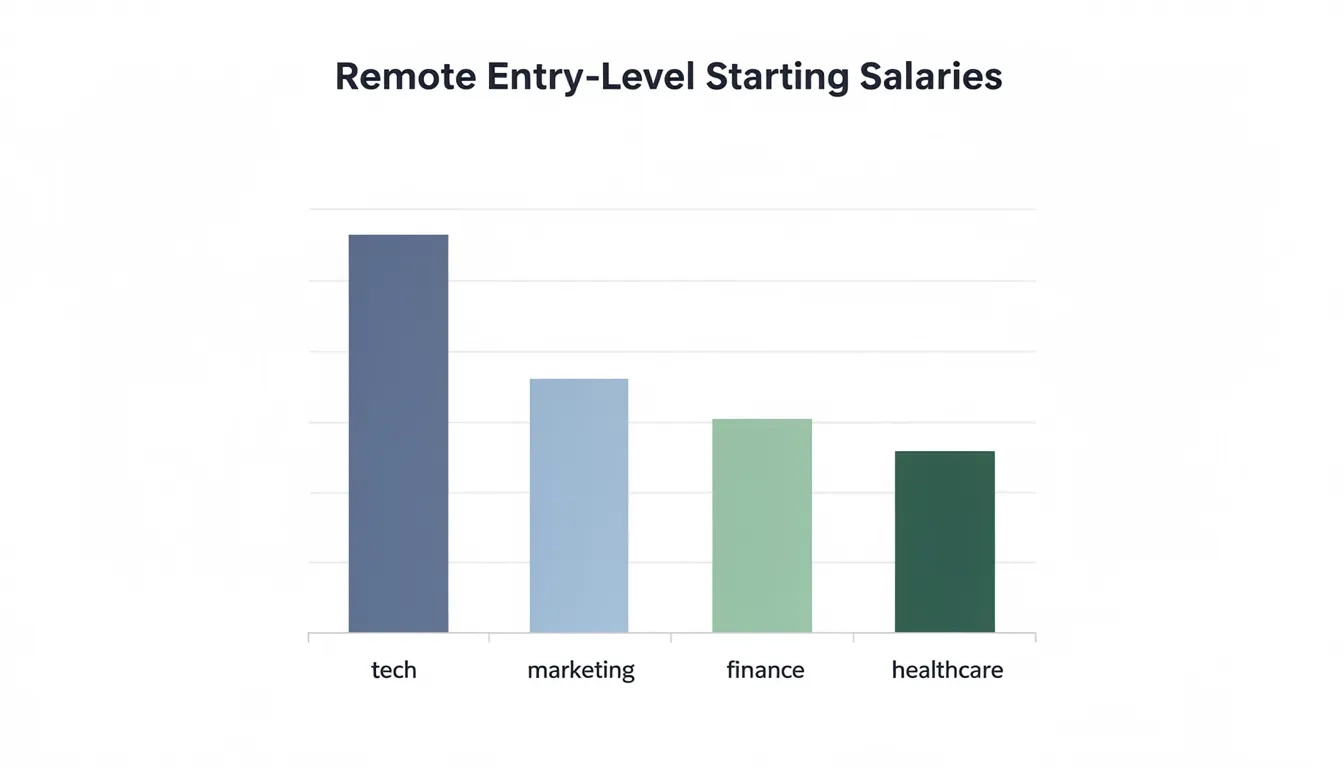
Starting salaries for remote entry-level roles vary dramatically by field. Technology remains the outlier. Entry-level remote software engineering positions typically open between $65,000 and $85,000. AI and machine learning roles push higher still — new grad positions at well-funded tech companies often start between $100,000 and $120,000, with equity packages adding another $47,000–$82,000 depending on the firm.
Outside tech, the picture narrows fast. Remote marketing coordinators, junior analysts, and entry-level HR roles generally land in the $45,000–$60,000 range.
There's a subtler dynamic at play, though. Remote workers on paper earn more, but 71% of companies use location-based pay adjustments. If you live in Boise and accept a role posted for a San Francisco company, don't assume you're getting San Francisco rates. Geographic tiers can slice the advertised salary by 5–30% depending on the employer's model.
Why the Entry-Level Remote Market Got So Tight
The conventional wisdom blamed AI. Turns out, that's wrong.
Researchers at the London School of Economics and the University of Warwick (Peter John Lambert and Yannick Schindler) analyzed hiring records from 2017 through 2025 across the US, UK, Canada, and Australia. Their finding was blunt: remote work continued to cause junior-level hiring declines, while "AI's impact attenuates sharply and is often statistically indistinguishable from zero."
The Federal Reserve Bank of New York published follow-up research in June 2026 tracing graduate unemployment since the pandemic. Remote work, they estimated, could account for roughly 64% of the overall rise in youth unemployment since 2019.
The mechanism is intuitive once you see it:
- Companies that went remote early shifted their workforce toward experienced hires.
- Senior workers can be productive without in-person mentoring. New graduates often cannot.
- Rather than build remote onboarding infrastructure, many employers quietly stopped hiring junior roles.
So entry-level hiring dropped 29%, junior-level hiring fell nearly 26%, and senior-level hiring actually rose more than 5%. This isn't malice. It's economics. Training someone remotely is harder. The return on that training is less predictable.
"Remote work has weakened incentives to hire young workers by impeding on-the-job training." — Federal Reserve Bank of New York, June 2026
The Location Pay Trap Nobody Warns You About
A lot of new graduates get burned here. They land a remote job, celebrate escaping their high-cost city, move somewhere cheaper — and then discover their employer has a geographic pay tier system that cuts their salary by 15%.
Location-based pay models generally fall into three camps:
| Model | How It Works | Good for New Grads? |
|---|---|---|
| Fully location-adjusted | Salary tied directly to your metro's cost of living | No — punishes moves to lower-cost areas |
| Tiered (3–5 geographic bands) | Broad regions, 5–20% variance between tiers | Depends on which tier you land in |
| Location-agnostic | Same rate regardless of where you live | Yes — cleanest model for graduates |
The surprising upside: according to the State of Remote Work 2025 report, 92% of employers lack formal systems for determining remote worker compensation. That means there's real negotiating room — your employer often hasn't thought this through rigorously either.
Workers who negotiate remote compensation earn 15–25% more on average than those who accept the first offer. For a $65,000 entry role, that's a gap of $9,750–$16,250. Over five years of compounding base salaries, the delta becomes genuinely life-altering.
The Industries Where Graduates Can Actually Break In
Not all sectors are equally closed to entry-level remote candidates. Second Talent's 2026 hiring statistics show that technology leads with 94% of remote-capable roles offering some location flexibility. Finance follows at 78%, marketing at 71%, and manufacturing sits at 23%.
Best bets for remote-seeking graduates:
- Software engineering, data science, cybersecurity
- Digital marketing and content strategy
- Technical writing and UX research
- Data analytics and business intelligence
Harder roads:
- Corporate finance (many firms reversed junior-remote policies after 2024)
- Management consulting (client-facing norms still push for physical presence)
- Traditional banking and insurance
The gender dimension here rarely gets discussed plainly enough. The Interview Guys' State of Remote Work 2025 report found that women are significantly more willing to accept pay cuts of 20% or more to maintain remote flexibility, compared to men. This creates a structural pay gap that compounds over years. Trading too much salary for flexibility early in your career anchors your compensation baseline in ways that are genuinely difficult to undo later.
The Mentorship Problem That Affects Your Long-Term Pay
There's a version of the remote salary conversation that stays focused purely on starting numbers. That's the less important half.
The trajectory matters more than the starting point. A junior engineer who spends their first two years learning from senior colleagues in person compounds skills at a different rate than someone working in isolation. National Bureau of Economic Research data on software engineers found that in-office coding feedback runs 18.3% higher than in remote settings — and younger engineers benefit disproportionately from that difference.
Faster skill development means earlier promotions. Earlier promotions mean higher base salaries at every subsequent negotiation. The $5,000 you might gain by taking a fully remote role at 22 could cost you $20,000 or more by 27 if it slows your first promotion by even one year.
This is not an argument against remote work. It's an argument for being careful about when you go fully remote. A hybrid role at 22 that puts you in a room with sharp seniors twice a week might beat a fully remote offer $10,000 higher — depending on the team's mentorship culture and how seriously they invest in junior development.
What Graduates Who Get Good Offers Are Doing Differently
The graduates who come out of this market well tend to follow a few principles that aren't obvious from the outside.
They target hybrid first, not fully remote. Hybrid roles represent about 18% of entry-level openings, versus 10% for fully remote. That's a wider target window. Practically, hybrid roles also come with better mentorship and faster promotion cycles.
They ask about compensation philosophy before applying, not after. "Does your company use location-based pay tiers?" belongs in the first recruiter call, not after the offer arrives. A company that can't answer that question clearly is telling you something.
Here's a negotiation sequence that actually works:
- Get the offer in writing before countering.
- Research comparable remote salaries using Levels.fyi (for tech) or LinkedIn Salary filtered by role title, not geography.
- Ask explicitly whether the offer reflects your location or the role's national market value.
- Counter with a specific number — $72,400, not "around $72,000" — anchored to role value, not personal need. "This role benchmarks at $X nationally for someone with my background" lands better than anything else.
- If base salary is locked, push on equity, signing bonus, remote equipment stipends, or learning and development budgets. These often have more flexibility than base pay.
The Bigger Shift That's Coming
Here's where I'll take a clear position: the current suppression of entry-level remote hiring is temporary. But the adjustment won't happen on its own.
Companies that crack remote onboarding — structured learning paths, deliberate peer mentoring, async feedback loops — will gain a significant talent advantage over the next five years. They'll recruit from the full global candidate pool while competitors are stuck fishing in their local metro. GitLab is the most-cited example of this done well, and their talent acquisition looks nothing like traditional tech employers.
Skills-based hiring is also shifting the equation. When hiring managers evaluate a GitHub commit history, a portfolio, or a published case study rather than an in-person interview performance, the case for requiring physical presence weakens. That creates opening for graduates who build visible proof of work early.
The window where you need to compromise — take hybrid over remote, prioritize mentorship over flexibility, accept a lower initial rate while compounding skills — is probably two to three years. The graduates who build a strong, public track record in that window will negotiate from a fundamentally different position at 25 than those who optimized for immediate remote access.
Bottom Line
The remote work salary story for graduates is messier than the headline numbers suggest. Here's what to act on:
- Don't assume the remote premium applies to you at entry level. It mostly flows to experienced workers. Your first priority should be access and mentorship, not immediate location flexibility.
- Negotiate location-agnostic pay from day one. Accepting a location-adjusted rate quietly anchors your salary for years in ways that are painful to reverse.
- Hybrid beats fully remote for most graduates in the first two to three years. The mentorship dividend pays out in faster promotions and stronger leverage at every future negotiation.
- Tech and AI roles remain the clearest path to strong remote salaries at entry level. If that's your field, concentrate your search there.
- Build visible proof of work — public portfolios, GitHub activity, case studies with measurable outcomes. These are what make remote hiring managers willing to take a chance on someone they haven't met in person.
Frequently Asked Questions
Do remote jobs actually pay more for new graduates?
On average, remote workers earn 4–7% more than in-office peers — but that figure is pulled up by experienced workers, not new grads. Entry-level remote jobs are scarcer (only 10% of entry-level openings are fully remote) and are frequently subject to location-based pay adjustments that erase much of the premium. The advantage rarely applies cleanly at the entry level.
Myth or reality: AI is killing entry-level remote job opportunities for graduates?
Mostly myth, at least for now. Research from the London School of Economics and the University of Warwick, covering 2017–2025 hiring records across four countries, found that AI's contribution to entry-level hiring declines is statistically near zero. Remote work's contribution is large and documented. Companies aren't pulling back on junior hiring because robots replaced those workers — they're pulling back because mentoring remote juniors is structurally harder and riskier than hiring experienced workers who need less guidance.
How should I negotiate salary for my first remote job?
During your first recruiter call, ask whether the company uses location-based pay tiers. Then research the role's market value using Levels.fyi or LinkedIn Salary, filtered by role title rather than city. When you counter, use a specific number anchored to role value, not personal need — and frame it around what the position benchmarks to nationally. Workers who negotiate remote compensation earn 15–25% more on average than those who accept the first offer.
What's the best field for graduates who want strong remote pay?
Technology is the clear leader: 94% of tech remote-capable roles offer some flexibility, and entry-level software and AI roles start between $65,000 and $120,000 depending on specialization. Data analytics, digital marketing, and technical writing offer solid remote access at $45,000–$65,000 to start. Finance and consulting remain harder; many firms have quietly reversed remote policies for junior hires specifically.
Should I take a hybrid job instead of holding out for a fully remote one?
For most graduates, yes — especially in the first two years. Hybrid roles represent 18% of entry-level openings versus 10% for fully remote, so there are simply more of them. Beyond the numbers, the mentorship access that comes from even two in-office days per week meaningfully accelerates skill development and promotion timelines. A delayed first promotion can cost more than the salary difference between a hybrid and remote offer.
Does where I live affect my remote salary as a new graduate?
Often, yes. 71% of companies use location-based pay adjustments. If you're in a Tier 1 market like Seattle or New York, companies may leave your rate intact or even pay a premium. If you're in a lower-cost region, adjustments of 10–25% from the "standard" rate are common. Ask any prospective employer during the first call whether they pay based on the role's market value or adjust by location — and prioritize location-agnostic employers when that gap is too large to ignore.
Sources
- New York Fed research is just one of many saying remote work is behind the real Gen Z hiring nightmare | Fortune
- Remote Work May Be a Bigger Threat to Entry-Level Jobs Than AI | Built In
- State of Remote Work 2025 | The Interview Guys
- Top 100+ Remote Work & Hiring Statistics 2026 | Second Talent
- What if remote work is the real Gen Z hiring nightmare? | Fortune