How States Are Fighting the Enrollment Cliff — and What's Actually Working
The demographic math was visible for years. Babies born during the 2008 financial crisis — when the U.S. fertility rate dipped to 2.08 per woman — were going to turn 18 around 2026. Higher education had a decade to prepare. And yet here we are: at least 16 nonprofit colleges closed in 2025, enrollment is projected to fall 13% through 2041, and state higher education leaders ranked operating budget support as their single top policy priority for the first time in recent memory. The enrollment cliff isn't coming. It's here.
The Demographic Wall Nobody Can Climb Around
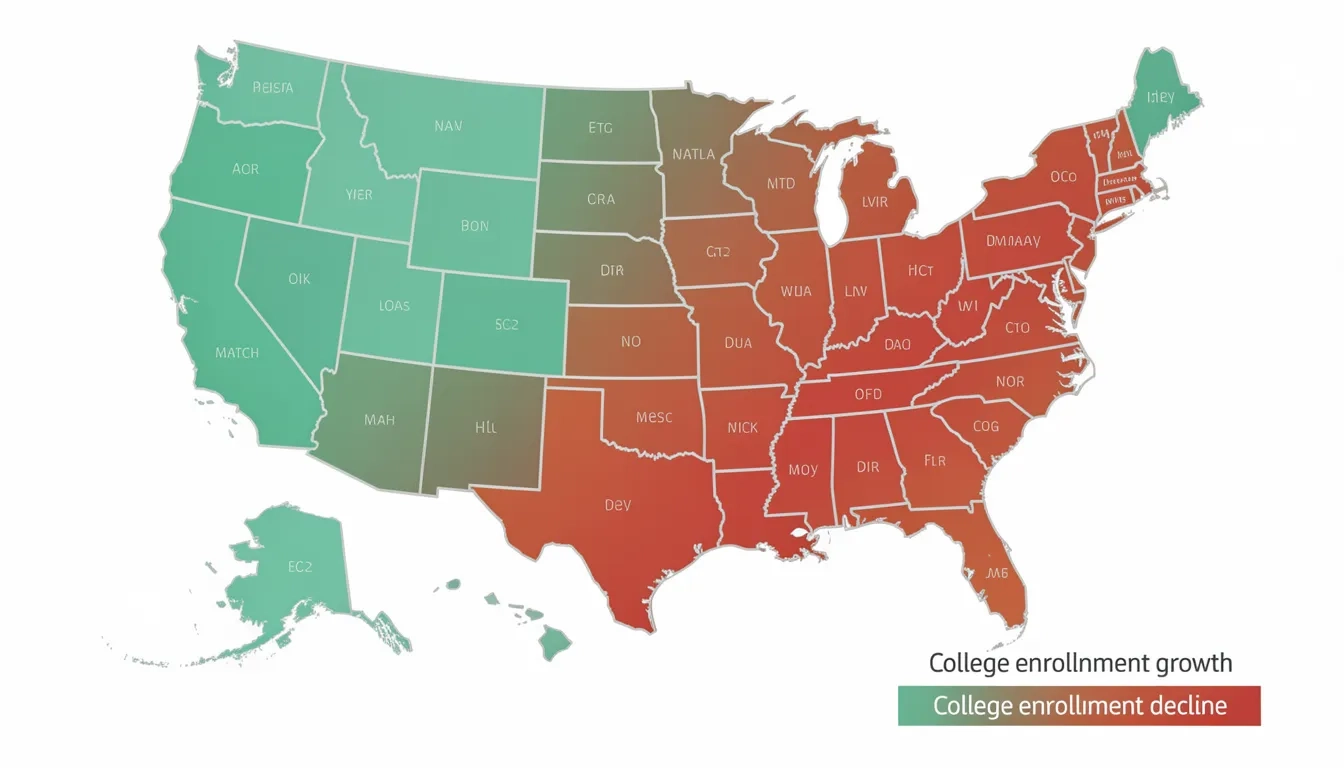
The problem is not evenly distributed, and that distinction shapes every policy decision. Only 12 states plus Washington D.C. are projected to see growth in high school graduates through 2041. The rest are losing ground. California, Hawaii, Illinois, New York, West Virginia, and Wyoming face declines of more than 20% in their high school graduate populations — figures that translate directly into empty seats and closed programs.
This is not a national problem with a national solution. A mid-size regional university in rural Ohio faces a completely different situation than a flagship in fast-growing Austin. Treating them identically is how you get bad policy.
Funding pressure amplifies the enrollment problem. Public higher education appropriations increased 2.6% in 2025 after adjusting for inflation, but enrollment grew faster at 3.6%, producing a 1% drop in per-student funding. According to SHEEO's 2025 survey of state higher education leaders, that's the first per-student decline in 12 years. Tight budgets make it harder to invest in the programs that might actually reverse the trend.
According to Lightcast's workforce data, regional public institutions — not flagship universities — are projected to lose an estimated 11% of their students (from 1.43 million to 1.27 million) by 2029.
The institutions most exposed are regional four-year publics, liberal arts colleges, and tuition-dependent private schools. Many run on thin margins. A 5% tuition revenue drop can trigger program cuts and layoffs, making the institution less attractive, which drives further decline. It's a trap with no easy exit.
The Tuition-Free Gamble
Nine states now offer income-based free tuition at four-year public universities, with four launching programs in 2025 alone. The models differ by income threshold and scope:
- Massachusetts: Free tuition for households earning $75,000 or less
- Texas: Threshold set at $100,000 household income
- Tennessee: Launched the modern template in 2015, initially focused on community colleges
The results, in some cases, are striking. Community college enrollment spiked 10–40% in Massachusetts following its program announcement. Austin Community College saw a 27.3% enrollment surge within a single month of Texas's program going live. The University of Arkansas at Little Rock reversed a 15-year enrollment decline through its Trojan Guarantee scholarship, posting a 3.7% jump in undergraduate enrollment and a 28.9% surge in first-time freshmen in the program's debut year.
But Oregon's experience is a useful warning. The state is actively considering scrapping the Oregon Promise (which made community college tuition-free) and redirecting that money into need-based aid. The reasoning: 52% of low-income Oregon Promise students still couldn't afford to attend even with tuition covered. Housing, food, transportation — total cost of attendance is the real barrier, not tuition alone.
The lesson is that affordability programs work best when they target students who would actually enroll with the barrier removed. Blanket free tuition often subsidizes students who were already going. That's a policy trade-off worth having honestly.
Dual Enrollment: Building the Pipeline Early
Dual enrollment has quietly become one of the higher-leverage strategies states are running. Thirty states now have dual enrollment rates above 20%. Idaho and Indiana have pushed this further: both states have over 50% of their community college populations consisting of dual-enrolled high school students.
Why does it work?
First, familiarity lowers barriers. A student who's already completed three college courses by senior year has a much lower psychological hurdle to full enrollment. College stops being an abstraction.
Second, it's cost-effective for states. High school students earn credits at a fraction of the per-credit cost of traditional enrollment, often using existing infrastructure at both the high school and college level.
Third, it strengthens graduation rates. Students who enter college with credits already banked are less likely to exhaust financial aid before completing a degree — one of the cleaner data patterns in retention research.
The ACCT's research found that freshmen enrollment at public two-year institutions actually increased 1% from Fall 2023 to Fall 2024. That's a meaningful contrast to declines across nearly every category of four-year institution in the same period. Strong dual enrollment pipelines are part of the reason community colleges are holding better.
Mergers, Closures, and the Shrinking Map
More than 120 U.S. colleges have closed or merged since 2016. A Federal Reserve working paper published in early 2025 modeled closure risk across institutions and projected an 8.1% increase in annual college closures as enrollment pressures intensify.
Some states are getting ahead of this rather than waiting for institutions to collapse. They're facilitating mergers to preserve shared resources — back-office operations, faculty, infrastructure — across what would otherwise be two financially struggling schools.
This is not painless.
Mergers eliminate programs, trigger faculty layoffs, and gut the institutional identity of smaller colleges that served specific communities for decades. A liberal arts college in a rural county that merges into a regional university might survive on paper while the community loses something real.
But managed consolidation tends to be better than chaotic collapse. A sudden closure strands students mid-degree, destroys local access points for working adults, and eliminates one of the region's largest employers overnight. States navigating consolidation thoughtfully are asking where higher education infrastructure should be concentrated to maximize access for the population that actually exists — not the one from 1995.
Going After Adult Learners
The traditional 18-to-22-year-old cohort is shrinking. But adults who didn't complete a degree, or need new skills to advance, are not. This is one of the largest untapped enrollment opportunities in higher education, and states are starting to act like it.
Part-time freshmen enrollment is growing, primarily among students 21 and older. The strategies driving this:
- Flexible scheduling — evening, weekend, and asynchronous options aligned with work schedules
- Credit for prior learning — formal recognition of work experience, military training, and professional certifications
- Earn-and-learn partnerships — employer-sponsored enrollment where students work and study at the same time
The Detroit example from Lightcast's research is instructive. The region's chamber of commerce, major employers, and the community college system built a structured automotive-sector skills program together. Students earned while learning, employers got trained workers, and the college got stable enrollment. Three-party deals like this don't happen by accident — they require state-level coordination and willingness to treat higher education as workforce infrastructure.
The catch: adult learners have near-zero tolerance for bureaucratic friction. They're not 18-year-olds with time to navigate confusing portals. Institutions that streamline admissions, fast-track transfer credit evaluation, and deliver genuinely flexible programs win this market. Those that don't lose these students to online certificate programs before they ever enroll.
Community Colleges vs. Four-Year Schools
The most underreported story in the enrollment crisis is that community colleges are largely holding their own. The ACCT data shows freshmen enrollment at public two-year institutions rose 1% from Fall 2023 to Fall 2024 — a sharp divergence from declines across nearly every category of four-year institution. International student enrollment at community colleges grew 8.3% in the same period, compared to a 0.4% decline in four-year freshmen.
Why the gap? Community colleges were built for the students of this moment.
The labor market is genuinely competing with four-year enrollment. Trade-based careers paying $50,000+ without student debt are real alternatives, and community colleges sit closer to that market. Certificate programs in fields like welding, medical assisting, and HVAC already overlap with what employers need. A four-year institution charging $35,000 in annual tuition needs to make an airtight case for its ROI.
Schools making that case with specific graduate employment data, real salary outcomes, and transparent career placement rates are holding enrollment better than those relying on brand and tradition alone.
What the Evidence Actually Shows
Not every state response is equal. Here's an honest accounting of what's working and where the limits are:
| Strategy | States Deploying | Measured Impact | Core Limitation |
|---|---|---|---|
| Free tuition programs | 9+ states | 10–40% enrollment spikes in some cases | Doesn't address total cost of attendance |
| Dual enrollment expansion | 30 states at 20%+ rates | Stronger pipeline, better retention | Requires sustained K–12 coordination |
| Adult learner recruitment | Widespread | Part-time enrollment growing | Traditional systems create friction |
| Institutional mergers | Select states | Preserves access, reduces redundancy | Community disruption, program loss |
| Workforce-aligned curricula | Growing | Strong employer demand | Requires ongoing curriculum revision |
My read: states treating this as a marketing problem will lose. "Come to college, it's affordable now" doesn't address a labor market where non-degree paths are genuinely viable for many people. The states most likely to maintain healthy enrollment systems are those reframing higher education as workforce infrastructure, not just the default path after high school.
Tennessee recognized this early. The Tennessee Promise program (launched in 2015) wasn't just about free tuition — it built mentorship networks, required community service, and embedded career counseling from day one. That's why it became a national model rather than a cautionary tale.
Bottom Line
States are responding with urgency. But urgency alone doesn't determine what works.
- Free tuition improves access but doesn't create demand. It helps students who want to come afford to come. It doesn't convert someone who sees a $58,000 trade career as a better bet than four years of debt.
- Dual enrollment is the highest-leverage structural play available right now. States with strong pipelines are building enrollment before students even graduate high school. Idaho and Indiana are years ahead of most.
- Adult learners are a real growth market, not a fallback option. Institutions that genuinely remove friction — not just add a night course — can grow enrollment even as traditional cohorts shrink.
- Regional four-year institutions face the hardest math. Differentiate clearly or consolidate strategically. Doing neither leads to the closures we're already seeing.
The states and institutions that weather this period won't be the ones that waited for demographics to improve. They'll be the ones that built for the students actually showing up.
Frequently Asked Questions
What exactly is the enrollment cliff and when does it peak?
The enrollment cliff is the projected sustained decline in college-age students, driven by falling birth rates after the 2008 financial crisis. The number of U.S. high school graduates peaked in 2025 and is expected to decline roughly 13% through 2041. The impact is already showing up in data: four-year institutions are losing freshmen while some community colleges hold steady.
Are free tuition programs actually reversing enrollment decline?
Results are mixed. Programs in Massachusetts and Texas produced dramatic short-term spikes — Austin Community College saw a 27.3% enrollment surge in a single month. But Oregon's experience shows the limits: more than half of low-income Oregon Promise recipients still couldn't afford to attend because housing and food costs weren't covered. Free tuition works best as an access tool for students already inclined to enroll, not as a broad recruitment lever.
Why are community colleges outperforming four-year schools right now?
Community colleges were already designed for the students most likely to keep enrolling: working adults, first-generation students, and people seeking affordable credentials quickly. Their cost structure, scheduling flexibility, and proximity to labor market demand match what current students and employers need. Four-year institutions, especially smaller private ones, face a harder value case when strong non-degree career paths are increasingly visible.
What actually happens to students when a college closes?
The disruption can be serious. Students mid-degree may find credits that don't transfer cleanly, face sudden gaps in financial aid, and have limited time to find alternatives. States are increasingly requiring closure runoff plans (sometimes called "teach-out agreements") that guarantee students can finish degrees at nearby institutions — but the quality and execution of these agreements varies widely.
Which states face the steepest enrollment declines?
California, Hawaii, Illinois, New York, West Virginia, and Wyoming are each projected to lose more than 20% of their high school graduate populations through 2041. Midwest and Northeast states broadly face 12–15% fewer high school graduates than a decade ago. Southern and Western states with growing populations have more runway, but even they're not immune as birth rate trends catch up.
Is declining enrollment bad for students, or mainly bad for colleges?
Mainly the latter — from an access standpoint, fewer applicants competing for the same seats means less admissions pressure. But closures and mergers cut geographic access, particularly in rural areas where a community college may be the only higher education option within 60 miles. When institutions cut programs to balance budgets, surviving students lose options. And colleges are often among a region's largest employers, so community economic consequences can be significant.
Sources
- State Priorities in Higher Education 2025 — SHEEO
- Navigating the Enrollment Cliff — Lightcast
- In the Face of Freshmen Enrollment Decline, Community Colleges Tell a Different Story — ACCT Perspectives
- Colleges in the US Are Facing Hurdles. More Are Hoping Free Tuition Will Help — Christian Science Monitor
- Oregon Considers Closing Free College Program — Inside Higher Ed
- Enrollment Challenges 2026: Demographic Cliff and Declines — Academic Jobs