Stevens Institute: Admissions, Rankings & Student Life

Here's something that surprised me the first time I dug into Stevens' numbers: a university ranked 80th nationally by U.S. News & World Report produces graduates whose 40-year earnings return works out to $3,603,000. Georgetown University's ROI research places that figure 16th in the country. Better than many schools sitting 30 or 40 spots higher in the overall standings. The elephant in the room for anyone considering Stevens is whether a mid-tier national ranking tells you anything useful. It doesn't. Not the full story anyway.
Who Gets Into Stevens
Stevens Institute of Technology sits on a 55-acre campus in Hoboken, New Jersey, directly across the Hudson River from Manhattan. Out of 10,673 applicants in the most recent admissions cycle, roughly 5,078 received offers — an acceptance rate of 47.6%. That's firmly moderately selective.
The typical admitted student carries a 3.86 GPA. On the SAT, the middle 50% of admitted students scored between 1390 and 1490, with the average at 1440. ACT scores run parallel: average 33, middle 50% between 31 and 34.
Stevens is test-optional, but the school is candid that most applicants still submit scores. For most students, that's the right call.
What Actually Gets You In
The application requires two letters of recommendation, a personal essay, and a strong transcript. Minimum coursework expected: four years each of English and math, three years of science. Some programs require a digital portfolio.
Scoring above the 75th percentile (1490 SAT, 34 ACT) puts you in strong shape. Scoring below the 25th percentile makes the rest of your application do a lot of heavy lifting.
The admissions process weighs more than test scores. Demonstrated interest matters, extracurricular depth matters, and the rigor of your coursework — how many AP or IB classes you took — factors into how Stevens reads a GPA.
| Deadline | Type | Notes |
|---|---|---|
| November 15 | Early Decision | Binding commitment |
| December 1 | Early Action | Non-binding |
| February 1 | Regular Decision | Standard cycle |
If Stevens is genuinely your top choice, Early Decision on November 15 is worth taking seriously. It signals commitment, and Stevens considers demonstrated interest in its admissions process.
Making Sense of the Rankings
Stevens holds the #80 national university ranking from U.S. News for 2026. That number appears in headlines, but it hides more than it reveals.
The rankings that better predict what happens after graduation are the career and ROI metrics. U.S. News puts Stevens 9th nationally for "Colleges With the Best Return on Investment." The Princeton Review ranks it 12th for career placement. LinkedIn's Top Colleges 2025 places it 45th. Those aren't soft rankings — they measure where graduates actually go and what they earn.
| Ranking Source | Category | Position |
|---|---|---|
| U.S. News 2026 | National Universities | #80 |
| U.S. News | Best ROI Colleges | #9 |
| U.S. News | Most Innovative Schools | #48 |
| U.S. News | UG Business MIS Programs | #18 |
| Princeton Review | Career Placement | #12 |
| LinkedIn Top Colleges 2025 | Overall | #45 |
| Georgetown ROI Study | 40-Year Earnings Return | #16 |
For global rankings, QS World puts Stevens around 673rd and Times Higher Education places it 401-500. Both weight research output heavily. For domestic students focused on getting a strong job, they're mostly noise.
The online engineering management master's program ranks 7th nationally (U.S. News), which matters if you're thinking about returning for a graduate degree.
The Hoboken Factor
Stevens' location is a genuine asset, not just a talking point. Hoboken earns a Walk Score of 95 out of 100, making it the most walkable city in New Jersey. The Princeton Review ranked it 2nd in the country for "College City Gets High Marks."
New York City is about 20 minutes away by PATH train, NJ Transit, or ferry. Students don't just visit Manhattan — they build professional networks there, complete internships there, and often accept job offers there before finishing their degrees.
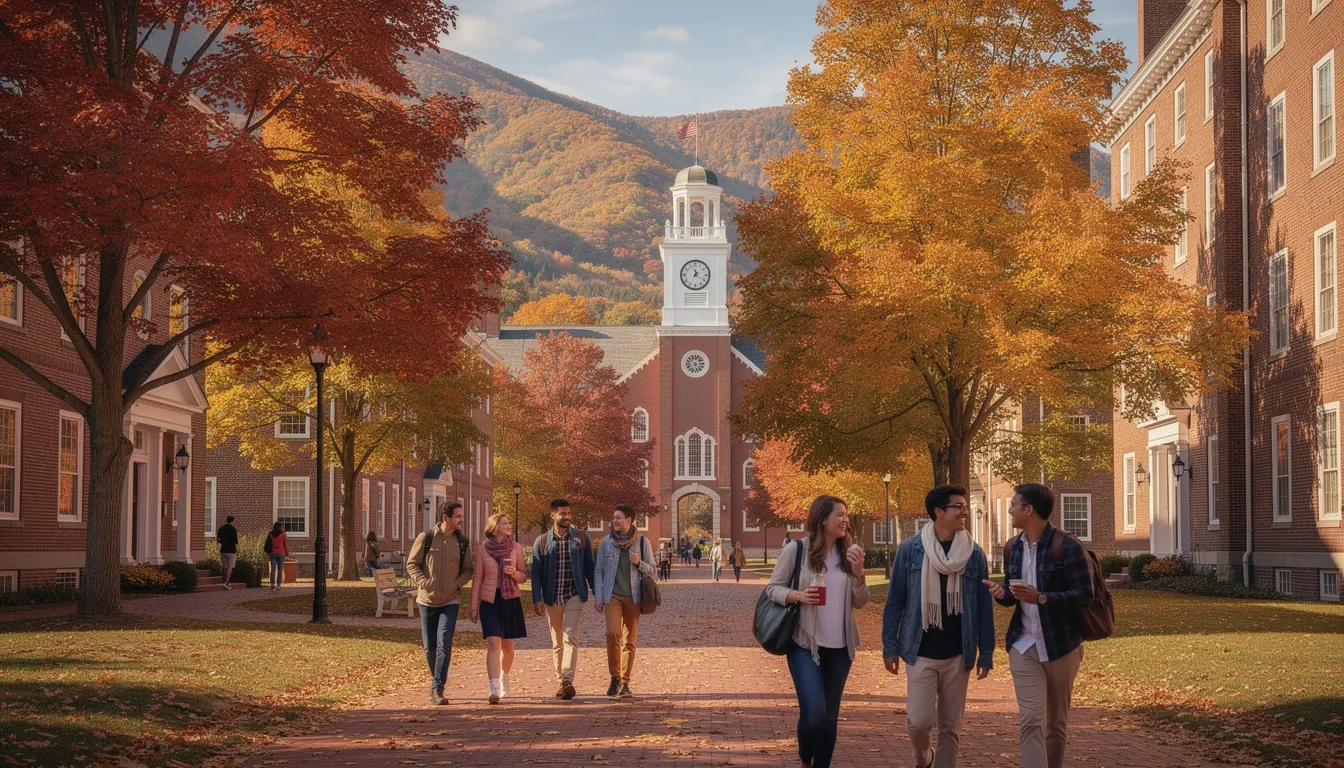
The campus itself sits on the Hudson River hillside, with views of the Manhattan skyline from its highest point at Castle Point. It's a compact 55 acres, which reinforces the close-knit atmosphere the school trades on.
Student Life: The Real Picture
With roughly 4,200 undergraduates (Fall 2025 enrollment: 4,206), Stevens is a small school. That shapes everything.
Over 150 student organizations span the full spectrum: ASME chapters, anime and gaming clubs, chess, photography, car-building teams, and cultural organizations. Greek life is active and runs a significant chunk of social programming on weekends. The school fields 23 Division III varsity sports teams — the men's volleyball team won the 2023 NCAA Division III national championship.
The annual "Flock Party" involvement fair is how most first-year students find their community fast. There's also "Ducks on Display," a campus-wide talent show that's become a genuine tradition. The mascot is a duck, for what it's worth.
"Hoboken is ranked one of the top college towns in the nation, and is the most walkable city in New Jersey." — The Princeton Review, as cited by Stevens Institute
Seven residence halls house students on campus. Freshmen are generally expected to live on campus (and the retention data supports this practice).
The 11:1 student-to-faculty ratio is a real differentiator. Upper-level courses run small, and professors are accessible in ways that simply don't happen at large research universities with 300-person lecture halls.
One tradeoff worth naming: the small size cuts both ways. You build genuine relationships with classmates and faculty. You also see the same people constantly, which means social dynamics are tighter and harder to reset. Students who prefer the anonymity of a 40,000-person flagship should factor this in before applying.
What Happens After Graduation
The Class of 2025 outcomes report is where Stevens makes its clearest argument. 93% of graduates found employment or entered graduate school within six months of graduation. Women graduates came in even higher, at 96%.
Average starting salary: $86,900. By major, the picture looks like this:
- Computer science: $97,400 average (highest of any undergraduate major)
- Finance: $91,700 average; 97% outcomes rate
- Quantitative finance: $89,800 average; 100% outcomes rate
- Physics, math, civil/environmental/naval engineering: 100% outcomes rate
Major employers hiring multiple Class of 2025 graduates included Amazon Web Services, Google, IBM, BNY, Verizon, L3Harris, PepsiCo, and Wells Fargo. 83% of employed graduates completed at least one internship or co-op experience before finishing their degree. That's not an accident. Stevens' proximity to New York and its career infrastructure make stacking experience structurally easy.
Graduate school placements included Johns Hopkins, Yale, and Trinity College Dublin. Outcomes skew applied rather than academic, which fits the student body well.
Is It Worth the Money?
Stevens' annual tuition runs around $60,000 before financial aid. Not a small number.
But the long-term earnings data holds up. Stevens ranks #1 in New Jersey for graduate earnings by federal salary data, and sits in the top 1% of all U.S. universities nationwide by that same measure. Georgetown University's ROI analysis puts the 40-year return on a Stevens education at $3.603 million — 16th best in the country.
My position here is fairly direct: Stevens is underranked relative to what it actually delivers. A school at #80 nationally shouldn't rank 9th for ROI and 12th for career placement unless something substantive is happening — and something is. The Hoboken location, the small cohort, the access to Wall Street and Big Tech employers, and the career infrastructure all compound in ways that pay out over a career.
The fit question is separate. Stevens is technical, demanding, and small. If you want a sprawling Big Ten social experience, it's the wrong choice. But if you want to know your professors by name, live next to one of the world's great cities, and graduate with a strong shot at a job that pays well — the case for Stevens is real.
Bottom Line
- Apply Early Decision by November 15 if Stevens is your first choice. Demonstrated interest carries real weight in admissions, and the binding commitment signals exactly that.
- Aim for a GPA above 3.86 and an SAT above 1440 to sit in the middle of the admitted pool. Below the 25th percentile, lean hard on essays and extracurriculars.
- Don't treat #80 nationally as the ceiling on what Stevens represents. The ROI, career placement, and starting salary data all outperform that number.
- Use New York City as part of your education. Students who intern in Manhattan and build professional networks there before graduation leave with an advantage that's hard to replicate elsewhere.
- Run the net price calculator before deciding. Stevens offers financial aid, and the actual cost of attendance for many students is well below the sticker price.
Frequently Asked Questions
Is Stevens Institute of Technology hard to get into?
Stevens admits roughly 47.6% of applicants, which puts it in the moderately selective range. The average admitted student has a 3.86 GPA and a 1440 SAT. It's not in the same tier as Carnegie Mellon or Georgia Tech for selectivity, but strong academics — especially in math and science — are still required.
Does Stevens require SAT or ACT scores for admission?
Stevens is test-optional, so scores aren't required. That said, most applicants still submit them. A score at or above the 75th percentile (1490 SAT, 34 ACT) is a genuine advantage. If your scores fall below the 25th percentile (1390 SAT, 31 ACT), leaving them off is likely the smarter move.
Is a Stevens degree worth the tuition cost?
Based on earnings data, yes — with the caveat that your outcome depends on major, aid package, and how aggressively you use the career resources. Stevens ranks 9th nationally for return on investment (U.S. News) and 1st in New Jersey for graduate earnings. The Georgetown University ROI study puts the 40-year return at $3.603 million, which ranks 16th in the country.
What is student life like at Stevens?
About 4,200 undergrads, 150+ clubs, 23 varsity sports teams, active Greek life, and a campus 20 minutes from Manhattan by train. The small size creates tight community — students consistently say they know their classmates and professors well. The flip side is less social anonymity than a large university, which takes some adjustment for students who prefer that.
How does Stevens compare to other STEM schools in the Northeast?
Stevens sits below RPI and Carnegie Mellon in overall and research-focused rankings, but outperforms both on career placement and ROI metrics. For students who prioritize employment outcomes over research prestige, Stevens is a serious option. Its access to New York City employers gives it a structural advantage that schools in Pittsburgh or Troy can't match.
What are the strongest majors at Stevens?
Computer science, finance, and quantitative finance produced the strongest Class of 2025 outcomes. CS averaged $97,400 in starting salary — the highest of any undergraduate major. Quantitative finance hit a 100% outcomes rate. Business management information systems ranks 18th nationally (U.S. News). At the graduate level, engineering management ranks 7th in the country.
Sources
- Facts and Statistics | Stevens Institute of Technology
- University Rankings & Recognition | Stevens Institute of Technology
- Class of 2025 Outcomes Report | Stevens Institute of Technology
- Stevens Admissions Requirements | PrepScholar
- Undergraduate Student Life | Stevens Institute of Technology
- Stevens Institute of Technology Profile | US News Best Colleges