Top AI Research Universities: Where the Field Gets Built
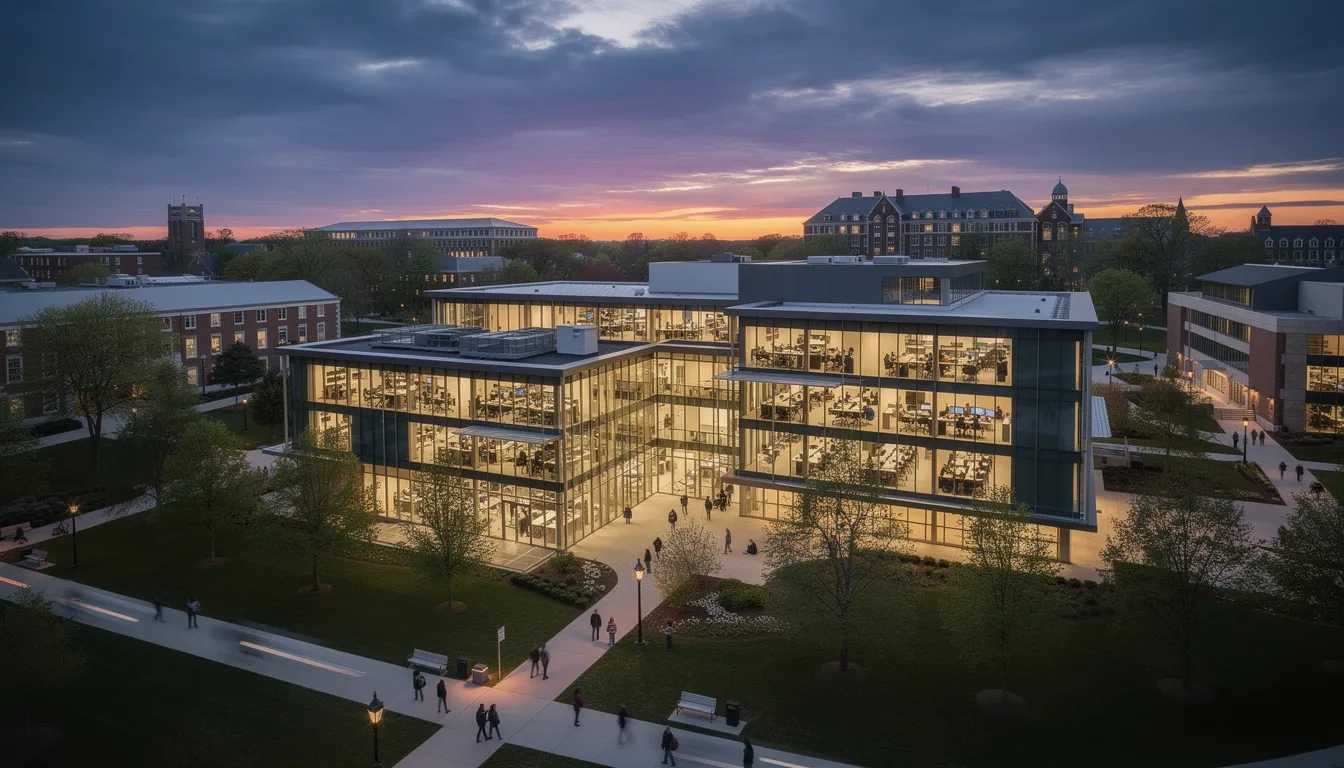
The most consequential AI breakthrough of the past decade didn't start in a Silicon Valley office. Geoffrey Hinton had spent years at the University of Toronto arguing that neural networks could work when almost no one believed him. In 2012, his student Alex Krizhevsky trained AlexNet on a dataset of 1.2 million labeled images and blew the field open. That story keeps repeating: academic labs generate the ideas, and the world builds products out of them years later.
If you want to understand where AI is actually heading, follow the research universities. Not the press releases.
The American Elite: MIT, Stanford, and Carnegie Mellon
These three institutions have dominated AI research for decades and remain the programs that top labs recruit from first.
MIT's Computer Science and Artificial Intelligence Laboratory (CSAIL) is the largest AI research center at any university, with over 1,000 researchers working across robotics, machine learning, computer vision, and hardware-integrated AI. MIT's edge is a preference for AI that does things in the physical world. The lab's 2024 real-to-sim-to-real robotics work trained robots inside digital twins built from phone cameras, then deployed them in home environments with dramatically higher reliability than previous methods.
Stanford's AI Lab (SAIL), founded in 1962, has 64 years of institutional depth that no newcomer can replicate. Andrew Ng ran SAIL before co-founding Coursera and Google Brain. Carlos Guestrin took over as director in 2025 after Christopher Manning's seven-year tenure. SAIL's practical advantage is geography: PhD students routinely intern at Anthropic, Google DeepMind, and OpenAI by commuting 20 minutes down El Camino Real.
Carnegie Mellon was the first U.S. university to offer a dedicated undergraduate degree in artificial intelligence. That distinction matters more than it sounds. Building an AI-specific curriculum from scratch, rather than adapting existing CS courses, produced a culture of technical rigor that permeates every level of CMU's program. The Robotics Institute and Language Technologies Institute are among the most-cited AI research groups in the world.
UC Berkeley: The Open-Source Conscience of AI
Berkeley sits just outside the obvious Big Three but belongs in any serious conversation about where AI research actually happens.
The Berkeley Artificial Intelligence Research Lab (BAIR) has a distinctive identity: a stronger commitment to open publication and community-accessible research than almost any peer institution of comparable caliber. Stuart Russell, whose textbook Artificial Intelligence: A Modern Approach (now in its fourth edition) has been adopted at over 1,500 universities globally, anchors Berkeley's AI safety and ethics work.
Berkeley's graduates lead positions at OpenAI, DeepMind, and Cohere. Pieter Abbeel's reinforcement learning research at BAIR directly influenced how modern robots learn complex tasks from human demonstration.
Where Berkeley differs from Stanford isn't talent or output volume. It's culture. Berkeley researchers publish more openly, critique industry more freely, and ask harder questions about whether certain AI systems should be deployed at all. That makes it the right fit for a specific kind of researcher.
European Powerhouses: Oxford, ETH Zurich, and Cambridge
European AI programs run on a different clock. Less focused on commercialization, more willing to take the long view.
Oxford's AI ecosystem splits across three distinct research threads: technical AI in the Department of Computer Science, AI governance at the Oxford Internet Institute, and existential risk analysis at the Future of Humanity Institute (founded by philosopher Nick Bostrom). Mike Wooldridge's multi-agent systems work and Bostrom's long-term safety research make Oxford the most philosophically serious AI research environment in the world.
ETH Zurich is the engineering answer to Oxford's philosophy. Thomas Hofmann's machine learning group and Andreas Krause's work on autonomous systems and sensor networks have built ETH into a robotics and computer vision force. With a research H-index around 170, competitive with the strongest U.S. programs, ETH punches far above its institutional size.
"There's a difference between universities that study AI and universities that are actively constructing the intellectual foundations the field runs on. The gap between those two categories is larger than most rankings admit."
Cambridge rounds out Europe with strong probabilistic methods research. Zoubin Ghahramani's Bayesian machine learning work at the Machine Learning Group shaped how modern AI systems quantify uncertainty. The Cambridge Centre for AI in Medicine has grown into one of the leading drug discovery AI labs globally. Quieter about it than most.
Asia's Ascent
The writing has been on the wall for years: Asian research institutions are closing the gap faster than Western rankings reflect.
Tsinghua University ranks first globally in AI research output by citation count, according to multiple independent analyses. This is not a rounding error or a quirk of methodology. Tsinghua's Yao Class, a theoretical computer science program built around Turing Award winner Andrew Chi-Chih Yao, has produced researchers now working on faculty at MIT, Stanford, CMU, and every major AI lab. National investment in AI infrastructure since China's 2017 national AI strategy has been aggressive and sustained.
The University of Toronto remains the center of deep learning foundations. Geoffrey Hinton won the Nobel Prize in Physics in 2024 for foundational work on artificial neural networks. (He had already shared the Turing Award with Yoshua Bengio and Yann LeCun in 2018.) The Vector Institute, a standalone AI research organization built around Toronto's faculty, concentrates deep learning work in ways few university departments can match structurally.
Singapore's NUS and NTU benefit from a genuinely unusual circumstance: a city-state that treats AI as national infrastructure rather than an academic exercise. NUS's AI Institute has active partnerships with Google and Huawei. NTU has become a testing ground for smart city AI applications in transit routing, urban planning, and hospital logistics delivery.
What Rankings Actually Measure (And What They Miss)
Here's something that contradicts the premise of most ranking articles: QS and U.S. News are largely measuring the wrong things for research purposes.
They rank on citation counts, faculty reputation surveys, and employer brand perception. CSRankings.org offers a sharper lens. It counts faculty publications at the top AI venues: NeurIPS, ICML, ICLR, CVPR, and ACL. Because you can filter by subfield, a school ranked 10th overall might rank 2nd specifically in natural language processing. That distinction is the one that matters if you're planning a five-year PhD on language model alignment.
Use this subfield-to-institution map as a starting point:
- Robotics and physical AI: CMU, MIT, ETH Zurich
- NLP and language models: Stanford, CMU, University of Edinburgh
- Reinforcement learning: Berkeley, CMU, University of Alberta
- AI safety and ethics: Oxford, Berkeley, MIT
- Computer vision: MIT, Stanford, Tsinghua
- AI in medicine and biology: Cambridge, MIT, Toronto
The other gap that rankings never fill is advisor-level fit. A PhD student publishes with their advisor, not with their university. Spending an afternoon on Google Scholar reading the last three years of papers from a specific professor tells you more than any ranking table ever will.
A Comparison Across Key Dimensions
| University | QS 2026 AI Rank | Core Strength | Key Lab | Best Fit |
|---|---|---|---|---|
| MIT | #1 | Physical + systems AI | CSAIL | Hardware-integrated AI |
| Stanford | #2 | NLP, vision, commercialization | SAIL | Industry-adjacent research |
| CMU | Top 5 | Robotics, planning, reasoning | Robotics Institute | Technical rigor, full breadth |
| UC Berkeley | Top 5 | RL, open research | BAIR | Ethics, foundational work |
| Oxford | Top 10 | AI safety, governance | FHI / Dept. CS | Policy, long-term safety |
| ETH Zurich | Top 10 | Robotics, computer vision | AI Center | Engineering, Europe-based |
| Toronto | Top 15 | Deep learning theory | Vector Institute | DL fundamentals |
| Tsinghua | Top 15 | Vision, research volume | IAI | Output volume, China industry |
Funding and Compute: The Part That Actually Decides Research Quality
Academic prestige only takes a lab so far. The research groups with outsized impact tend to be the ones with serious compute access and real-world deployment partnerships.
Stanford's Human-Centered AI Institute (HAI), co-directed by Fei-Fei Li, raised over $400 million in industry gifts and partnerships in its first five years. That money flows directly into PhD stipends, GPU clusters, and the ability to retain faculty who field industry recruitment calls every week. MIT's 2024 partnership with AWS gave CSAIL researchers cloud compute at scales that change what experiments are even feasible to run.
A PhD program without serious compute is like a chemistry lab without reagents. When visiting programs, ask specifically: what does an average PhD student have access to for GPU compute? "We have some shared cluster resources" is a very different answer from "students in good standing can access 32 A100s for 72-hour jobs." The specificity of the answer tells you a lot.
Industry proximity matters for career translation too. Berkeley, Stanford, and CMU all sit within driving distance of multiple major AI labs. That shapes internships, post-doc pipelines, and the informal conversations where a lot of science actually happens.
Bottom Line
The right AI research university is the one where your specific questions are being actively worked on by faculty you'd want to spend five years alongside. Here's how to find it:
- Use CSRankings.org, not QS or U.S. News. Filter by your specific subfield and look at recent publication counts. Overall prestige rankings obscure more than they reveal.
- Read papers before you apply. Identify three to five faculty members whose work genuinely interests you. That shortlist is your application strategy.
- Ask about compute during campus visits. Vague answers about "shared resources" are a real red flag.
- Don't dismiss European and Canadian programs. Oxford, ETH Zurich, and Toronto produce globally-cited research and are less competitive to get into than MIT or Stanford for equivalent candidates.
- My position: the reflexive preference for a U.S. address is often driven by career network effects rather than research quality. If your interests align with Tsinghua's computer vision output, Toronto's deep learning foundations, or Oxford's AI safety work, ignoring those programs means cutting yourself off from some of the sharpest researchers working today.
Frequently Asked Questions
Which university ranks #1 for AI research in 2026?
MIT holds the top spot in the QS World University Rankings by Subject 2026 for Data Science and Artificial Intelligence. Carnegie Mellon and MIT share the #1 position in U.S. News 2026 for U.S. AI programs. Different methodologies produce different results, which is itself a hint that no single ranking should drive your decision.
Do I need a PhD from a top-ranked school to work in AI research?
For industry research roles, less than most people assume. Many of the most impactful researchers at OpenAI, Google DeepMind, and Anthropic hold degrees from programs outside the top 10. For academic faculty positions, however, a PhD from an elite program is nearly standard. The academic job market in AI runs almost entirely through advisor networks at a small cluster of institutions.
Is it a myth that Ivy League schools are automatically top AI programs?
Yes, largely. Harvard is the elephant in the room: it has strong interdisciplinary AI-adjacent work, but its core AI research output doesn't match MIT, Stanford, CMU, or Berkeley by publication-based measures. School-wide prestige and subfield research strength are related but genuinely not the same thing.
How much does university location matter for AI career outcomes?
Significantly for industry paths. Stanford and Berkeley graduates enter a job market where Google, Anthropic, and OpenAI are 30-minute drives away. For academic careers, location matters less than your advisor's network and your publication record. For those focused on AI governance and policy, proximity to Washington D.C. or Oxford's political science ecosystem carries specific advantages that pure technical rankings don't capture.
What is the best AI program in Europe?
Oxford and ETH Zurich both make strong cases, for different reasons. Oxford has the edge for AI safety, ethics, and governance research. ETH Zurich has the edge for robotics, computer vision, and applied engineering AI. Cambridge is strong in probabilistic methods and medical AI applications. Personal research fit matters more than any blanket ranking between them.
How are Asian AI universities closing the gap with American ones?
Tsinghua now leads in raw research output by citation count and has specific strengths in computer vision and theoretical AI foundations. Toronto (technically Canada) and NUS Singapore are competitive with the second tier of U.S. programs by most research quality metrics. The gap between the U.S. top three and global competitors has been narrowing every year since roughly 2018, driven by government investment, aggressive faculty recruitment, and access to large-scale compute infrastructure.
Sources
- QS World University Rankings 2026: Data Science & AI
- Top 9 Universities for AI Research - The AI Insider
- Best Universities for AI in the World 2026 - Analytics Insight
- 10 Best Universities for AI in 2025 - Rebellion Research
- Best AI Universities 2026 - The Campus Review
- Stanford: 3D Chip Breakthrough to Accelerate AI