University of Arkansas: Programs, Rankings, and Life in Fayetteville
Arkansas isn't the first state that comes up when people build their college lists. But Fayetteville — parked in the northwest corner of the state, nestled into the Ozark foothills — has built one of the more quietly compelling public university stories in the South. The University of Arkansas ranks #100 among Top Public Schools in the 2026 U.S. News & World Report edition, and specific programs in nursing, business, and education rank well above that overall number. The school also sits about 30 minutes from Bentonville, home to Walmart's global headquarters. That proximity doesn't show up in any ranking formula — but it absolutely shows up in internship pipelines and hiring outcomes.
How UA Ranks Across Different Systems
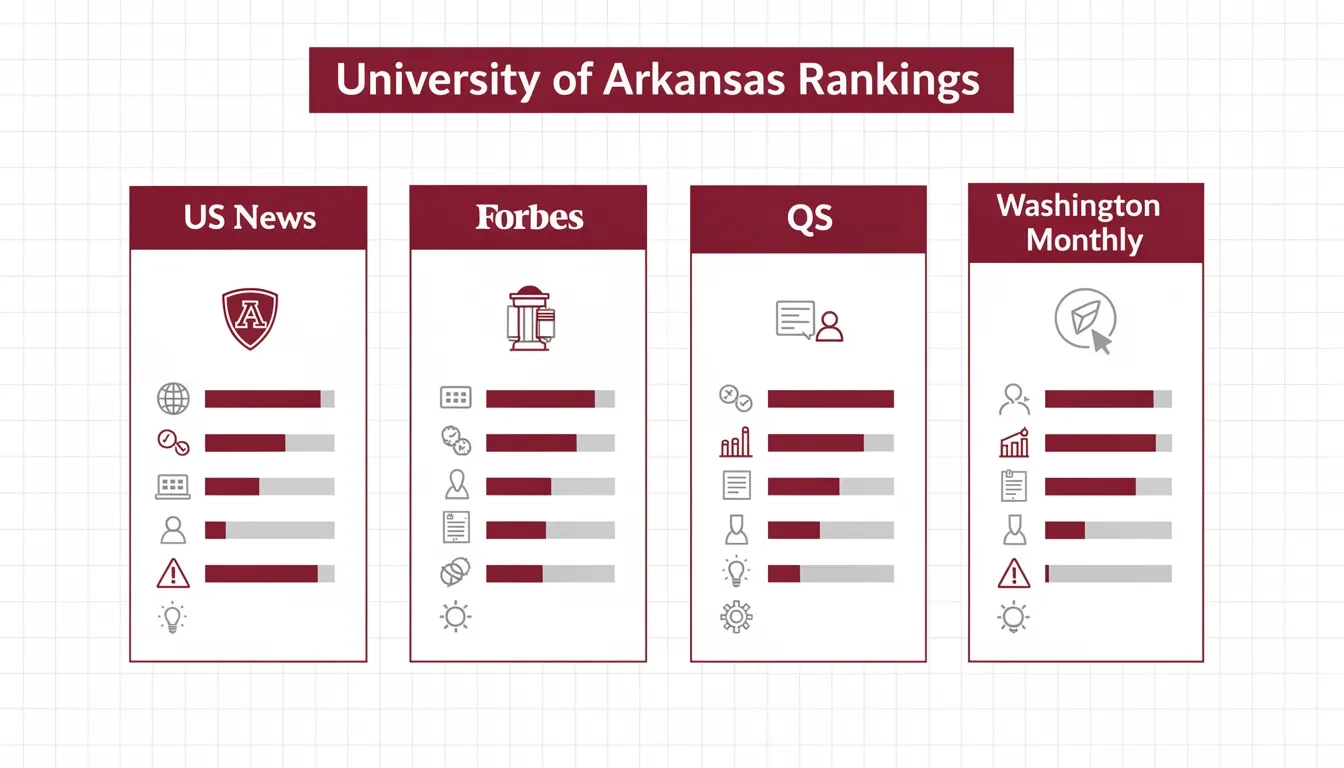
Rankings depend heavily on which system you're looking at. Here's the 2025–2026 snapshot across four major frameworks:
| Ranking System | Position | Year |
|---|---|---|
| U.S. News Top Public Schools | #100 | 2026 |
| U.S. News National Universities (all) | #183 | 2026 |
| Times Higher Education World Rankings | #601 | Oct 2025 |
| QS World University Rankings | #1001 | June 2025 |
The most useful number here is the public schools rank. The National Universities list throws UA against MIT, Stanford, and every Ivy. Being #183 in that group while landing #100 among public peers tells you it holds its own against the state flagships it actually competes with — schools like University of Missouri, University of Tennessee, and University of Oklahoma.
The QS #1001 slot looks rough until you factor in that QS evaluates roughly 5,000 universities worldwide. Sitting in the top fifth of a global pool, as a regional public school in Arkansas, is not a bad outcome.
Fayetteville itself ranks #10 on U.S. News & World Report's Best Places to Live list — a separate dataset that reflects cost of living, job market, and quality of life. It's worth reading alongside the academic rankings rather than treating it as a footnote.
Programs That Outperform the School's Overall Ranking
This is where UA's story gets more interesting. Several specific programs rank far above the institution's overall position — a pattern you see at schools where individual departments have invested heavily while the broader university still carries a regional reputation.
| Program | Ranking | Source |
|---|---|---|
| Graduate Education Programs | #57 (tied) nationally | U.S. News 2026 |
| Rehabilitation Counseling (MS) | #33 (tied) nationally | U.S. News 2026 |
| Online Bachelor's Degrees | #69 of 1,800+ programs | U.S. News 2026 |
| Online RN-to-BSN | Top 10 nationally | Forbes |
| Online Master of Science in Nursing | Top nationally | Princeton Review 2026 |
The rehabilitation counseling concentration is the most striking gap. Ranking #33 nationally for a specialty degree at a school sitting #183 overall is a significant divergence — not statistical noise. That signals a department that has built a real identity distinct from the institution around it.
The online program rankings are worth taking seriously too. Being #69 among 1,800+ online bachelor's programs surveyed nationally reflects both rigor and delivery infrastructure. The Eleanor Mann School of Nursing's online programs earned top-10 status from Forbes and recognition from Princeton Review — these aren't vanity rankings from obscure outlets.
The Walton College of Business: What the Name Actually Means
The Sam M. Walton College of Business is UA's most recognizable brand outside Arkansas — and it benefits from a connection to Walmart that goes well beyond naming rights.
Sam Walton opened his first store in Rogers, Arkansas, about 20 miles from Fayetteville. In 1998, the Walton family gave $50 million to the business school. The compounding effect of that endowment, combined with the proximity to Walmart's global headquarters in Bentonville, has turned the college into a primary talent pipeline for supply chain, retail logistics, and consumer goods employers in the region. Jim Walton, Sam's son, carries a net worth of approximately $118.9 billion as of February 2025 according to Forbes — making him the 12th-richest person in the world. That kind of generational wealth funds professorships and facilities that quietly compound a school's capabilities over decades.
In-state undergraduate tuition at Walton runs $365.15 per credit hour. Out-of-state students face $1,422.32 per credit hour at list price. But the university's New Arkansan Non-Resident Tuition Award covers most of the gap for qualifying out-of-state students, making UA's effective cost meaningfully lower than the sticker price suggests.
The MBA program totals $24,054 for in-state students — significantly below what most ranked business schools charge for a single year. Walton itself says the cost "is much lower than other elite business colleges, and the return is high." That's a marketing line, but in this case, the numbers largely support it.
Nursing, Education, and Engineering
The College of Education and Health Professions houses some of UA's deepest program-level strengths.
Eleanor Mann School of Nursing runs an online MSN that Princeton Review named among the top such programs nationally for 2026. The online RN-to-BSN program earned a Forbes top-10 placement. For working nurses looking to advance credentials without relocating, these aren't just convenient options — they're genuinely competitive programs by national standards.
Graduate education programs rank #57 nationally. Solid for a public school that doesn't carry the name recognition of Michigan or UVA.
The College of Engineering covers civil, mechanical, electrical, and agricultural engineering. Proximity to a dense industrial base — Tyson Foods, J.B. Hunt, ArcBest — creates real employer relationships. But if your goal is frontier research in robotics or materials science, that's an honest gap relative to schools like Georgia Tech or University of Illinois Urbana-Champaign.
What Campus Life in Fayetteville Actually Looks Like
Fayetteville routinely earns rankings as one of the better mid-sized cities to live in the U.S. U.S. News put it at #10 on their Best Places to Live list. That reflects a combination of low cost of living, outdoor access, and a job market that has grown considerably over the past decade as Fortune 500 companies expanded their regional presence.
On campus, students can join more than 400 registered organizations. About 30% participate in one of the 33 fraternities and sororities. That's a significant Greek presence but not so dominant that non-Greek students feel left out — the university funds its own speaker series, festivals, and cultural programming that runs parallel to Greek life.
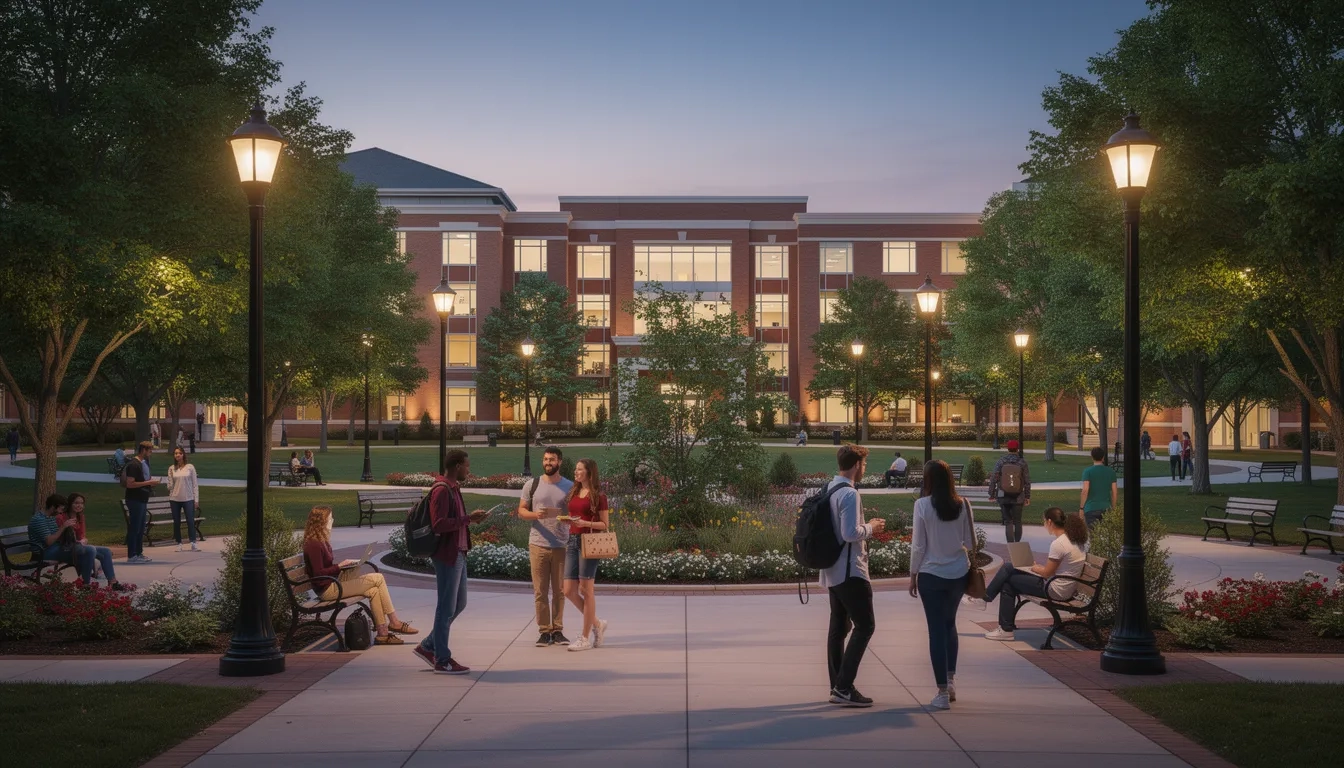
Dickson Street is the main student social corridor: restaurants, coffee shops, art galleries, and bars within walking distance of campus. It functions as the kind of central gathering place that makes a college town feel like a real community rather than a commuter school parking lot.
The athletics program competes in 20 NCAA sports. Donald W. Reynolds Razorback Stadium holds more than 76,000 fans on fall Saturdays — and if you haven't stood inside a packed SEC stadium during a football game, it's genuinely hard to describe. Loud barely covers it. Over 200 sporting events happen on campus each academic year across all sports.
"Fayetteville gives students something that's hard to find at bigger urban universities: serious outdoor recreation within 20 minutes of campus, combined with a growing tech and logistics job market that didn't exist a decade ago."
The Ozark Mountains are right there. Hiking, mountain biking, and kayaking trails start just outside city limits. The Razorback Regional Greenway runs 36 miles of paved trail from Fayetteville to Bentonville, connecting the two cities. Crystal Bridges Museum of American Art — designed by architect Moshe Safdie and located in Bentonville — has become a legitimate cultural destination that draws visitors from across the country, and the Walton Arts Center in Fayetteville brings nationally touring performances to town regularly. For a city of about 100,000 people, the cultural density is higher than you'd expect.
More than 7,000 students live on campus. The Pat Walker Health Center provides medical, psychological, and women's health services, and the campus runs a food pantry for students who need it.
The Cost Picture
The elephant in the room at any public university discussion is what it actually costs, and UA is genuinely competitive here.
In-state students face below-average tuition for a public research university in the South. Graduate students at Walton pay $633.41 per credit hour in-state — expensive relative to community college but reasonable relative to private business schools.
For out-of-state students, the calculation changes with the Non-Resident Tuition Award. This is the single most important thing to understand before applying from out of state. Without it, out-of-state tuition is steep. With it, UA becomes cost-competitive with many in-state schools in neighboring states.
The MBA's total in-state cost of $24,054 sits well below what schools ranked similarly charge. That gap between cost and program quality is where UA makes its clearest value argument.
Who Fits Here — and Who Might Look Elsewhere
Here's the straightforward assessment: UA is a strong fit for students targeting business, healthcare administration, nursing, education, or engineering, especially if they want to work in the mid-South or with companies that recruit heavily from the region.
The recruiting ecosystem around Walmart, Tyson, J.B. Hunt, and Dillard's creates career pipelines that a similarly-ranked school in an economically thinner region simply can't match. Business and supply chain graduates benefit disproportionately from that geography.
UA is a weaker fit for students chasing nationally elite research programs in computer science, economics, or basic sciences. The work in those areas is solid, but the marquee programs are elsewhere. Students who need that level should look seriously at University of Michigan, UT Austin, or similar flagships.
Cost-conscious out-of-state students who qualify for the Non-Resident Tuition Award have a legitimate reason to put UA on a serious contender list. That's a real financial variable, not a marketing afterthought.
Bottom Line
- Best-fit students: Business (especially supply chain and logistics), nursing, education, and engineering students who want strong employer pipelines into mid-South companies.
- Rankings that matter most: #100 among public schools nationally; #33 in rehabilitation counseling; top-10 for Forbes online RN-to-BSN; #57 for graduate education programs.
- The Walton College advantage is specific but real: if your post-graduation target includes Walmart, Tyson, J.B. Hunt, or their supplier network, the recruiting access at UA is disproportionate to the school's overall rank.
- Before applying from out of state: research the New Arkansan Non-Resident Tuition Award first. It can shift your four-year cost calculation by tens of thousands of dollars.
- Campus life and location are genuine strengths — Fayetteville's outdoor access, SEC athletics, and a growing regional economy make it a city that improves for students who stay after graduation.
Frequently Asked Questions
Is the University of Arkansas a good school?
UA is a solid public research university with standout programs that significantly outperform its overall ranking. Its #57 graduate education programs and #33 rehabilitation counseling rank tell a different story than the #183 National Universities position. Whether it's "good" depends almost entirely on what you plan to study and where you plan to work afterward.
What is the University of Arkansas best known for academically?
The Sam M. Walton College of Business gets the most national attention, particularly in supply chain management and entrepreneurship. The Eleanor Mann School of Nursing's online programs earned top-10 placements from both Forbes and Princeton Review for 2026. The College of Education's rehabilitation counseling MS ranks #33 nationally — the department most likely to surprise people who only know UA by its football program.
Is the University of Arkansas hard to get into?
UA is moderately accessible compared to more selective flagships, with historically high acceptance rates relative to schools like University of Michigan or University of North Carolina. Admission to the Honors College is significantly more competitive than general admission. Students targeting the Walton College or specific programs should research department-level requirements separately.
Is it worth attending UA from out of state?
For the right student, yes — and the key factor is the New Arkansan Non-Resident Tuition Award, which the university offers to qualifying out-of-state applicants and substantially reduces the cost gap. Combined with program-specific strengths in business and healthcare, UA can undercut the effective cost of many in-state schools in neighboring states while offering competitive program outcomes.
What is Fayetteville, Arkansas actually like for college students?
Better than most people expect before they visit. U.S. News ranked Fayetteville #10 on its Best Places to Live list for 2026. The city has Dickson Street's restaurant and bar scene, access to Ozark trail systems within 20 minutes of campus, and a cultural footprint that includes the Walton Arts Center and Crystal Bridges Museum in nearby Bentonville. It's a college town that has matured into a legitimate small city.
Are the University of Arkansas online programs worth it?
For nursing specifically, yes. The Eleanor Mann School of Nursing's online RN-to-BSN program ranks in the Forbes top 10 nationally, and the MSN earned top recognition from Princeton Review for 2026. The online bachelor's programs as a whole rank #69 among 1,800+ surveyed programs nationally by U.S. News. These aren't throwaway distance offerings — they reflect real institutional investment in online delivery.
Sources
- National Rankings | College of Education and Health Professions | University of Arkansas
- Campus Life | University of Arkansas Admissions
- Costs and Funding | Walton College | University of Arkansas
- 2026 University of Arkansas Rankings | Niche
- University of Arkansas Profile | US News Best Colleges
- Campus Life at UA Fayetteville | CollegeVine
- 100 Notable Alumni of University of Arkansas | EduRank