University of Oregon: Admissions, Rankings, and What Student Life Is Really Like
The University of Oregon men's basketball team won the very first NCAA tournament in 1939 — back when the event had just eight teams and nobody called it March Madness. That fact sits quietly alongside 28 total NCAA championships, a campus that Nike's co-founder has reshaped with over $1 billion in donations, and a journalism school founded in 1916 that predates most of its competitors by decades. UO doesn't always dominate the headline rankings. But once you look at specific programs, financial aid structures, and what Eugene actually feels like to live in, the picture gets more interesting than the composite numbers suggest.
Where UO Actually Ranks
U.S. News & World Report places UO at #110 among national universities and #54 among top public schools in its 2026 edition. Forbes ranks it at #133 nationally. QS puts it in the 751-760 range globally.
These numbers look modest at a glance. But UO holds membership in the Association of American Universities (AAU) — a selective network of 71 research institutions that collectively drive the bulk of American academic research — since 1969. That puts it alongside schools whose names carry more public recognition but not necessarily more academic infrastructure.
The ranking gap also matters less for specific programs than it does at the composite level. UO's journalism school, College of Design, and business programs regularly earn higher subject-specific placement than UO's overall number would imply.
| Ranking System | UO Placement | Category |
|---|---|---|
| U.S. News (2026) | #110 | National Universities |
| U.S. News (2026) | #54 | Top Public Schools |
| Forbes | #133 | National |
| QS World (2026) | 751-760 | Global |
UO holds "R1: Doctoral University" status — the Carnegie Classification's highest designation for research activity. For undergrads, that means access to faculty-led lab work, funded research positions, and graduate-style research experience that smaller schools can't offer.
Getting In: What the 88% Acceptance Rate Means
UO's acceptance rate stands at 88.30%, based on 2024-25 admissions data. Among flagship public research universities in the AAU, that's on the accessible end of the spectrum. Accessible, though, is not the same as automatic.
Competitive admitted students typically carry GPAs between 3.35 and 3.76, with a median of 3.56 among enrolled students. On standardized tests, the median SAT score is 1,260 and the median ACT is 27. UO runs a test-optional policy, so applicants who perform stronger in the classroom than on a Saturday morning with a No. 2 pencil can lead with their transcript.
A few practical admissions details worth knowing:
- UO accepts the Common Application and has no published minimum GPA
- Test scores, when submitted, are considered alongside course rigor — not in isolation
- Oregon residents receive priority consideration and automatic access to lower tuition
- First-year applicants must confirm enrollment by submitting an Intent to Register form with a $200 deposit by May 1
- IntroDUCKtion, UO's required two-day orientation, has students building schedules with academic advisors before the first week of classes
Students who start building their college list in spring of junior year can evaluate UO's financial aid policies before committing to application fees — which changes the calculus for out-of-state families comparing UO against peer institutions.
The Real Cost, After Aid
2025-26 cost of attendance comes to $38,607 for Oregon residents and $68,931 for nonresidents. The resident figure breaks down as $16,755 in tuition and fees plus $17,400 in on-campus living. Out-of-state tuition alone hits $46,077 before room and board.
Sticker price tells you almost nothing useful. What matters is net price after aid.
82% of UO first-year students receive some form of financial aid. The university funds roughly $70 million in undergraduate scholarships and grants annually, and the average need-based grant for incoming students came to $12,074, with 48% of first-year students qualifying for need-based support.
Three scholarships worth knowing before you apply:
- PathwayOregon: Covers full tuition and fees for Oregon residents who qualify for federal Pell grants. Full ride, structured around keeping lower-income Oregon students from taking on debt for a flagship education.
- Duck Excellence Scholarship: $7,500 merit award available to competitive incoming students regardless of financial need.
- Stamps Scholarship: Roughly 20 students per year receive this award, plus up to $12,000 in enrichment funding for research, travel, or study abroad over four years.
PathwayOregon is the elephant in the room for in-state applicants from lower-income families. An Oregon resident who qualifies can bring the real annual cost well under $22,000 — less than many schools that look cheaper on their websites once loans enter the picture.
Academic Programs Worth Paying Attention To
UO offers 420 degree programs across nine colleges and schools. That range means "what's UO known for?" doesn't have one answer — and the best programs aren't always the ones people expect.
The School of Journalism and Communication is one of the oldest in the United States, founded in 1916. Graduates work across major newsrooms, broadcast networks, and digital media companies. The program requires students to produce real journalism for real audiences, which keeps its reputation grounded in practice rather than theory.
The Lundquist College of Business consistently ranks among the stronger regional programs on the West Coast. Named after a 1953 UO alum, it offers concentrations in finance, accounting, sports business, and sustainable business. The sports business and sustainability tracks reflect Eugene's particular cultural priorities and connect students to an industry ecosystem centered around UO's own athletic infrastructure.
UO's College of Design covers architecture, landscape architecture, interior architecture, product design, and digital arts under one roof. Most universities split these disciplines across separate departments. The integration mirrors how studios and firms actually operate, and students regularly cross-collaborate across disciplines as a result.
The law school, founded in 1884, and the Oregon Bach Festival (the only major music festival formally affiliated with an American university) round out an institution that resists the "big state school" label in more ways than most.
Campus Life in Eugene
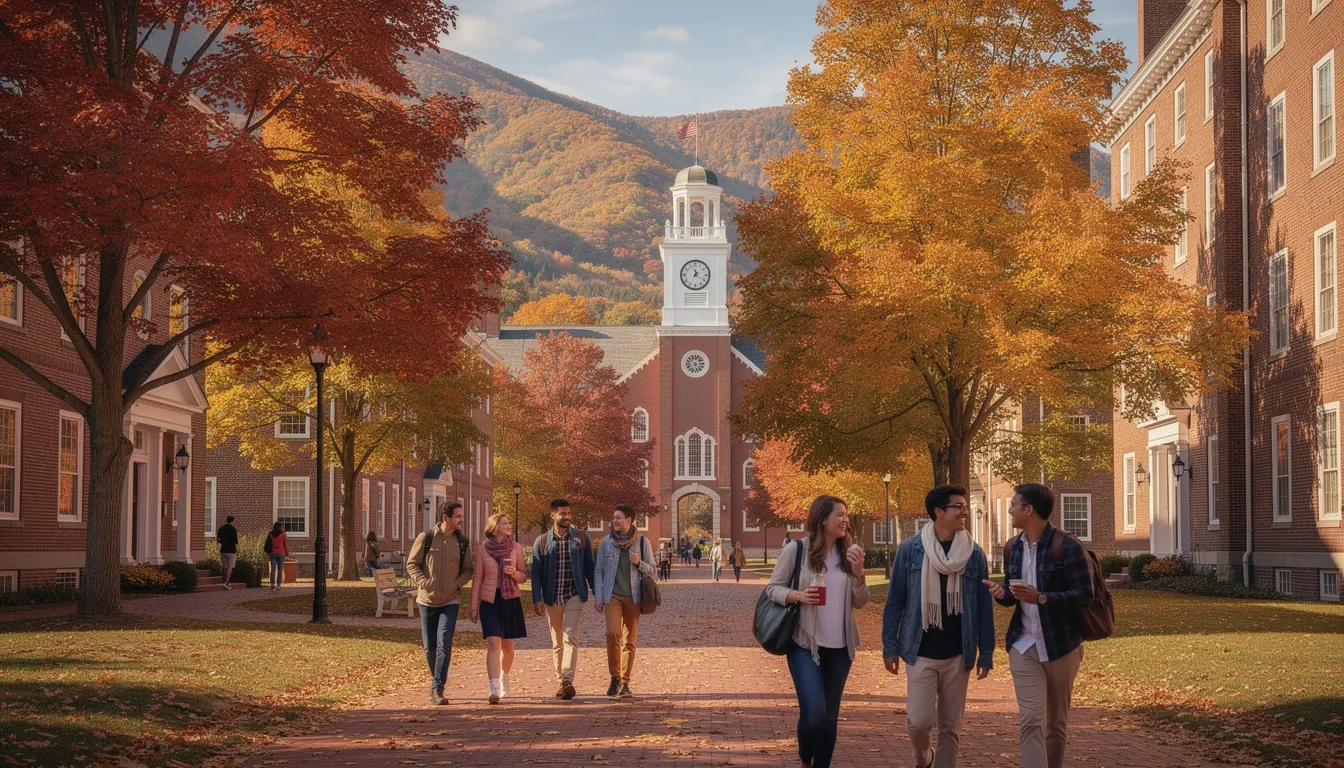
UO's campus stretches across 295 acres along the Willamette River, with 80 buildings and more than 3,000 trees making it one of the genuinely green campuses in the Pacific Northwest. The setting matters — Eugene is a city shaped by the outdoors, and students who want access to hiking, skiing, or the Oregon coast can reach all three within two hours.
First-year students are required to live on campus, which most upperclassmen in hindsight say was worth it. The residential system includes Academic Residential Communities where students select housing tied to their field of study or identity. Live-in faculty members, traveling tutors, music practice rooms, and maker-hacker spaces are built into the residence hall network.
Dining spans 14 locations, sourcing from 25 local farms and composting over 170 tons of food scraps annually. For a campus dining operation, that's a real sustainability commitment.
The Erb Memorial Union functions as the student hub — dining, events, student government, the student newspaper, and gathering spaces all centered in one building. Over 250 student organizations operate on campus, including an amateur radio club that has been active since 1921 (for context, that predates commercial broadcast radio in America).
Greek life has a visible presence. IFC and Panhellenic chapters make up most of the active fraternities and sororities, with NPHC organizations including Alpha Kappa Alpha and Delta Sigma Theta also active on campus. Philanthropy events drive much of the fall social calendar for Greek members.
75% of surveyed students report feeling safe on campus. Eugene itself has a population of around 176,000, direct Amtrak rail access to Portland, and a strong local food and coffee culture that goes well beyond what a purely college-adjacent town usually offers.
Athletics and the Nike Factor
Eugene earned the "Track Town, USA" label through decades of results. UO's track and cross country programs have combined for 20 NCAA championships, and the 2022 World Athletics Championships were held at Hayward Field — the first time that event came to the United States.
Phil Knight, Nike's co-founder and a 1959 UO journalism graduate, has donated over $1 billion to the university since the late 1980s. The current Hayward Field, rebuilt for approximately $270 million with heavy Knight funding, opened in 2020 and is widely regarded as the finest dedicated track and field facility in the world. Nike also designed UO's "O" logo in 1998.
Steve Prefontaine, the distance runner who died in 1975 at age 24, remains a defining figure for UO athletics. His story draws runners and sports fans to Eugene in a way that goes beyond typical school spirit — the Pre's Trail along the Willamette River is named after him, and his legend still shapes how the university talks about itself.
The Oregon Ducks compete across 14 varsity sports, joining the Big Ten Conference in 2024. Football drives significant revenue and fan attention, but track is the spiritual center.
My honest take: the Nike relationship cuts both ways. The money built world-class facilities. But it also made UO financially dependent on a single donor and his company in ways that occasionally raise real questions about a public university's independence. That tradeoff is worth understanding before you enroll.
Bottom Line
UO is a strong choice for in-state students — particularly those who qualify for PathwayOregon, where the cost advantage over comparable schools is substantial. Out-of-state applicants should run the net price calculator before making any assumptions about the $68,931 figure.
- Oregon residents with financial need: PathwayOregon may make UO your most affordable flagship option. Check eligibility before dismissing it.
- Journalism, design, or business students: UO's subject-specific reputation outpaces its composite ranking. Those program reputations carry real weight with employers.
- Track-focused student athletes: Hayward Field and the program's legacy represent a genuinely elite environment at any level of competition.
- First-year experience: The required on-campus living policy and the 250+ club ecosystem build community faster than commuter-heavy schools can.
- The number to remember: 88% acceptance rate, yes — but admitted students still average a 3.56 GPA. Apply with a strong transcript, not just confidence in the acceptance rate.
Frequently Asked Questions
Is University of Oregon difficult to get into?
UO's 88.30% acceptance rate makes it one of the more accessible R1 research universities in the country. That said, competitive admitted students typically carry GPAs between 3.35 and 3.76. The acceptance rate is high, but the academic bar for comfortable admission is still real.
Does University of Oregon require SAT or ACT scores?
No. UO runs a test-optional admissions policy. Students may submit scores and they'll be considered alongside GPA and course rigor — but not submitting scores won't hurt an otherwise strong application. The median SAT among enrolled students is 1,260 and the median ACT is 27.
What is University of Oregon academically best known for?
The School of Journalism and Communication (founded 1916) and the College of Design are most frequently cited by both rankings and employers. The Lundquist College of Business and the School of Law also carry strong regional reputations. UO's R1 research status gives undergrads access to faculty-led research that smaller institutions simply can't replicate.
What is PathwayOregon and who qualifies?
PathwayOregon covers full tuition and fees for Oregon resident students who qualify for federal Pell grants and meet UO's standard admission requirements. It's designed specifically for first-generation and lower-income Oregon students, and it removes loans from the equation entirely for eligible recipients.
Is Eugene, Oregon a good college town?
Eugene works well as a college town for students who value outdoor access and a city with genuine local character. With a population around 176,000, it offers a strong restaurant and coffee scene, Amtrak service to Portland, and proximity to the Cascades and the Oregon coast. It's not a major metro, but it's more than a pure college bubble.
What is the Phil Knight and Nike connection to UO?
Phil Knight graduated from UO's journalism school in 1959 and co-founded Nike. Since the late 1980s, he has donated over $1 billion to the university, primarily for athletic facilities including the Hayward Field rebuild. Nike also designed UO's "O" logo in 1998. The depth of this relationship has produced world-class sports infrastructure and ongoing discussion about corporate influence over a public institution.
Sources
- University of Oregon - US News Best Colleges
- Cost of Attendance 2025-26 - UO Financial Aid & Scholarships
- Campus Life - Division of Student Life - University of Oregon
- University of Oregon - Wikipedia
- 2026 University of Oregon Rankings - Niche
- Fraternity and Sorority Life - UO Dean of Students
- University of Oregon 2026 - Research.com