How Virtual Reality Is Actually Changing Education
A surgeon runs through a laparoscopic procedure for the 47th time this month. No patient. No risk. Just a headset and a haptic glove and a virtual abdomen that behaves exactly like the real thing. When researchers tracked those surgeons against peers trained conventionally, the VR-trained group made 40% fewer errors in actual operating rooms.
That's not a marketing claim. It comes from surgical performance data cited across multiple training studies. And it's the right anchor for understanding what virtual reality is doing to education right now — because the benefits are real, the hype is sometimes overblown, and the list of unsolved problems is long enough to give any school board pause.
Why Learning in VR Is Different From Learning on a Screen
The core theory borrows from cognitive science. Researchers call it embodied cognition — the idea that what you do with your body shapes what your brain actually encodes and retains. Watching a video about dissecting a frog and virtually dissecting one activate different memory systems. The second one sticks differently.
A review of 33 peer-reviewed studies published in Frontiers in Education found that VR consistently outperforms passive media on three dimensions: cognitive engagement (how deeply students process material), behavioral engagement (whether they actually participate), and affective engagement (whether they care). These aren't soft, hand-wavy distinctions. Each maps to measurable learning differences.
PwC's VR Soft Skills study — probably the most-cited data set in this conversation — found that VR learners were 3.75 times more emotionally connected to training content than classroom participants. They also showed a 275% increase in confidence when applying new skills afterward, outperforming both classroom and e-learning formats by significant margins. Those aren't marginal gains. That's a qualitatively different learning experience.
That said, most of these studies have small sample sizes and short time horizons. Long-term retention data remains genuinely sparse. Any vendor quoting you engagement stats without showing 6-month recall outcomes deserves a follow-up question.
Where VR Is Actually Working
Not every classroom scenario benefits from strapping on a headset. The strongest evidence clusters around specific domains.
Surgical and clinical training is the clearest win. A 2023 controlled trial found that a VR suturing course performed as well as a tutor-led course — and significantly outperformed an e-learning equivalent. Across 20 separate research reviews catalogued in a 2024 PMC scoping review of 69 medical education studies, VR training reduced procedure time. Eleven of those reviews documented lower error rates. Eight recorded reduced patient complication rates.
Vocational and industrial training is nearly as strong. Iowa State University found that 100% of welding students performed better after VR training than those who learned through traditional methods. Mining company Minesafe International tracked a 43% reduction in lost-time injuries after implementing VR safety training. These aren't attitude surveys. They're measurable real-world changes.
Soft skills and professional confidence round out the picture. VirtualSpeech, a VR communication training platform, found that students reported 85% greater confidence for job interviews after at least 25 minutes of VR practice. 95% said it prepared them better for high-stakes professional scenarios.
| Domain | Key Outcome | Source |
|---|---|---|
| Surgical training | 40% fewer OR errors | Medical simulation research |
| Welding education | 100% performance improvement | Iowa State University |
| Mining safety | 43% fewer lost-time injuries | Minesafe International |
| Interview / soft skills | 85% confidence improvement | VirtualSpeech |
| Training speed | 4x faster than classroom | Finance Online / PwC |
The K-12 Question
Here's where things get more complicated.
K-12 schools are not medical training centers. The use cases are murkier, budgets are tighter, and the evidence base is thinner. A 2025 systematic review found that VR in P-12 settings shows promising results in science, language arts, and history — but implementations vary enormously and most studies run for less than a full semester.
A few things do hold across multiple studies:
- Students learning history through immersive environmental recreation (walking through ancient Rome, navigating a WWI trench) showed higher engagement and better recall than control groups using textbooks
- Science simulations helped students grasp abstract concepts like molecular bonding and gravitational fields faster than text-and-diagram methods
- Language learners practicing conversations with virtual characters showed improved vocabulary retention at the two-week mark
But that widely-cited "30% increase in student focus" figure? It aggregates across wildly different implementations, age groups, and subjects. Treat it as a directional signal. Not a guarantee.
The best K-12 results tend to come from specific, bounded use cases — not from replacing general instruction with VR. A 45-minute immersive simulation of tectonic plate movement, paired with a pre-lesson and a reflection activity afterward, is very different from giving students headsets and calling it class.
What's Holding VR Back in Schools
Every administrator who has priced out a classroom VR rollout hits the same wall. Meta Quest 3 headsets run around $500 each. A class of 30 needs 30 headsets — that's roughly $15,000 before software, teacher training, or storage infrastructure.
And hardware is just the start. A 2024 PMC scoping review of medical VR programs identified three persistent barriers that apply equally to K-12:
- Financial constraints — content development requires interdisciplinary teams (software engineers, instructional designers, subject experts), and schools rarely have those in house
- Teacher proficiency gaps — educators need training not just to operate headsets but to evaluate simulation accuracy and integrate VR meaningfully into lesson plans
- Cybersickness — roughly 10-15% of users experience nausea, dizziness, or eye strain during immersive VR sessions (a physiological response called vestibulo-ocular conflict, and it's not trivially fixed with a software update)
The PwC cost analysis offered one genuinely useful data point: VR training reaches cost parity with classroom instruction at 375 learners. At 3,000 learners, it becomes 52% more cost-effective. That math is built around corporate training contexts, but it suggests district-wide rollouts have a better economic case than single-classroom deployments.
The Evidence Gap Nobody Talks About
I want to spend a moment on something the enthusiasts often skip over.
The VR education research base is growing fast but has real structural weaknesses. Most studies are short. Most have small sample sizes. Many rely on self-reported outcomes. The statistical methods vary enough across papers that meta-analyses struggle to make clean comparisons.
"Inconsistent or missing evidence plagued cost-effectiveness and long-term retention assessments across 24 reviews." — PMC Scoping Review of 69 Medical VR Education Publications (2024)
That quote comes from one of the more rigorous analyses published recently. We know VR improves short-term engagement. We know surgeons perform better in ORs after VR training. What we don't know nearly as well: whether a 10th grader who learned about the Civil War through an immersive simulation remembers more of it in six months than a student who read the chapter carefully.
This isn't an argument against VR in education. It's an argument for demanding longer-term data before committing large institutional budgets to it.
The Teacher Factor Nobody Is Solving Fast Enough
No VR implementation works without teachers who know what they're doing with it.
That sounds obvious. But this is the part the ed-tech vendors consistently underemphasize. A 2025 systematic review covering VR teacher education literature from 2014 to 2024, published in Frontiers in Virtual Reality, found that teacher training programs have not kept pace with headset availability. Educators receive hardware without receiving frameworks for when and how to use it.
Research points to what good integration actually looks like:
- Select simulations that match specific learning objectives, not just the flashiest available experience
- Build structured pre-lesson and post-lesson activities so students connect the VR experience to curriculum content
- Monitor for cybersickness and have non-VR alternatives ready for affected students
- Critically evaluate simulation accuracy, since some commercially available VR content contains factual or procedural errors
When teachers do all of this, outcomes are strong. When they don't, VR becomes a $15,000 novelty that students love once and learn nothing lasting from. The writing is on the wall for vendors who sell hardware without teacher development: districts are starting to push back.
What Comes Next
The VR education market was valued at $4.40 billion in 2023. Fortune Business Insights projects it will reach $28.70 billion by 2030, growing at a 30.7% annual rate. That's a significant amount of capital chasing the space, and it's already reshaping what products exist.
Two shifts look most important over the next five years.
AI-integrated simulations are moving from prototype to product. Instead of scripted branching scenarios, AI-powered virtual tutors respond dynamically to what a student says or does — adjusting difficulty, prompting reflection, demonstrating alternatives. This is potentially the development that unlocks language learning and clinical communication training at genuine scale.
Shared lab rotation models are proving smarter than one-to-one headset deployment. Schools getting the best results tend to run VR in 20-minute focused sessions, rotating small groups through a shared lab while the rest of the class does conventional work. Per-student cost drops. Cybersickness exposure stays within manageable windows. Teachers maintain more control over pacing.
My read: VR won't replace teachers or textbooks within the next decade. But for specific applications — surgical training, industrial safety, language immersion, STEM concepts that are genuinely hard to visualize — the evidence is strong enough that institutions not actively piloting it are probably leaving real performance gains on the table.
Bottom Line
- The strongest evidence is in professional and vocational training. A 40% reduction in surgical errors and a 43% drop in mining injuries are outcomes that can't be dismissed.
- K-12 benefits are real but narrow. VR works best when teachers are trained, objectives are specific, and sessions are paired with structured pre/post activities. It is not a general substitute for good instruction.
- Cost math favors scale. VR becomes 52% cheaper than classroom training at 3,000 learners. Single-classroom purchases rarely make financial sense.
- Teacher professional development is non-negotiable. Hardware without it produces expensive shelfware.
- Demand longitudinal data from vendors. Short-term engagement stats are easy to generate. Six-month retention outcomes are what actually matter.
Frequently Asked Questions
Does VR actually improve grades, or just engagement?
Engagement and learning outcomes are related but distinct. Studies consistently show VR improves attention, motivation, and short-term retention. Grade improvement data is harder to isolate, because grades depend on so many variables beyond any single teaching tool. The Frontiers in Education review of 33 studies found improved motivation and knowledge retention as the strongest documented outcomes. VR improves the conditions for learning — whether that shows up in grades depends largely on how well teachers build around it.
Is VR safe for kids to use in school?
For most students, short sessions under 30 minutes with modern standalone headsets are considered safe. The main concern is cybersickness, which affects roughly 10-15% of users and includes nausea, dizziness, and eye strain. Current guidance generally recommends VR headsets for children aged 12 and up. There's still limited research on long-term effects on younger children's visual development. Schools should always have non-VR alternatives available for affected students.
Isn't VR just an expensive version of educational video?
This is the most common misconception worth addressing directly. The difference is agency. In a video, you watch. In a VR simulation, you act — you make decisions, manipulate objects, practice procedures, and experience consequences. That active involvement is what drives the neurological difference in retention. A video of a chemistry experiment and actually running the experiment (virtually) engage different cognitive processes. Passive observation and active experience are not the same thing, even when the content is identical.
How much does it realistically cost to set up VR in a classroom?
Hardware runs around $400-$500 per headset (Meta Quest 3 pricing in early 2025). A class of 30 students runs roughly $12,000-$15,000 in hardware alone. Add curriculum software subscriptions, teacher training time, and IT support, and a single-classroom deployment can exceed $20,000. The cost-per-learner drops significantly when the same headsets serve multiple classes over multiple years. Districts can also explore E-Rate funding, which has expanded eligibility in recent years to include certain immersive learning technologies.
Which school subjects benefit most from VR?
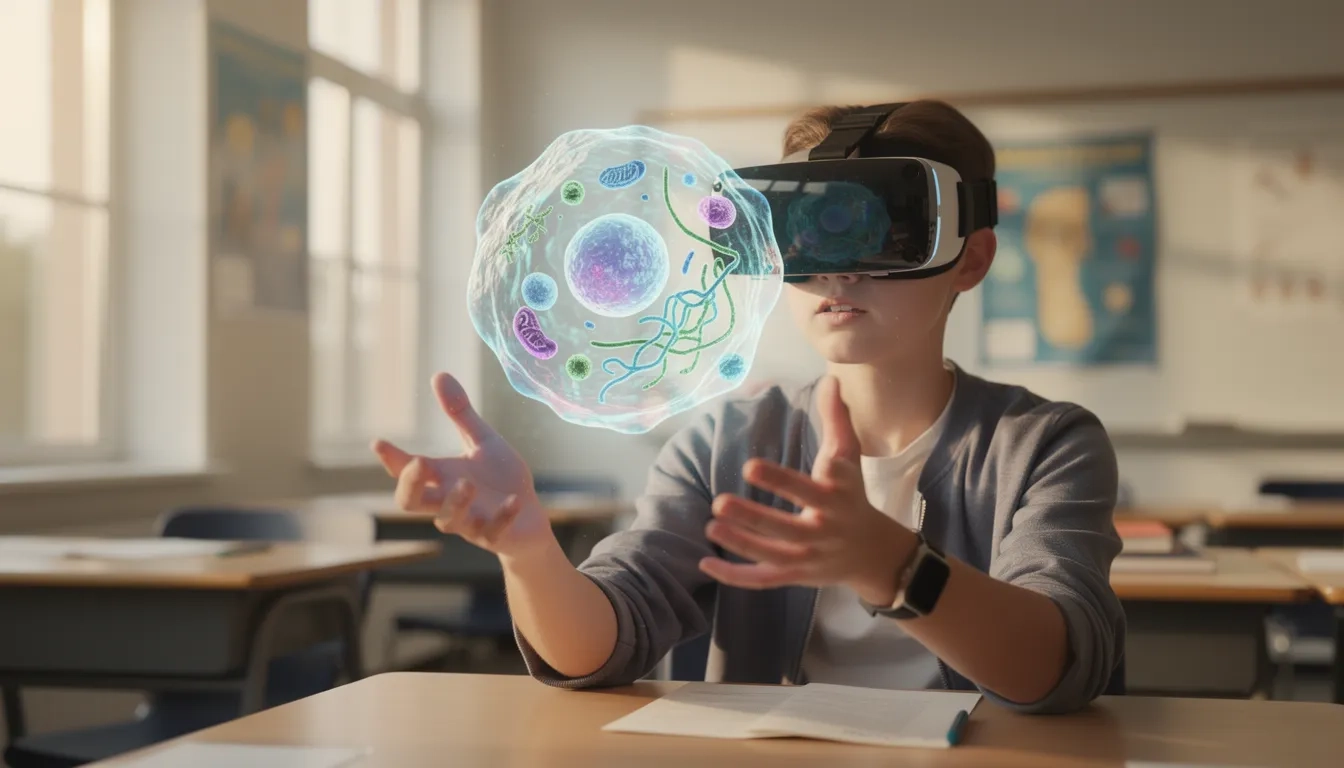
Science, history, and foreign language show up most consistently in the research as high-benefit subjects. Science gains from visualizing phenomena at scales impossible in a classroom (molecular structures, geological processes, the interior of a cell). History gains from environmental recreation that textbook images can't replicate. Foreign language gains from simulated conversation practice with virtual characters. Math and English show weaker VR-specific benefits — those subjects rely more on abstract symbolic reasoning than on spatial or experiential understanding, where VR's advantages are strongest.
What's the difference between AR and VR for classroom use?
VR replaces the physical environment entirely with a virtual one, requiring a headset that blocks out the real world. Augmented reality (AR) overlays digital content onto the physical world, viewed through a tablet or AR glasses. AR generally has lower hardware costs and doesn't trigger cybersickness the same way, making it more practical for day-to-day classroom integration. VR is better suited for fully immersive simulations where presence and environmental context matter — surgical training, historical reconstruction, or industrial safety scenarios where the "being there" quality is the point.
Sources
- The impact of virtual reality on student engagement in the classroom – PMC
- VR Stats for the Training & Education Industry – VirtualSpeech
- Reviewing the current state of virtual reality integration in medical education – PMC
- Using virtual reality for teacher education: systematic review and meta-analysis (2014–2024) – Frontiers in Virtual Reality
- Virtual reality in education: global trends, challenges, and impacts – Discover Education, Springer