Getting Into Pitt: Admissions, Rankings, and Student Life
Pitt admitted 38,477 of the 64,724 people who applied for the Class of 2029, a 59.45 percent acceptance rate. That confuses people who assume a top-70 national university must be brutal to get into. It isn't — Pitt's gotten pickier about who it wants, not just how many it lets in, and that difference is the real story here.
The Acceptance Rate Doesn't Tell the Whole Story
Here's the part the headline number skips. Of admitted students in that same class, 61 percent walked in with a flat 4.0 GPA, and only 7 percent had anything below a 3.5. A high acceptance rate and a strong applicant pool aren't contradictions. Both can be true at once.
Test scores follow the same pattern. Half of admitted students who submitted scores landed an SAT between 1280 and 1460, or an ACT between 29 and 33. Pitt extended its test-optional policy through Fall 2028, so a growing share of admits never submit a score at all.
The acceptance rate is close to useless for predicting your own odds at Pitt. Your GPA trend and course rigor tell you more than that 59 percent ever will.
| Class of 2029 Metric | Figure |
|---|---|
| Applicants | 64,724 |
| Admitted | 38,477 |
| Acceptance rate | 59.45% |
| Admits with a 4.0 GPA | 61% |
| Middle 50% SAT | 1280–1460 |
| Middle 50% ACT | 29–33 |
Numbers this granular come from Pitt's own reporting to the Common Data Set, which is why they're worth more than a random ranking site's guess.
What the Application Actually Requires
Pitt runs rolling admissions, and the gap between applying in September versus February is bigger than most families realize. The application opens August 1, and the admissions committee starts reading files daily as soon as they arrive.
Deadlines and Priority Dates
- Fall term deadline: April 1 for general admission
- Frederick Honors College priority: December 1, for students who flag interest and submit full materials
- Spring term deadline: October, for the smaller January intake
Applying early isn't just a platitude here. Because review happens on a rolling basis, a strong application submitted in October competes against a thinner pool than one submitted in March.
The Essay You Might Not Need
Most first-year applicants to Pitt's Pittsburgh campus don't have to submit an essay at all. But four groups do need one: students seeking scholarship consideration, Honors College hopefuls, international applicants, and anyone applying test-optional.
Skipping the essay just because it's optional for you personally can be a mistake. If you're on the fence about your GPA or scores, a personal statement is your one real chance to add context a transcript can't.
What Pitt Actually Costs, and Who Pays List Price
The gap between in-state and out-of-state pricing is bigger than a lot of applicants expect going in. For the 2024–25 year, in-state students paid roughly $21,926 in tuition and fees, with a total cost of attendance near $39,156 once housing and food get added in.
Out-of-state students paid close to double: $41,430 in tuition and fees, and a total cost of attendance around $58,660. That's a real stretch for a family paying full price.
Pitt's merit aid runs through named programs like the Chancellor's Scholarship, and Honors College admission often opens doors to funding that general admits never see.
| Cost of Attendance (2024–25) | In-State | Out-of-State |
|---|---|---|
| Tuition & Fees | $21,926 | $41,430 |
| Room & Board | $13,620 | $13,620 |
| Total Cost of Attendance | $39,156 | $58,660 |
Here's the tradeoff nobody puts on the admissions brochure: an out-of-state student paying full price is subsidizing a meaningfully cheaper education for the in-state roommate down the hall. Worth knowing before you fall for the campus tour and skip straight past the tuition page.
Rankings: Where Pitt Sits, and Why Nursing Is the Real Headline
Pitt climbed from 70th to 69th nationally in U.S. News & World Report's 2026 rankings, and holds steady at 32nd among the 225 public universities the magazine tracks. On the global list, Pitt lands at 52nd out of 2,250 schools across 105 countries.
Those national rankings move by single digits most years, so don't read too much into a one-spot jump. The more useful number is the nursing ranking, which sits in the national top 10 — a rare distinction for an undergraduate program at a public research university this size.
Business, economics, and psychology all land in the top 50 nationally. None of those are chart-topping in isolation, but stacked together they describe a school with genuine depth outside its flagship program, not just one strong department propping up the brand.
Beyond Nursing: Engineering, Business, and an Honors College Named After an Alum
The Swanson School of Engineering and the College of Business Administration round out Pitt's strongest undergraduate options, alongside programs in computing and information science. Students chasing extra rigor typically land in the David C. Frederick Honors College, renamed in 2023 after a Pitt alum and appellate attorney made the largest single naming gift in the university's history.
Business students aiming higher can also apply to the Pitt Business Honors Program, a smaller cohort inside the College of Business Administration built around the kind of project work and networking a general business degree doesn't guarantee.
That gift also built a partnership with Oxford's University College, which says something about where Honors leadership wants students pointed. Getting into Pitt doesn't automatically get you into the Honors College. It runs its own review, closer to a second, smaller admissions process than a formality.
What Honors status actually buys you:
- A degree jointly conferred by the Honors College and your home school (Arts and Sciences, Engineering, Business, Nursing, or Computing and Information)
- Priority course registration ahead of the general student body
- Priority access to Honors-only housing communities
- An assigned Scholar-Mentor for one-on-one academic guidance
Bluntly: none of this matters much if your intended major sits outside the Honors College's usual strengths. A student focused on nursing shouldn't chase Honors status for its own sake. Chase the program fit first.
Campus Life: The Cathedral, the Dorms, and Where Freshmen Actually Live
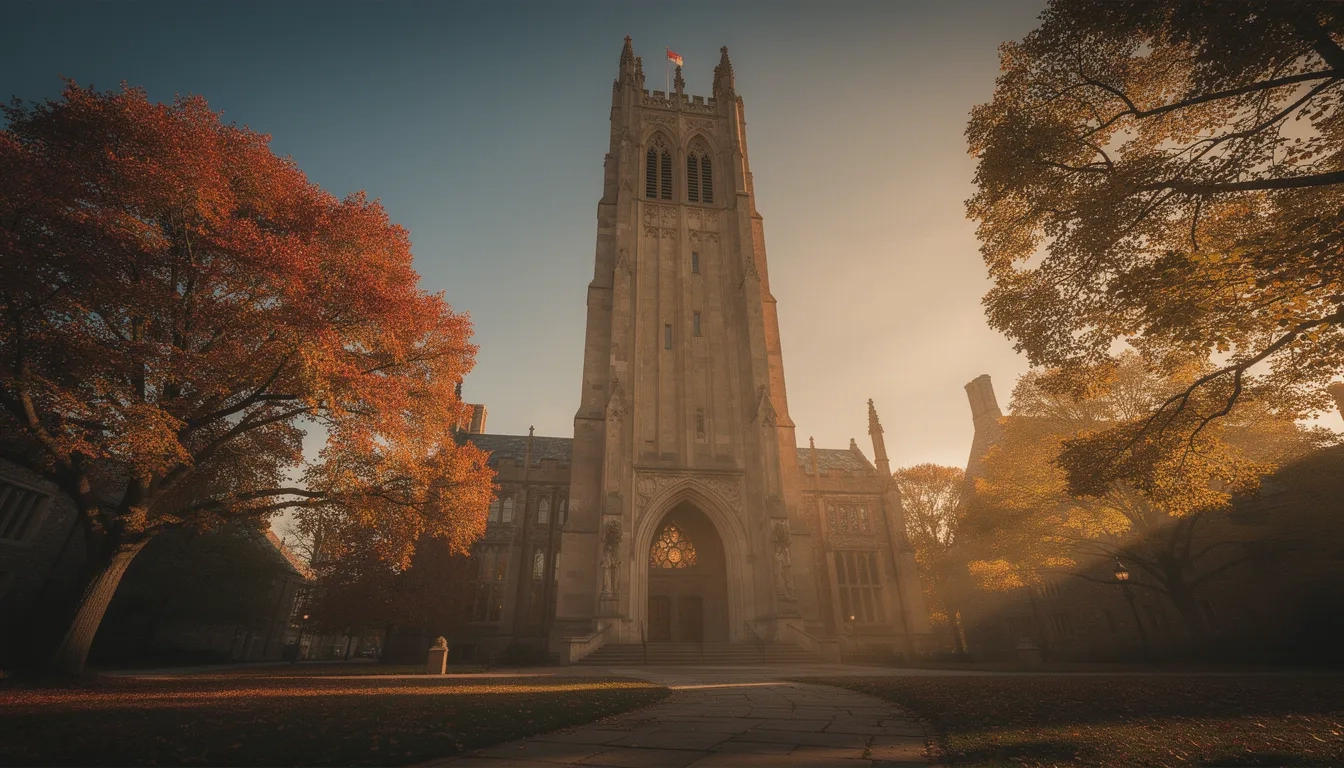
The Cathedral of Learning anchors Pitt's campus, and it's not subtle about it: a 42-story Gothic Revival tower that houses actual classrooms, not just a symbol on a brochure. Inside are the Nationality Rooms, 29 of them, each designed and funded by a different ethnic community with roots in the Pittsburgh region.
Pitt sociologist Ruth Crawford Mitchell pushed the project forward in 1926 after working with second-generation immigrant students, and the first four rooms (Scottish, Russian, German, Swedish) were dedicated in 1938. The English Classroom, the largest of the set, contains relics salvaged from the British House of Commons chamber destroyed by German bombing in 1941. It's genuinely one of the stranger, more moving details on any American campus.
Location does a lot of the heavy lifting here, too. Pitt sits in Oakland, wedged between Carnegie Mellon's campus and UPMC's flagship hospitals, which matters if you're eyeing nursing, pre-med, or anything health-adjacent. Clinical placements and research labs are a short walk away, not a shuttle ride.
Housing works differently than at a lot of state flagships. First-year students must live on campus, and if you pay your enrollment fee by May 1 and hit the housing deposit deadline, Pitt guarantees you housing for three years running, not just freshman year.
Where Freshmen End Up
- Holland Hall, reserved entirely for first-years, sits next to the Litchfield Towers in the center of campus
- Litchfield Towers, where some floors house freshmen and others house upperclassmen
- A required dining plan of at least Tier 2, bundled into the housing cost rather than billed separately
Assignments run through a mass allocation process in mid-June. It's a lottery weighted by preference, not first-come-first-served, so submitting your housing form early doesn't buy you Holland Hall by itself.
What Happens After You Graduate
Pitt's four-year graduation rate sits at 71 percent; the six-year rate climbs to 84 percent. That 13-point gap is the honest story, since plenty of students take a fifth year, often because they're double-majoring, co-oping, or working through Pitt's combined-degree tracks in engineering and pharmacy.
I'd trust the six-year number over the four-year one if you're comparing schools. It captures more of how Pitt students actually move through college, rather than punishing normal schedule changes.
Within six months of graduation, 96 percent of Pitt undergrads are working full time or enrolled in graduate school. Median earnings sit at $49,721 one year out and climb to $69,754 by year five, though the spread by major is wide.
Where the Money Tracks by Major
- Chemical engineering and industrial engineering graduates average roughly $69,000 to $71,000 in early salary
- Computer science graduates land close to $67,800
- Fields outside engineering and tech trend lower on average, which is normal for any research university and not specific to Pitt
None of this means pick your major by salary chart. But if you're weighing Pitt's Swanson School against a humanities track purely on job prospects, the engineering numbers make the answer pretty clear.
Bottom Line
- The acceptance rate undersells Pitt. Focus on your GPA trend and course rigor, not the 59 percent headline number.
- Apply early. Rolling admissions means October applicants compete against a thinner pool than March applicants.
- Decide on Honors separately from your Pitt decision. It runs its own review with its own December 1 priority deadline.
- Budget for three years of guaranteed housing, not four. Have a plan for senior year before you commit to Pitt.
- Weigh outcomes by major, not by Pitt's brand alone. Nursing and engineering carry the strongest ranking and salary data; other fields vary more.
Frequently Asked Questions
Is Pitt hard to get into?
Not in the way its ranking might suggest. The overall acceptance rate runs near 60 percent, but a majority of admits carry a 4.0 GPA, so the bar is about consistency more than raw selectivity. Weak grades won't be rescued by a generous acceptance rate.
What's the biggest misconception about Pitt's acceptance rate?
People assume a nearly 60 percent acceptance rate means an easy admit. It doesn't. The applicant pool is already self-selected toward strong students, so the rate reflects who applies almost as much as who gets in.
How do I apply to the Frederick Honors College?
Indicate interest on your Pitt application and submit every required document, including a personal statement, by December 1 for priority consideration. Applying after that date doesn't disqualify you, but you lose the priority review window and some spots may already be filled.
Do I have to submit SAT or ACT scores?
No. Pitt extended its test-optional policy through Fall 2028, though a strong score can still help borderline applicants. If you go test-optional, a personal statement becomes required rather than optional.
Is Pitt's nursing program really that competitive?
Yes, and it's arguably the strongest reason to pick Pitt over a similarly ranked school. It's ranked in the national top 10, which is unusual for an undergraduate nursing program at a public research university this size.
Will I be guaranteed housing all four years?
Only three, not four, provided you meet enrollment and housing deposit deadlines each year. Plan on off-campus housing or a fourth-year lottery entry for your senior year.
Sources
- Pitt Is Among the Top Public Universities in the Nation, According to U.S. News
- University of Pittsburgh Admissions Statistics
- First-Year Student - Admissions
- First-Year Students - Housing Services
- We Will Cultivate Student Success
- About the Nationality Rooms & Intercultural Exchange Programs
- A Gift From David C. Frederick Will Benefit Students at the Honors College